Daily insights for city builders, delivered every morning at 6 AM ET. I’m Brandon Donnelly — a Toronto-based real estate developer and founder of Globizen. I’ve been writing here since 2013.

Tag: new york city

  • Shift toward the center

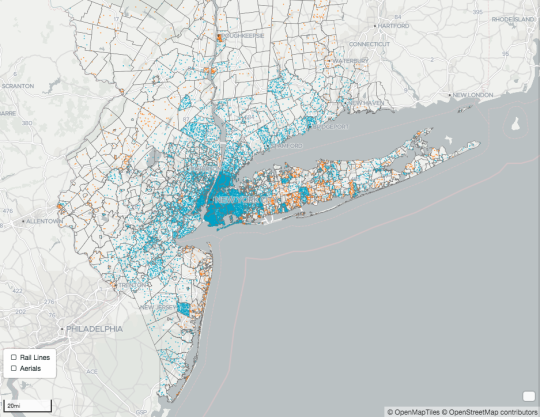
    The New York City Department of City Planning has a very cool “metro region explorer” online that allows you to explore population, housing, and employment trends in the tri-state NYC Metropolitan Region. Start here and then click on “Learn More” to cycle through the slides and data.

    One interesting takeaway is that population growth continues to centralize in the region’s core. Since 2010, 60% of the region’s population growth has taken place in the five boroughs of New York City, and in particular it has occurred in neighborhoods with strong rail transit.

    There has also been a slowing in terms of the number of residents leaving New York City. Historically, people moved to the city in their 20′s and left in their 30′s. That trend is slowing.

    I suspect this has to do with a combination of factors, including the shift toward a city-centered knowledge economy; the desire for walkability and urban amenities; the phenomenon of people getting married later in life (if at all); and so on.

    The people who do leave the city are also more likely to leave for other parts of the U.S. than other parts of the region. This has led to a decline in the number of prime age (25-54 years old) workers in the suburbs.

    Check out the Metro Region Explorer, here. There’s a lot of good stuff in there.
  • Urban American life before the car

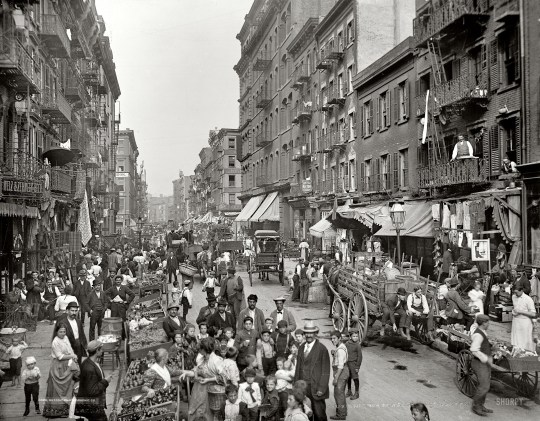
    This morning I stumbled upon an old (2013) post from Rebel Metropolis that documents urban American life through street photos taken before the automobile. 

    Above is Little Italy, New York City, 1900. All of the photos in the post are from Shorpy

    The photos are beautiful architecturally and from a photography standpoint. But as is pointed out in the post, they also speak to a different kind of street:

    What’s more, the street here is not purely the thoroughfare – it is the essential common gathering place for demonstrations, for buying and selling food, for children to play in, for celebration, for lingering and people watching.

    That sounds like a great street. And now I am off to start my day. Because I have meetings all around the city today, I’ll be driving to the office. 

  • Percentage of residential properties dedicated to single-family housing in US cities

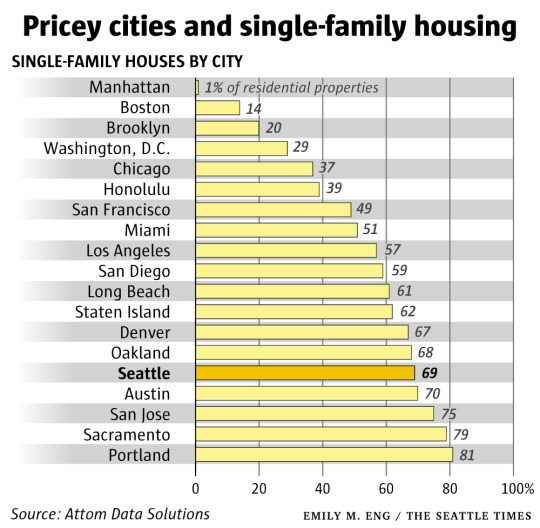
    The Seattle Times has an article up about “widespread single-family zoning” that will feel familiar to many here in Toronto who, I know, are having similar conversations about the amount of land dedicated to low-density housing.

    The article, by Mike Rosenberg, estimates that 49% of all developable land in Seattle is dedicated to single-family housing; that 8% is dedicated to multi-family housing; and that another 8% is dedicated to commercial and mixed-use buildings. The rest of the land is institutional, open space, vacant, and so on.

    Of all the residential lots in the city, the estimate is that 69% of them are occupied by single-family houses. This is compared to 1% in Manhattan. 

    I tried to reverse engineer the 69% based on the land use areas in the article, but the math didn’t quite add up. In any event, the argument here is, of course, that single-family homes are too expensive in Seattle and that the city needs more land available for multi-family housing.

    Housing supply is no doubt important, but looking at the above chart, having a low, or lower, percentage of residential land dedicated to single-family housing doesn’t seem to necessarily guarantee affordable housing.

  • Tech salaries and brain drain

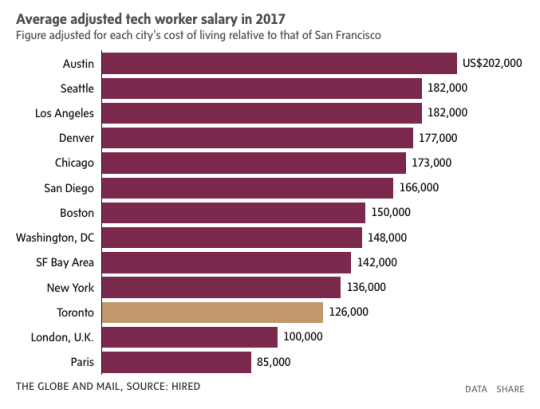
    The Globe and Mail recently ran an article arguing that tech salaries in Toronto are significantly less than those in the US and that it is leading to “alarmingly high rates” of brain drain. The claim is that the average tech salary in 2017 was US$73,000 in Toronto, compared to US$140,000 in the Bay Area or US$129,000 in New York City. 

    However, if you adjust these salaries for each city’s cost of living, the numbers look like this (chart taken from the same article):

    Now all of a sudden Toronto is lumped together with the Bay Area and New York City. It was adjacent to London even when you didn’t adjust the salaries. As Tobi Lütke – CEO of Shopify – points out in his Twitter rebuttal of the article, housing is the determining factor in this adjustment: “Toronto is a very expensive city, and Austin isn’t.”

    Lütke also points out, in case you’re in the market, that Canadian-based Shopify pays its tech employees well above market, provides stock compensation, and is currently “hiring like crazy”. But perhaps more importantly, he stresses the importance of Canadians building the economy of the country in which they are from. I feel exactly the same way.

  • What’s Manhattan worth?

    I like looking at real estate values over longer periods of time because it helps to put things into perspective. 

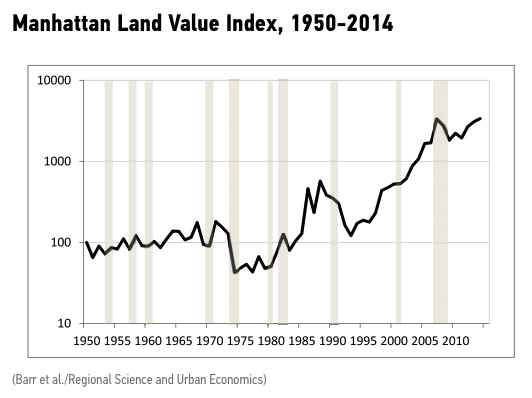
    Below is a land value index for Manhattan running from 1950 to 2014 that was recently created by economists out of Rutgers University.

    image

    The study was also cited in this recent article by Richard Florida.

    Here are some of the highlights from their study:

    We find three major cycles with land values reaching their nadir in 1977, just after the city’s fiscal crisis.

    Since 1993, land prices have risen much faster than population or employment, at an average annual rate of 15.8%.

    We estimate the entire amount of developable land on Manhattan in 2014 was worth approximately $1.74 trillion.

    We estimate the long run return to Manhattan land values [since the island was first inhabited by Dutch settlers in 1626] to be about 6.4%.

    What’s fascinating to me is the accelerated appreciation. The index starts at 100 in 1950, ends up slightly above that by 1993, and then simply takes off.

  • New York City’s retail vacancy problem

    The New York Post has some interesting articles, here and here, on the growing retail vacancy problem in NYC. (Thank you Michael for the link in the comments this week.)

    The vacancy rate on Amsterdam Avenue in the Upper West Side is said to be around 27% and it is said to be around 20% on a stretch of Broadway in Soho. It has become such a problem that Mayor Bill de Blasio wants to implement some sort of retail vacancy tax:

    “I am very interested in fighting for a vacancy fee or a vacancy tax that would penalize landlords who leave their storefronts vacant for long periods of time in neighborhoods because they are looking for some top-dollar rent but they blight neighborhoods by doing it,” he said on WNYC. “That is something we could get done through Albany.”

    But this is based on the assumption that greedy landlords are simply holding out for exorbitant rents. It doesn’t consider the fact that, maybe, there is simply too much retail space:

    Only a few grasp the true scope of the problem. Vornado Realty Trust titan Steven Roth said we can only cure the national plague through “the closing and evaporation” of up to 30 percent of the weakest space — which would take five years.

    All of this, of course, has me thinking about the future of ground floor main street retail. What are your thoughts?

  • 11 Hoyt, Brooklyn

    Tishman Speyer just unveiled a new condo project in Brooklyn called 11 Hoyt. And it just so happens to be Studio Gang’s first residential project in New York City. Preview above. More renderings over here.

    It’s a 51 storey condominium with 480 residences and 55,000 square feet of indoor and outdoor amenities. The unit mix ranges from studios to four-bedroom residences, and prices range from $600,000 to over $4 million (USDs, of course).

    If you’re from Toronto, you’re probably looking at the renderings and thinking to yourself: “There are no balconies or outdoor spaces.” But that’s fairly typical in the NYC market, as I understand it.

  • The Great Recession only paused suburbanization

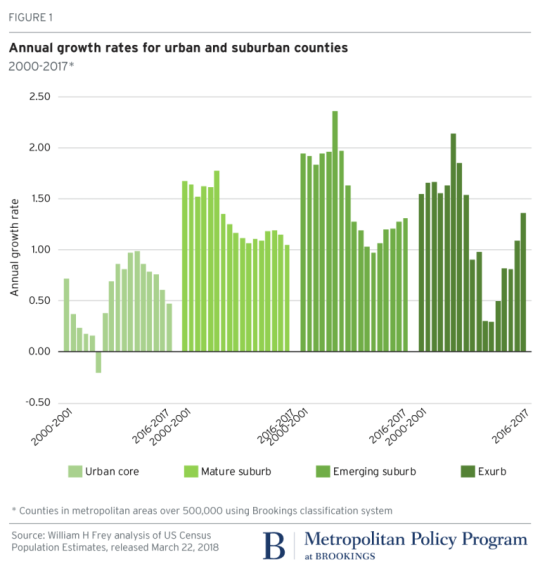
    According to newly released US census data for 2010-2017 – which Brookings analyzed here – the “back to the city” movement appears to have peaked in 2012. (This is something that we’ve looked at before on the blog.)

    Here is a graph from Brookings showing the annual growth rate for urban and suburban counties. Note how growth in the “urban core” peaked in 2012 and how growth in both the “emerging suburb” and “exurb” have increased since then.

    image

    The other finings from Brookings are that growth has slowed in large metropolitan areas (small metro areas and non metro areas, on the other hand are up) and that people are continuing to move from the Snow Belt to the Sun Belt.

    If you look at population gains and losses from 2016-2017 for the 100 largest US metro areas, the only Snow Belt gainers within the top 20 are New York (15th), Columbus (19th), and Boston (20th). Dallas, a Sun Belt city, was first with a gain of 146,000 people.

    So what’s going on? The narrative is that soon as the US economy and housing market recovered from the Great Recession of 2008, the trend lines simply reverted back to business as usual: sun and sprawl.

  • The most popular building amenities (according to a small subset of people)

    Here are the results from my primitive multi-unit building amenities survey:

    Gym is number 1. No surprise there. 46% of respondents said it was in their top 3. 

    Rooftop outdoor space at number 2 was perhaps a bit surprising. But then again, who doesn’t love a good rooftop patio?

    As for concierge service, I tend to think this was driven by package delivery. That’s certainly the biggest value add for me.

    One standout near the top, for me at least, is co-working space. Andrew LeFleur made mention of this on Twitter and I think he’s right: The changing nature of work is making these spaces more valuable in multi-family dwellings.

    And now some color on the above results.

    436 amenity selections were made as part of this survey. 

    About half of the respondents were from the Greater Toronto Area, followed by Calgary, San Francisco, Ottawa, Boston, New York City, Denver, Los Angeles, Paris, Miami, and many other cities. Shoutout to whoever responded from Kuala Lumpur and Porto Alegre.

    In terms of “Other” amenities, there were suggestions for a band rehearsal space, a vending machine, a grassy area for sports, and programming the helps you meet your neighbors.

    In terms of this one last, it can be tricky for condo buildings. Developers only provide the space. It’s then up to management. But I’ve seen it done very well in rental buildings.

    Are you surprised by any of the results from this survey?

  • Crypto networks and top-down urban planning

    Taylor Pearson recently compared crypto networks to cities and argued that the best crypto networks, much like the best cities, are formed from the bottom up. 

    The example he gives is that of Paris (bottom-up) vs. Brasilia (top-down). Paris is the hugely successful city and Brasilia is the failure of high-modernism.

    I appreciate the argument he’s making and I do agree with him on the potential of decentralization, but I couldn’t help but dig into his city example a bit further.

    The Paris we all know and love today is the result of an enormous centrally planned urban renewal exercise. Baron Haussmann carved, among many other things, long straight boulevards through Paris’ medieval fabric in order to modernize and rationalize the city.

    What makes this top-down exercise different from that of Brasilia’s? Is it simply that Haussmann was constrained by Paris’ existing and decidedly urban fabric?

    Because then we could turn our attention to New York City’s gridiron plan of 1811, which laid out – before the island of Manhattan had even fully developed – a relentless and orthogonal street network from Houston Street all the way up to 155th Street.

    Is the difference that Brasilia was planned with suburban sensibilities in mind and Manhattan was not? Or was it the restrictive Euclidean zoning that did it in for Brasilia? 

    Whatever the case may be, history suggests that some top-down planning exercises may have worked out just fine. Though to be fair, each of them was not without their share of critics.

    Photo by Rafael Leão on Unsplash