Daily insights for city builders, delivered every morning at 6 AM ET. I’m Brandon Donnelly — a Toronto-based real estate developer and founder of Globizen. I’ve been writing here since 2013.

Tag: new york city

  • Transit tech lab launches in NYC

    image

    Earlier this month, the Metropolitan Transportation Authority (MTA) and the Partnership for New York City launched a new vertical accelerator dedicated to public transit. The mission is to make the city a global leader in this space.

    Applications are open until November 30, 2018 and they are looking for early and growth stage companies that address one or both of the following challenges:

    1. How can we better predict subway incident impacts and serve customers?
    2. How can we make buses faster and more efficient?

    Selected companies will go through an 8-week accelerator and, at the end of it, the most promising companies will partner with the MTA on a 12-month pilot. So it is an opportunity to potentially test your product(s) on the largest transit authority in the US.

    If you’d like to apply, you can do that here.
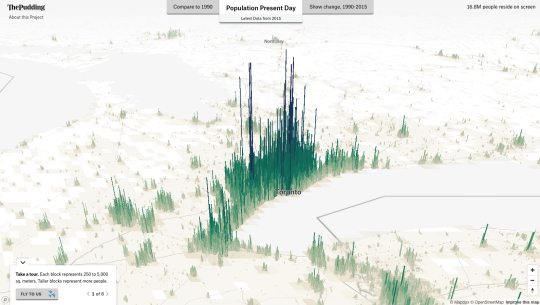
    Photo by Tim Gouw on Unsplash

  • China has a lot of people

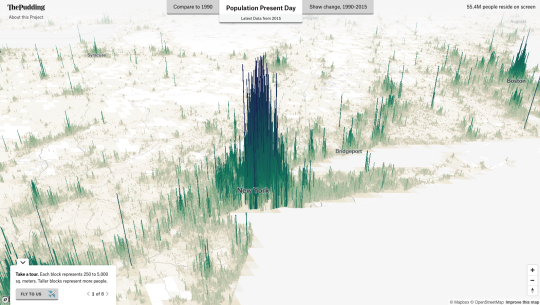
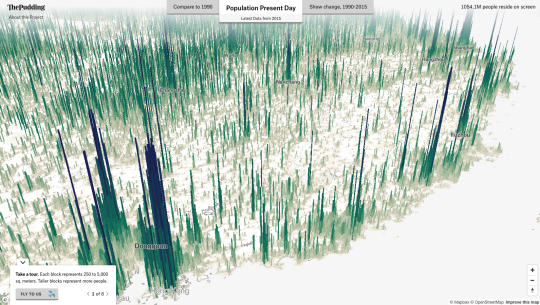
    Matt Daniels over at The Pudding recently visualized the world’s population in this spiky 3D map. You need to take a look. Better on desktop.

    The data is from 2015, but you can also compare it to and show the change from 1990.

    Here is the Greater Toronto and Hamilton region (16.8 million people reside in this screen grab):

    Here is the New York City region (55.4 million people reside in this screen grab):

    And here is China (1.054 billion people reside in this screen grab):

    I tried to capture both Shanghai and Hong Kong in this image. Guangzhou, Hong Kong, and Shenzhen are currently in the mist of forming a 40 million-person megalopolis.

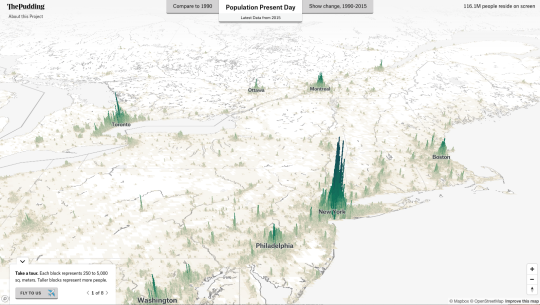
    If we pan back over to the northeastern United States and Central Canada – keeping the same scale as the above image from China – it looks like this:

    These last two images say a lot. 

  • The tallest residential building in the world

    Earlier this month, Extell Development Company announced the launch of sales for its Central Park Tower – which it is calling “the definitive New York skyscraper”, as well as the tallest residential building in the world. 

    The project is located on Billionaire’s Row in NYC and it will be 1,550 feet tall when completed. That puts it well into supertall territory.

    According to Curbed, the smallest apartments start at 1,435 sf and the largest will be an estate in the sky at around 17,500 sf. 

    The projected sellout for the project is, or at least was, $4 billion back in 2017. That will set all sorts of records upon completion. At the time of the above filing, the average price was pegged at $7,106 per square foot.

    If you’d like to read up on the project’s capital stack, you can do that here. And for those of us who are used to having to pre-sell condos before digging, you may find it interesting to know that this project started construction in 2014.

    I wonder how much a parking spot costs (assuming there is even parking).

  • Average age of a first-time mother

    image

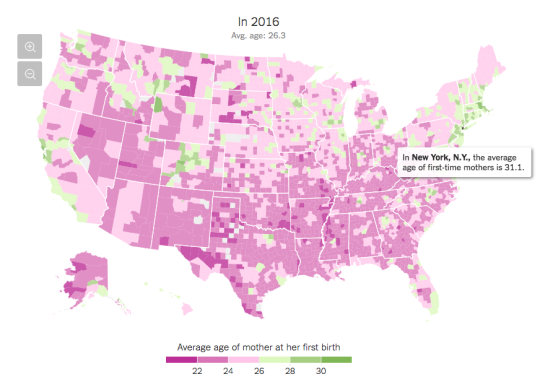
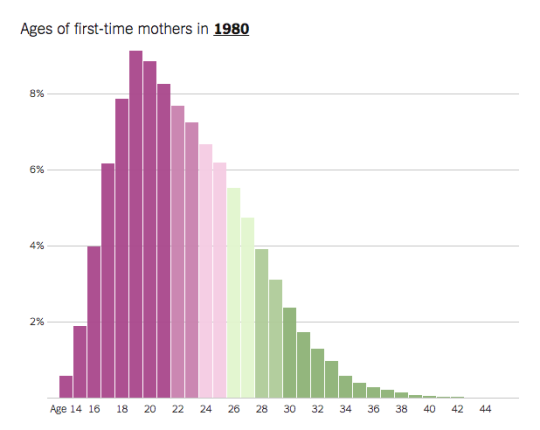
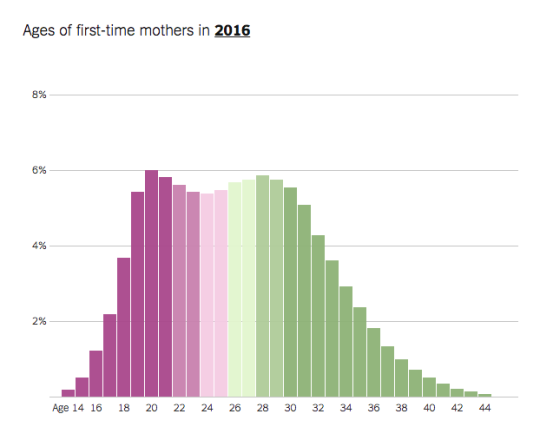
    According to a recent study in the New York Times, the average age of a first-time mother in Manhattan is 31.1 years old. In San Francisco County, the number is nearly 32. And in the US as a whole, it was 26.3 in 2016.

    This is what the national distribution looked like in 1980:

    image

    And this is what it looked like in 2016:

    image

    Perhaps not surprisingly, the biggest factor influencing the age of a first-time mother is education. Becoming educated and building a career takes time. First-time mothers tend to be older in big cities (particularly on the coasts) compared to rural areas.

    The concern that researchers have with all of this is that it is symptomatic of growing inequality. Scrolling over the NY Times’ map, it would appear that there’s nearly a 10 year gap between the coasts and many parts of the country.

    On the one hand you have people who are finishing high school and having kids fairly soon after. And on the other hand, you have people going to college, establishing their career, and waiting, in some cases a decade, to have kids.

    This is significant because it can create a virtuous circle (excerpt from article):

    “A college degree is increasingly essential to earning a middle-class wage, and older parents have more years to earn money to invest in violin lessons, math tutoring and college savings accounts — all of which can set children on very different paths.”

    Unequal childhoods can lead to unequal outcomes.

    Images: New York Times

  • Order without Design

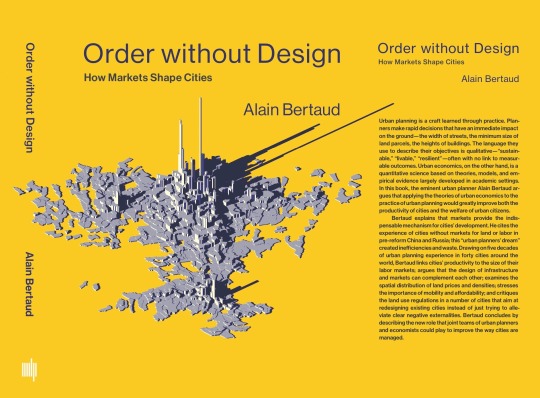
    Alain Bertaud has a new book coming out later this year from MIT Press called, Order without Design: How Markets Shape Cities. If you’re based or happen to be in New York, there’s a book launch on Tuesday, December 11, 2018 at NYU. You can RSVP here

    The book argues that, “operational urban planning can be improved by the application of the tools of urban economics to the design of regulations and infrastructure.” I haven’t read it yet and it’s not available until December, but I’ve just added it to my reading list.

    I am of the opinion that none of us involved in the built environment should be working in insolation, without some understanding of the myriad of other forces shaping our cities. Cities are too complex and important for narrow views.

    From what I’ve read about this book, it subscribes to that philosophy. And so I’m giving it a place in the queue.

    Image: NYU

  • The Trump family real estate empire

    He is tall, lean and blond, with dazzling white teeth, and he looks ever so much like Robert Redford. He rides around town in a chauffeured silver Cadillac with his initials, DJT, on the plates. He dates slinky fashion models, belongs to the most elegant clubs and, at only 30 years of age, estimates that he is worth “more than $200 million.” 

    Judy Klemesrud, New York Times, 1976

    Last week the New York Times published a special investigation looking at the Trump family’s real estate empire and the suspect tax schemes that they allegedly employed over the years to preserve, grow, and pass it down. 

    According to the Times, all of which has been rebuked by a lawyer for the president, Donald Trump received at least $413 million in today’s dollars from the family empire. 

    I just finished reading the investigation in its entirety. It’s a long one. But if you’re interested, you can do the same here. If you’d prefer the Coles Notes version (Cliff Notes for you Americans), have a scroll through the headlines in this article instead.

  • Leading female architects

    Reed Kroloff has a noteworthy piece in the New York Times talking about how architecture is no longer just a ‘gentleman’s profession’. Though less than a third of AIA (American Institute of Architects) members are females, “offices led or owned by women are creating an ever-wider range of public buildings that address architecture and urbanism in new and invigorating ways”, says Kroloff.

    I am thrilled, but not surprised, to see Jeanne Gang of Studio Gang on the list (pictured above). Her firm is the design architect behind our One Delisle proposal. And I was also happy to see Magui Peredo of Estudio Macias Peredo on the list. She is based in Guadalajara and, if you aren’t familiar with her work, I recommend you check it out. I love the materiality of it.

    Image: New York Times

  • Invisible walls

    image

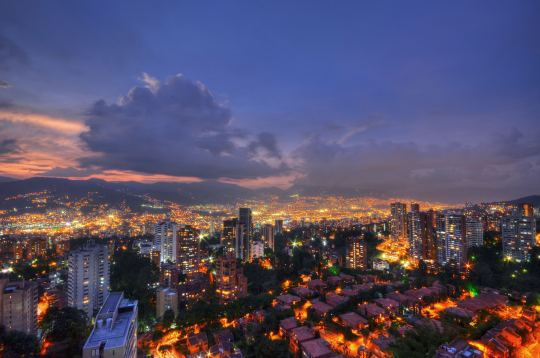
    This is an interesting working paper by a team of researchers at NYU’s Marron Institute of Urban Management. The paper examines the relationship between urban density and organized violence, first in Colombia and then within a sample of 200 global cities.

    The finding is that organized violence actually increases the population density of the surrounding areas within a city because it creates a kind of “invisible wall” – effectively a no-go zone.

    This makes perfect intuitive sense, but it’s not something I ever considered. Geography and other natural constraints typically drive density. Think about the island of Manhattan. But so too can invisible walls.

    For the full working paper, click here.

    Photo by Joel Duncan on Unsplash

  • Street-level intelligence and analytics

    I discovered a company yesterday called CARMERA, which just raised a $20 million Series B funding round. They call themselves a “real-time, street-level intelligence platform” and their flagship product, called Autonomous Map, provides HD maps and real-time navigation data to autonomous vehicles. That’s the way AVs work. They need maps like CARMERA’s to function. Here is an overview of what is supposedly the largest AV taxi service in the world. It is a partnership between CARMERA and Voyage.

    One of the interesting things about this product is that it is cleverly powered through another one of their products: a free fleet monitoring tool for commercial operators. So fleet managers use this service to keep track of their actual human drivers and, at the same time, CARMERA uses the vehicles to collect the data it needs for its Autonomous Map. They call it “pro-sourcing” the data (a play on crowdsourcing).

    It is perhaps a good example of “single user utility.” The product you’re making often has to be valuable to a single user before scale is reached. In this case, Autonomous Map would be a hard sell without a critical mass of pro-sourced data. It solves the perennial chicken-and-egg problem when creating new marketplaces.

    Finally, I think many of you will be interested to know that CARMERA has also announced a partnership with the New York City Department of Transportation. As part of this, the company will be handing over the data they have on pedestrian density analytics and real-time construction detection events. Part of their mission is to “automate cities” and better street analytics will certainly help to open up a new world of city building possibilities.

    Photo by Yeshi Kangrang on Unsplash

  • North American cities with the most construction cranes

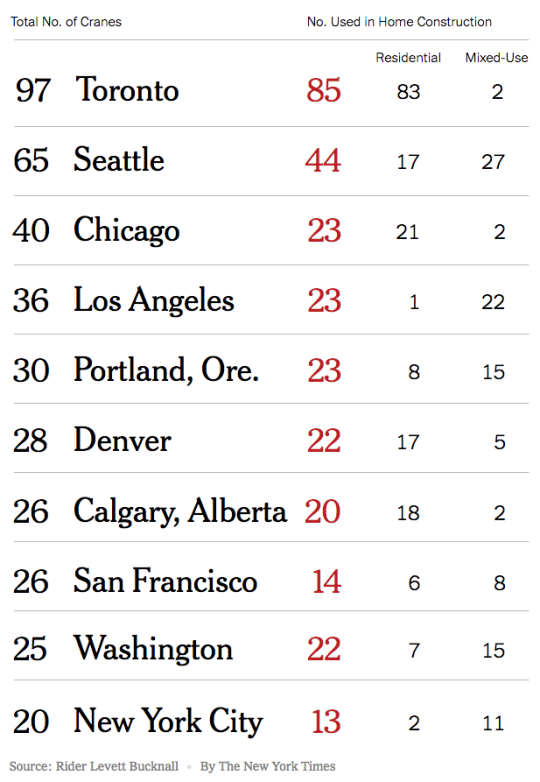
    Rider Levett Bucknall recently released its RLB Crane Index for Q3-2018. Here are the top 10 cities in North America (table via the New York Times):

    For the third consecutive reporting period, Toronto has taken the number one spot at 97 cranes – 85 of which are being used on residential projects. 

    I’m not at all sure how the study defines “mixed-use” projects. But given that Toronto only has 2 of them, it must not include projects with grade-related retail.

    Across North America, residential and mixed-use projects (whatever they are) make up approximately 70% of the total crane count. 

    I am surprised that Miami didn’t make the list.