Daily insights for city builders, delivered every morning at 6 AM ET. I’m Brandon Donnelly — a Toronto-based real estate developer and founder of Globizen. I’ve been writing here since 2013.

Tag: new construction

  • One year of Inclusionary Housing in Portland

    image

    About a year ago, Portland enacted “Inclusionary Housing” policy requiring new apartment buildings of 20 units or more to offer up a portion of the units at below market rents.

    Developers are able to select from a few different options and the rents are calculated according to a percentage of the city’s median family income (30-80%). I’m not sure how this policy would apply to new condo buildings.

    This is an interesting account by The Portland Mercury of what this policy may be doing to the housing market. I say may because it’s only been a year and there could be other factors at play.

    Between 2013 and 2017, Portland typically built between 3,000 and 6,000 new units per year. Since the IH policy went into effect on February 1, 2017, 682 new units have applied for permit. 

    About half are coming from one developer who appears to be building the requisite affordable units in exchange for no parking minimums. They are now proposing buildings with zero parking.

    Again, in all fairness, it’s only been a year. But already Mayor Ted Wheeler is looking at other incentives to encourage more new construction in the central city. The biggest levers: height and density.

    All of this begins to speak to the very real impact of inclusionary zoning on development feasibility.

    Photo by Zach Savinar on Unsplash
  • 2017 was a record year for housing starts in Canada, but…

    According to Bloomberg (using data from CMHC), 2017 was a surprising record year for housing starts in Canada: 219,675 units. This is the most since 2007 and is up from 197,916 units in 2016.

    The explanation: job growth (nearly 400,000 new jobs) and population growth were both more robust than expected.

    Multiple unit project starts are also up significantly with 142,840 units starting in 2017. This is a 15% increase from the prior year. Of these units, 102,516 of them were “apartment-like homes.”

    But all of this is nationwide data. Look at what happened in Toronto and Vancouver:

    The increased activity mostly sidestepped land-constrained Toronto and Vancouver, the country’s two most expensive markets, but was robust in the suburbs and less pricey surrounding cities. Starts in Toronto fell 1 percent to 38,738 in 2017, while declining 6 percent in Vancouver to 26,204 units.

    This is not because of a lack of demand. It’s becoming systematically more difficult and more costly to build new housing in these two markets.

  • The year of the condo

    Over the past 5 years or so, real estate headlines in the Greater Toronto Area have often focused on the rapid appreciation of low-rise housing. High-rise housing simply wasn’t appreciating at the same rate – at least in aggregate terms.

    But 2017 has brought a different story. 

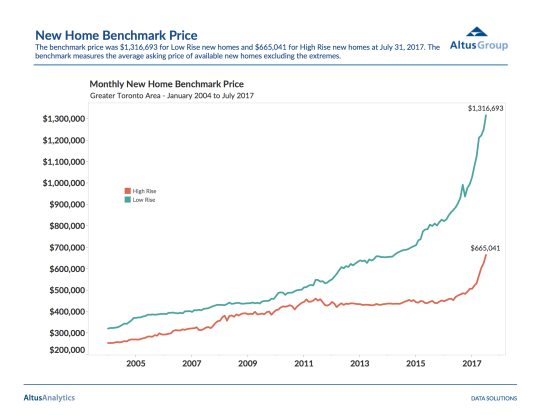
    If you look at BILD’s “New Homes Monthly Market Report” (data provided by Altus Group as of July 2017), you can see that high-rise pricing is now on a similar trajectory to low-rise pricing.

    Here is that graph:

    image

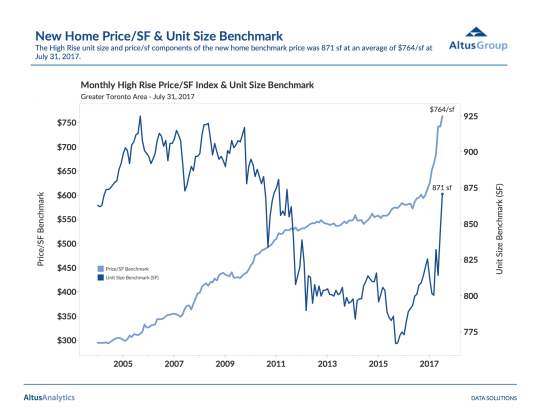
    This sharp uptick in pricing is also apparent when you look at the average price per square foot of new high-rise inventory. As of July, it was $764 psf across the GTA. See below.

    At the same time, average unit sizes have also jumped up to 871 square feet. So not only are new high-rise homes becoming more expensive on a normalized basis, they are also getting bigger, which further increases prices.

    image

    I recognize that we’re only seeing data up to the end of July, but, from the looks of it, 2017 is shaping up to be an extraordinary year for the condo.

    Of course, part of the reason this is happening is because remaining inventory for both low-rise and high-rise product is hitting 10-year lows. We’re back to the topic of supply.

    If you’re curious how some of these numbers have changed from the month prior (June 2017), check out this post.

  • What a “buy now” button will mean for the new construction real estate industry

    Colored apartments by Pierre-Yves Babelon on 500px.com

    https://500px.com/embed.js

    Recently it has been in the news that BuzzBuzzHome.com – the new construction real estate site – will be launching a “buy now” feature in the new year (2016).

    This will allow people to buy condos and homes online with their credit card, which means that people will be able to pay the $5,000 deposit online and process all the paperwork that today happens within a sales office.

    This is huge.

    If you’re somebody who has used a computer and the internet before, the process today feels archaic. Typically you go online to register for a project and then somebody will call you to arrange an appointment. If you ask them to email you the price sheet and floor plans ahead of time, they’ll almost always tell you that they can’t do that and that you’ll need to come into the sales office for an appointment. 

    But what about if you end not liking the floor plans and you’re about to waste a few hours of your time? Too bad. The sales funnel requires you to be present in person. This is nothing against the many talented sales professionals working in new construction; it’s just that if I can design and price out a car online and if Mark Cuban can buy a $40 million jet online, then I should be able to shop for a new condo online.

    BuzzBuzzHome has been chipping away at the current model for years and they’ve managed to get a lot more information online than was previously available. When Matthew and Cliff first launched BuzzBuzzHome in the late 2000s it was almost unheard of for developers to put any sort of pricing and floor plans online. Now they at least have some of that on their site. I’m glad they stuck with it.

    Because what’s equally exciting about what BuzzBuzzHome is doing is that in order to offer a “buy now” feature, they also need to have an accurate account of all developer inventory on hand. And so alongside this “buy now” feature they’re also building out a full cloud-based inventory management system for developers. 

    This means that BuzzBuzzHome will soon be managing the supply-side of the new construction marketplace. Think of the data and analytics you can extract from a platform like this. It’s going to bring much greater transparency to this industry.

    But if your business is in any way connected to the new construction real estate market, I would take this morning and think about how the above innovations could impact your business model. I can think of a few winners and losers.

    Some of you might be thinking that people aren’t going to make the biggest purchase of their life online. But I would bet the farm that many people will. I know I would.

  • America really is building very few condominiums

    On my way back from Philadelphia
    this past weekend I wrote a post called, The
    Philadelphia (real estate) story
    . It was about how opposite the market is
    in Philly compared to Toronto.

    After writing that post and
    because of a discussion in the comment section, I started thinking about condo
    vs. rental apartment development across the US. Because unlike cities such as
    Toronto and Vancouver, it struck me that – outside of maybe New York and Miami
    – most U.S. cities are really not building a lot of for sale condos. And if
    you’re from Toronto or Vancouver, I bet that feels odd to you.

    But what exactly is that number?

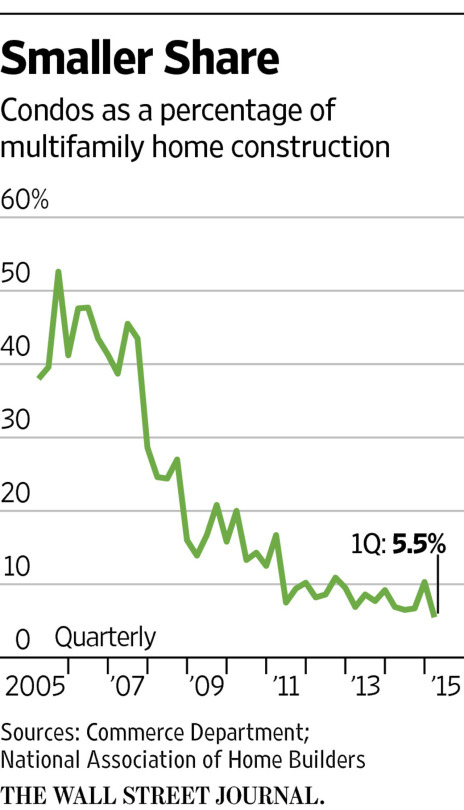
    As of the first quarter of 2015, condos as a percentage of all new
    multifamily (apartment) construction in the US was only 5.5%. That’s a tiny number and is down from
    over 50% before the Great Recession, which means most
    cities in the US really are building mostly rental. Last year the US built 264,000
    multifamily units across 11,000 buildings
    .

    So why is that happening?

    There appears to be a number of
    factors, according to a
    recent article in the Wall Street Journal
    .

    There’s a supply side
    constraint:

    Another obstacle cited by developers: construction loans. Matt
    Allen, chief
    operating officer of the Related Group, a developer based in Miami, said he can
    get a construction loan for roughly 75% of the cost of building an apartment
    complex. But lenders will cover only 50%, on average, of a condo complex’s cost
    because of the greater risk, he said.

    There’s a demand side
    constraint:

    As a result, the Federal Housing Administration, which
    backs mortgages made to low-wealth buyers, tightened its lending standards in a
    series of moves from 2008 to 2012. Under the new rules, in order for the FHA to
    insure mortgages in a given condo complex, at least half of the units must be
    owner-occupied and no more than half can be FHA-insured, among other
    requirements. For condo projects under development, at least 30% of units must
    be under contract for sale before the FHA will start backing mortgages there.
    Mortgage giants Fannie Mae and Freddie Mac tightened
    their standards as well.

    And there are macroeconomic
    factors:

    On the entry-level end, tepid job growth early in the
    recovery and the younger generation’s affinity for flexibility have fueled
    demand for rentals. Apartment rents are up nearly 16% since 2010, according to Reis Inc.

    Notwithstanding
    the above, could this be a post-recession policy pendulum that has swung
    too far in one direction?