
Daily insights for city builders, delivered every morning at 6 AM ET. I’m Brandon Donnelly — a Toronto-based real estate developer and founder of Globizen. I’ve been writing here since 2013.

Tag: mountains

  • Psycho pillow run

    I have been told by some of you that when I write about snowboarding, you tune out on those days. If you are one of these people, then today is a good day to skip over on the blog. See you tomorrow.

    However, if you’re not one of these people, and you enjoy exceedingly cool things, then you’re going to want to take 6 minutes and — at the very least — watch Part III of the above video. Travis Rice is one of the best. And in this Red Bull video he goes from BC to Wyoming. (If for whatever reason it doesn’t start in the right place, click here and fast forward to 7:22 for Part III.)

    I once heard Quentin Tarantino say that if you choose the right song for the right scene in a movie, you’ll never be able to listen to that song ever again without thinking of the movie. (Think Pulp Fiction.) Now, this isn’t a movie per se, but it definitely feels like one of those cases. This techno song will forever remind me of this psycho “pillow” run.

  • Bar d’altitude

  • /imagine prompt: A silver Land Rover Defender driving through a snowstorm in the mountains of Utah

    Like everyone else, I have started playing around with Midjourney to create AI-generated images. Here are two that I created last night using the prompt: “A silver Land Rover Defender driving through a snowstorm in the mountains of Utah.”

    Now, you can tell that these are AI-produced images, but it’s still wildly impressive that something like this can be easily generated in a matter of a few seconds. And that’s the thing about AI: it’s easier to get, especially compared to crypto. It’s immediately useful and it’s immediately clear what this can and will disrupt.

    Levis, for example, just announced that it will start using AI-generated photography in lieu of actual fashion photoshoots. This is obviously suboptimal for photographers, models, makeup artists, and so on, but a hell of a lot easier for Levis. I would also imagine that the same thing will happen to real estate renderings and many other things beyond just imagery.

    Ben Myers and Steven Cameron recently speculated on their podcast — Toronto Under Construction — that AI could be used for reviewing development applications. Imagine how much this would speed up reviews and the delivery of new housing! So there are very good reasons for why the hype cycle has moved over to AI from crypto and NFTs.

    However, I’d like to go on the record saying that my gut tells me that this will only make what crypto offers even more important. Permissionless public databases (as opposed to databases controlled by individuals/companies) and the ability to demonstrate authenticity/ownership, feel like two important things to me in a world where computers are constantly generating a flood of new content and nobody knows what is “real” anymore.

    It’s certainly a lot less tangible than, “hey, check out this badass Defender driving through the snow.” But I feel strongly that these two innovations will end up working together.

  • Retaining earth in the mountains

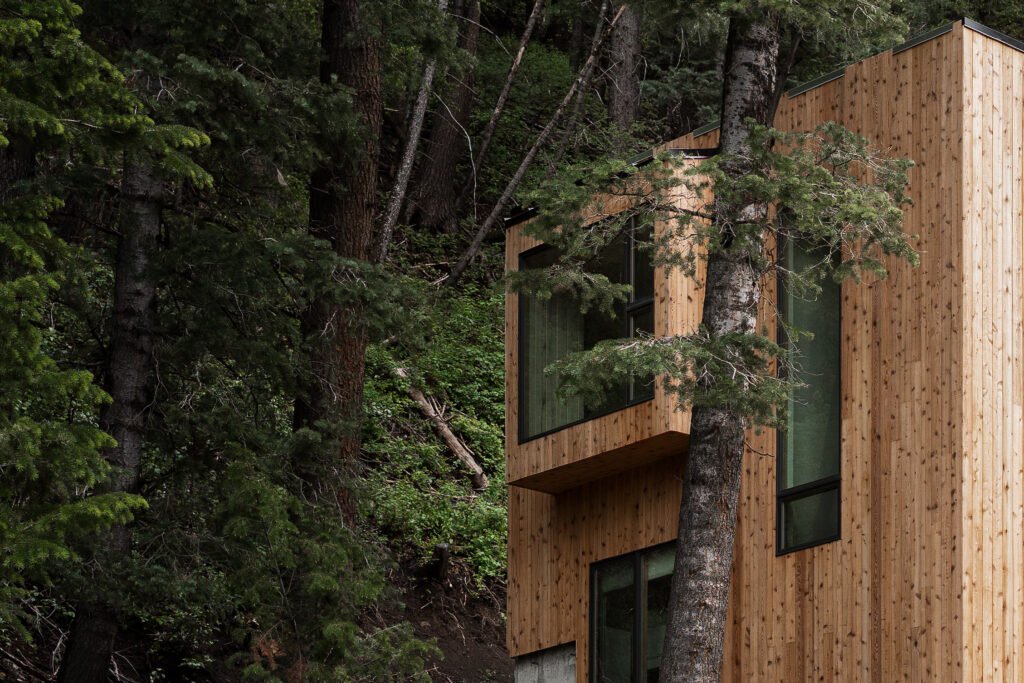
    As many of you know, I am working on a new build in Park City, Utah. One of the things that I have had to get up to speed on are earth retention systems. Building in the mountains is challenging. Here are a couple of photos from this morning of a new single-family home under construction near the lot that I am working on.

    It looks to be a combination of cast-in-place concrete and precast blocks (right side). We are looking at a similar strategy. To give you a sense of the magnitude, some of the concrete blocks we are looking at are 1,800 lbs each. As is the case with many construction projects, a lot of the costs here end up going towards things that most people won’t ever see or think about.

  • Schematic design phase complete for Parkview Mountain House

    Some of you may be aware that Globizen is working on a new project in Park City, Utah right now called the Parkview Mountain House.

    It was first announced on the Globizen Journal back in the summer and then a later announcement was made appointing New York-based Mattaforma as the project architect. It’s kind of a great story because Mattaforma is a relatively new firm that was formed by two architects who used to be at Studio Gang. So we have a long history of working together.

    The vision for the project is a creative retreat in the mountains. A place to unplug, be active, and hopefully a place to foster creative expression, whatever that may be for you. It was inspired by the trip that I have been making to the mountains each year where we try and do exactly this. It’s one of my favorite times of the year and one that I look forward to the minute the last one is over.

    The team has just finished the schematic design phase for the house (see above axonometric). And we are now working through some of the structural and geotechnical issues that come with building in the mountains on very steep terrain.

    To give you all one example, we had initially contemplated large multi-storey retaining walls to hold back the earth and embed the house into the side of the mountain. But that is now being changed to a stepped foundation that minimizes the amount of excavation and reduces each retaining wall to no more than a single storey. This move will also result in more wood and less concrete. It has been a fun learning process.

    The creative retreat concept has also been evolving and we recently decided to make digital NFT art an integral part of the experience. We have a few collections that we have been stocking up on, but if any of you have any recommendations we are, of course, all ears.

    Once the floor plans have been finalized, they’ll be posted up on the Globizen Journal. So make sure to e-mail subscribe and follow along on Instagram at @parkviewhousepc.

  • It’s okay for urbanism to be a bit messy

    The urban-to-rural transect is a New Urbanist planning framework that prescribes a smooth continuum of settlements that go from least dense to most dense. The six zones are as follows: natural (T1), rural (T2), sub-urban (T3), general urban (T4), center (T5), and core (T6).

    Part of this framework is about rejecting single-use Euclidean zoning. Instead of segregating uses, New Urbanism looks to return to a mix of uses within close proximity of each other. This is a good thing.

    But the transect also advocates for a certain orderliness. There should be a smooth transition as you move outward from T6 toward T1. It is about placing things in their useful order and maintaining a certain kind of character.

    Witold Rybczynski makes an interesting observation about this in a recent post called “urban discontinuities.” The point he makes is that some of the most remarkable urban moments are the result not of smoothness, but of “odd juxtapositions.”

    Think:

    – Mount Royal (T1) in the middle of downtown Montreal (T6).

    – The North Shore Mountains (T1) that terminate views from within the building canyons of downtown Vancouver (T6)

    – The walls of tall buildings (T6) that frame Central Park (T1) in Manhattan

    – The wonderful ravines (T1) that cut through Toronto’s urban fabric (T6)

    These are contrasting zones in the transect bumping up against each other. And it turns out that most of us really like these moments. But I think that the bigger point to be made here is that urban environments aren’t always neat and tidy, and that’s because they are a constantly evolving organism.

    That’s not a bug. It’s actually a feature to be celebrated.

  • 11th annual

    We landed in Calgary last night, stopped for a bowl of pho noodle soup, and then did the three hour drive into the BC interior. This year’s “annual” is in Fernie, British Columbia. It’s my first time here and the snow is everything I was promised. And since I have been meaning to post more photos on this blog, here are a few that I took today on my iPhone (with only minor edits made in VSCO). More to come, here.

  • The future of clothing

    Today’s post is going to be a bit of a departure from our regularly scheduled programming. But it’s so cool that I had to share it. It’s a company called Vollebak, and they use science and technology to make highly technical clothing (or, as they call it, the future of clothing). It was founded by two brothers.

    Every month they launch a new clothing concept. (Sign up here if you want to get on their list.) But each new piece they develop could take anywhere from one to five years to actually produce. Usually we’re talking about new production methods and materials that have never before been used for clothing.

    Examples include an indestructible puffer jacket designed to help us withstand up to -40 degrees; a solar charged jacket; a “black squid jacket” that reflects visible light to go from black to bionic; and a plant/algae t-shirt that is grown and can later be composted.

    But the piece I’m really eyeing is this blue morpho ski/snowboard jacket. It uses two billion microscopic glass spheres to try and replicate the wings of a blue morpho butterfly. During the day the jacket is matt blue. But as soon as you shine light onto it, it looks like the above photo.

    This would be useful if you were, say, caught in an avalanche and a helicopter searchlight was trying to find you. Hopefully that’s a use case that none of us have to experience. But it could also be invaluable if you were out walking or cycling at night and you wanted to make sure that cars could see you.

    (Please note how I somehow managed to make this post mildly relevant to cities.)

    Image: Vollebak

  • 10th annual

    It is that time of year again.

    For those of you who are regular readers of this blog, you’ll know that every year around this time I go on a snowboarding/ski trip with groups of friends that I went to grad school with and/or grew up with.

    We have been doing this for a decade now. Last year we were in Jackson, Wyoming (my favorite place so far). And this year we are in Austria.

    Here is a photo that I took — of paradise — this afternoon:

    I’m not sure there’s anything to say after a photo like this. So I’ll leave it at that. See you tomorrow.

  • Man behind the map

    For those of you who are regular readers of this blog, you’ll know that I love to snowboard and that I leave Ontario every winter in search of fresh lines. It is an annual tradition that has been going on for over a decade.

    One of the things I wish I had been more diligent about is collecting all of the trail maps. I am sure I have a number of old ratty ones in some of my snowboard bags and snow pants, but none of them are probably worth keeping.

    That’s why I think this is a terrific Kickstarter campaign by James Niehues. Over the last 30 years, James has researched, photographed, and painted almost every ski map in use across North America. Yes, these maps are all painted by hand. 

    If you would like to back James’ project – a hardcover coffee table book of his work – you can do that here.

    https://www.kickstarter.com/projects/orsc/james-niehues-the-man-behind-the-map/widget/video.html