Daily insights for city builders, delivered every morning at 6 AM ET. I’m Brandon Donnelly — a Toronto-based real estate developer and founder of Globizen. I’ve been writing here since 2013.

Tag: Montréal

  • Statistics Canada publishes its wastewater-based estimates of drug use

    In March 2018, Statistics Canada launched the largest “wastewater-based epidemiology pilot test” ever conducted in North America. Over a 12 month period, it collected wastewater samples across the country in order to test for traces of cannabis and other drugs. The pilot captured 8.4 million people in Vancouver, Edmonton, Toronto, Montréal, and Halifax. And it was allegedly timed to coincide with the legalization of cannabis in Canada on October 17, 2018.

    This week Statistics Canada published its findings. While the study does cover over 8 million people, it was not intended to be representative of the entire Canadian population. Some sites, such as Vancouver, had nearly complete coverage of the metro area population. While others, such as the Halifax site, only covered about half of the metropolitan area. In any event, the findings are interesting.

    Above is one example: methamphetamine load per capita for the five study cities. The y-axis is grams per million people per week. And the time period is, again, March 2018 to February 2019. Average levels for Edmonton and Vancouver were found to be about 3.7x higher than those in Montréal and Toronto. There was also no apparent seasonal/monthly variation, which is something else they looked at.

    Here I learned that a large portion of this drug passes through the body unchanged. And so the concentrations they discovered in wastewater is likely a fairly direct indicator of consumption within the population. Stats Canada is still reviewing its findings and evaluating this approach to collecting large scale urban data. But I am certain we’ll be seeing more of these kinds of urban studies.

    Chart: Statistics Canada

  • Minimalist smart biking device

    I just came across this smart biking device on Kickstarter. It is the next generation of their original SmartHalo, which did very well and is now sold in Apple Stores. The company is based in Montréal.

    Here’s how it works:

    https://www.kickstarter.com/projects/smarthalo/smarthalo-2-make-your-bike-smarter

    I know that a lot of you are cyclists, so I figured some of you might appreciate this. It looks pretty awesome. Delivery of SmartHalo 2 is expected by December 2019.

    Their Kickstarter campaign ended on July 2. The project got funded with about CAD 1.7 million from over 10,000 backers. But you can still pre-order a device, here.

  • A subway network at the scale of a country

    The Hyperloop space has a number of competing companies that are all trying to figure out how to move people (between cities) in low-pressure tubes at nearly the speed of sound (1,234.8 km/h). For what it’s worth, Virgin Hyperloop One, which was founded in 2014, has supposedly completed the most testing and raised the most money ($295 million as of December 2017).

    This morning I was reading up on the Toronto-based TransPod, which was founded in 2015 by Sebastien Gendron and Dr. Ryan Janzen. They raised a $15 million seed round from an Italian tech group in 2016 and are close on another $50 million round right now. Following this, they’ll look be looking for a few hundred million. They seem encouraged by where Canada’s Strategic Innovation Fund has been placing money.

    Supposedly, their biggest competitive advantage is cost. The company estimates their cost per kilometer to be about $25 million, which would put the cost of a Toronto-Montreal link at around $15 billion. This is not cheap, but it is allegedly cheaper. The travel time between these two cities could then be as short as 40 minutes.

    Virgin Hyperloop One has been similarly looking at a Toronto-Ottawa-Montreal line, as it would stitch together about 25% of Canada’s population. But apparently the federal government recommended that TransPod instead look at a line that sits entirely within one province — at least at the start.

    So the company has gone ahead and secured a 10-kilometer parcel of land in Alberta that will eventually form part of a future connection between Calgary and Edmonton. TransPod hopes to have this test track operational by 2022.

    However, their focus right now is on France. (Being in Europe is another differentiator for the company. Europe gets transport.) With the help of a few partners, the company has started work on a 3-kilometer test track in Limoges, France. Permits were received at the end of last year and they hope to begin testing by the end of this year.

    There’s no question that this technology has the potential to be transformational, which is why so many companies are competing in the space right now. But it’s obviously going to take a whole lot of moxie. Gendron is on the record talking about the risk-adverse nature of both Canadian regulators and investors when it comes to these sorts of large-scale innovations. That’s a problem that we need to address.

    The title of this post is a quote by Gendron taken from this TechVibes article.

    Image: TransPod

  • How are condos in Canada used?

    Jens von Bergmann (data analyst and mathematician); Nathanael Lauster (sociologist); and Douglas Harris (law professor) have been working since 2018 on a study of how condominiums are used and occupied across Canada. The goal is to use the results to better inform public and academic debate.

    They recently presented some of their early findings at the National Housing Conference in Ottawa and have since made that information public. It is still a work in progress, but already there are some interesting takeaways. To start, here is a chart showing occupied housing units in Canada and in select CMAs:

    Not surprisingly, Canada is broadly speaking a nation of single-detached houses. But in our three largest cities — Toronto, Montreal, and Vancouver — apartments/condominiums are doing a lot of the heavy lifting.

    Vancouver has the highest proportion of condominiums. It is a geographically constrained metro area and it is one of the first cities in the country to adopt condominiums as a housing tenure. And in Montreal, there are more apartments under 5 storeys than there are single-detached houses. Not surprising. There’s no “missing middle” in this city.

    But the really interesting question is, how are these condominiums being used and occupied? It’s a challenging question to answer, which is why it’s so often debated, but here’s what the researchers have found so far:

    The owner and renter categories are self-explanatory. Temporary, which is the least common type of tenure, is where the owner has declared their principal residence as being somewhere else. In other words, the condominium is a second home.

    The vacant category is effectively that city’s condominium rental vacancy rate. These are condominium units which are empty, but that are at the same time listed for rent. There are relatively few of these. In Toronto and Vancouver they’re virtually non-existent in this dataset (2016).

    Finally, we get to unoccupied units. This one is tricky and the researchers aren’t exactly clear on what is driving this number. They chalk it up, at least partially, to the flexible nature of condominiums. For example, it could be empty because the unit is switching from owner-occupied to rental, or vice versa.

    That said, it is very interesting to note that Toronto and Vancouver actually have the lowest percentage of unoccupied condominium units. This may be surprising to some of you given the public discourse around investor units in these two cities.

    Generally, they found that in Canada’s three largest metro areas, the following rule of thumb seems to apply: For every 10 condominium units built, 6 will become owner-occupied, 3 will enter the rental stock, and 1 will go unoccupied. Does that seem right to you?

    If you’d like to dig into the methodology that the researchers used, you can do that over here at Mountain Doodles. All of the charts and data used in this post were taken from there.

  • Canada admitted 321,065 permanent residents last year

    Bloomberg recently reported that Canada admitted 321,065 permanent residents last year. This is up 12% from 2017, where the country admitted 286,479. Last year was also the largest cohort since 1913 (the year before World War I), where the country admitted just over 400,000 people.

    Here is a chart from Bloomberg (it is interactive if you click through):

    Of course, Canada was a much smaller country back in 1913 (about 7.6 million people), and so on a percentage basis we are much lower than where we were at the beginning of the 20th century. We’d have to admit close to 2 million permanent residents a year to get to a similar rate.

    And that is not what is in the books. Here are the projected admissions for 2019 to 2021. All of the below stats are from the 2018 Annual Report to Parliament on Immigration.

    I couldn’t find a geographic breakdown for last year, but in 2017, about 40% of admitted permanent residents (or 111,925 total) ended up in Ontario and about 72% ended up in Ontario, Quebec, and Alberta (the top 3 provinces for this year). If we add in BC, it brings this figure up to 86%.

    Here are also the top 10 countries of origin:

    If you’d like to download a PDF of the full report, you can do that here.

  • Tech and the North American office market

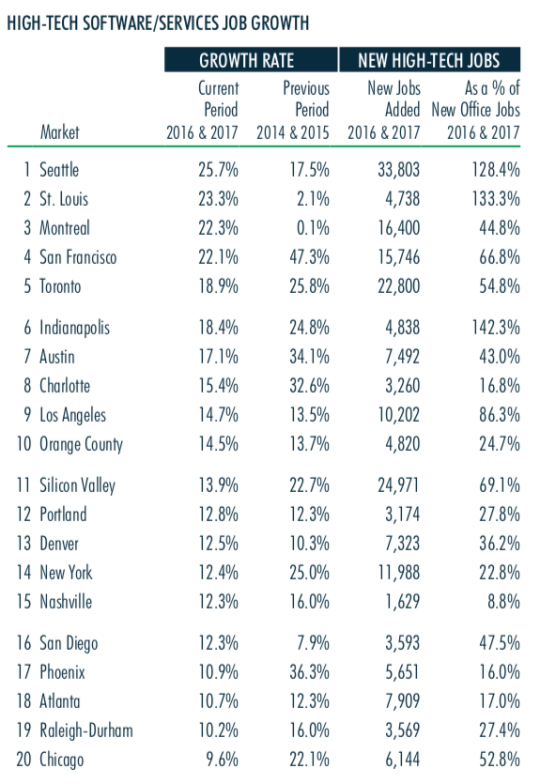
    CBRE recently published this report looking at the impact of the “high-tech software/services industry” on the North American office market. 

    Here are a few highlights:

    – Since 2010, tech has created ~1.1 million jobs in the US at an annual growth rate that is 3x the national average.

    – Seattle currently has the fastest tech job growth in North America. This is the first time in 7 years that San Francisco hasn’t been at the top of their list.

    – Silicon Valley, Toronto, New York, and Los Angeles all added more than 10,000 tech jobs from 2016 to 2017.

    – The biggest “momentum markets”, relying on 2016 and 2017 data, are Montreal, St. Louis, and Seattle.

    – Over the past two years (Q2-2016 to Q2-2018), Atlanta, Los Angeles, Orange County, Seattle, and Portland have all seen double-digit rent growth.

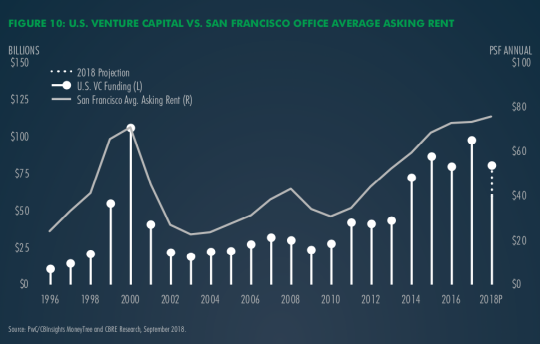
    One figure that also stood out for me was this one here showing the relationship between US venture capital investment and the average asking rent for office space in San Francisco.

    If you’d like to download the full report, click here. You’ll need to sign up for an account with CBRE, but it’s free to do that.

  • Project Profile: Golf Exécutif Montréal Clubhouse

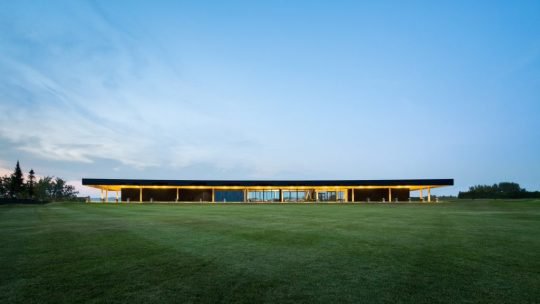
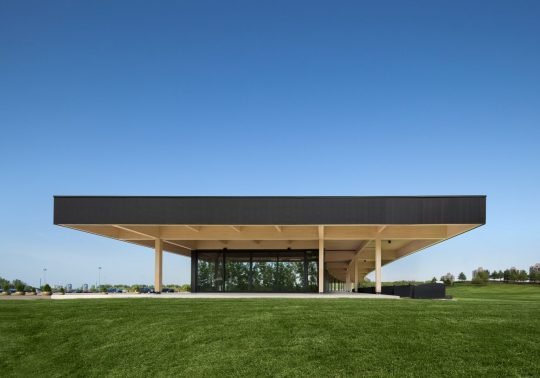
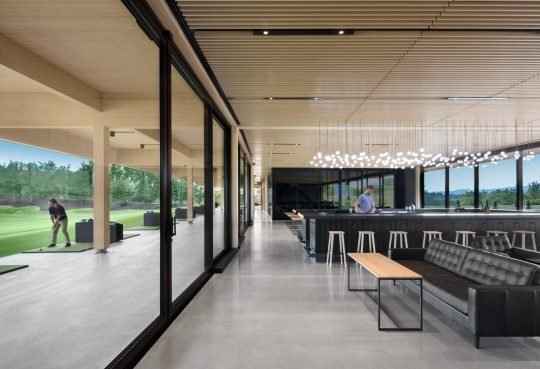
    I’m not a very good golfer (probably because I don’t golf), but this clubhouse in Montréal has me wanting to try my hand at the driving range again. Designed by Architecture49, the clubhouse itself is 855 square meters, but the roof area is around 1,800 square meters – so more than double as a result of the overhangs that protect golfers from poor weather. Black zinc panels and pale wood get me every time.

    Images: Dezeen

  • Project Profile: Pavillon du lac

    Over the years on this blog I have posted the occasional “Project Profile”, where I have shared a noteworthy development project, an interesting piece of architecture, or some other kind of project that I thought would interest all of you. Everything is now a project.

    This morning I decided that I should do that more often. I’m not sure if it will be every week, but hopefully it’ll be fairly regularly. I also have a few other alliterative blog series that I have started in the past and should continue.

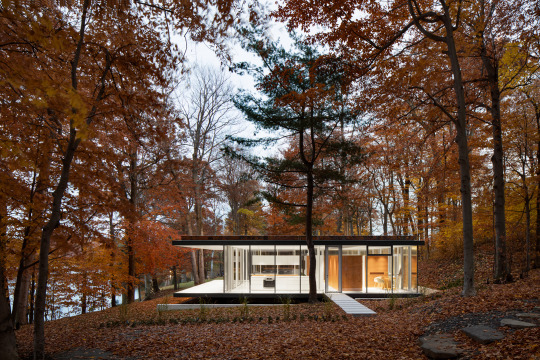
    This week’s Project Profile is the Pavillon du lac in Quèbec (somewhere) by Montréal-based Daoust Lestage. All of the photography used in this post is by Adrien Williams

    The first thing you may notice is that it is evocative of Philip Johnson’s Glass House and Mies van der Rohe’s Farnsworth House (1951) – but probably more the latter.

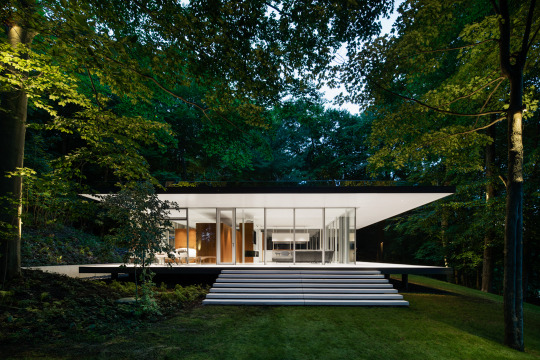
    Le Pavillon du lac was completed in 2015. It has 2 bedrooms and is about 1,240 square feet. The entire glass pavilion is housed between two thin flat slabs with cantilevering overhangs on two of its elevation. They create a kind of portico that frames views of the water. All of the glass is triple-glazed.

    image

    One of the key distinctions for me is how the house sits on the ground. As is the case with the Farnsworth House, le Pavillon du lac sits on stilts, elevated off the ground. The ground floor slab is then able to ignore whatever topography there may be beneath it. 

    image

    At the same time, there are elevations of the house where the ground has been carved into (see below). This creates a small moat around the perimeter and roots the building within the landscape. 

    image

    For more photos of le Pavillon du lac, click here.

  • Blackstone enters Canadian multi-family sector

    image

    A few days ago it was announced that Blackstone has entered the multi-family space in Canada through a JV with Starlight Investments. They are buying 6 undisclosed multi-family buildings. 5 in Toronto. And 1 in Montréal. The total is 746 units.

    The message in the press release is that apartment buildings in Canada are difficult to find and buy at meaningful scale. Most are held by small private investors and those owners are reluctant to sell. 

    At the same time, places like Toronto and Montréal have built relatively little purpose-built rental over the past few decades. Supply is restricted. 

    This is an interesting stat from the announcement: The Canadian rental market is about 2 million housing units. Dallas, alone, is 500,000 units. But this must only be purpose-built, investment grade, and/or some other subset of units. Because there are over 14 million private households and over 4.4 million rented households in Canada (2016 data).

    They also hint at a longer-term relationship between Blackstone and Starlight. Perhaps that will translate into some purpose-built rental development in the future.

    On a related note, I recently picked up the book, King of Capital: The Remarkable Rise, Fall, and Rise Again of Steve Schwarzman and Blackstone. It was published in 2012, so it’s not new. But as soon as I stumbled upon it, I picked it up. It was new to me.

    Once I’m finished it maybe I’ll report back here on the blog.

    Photo by Warren Wong on Unsplash

  • True North by Alain Carle Architecte

    I just recently discovered the work of Montréal-based firm, Alain Carle Architecte. If you aren’t familiar with their work, do yourself a favor and check it out here. They are apparently known for their secondary homes across the country.

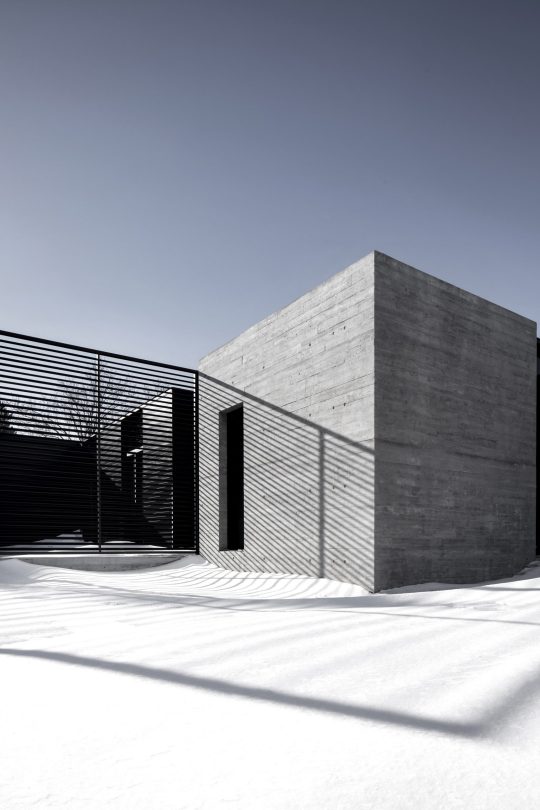
    The project that caught my attention was their True North home in Cornwall, Ontario. Here are two photos by renowned architecture and design photographer Adrien Williams (also of Montréal).

    imageimage

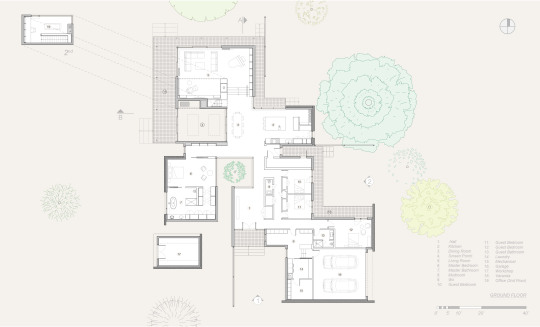
    And here is a plan via Dezeen.

    image

    The concrete and black metal cladding against the snow is pure magic. I also love the way they employed black screens to create a gradient across the landscape and frame some of the outdoor spaces. You really see that in the plan.

    The shadows these screens cast on the concrete are also quite beautiful.