Daily insights for city builders, delivered every morning at 6 AM ET. I’m Brandon Donnelly — a Toronto-based real estate developer and founder of Globizen. I’ve been writing here since 2013.

Tag: money

  • Money, identity, and ownership

    For those of you who are interested in crypto (and for those of you who aren’t but are open-minded), Vitalik has just published this post talking about what in the Ethereum application ecosystem currently excites him. A lot of it is pretty technical, but the 5 overarching categories he talks about are: (1) money, (2) decentralized finance, (3) identity, (4) decentralized autonomous organizations, and (5) hybrid applications.

    Money has always been considered the first and most important application of crypto. But there is no shortage of people who will tell you that it’ll never work and that fiat currencies backed by a government will always be superior. Today I already think the answer is: it depends. So lately, I have been responding to this comment by asking: Would you rather own the Argentine Peso or would you rather own someting like ETH?

    Here’s how Vitalik talks about this same point:

    When I first visited Argentina in December last year, one of the experiences I remember well was walking around on Christmas Day, when almost everything is closed, looking for a coffee shop. After passing by about five closed ones, we finally found one that was open. When we walked in, the owner recognized me, and immediately showed me that he has ETH and other crypto-assets on his Binance account. We ordered tea and snacks, and we asked if we could pay in ETH. The coffee shop owner obliged, and showed me the QR code for his Binance deposit address, to which I sent about $20 of ETH from my Status wallet on my phone.

    This was far from the most meaningful use of cryptocurrency that is taking place in the country. Others are using it to save money, transfer money internationally, make payments for large and important transactions, and much more. But even still, the fact that I randomly found a coffee shop and it happened to accept cryptocurrency showed the sheer reach of adoption. Unlike wealthy countries like the United States, where financial transactions are easy to make and 8% inflation is considered extreme, in Argentina and many other countries around the world, links to global financial systems are more limited and extreme inflation is a reality every day. Cryptocurrency often steps in as a lifeline.

    The other category that I find very interesting is that of identity. And it relates to a post that Fred Wilson also happened to share today where he talks about the importance of identity and the coming need for us to start cryptographically signing everything. In my mind, what this comes down to is proving things like who is who, who is doing what, and who owns what.

    This may sound counterintuitive since crypto is often held up by the media as a way to obfuscate identity and conceal nefarious activities. But the thing is, as soon as you link a real human to a blockchain, you can now have identity and ownership records that are institution-independent and fully interoperable. One use case that immediately comes to mind is property deeds, which is of course already being done in some places.

    For Vitalik’s full post, click here.

  • Income-to-expense ratio

    Professor Scott Galloway’s recent post called “The Algebra of Wealth” makes the argument that there are four key factors in the creation of wealth: focus, stoicism, time, and diversification. Some of you may argue with his points around diversification. I’ve heard Warren Buffet and Charlie Munger say before that diversification is really just admitting that you have no idea what the hell you’re doing. Because if you did, you wouldn’t need diversification to protect you.

    That said, I like a lot of the points that Galloway makes on his blog. For one, he calls bullshit on the age-old advice that you should just “follow your passion.” Finding something you love to do is important and ideal. I feel incredibly fortunate that I found something (there were pivots) that I want to be my life’s work. But that doesn’t mean that I didn’t and that I don’t think about money. As I’ve said before, I never understood why money is often a taboo topic in architecture schools.

    Galloway also takes a stab at defining, what is rich?

    I know a lot of people who make an extraordinary amount of money, but few people who are rich. Rich is having passive income greater than your burn. People on a path to money focus on their earnings; people on a path to wealth also focus on their burn. Joseph Heller said, “It takes brains not to make money.” (Note: I think he was casting a favorable light on his starving artist friends). This may be true, but it definitely takes brains to hold onto it (i.e., money).

    My father receives $48,000 per year from Social Security and his Royal Navy pension (he was a frogman). He spends $40,000, and it’s enough to make him happy. He swims every day, watches a shit-ton of hockey (Leafs fan), and on Fridays goes to The Taco Stand (an actual restaurant in La Jolla) where he orders something called a michelada. (Apparently it’s medicine delivered in a chilled salt-rimmed glass — he claims his hair is regrowing and that he’s sleeping better. I believe half of that so … I believe it.) Anyway, it’s not your income, but your income-to-expense ratio, that determines if you’re rich.

    When I was growing up, my dad used to always tell me that it doesn’t matter how much money you make, it matters what you do with the money that you make. That is another way of saying, focus on your income-to-expense ratio. Spend less than you make and be strategic with what’s leftover. This is a good principle to follow for real estate as well. As a rule, it’s generally a good thing when your revenue is greater than your operating expenses and your NOI is positive.

    But there’s another important message in Galloway’s excerpt: you don’t necessarily need a lot to be happy. (Sign me up for The Taco Stand on Fridays!) And if you’re in position where your passive income is greater than your burn, then you also have something called freedom.

    For Scott Galloway’s full post about The Algebra of Wealth, click here.

  • How to get rich (and why talking about money is okay)

    I’ve written about this before on the blog, but one of my qualms about architecture school was that it was too often taboo to talk about business and money. Why? Talking about and understanding the realities of the world doesn’t have to mean that you’re compromising on good design. Constraints are often good for design innovation. Similarly, I’ve always felt that personal finance should feature more prominently in schools at an early age. It should be considered a basic life skill.

    In any event, I came across this tweet thread last night by Naval Ravikant talking about how to get rich (without getting lucky). It’s from 2018, but the lessons — and there are many — obviously haven’t changed. (For those of you who may not be familiar, Naval was the co-founder of AngelList and was an early stage investor in companies like Uber, Twitter, and Opendoor.)

    When you see a headline like this it’s perfectly normal for your bullshit radar to go off. (In fact, it is one of his points.) But this thread is not bullshit. It’s about building wealth. Owning equity instead of renting out your time. Working hard. Taking a long view. Leveraging your time and skills. Understanding compound interest. Partnering with people of integrity. Being accountable. And becoming the best at what you do because you’re pursuing genuine curiosity (among many other great points).

    Here are a couple of his tweets. But I would encourage you to have a full read.

  • Should we be banning cashless businesses?

    Three years ago I wrote about how I was one step closer to not only going cashless — I had pretty much already done that — but also going walletless. (That’s one of the things about writing a daily blog — there’s a public record.) I still carry a wallet in most cases, but I couldn’t tell you the last time I paid for something using cash here in Toronto. It was probably at a Vietnamese restaurant.

    I did, however, notice on my trip last month that Germany and Austria are still quite reliant on cash. Many places only accepted cash and many places wouldn’t accept credit cards under a certain minimum spend. Fewer opportunities to just tap as well. I had forgotten how annoying it was to carry around lots of coins. You really need a change purse.

    Still, a paradigm shift has taken place. And because of this shift, there’s a growing movement in cities toward banning cash-free businesses. Philadelphia, Chicago, San Francisco, New York City, and Washington, DC are all working on policy. The concern is that not accepting cash discriminates against lower-income patrons.

    According to the Federal Deposit Insurance Corporation (FIDC), approximately 8.4 million US households (6.5% of all households) were “unbanked” in 2017. This means that no one in the household had either a checking or savings account.

    An additional 24.2 million US households (additional 18.7% of all households) are estimated to be “underbanked”, meaning they have at least one account at an insured institution, but they also rely on outside financial products — such as payday loans.

    When surveyed, somewhere around half tend to cite “not having enough money” as one of the reasons for being “unbanked.” But the good news is that the percentage of people without a bank account seems to be declining (see above chart).

    This is important because we all know where things are headed. And banning cashless businesses isn’t going to stop that march. There are deeper issues that need to be addressed. Here is an excerpt from a recent CityLab article on the topic:

    “I certainly don’t think [this bill] is the right long-term solution,” said Rogoff. “The future does not lie in this direction. The future lies in giving people free debit cards and financial inclusion.” He cited the case of India. The country launched a program to decrease the number of unbanked and saw the percentage decrease from 47 percent of adults in 2014 to 20 percent unbanked in 2017 according to the World Bank Global Findex Report. “If India can manage to give people free debit cards, so can the U.S.” Rogoff said.

    Kenneth Rogoff is a professor of public policy at Harvard University, the former chief economist of the IMF, and author of The Curse of Cash. If you’re interested in this topic, his book may be a good one to check out.

  • How U.S. cities make money

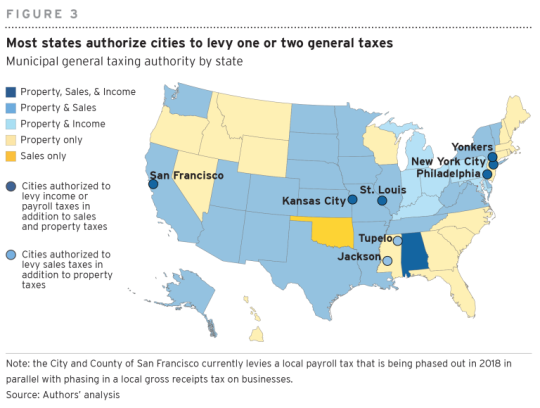
    The below figure shows the taxing authority of US cities by state. In some cases there’s a city or two with additional taxing authority. New York City, for instance, has been authorized by the state to levy property, sales, and income taxes, whereas other cities in the state can only levy property and sales taxes.

    image

    The figure is from a recent report by Brookings called, City budgets in an era of increased uncertainty. In addition to revenue sources, the report also covers spending limits and tax structure alignment. 

    The report concludes that cities generally have a stronger fiscal position when their tax structure aligns with their economy. For example, cities such as Las Vegas that have lower than average property values and are only authorized to collect property taxes, do not score well.

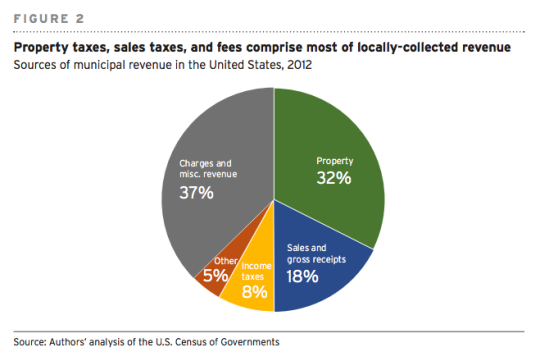
    One thing that the above figure does not get across is that more money now comes in from non-tax revenues, user fees, and other charges. According to 2012 census data, 37% of all municipal revenue in the United States came from these sorts of charges.

    image

    To download a PDF of the full report, click here.

  • Towards a cashless society

    I increasingly never carry cash on me. I just never think to take out money and, when I do, I hate paying for things and getting change back. That change just ends up in a “change jar” in my apartment and then never comes out ever again. I keep telling myself that I need to buy coin rolls but that never seems to happen.

    Lucky for me, it’s pretty clear that many cities and countries are quickly headed towards a cashless society. It’s pretty easy to get by in most cities today without cash. Here in Toronto, I use Uber and my PRESTO card to get around. I can use my phone for many purchases like coffee. And I can use my credit/debit cards for everything else. I never really thought about it until recently, but I have unintentionally gone almost completely cashless.

    But of course it’s not just cash that is going to disappear; it’s also our physical wallets. Just this week Fred Wilson wrote a post on his blog about how he forgot his wallet at home and how Apple Pay came to the rescue at Whole Foods. I can’t wait until more banks roll this out in Canada. It’s also encouraging to see that under “coming soon” on the Apple Pay website, the Toronto Transit Commission is listed. I guess that means it will be integrated with PRESTO.

    However, this transition is not happening in the same way everywhere. There are many countries that still prefer cash. According to CNN (November 2015), only about 10% of people in Indonesia and the Philippines would prefer to pay with a credit card. And it’s for this reason that Uber now accepts cash in a number of countries. It’s what those customers wanted. I find this interesting though, because not having to carry cash is one of the main reasons I use Uber.

    Of course, there’s also the question of what happens to people who are currently not connected in anyway to electronic forms of money. I get asked by people on the street for change at least every day when I walk around Toronto. But there is actually no way for me to transmit the money I have to them. I don’t carry cash and I certainly don’t carry change.

    I would be curious how many of you have gone or are close to going cashless. And if you are operating cashless, did you even notice the transition happening?

  • What tax policy could be doing to home sizes in Ontario

    Golden City (of Toronto) by Evgeny Tchebotarev on 500px.com

    https://500px.com/embed.js

    In yesterday’s post I made a remark that we have antiquated tax policies here in Ontario that encourage the building of smaller new construction condominiums. There seemed to be a lot of interest in that comment, and so I’d like to talk about that today.

    Some people thought I was referring to development charges, but I was actually thinking of the GST/HST New Housing Rebate in Ontario

    The way it typically works in Ontario is that when buy a new construction home, the price you pay is inclusive of HST (harmonized sales tax) and net of any applicable rebates, such as the rebate program mentioned above. 

    This means that the price you see on your agreement is usually the price you pay. I say usually only because there are ways that you could disqualify yourself from the New Housing Rebate program. But that’s a different post.

    So what does this mean in practice?

    Let’s say you went out and bought a new construction condo for $368,200 (there is a reason I’m picking what seems like an arbitrary number). If there was no such thing as the New Housing Rebate program, then the sales tax owing on this home would be the full 13%. And that would mean that the price paid before any taxes is actually $325,841 (x 13% = $368,200). This is an important number because it represents revenue to the developer.

    But since there is a New Housing Rebate program, the effective tax rate actually works out to be 5.20% for this particular sale price, which means that the price paid before any taxes is now $350,000 (a nice whole number). And so because of rebates and because they are now paying less HST, the developer’s revenue number has increased. It has gone from $325,841 to $350,000.

    The way this logistically works is that purchasers usually assign the New Housing Rebate benefits to the developer who then processes all the paperwork. This is what I mean when I say that the “sticker price” is inclusive of HST and net of any rebates – it already factors in the possible deductions.

    So far things are looking good. And I want to be clear that I don’t have concerns with the New Housing Rebate program in its entirety. In fact, it’s a hugely important part of the new home industry. Without it, many projects would simply not be feasible to build.

    However, as the price of the new home increases (which typically happens as the home gets bigger), the rebates start to fall off. The federal portion of the rebate maxes out at a base purchase price of $350,000 (which is why I chose that number) and the Ontario portion maxes out at a base purchase price of $400,000.

    What all this means is that as the unit sizes get bigger and more expensive, the effective tax rate is no longer at 5.20%, as was the case in the example I gave above. It increases. And if you hold prices constant for the purchaser, it means that the developer’s revenues now start to drop.

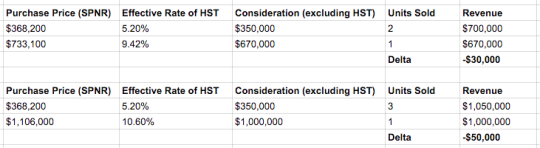
    To illustrate why this matters, consider the following chart:

    image

    In the first scenario, the developer builds and sells 2 units for a price of $368,2000. This translates into revenue of $700,000. However, if the developer instead decides to combine those 2 units and sell the larger single unit for $733,100 (roughly double the price) then the effective rate of HST goes up and revenue drops by $30,000.

    The second scenario is similar to the first one except that instead of 2 units, it’s 3 units which then get combined into one. Here revenue drops even further – by $50,000.

    Now, you could argue that there are some cost savings associated with building fewer suites, but I don’t think it would offset the differentials shown above, especially if you multiply those revenue numbers across an entire project. So what this all means is that it can be more profitable for developers to build smaller units priced below the thresholds mentioned above, as opposed to a smaller number of larger units. 

    Again, I’m not saying that HST rebates are bad. They’re critical to the industry. I love them. But I do believe we should be thinking about the possible implications that the current set up could be having on what we’re building and in particular on unit sizes.

    If you’d like to learn more about how the rebates work, check out this PDF from the Canada Revenue Agency. I tried to keep things simple in this post.

  • The global pyramid of wealth

    Every year the London-based property consultancy Knight Frank publishes something called The Wealth Report. And it’s one of those reports that I could go through for hours. 

    It includes a ton of really fascinating stats that speak volumes about where in the world wealth is being created and how it’s moving around. And of course there are a lot of connections between wealth, real estate, and city building.

    Below are 3 diagrams that really stood out for me in the 2015 version. 

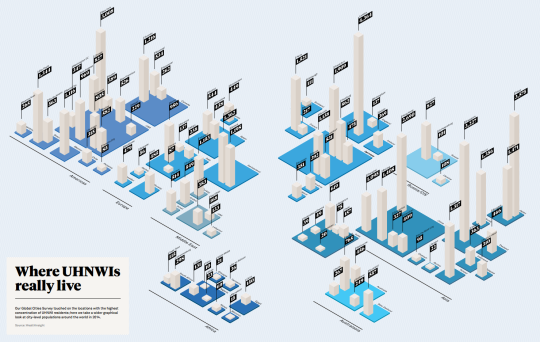
    The first diagram shows which cities have the most Ultra High Net Worth Individuals (UHNWIs). An UHNWI is defined as an individual with assets exceeding US$30 million, but excluding personal assets and property (such as one’s principal residence). Click here to see the full size image (I know the numbers are small).

    image

    Not surprisingly, London (4,364), Tokyo (3,575), Singapore (3,227), New York (3,008), and Hong Kong (2,690) are at the top of the list. But I was a little surprised – albeit happily surprised – to see Toronto (1,216) come in at #2 in North America, beating out Mexico City (1,116), Los Angeles (969), and Chicago (827). 

    The second diagram shows you how many square meters of luxury property (apartment) you can buy for US$1 million in a bunch of different cities around the world. 

    In Monaco (top end), that’ll buy you 17 square meters (183 square feet) and in Cape Town (bottom end), that’ll buy you 208 square meters (2,196 square feet).

    image

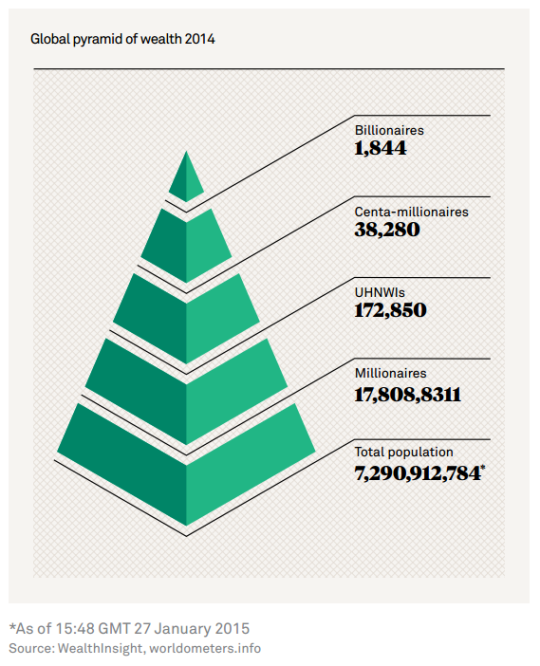
    The third and last diagram is what they call the global pyramid of wealth. It’s a pyramid of everyone in the world and then the number of millionaires, UHNWIs (see above), centa-millionaires, and billionaires. And if you do the math, the top of this pyramid comes nowhere close to 1% of the global population.

    image

    It’s fascinating (and exciting) to see where and how global wealth is concentrating. But it should also make you think about rising income inequality. I know it does for me.

  • An important problem in a market economy, and the one the VC attempts to solve, occurs when an entrepreneur has a good idea, but no money, while investors have money, but no good ideas.

    Steven N. Kaplan & and Josh Lerner. “It Ain’t Broke: The Past, Present, and Future of Venture Capital”