Daily insights for city builders, delivered every morning at 6 AM ET. I’m Brandon Donnelly — a Toronto-based real estate developer and founder of Globizen. I’ve been writing here since 2013.

Tag: millennials

  • A look at net migration by age group in Vancouver

    I’ve written quite a few posts about family formation and, more specifically, about where Millennials will move once they start having kids

    Many seem to believe that – despite the current Millennial love affair with urban centers – much of this cohort is destined to repeat the pattern of the previous generation. Meaning, once the kids come along, they’re headed to the suburbs in search of bigger and more affordable housing.

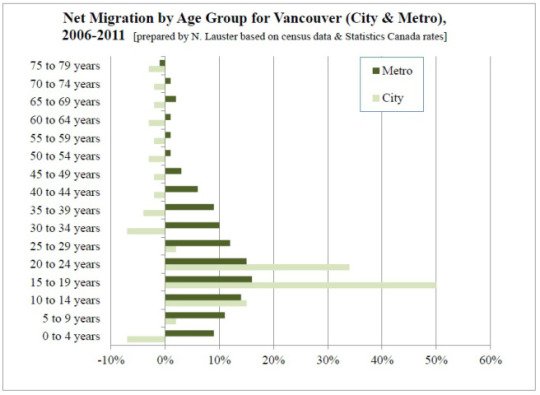
    If you look at the data, there’s a lot to support this prediction. Below is an interesting chart from Nathanael Lauster (Professor in Sociology at the University of British Columbia) that looks at net migration by age group for the City of Vancouver and the metro area.
    image

    What this chart shows is a flood of people in their late teens and early 20s migrating into the city (many of which are likely students), but then a fairly dramatic net loss of people leaving the city as they enter their 30s. The metro area, however, continues to grow – almost certainly because of people looking for more suitable family housing.

    But this data is from 2006-2011. We don’t yet have the 2016 census data. And I suspect that we will start to see an increase in the number of people opting to remain in the city across many different urban centers. 

    There are some very real economic pressures that successful cities today have to contend with. But I believe that the desire to remain in the city is there for a lot of young people.

  • The value of lifestyle in attracting human capital

    When I was in Revelstoke, BC last year I met a number of people who had made the move out there from Toronto. When I asked if they missed living in a big city, pretty much everyone gave me the same answer: “No, I love it here.”

    This past week when I was in Park City, Utah, I similarly met a number of people who had made the move from New York and other large cities. And when I asked them the same question, I heard statements like: “I used to live in New York, but then I got a life and moved out here." 

    In these two examples, the obvious draw is the mountains. But it’s not like everyone just moved and became a ski bum. In fact, Inc Magazine recently published an article talking about Park City’s robust startup scene. People are figuring out how to combine hard work with the lifestyle they want.

    What I find interesting about this is that it runs counter to the trend of young people preferring big cities. Here’s a quote from NPR:

    “But affordable real estate and waterfront views don’t have millennials biting. They continue "a multigenerational pattern of young adults preferring more expensive urban areas over lower-cost rural ones because the lifestyles and opportunities in such places make the extra burden of cost worth it,” says Robert Lang, professor of urban growth and population dynamics at the University of Nevada, Las Vegas.”

    However, some small towns clearly have a unique lifestyle advantage: mountains. And that seems to be a strong enough draw that some people are simply figuring out how to create the economic opportunities for themselves.

    For me, this is yet another reminder that if you’re trying to attract the best human capital to your city or town, you need to think about lifestyle. And since young adults aged 18-34 are far more likely to move around than any other generation, you should also be thinking specifically about what this generation wants.

    Here’s a chart from CityLab that shows how precipitously migration falls off (in the U.S.) once people finish school and get settled in a job:

    image

    Obviously, not every town or small city is blessed with mountains. But there are many lifestyle advantages that can be created. It’s for this reason that I keep talking about nightlife and Toronto’s laughable 2AM last call. Those are lifestyle things and we can do better.

  • Art is the new steel — a photo essay of Hamilton, Ontario

    Today, myself and a few others spent the afternoon urban exploring Hamilton, Ontario with Thomas Allen of the blog, Rebuild Hamilton. If you don’t read his blog, you should. Since he started writing about 3 years ago, he has really emerged as the online voice of Hamilton’s urban resurgence.

    If you’re from Toronto, you’ve probably been hearing rumblings about good things happening west of the city. Rumblings about people leaving overpriced Toronto for greener and more affordable pastures in Hamilton, and even that it was destined to become the Brooklyn of Toronto. That basically means Millennials, trendy coffee shops, and beards. (For the record, Thomas’s beard is very nice.)

    With all this talk of affordable housing and beards, I decided that it was time to make a pilgrimage. Below is a short photo essay of what we saw.

    We started the day east of Hamilton where we found this beauty along the waterfront. I don’t know who designed it, but it’s called the Cube House and it was construction managed by Toms + McNally Design. You’re going to want to click through to their website to see the interior photos. 

    image

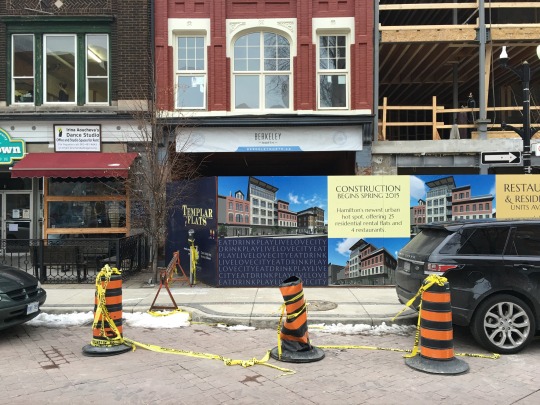
    We then made our way downtown to Jackson Square. Jackson Square is one of two downtown malls (the other is the post-modern City Centre Mall). It has seen a lot of investment in recent years and I was impressed to find a thriving grocery store. 

    image

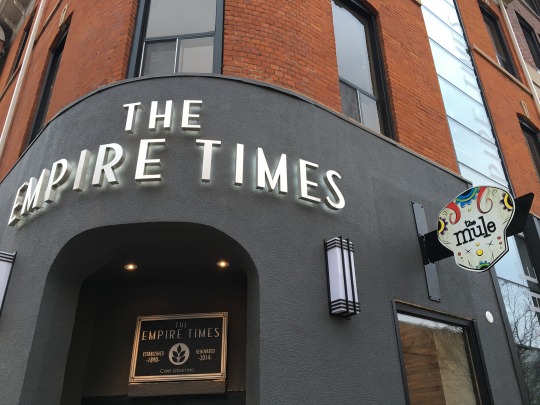
    Then came a taco and craft beer pit stop at The Mule. I would definitely recommend this spot if you happen to find yourself in the area.

    imageimage

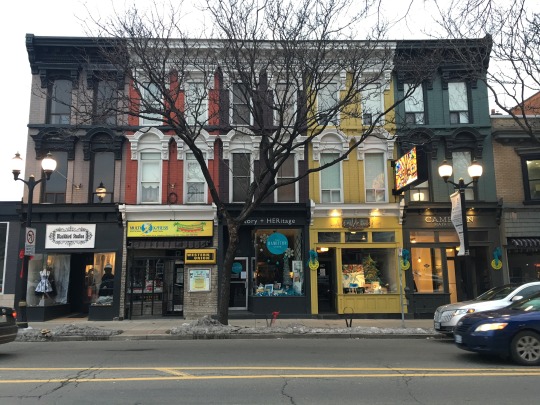
    Following this, we walked James Street North, which we were told has only really come up in the past 5 years or so. And alongside with this resurgence has come the slogan: Art is the new steel. This, of course, is responding to the fact that Hamilton is the steel capital of Canada, but that the industry is facing many challenges. I think it’s a neat slogan.

    imageimage

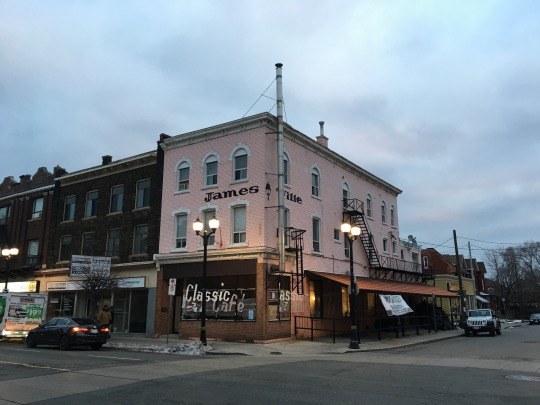
    On James Street we stopped in at Saint James Espresso Bar & Eatery, and it was everything we had hoped for and more. It was more because not only was it a cool space with great coffee, but they had some fancy thing called steam punk coffee.

    imageimage

    After James Street, we then drove around checking out some of the other areas in the city such as Kirkendall and neighboring Dundas.

    All in all, this afternoon was a great reminder that we are truly living in an urban century. It’s not just the Toronto’s, Berlin’s and Shanghai’s of the of the world that are laying down bike lanes, investing in art and culture, and generally reimagining their city centers. It’s also happening in smaller and mid-sized cities such as Hamilton. And that’s really exciting.

  • The Millennial Dream

    This evening I was interviewed for a documentary called The Millennial Dream. It’s all about how Millennials – people like me – are rethinking or even rejecting some of the traditional notions of The American Dream. It’s being produced by Hemmings House.

    My part was all about housing. 

    So a lot of it was about how housing preferences have (or have not) changed for Millennials. If you’re a regular reader of this blog, you’d already be familiar with many of the topics I covered.

    What’s most interesting to me though, is not what Millennials are doing today. We already know that there’s been a return to cities and that many young people prefer walkable and authentic communities. Everyone is talking about it and it’s no longer novel.

    What’s more interesting to me is what Millennials are going to do in the next 10 years when the majority of the cohort is in their 30′s. What percentage will be married? What percentage will have kids? And, where and how will they choose to live in cities?

    Because there are some structural changes happening. Marriage rates in the US have been declining since the 1960s (see New York Times).

    And fertility rates are at their the lowest in US history. So in theory, and unless things change, Millennials should on average demand different types of housing. Fewer of them are likely to marry and they’re having fewer kids.

    But at the same time, I also believe that there have been changes in consumer preference that are not going to completely reverse as Millennials age. So city builders will need to come up with new and creative forms of housing for families who want to stay in urban centers. And that’s an exciting challenge.

    I’d be curious to hear thoughts in the comment section below. The documentary won’t be out until the end of the year, so you still have a chance to influence its direction. More voices are better than one.

  • The big challenge is suburban infill

    Photograph Thorncliffe Park Drive (TORONTO) by Jenver Rosales on 500px

    Thorncliffe Park Drive (TORONTO) by Jenver Rosales on 500px

    Between the 1950s and 1980s, Toronto built a lot of towers. A 2010 report by the Centre for Urban Growth and Renewal identified 1,925 rental apartment towers of 8 storeys or more across the Greater Toronto Area. 

    That’s the second largest inventory of apartment towers in North America – many or most of which are in car-oriented suburban neighborhoods.

    Of course, Toronto continues to build a lot of towers. But this second and current wave of towers is quite different than the last. Virtually all of them are now condo (as opposed to rental) and most are concentrated in central neighborhoods that are generally well-serviced by transit.

    This has created a lot of positives for the city. It brought more people into the core to live, which in turn brought more retailers and employers into the city. It has created what I believe is a more vibrant and exciting 24/7 city.

    But this return to city centers (as well as the economic spikiness it has created) is now well established both in Toronto, as well as in other cities all around the world. Every real estate conference or panel you go to now talks about Millennials and their desire to be in walkable communities. We got it.

    And relatively speaking, those kinds of communities aren’t that difficult to create when you’re infilling city centers. Certainly not at this point. The street grid and bones are usually all in place. And the urban form is often conducive to transit.

    The real challenge – and thus opportunity – for Toronto and lots of other cities is how to urbanize the (inner) suburbs and in particular these “towers in a park”. If you follow this space, you’ll know that there’s a lot more that we could be doing.

    How do we rethink their relationship to the rest of the city? How do we better connect them through transit? How do we plug them in economically? In my opinion, these are far more difficult tasks. But they’re important ones for the long-term success of our cities.

  • Where are Millennials going to move when they start having children?

    Photograph Kembangan by Jason Waltman on 500px

    Kembangan by Jason Waltman on 500px

    Earlier this week I attended RealNet’s Q1 2015 market update webinar for the Greater Toronto Area. If you don’t already subscribe to RealNet, you should consider it. They’re one of the best sources for Canadian real estate market information.

    During their webinars, they occasionally run interactive surveys where they ask the audience a question and participants respond using their web browser. On this particular webinar, they asked the following question, which I thought was interesting:

    What is the likely housing moving by Millennials in raising their families?

    A) Move Up – Embrace urban high-rise housing forms

    B) Move Out – Accept extended commutes (including the Greater Golden Horseshoe and Hamilton Area) to find affordable ground oriented housing

    C) Move In – Cohabitate parental homes

    It’s an interesting question because it’s one that I’ve asked myself a number of times. Sure, Millennials are rushing back to cities and living in high density and walkable communities, today, but what are they going to do and where are they going to move when they start having children?

    As a Millennial myself, I know that I’ve always told myself that I want to stay urban for as long as I can (i.e. Move Up). But I’m only one data point. And given the seemingly endless demand for low-rise housing in Toronto, I always felt like I was in the minority. I figured that the majority of people, at least here in this city, still want a ground-related home when it comes time to raise a family.

    Putting aside economics, I still think that may be the case for a lot of home buyers. But the majority of people on this week’s RealNet webinar (which would be almost exclusively folks from the real estate industry) either think that preference is going to change (or already has) or that consumers won’t have a choice due to affordability.

    50% of the people on the call answered A – move up and embrace urban high-rise housing forms. The balance was about 44% for B and 6% for C.

    That’s not the outcome I expected to see. So today I’d like to re-ask this question to the Architect This City Community. Where do you think Millennials are going to move once they start having children? Please let us know in the comment section below.

  • Dead malls — what’s the future of offline retailing?

    image

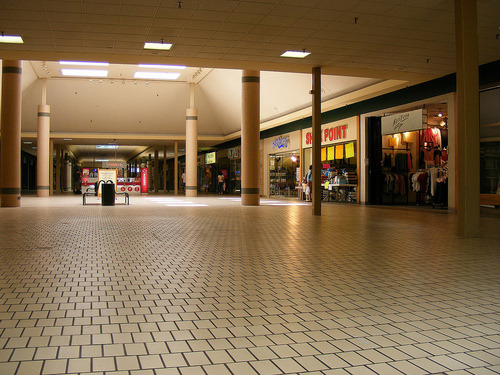
    A lot of shopping malls are dying. You’ve probably heard this before. But how bad is it and what exactly is happening?

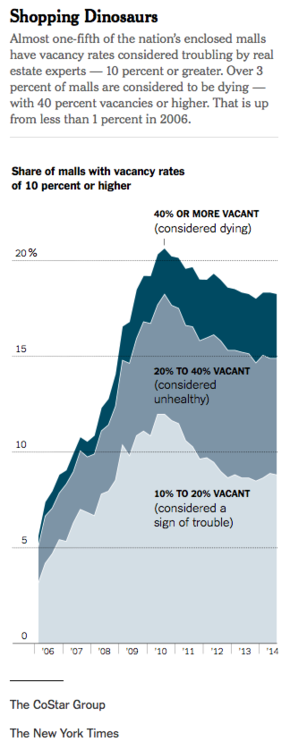
    Well, a new report by CoStar (heard through the New York Times) found that nearly 20% of the 1,200 malls in the US are presently in trouble. “Trouble” is defined as a mall with a vacancy rate of 10% or more.

    But what’s perhaps most disconcerting about this number is that, as recently as 2006, only about 5% of the malls in America would have been pegged as being “in trouble.” Here’s a chart from the New York Times (I’d love to see this same graph with a longer time horizon):

    image

    But not all malls are dying. The general sentiment seems to be that the high-end A malls are and will continue to thrive, and that it’s only the B and C malls that are dying:

    Tom Simmons, who oversees the mid-Atlantic shopping center division of Kimco, another real estate giant, is more blunt. “There are B and C malls in tertiary markets that are dinosaurs and will likely die,” he said, but “A malls are doing well.” (NY Times)

    So why is this happening? Some think it’s because the US is over-retailed. And some think it’s because of rising income inequality – which would explain why the high-end malls continue to thrive. But the experts seem to agree that it’s not the result of more people shopping online:

    One factor many shoppers blame for the decline of malls — online shopping — is having only a small effect, experts say. Less than 10 percent of retail sales take place online, and those sales tend to hit big-box stores harder, rather than the fashion chains and other specialty retailers in enclosed malls. (NY Times)

    I wrote a post 2 months ago where where I argued that big box stores will be the most impacted by online shopping (which is why so many of them now sell groceries). But I don’t believe that they are the only retailers that will be affected. Quite the opposite: Every retailer is or eventually will be impacted by the internet.

    This threat is real.

    Millennials have no hesitations about buying things online and, in many cases, they would prefer to do so. It has already been well documented that we (I’m a Millennial) don’t like driving as much as previous generations. So what makes you think we’d enjoy the process of driving to a mall?

    But the other factor at play, I think, is that malls are no longer the “public space” of young people. Their position as a kind of cultural institution is waning. At the same time, more and more people are craving uniqueness. They like independent shops, not malls that all look and feel the same. And as these young people become old people, we might find that even the A malls start becoming impacted.

    I don’t believe, for a second, that retail nodes within cities will ever disappear. But I think our attention would be better spent figuring out what the mall of the 21st century will be, as opposed to hiring PR firms to try and spin doctor our way out of this dead mall phenomenon.

    Image: Flickr

  • Vancouver boomers are sitting on $163 billion of mortage-free property

    Continuing with our discussion of Vancouver, I was reading today that baby boomers in the metro area (those aged 55 and older) are estimated to be holding over $163 billion of clear title property. That is, homes without any mortgage. This figure comes from Rennie Marketing Systems out of Vancouver.

    What’s interesting about this number is that it signals both a lot of equity that could be used for downsizing, rightsizing and lateral moves into a condo, and a source of capital for millennials to buy their first home. In fact, according to a survey that Rennie Marketing also conducted, somewhere around 40% of first time buyers in Vancouver are getting deposit help from their parents and/or grandparents.

    But the question that comes to my mind is: Are there going to be enough middle aged people willing and able to buy $163 billion worth of real estate? Because one person’s sale is another person’s buy.

  • The suburbs, they are a changing

    Earlier today, a good friend of mine shared this New York Times article on my Facebook wall. It talks about how some suburbs are taking action to try and curb the exodus of young people to cities. They’re doing things like making themselves more walkable and building bike lanes. I thought it was an interesting article.

    Of course, it’s not just young people moving from the suburbs to the city. It’s also a case of young people living in the city and never leaving for the suburbs–which they have traditionally done. 

    I’ve talked about this topic a lot here on ATC, but I wanted to share this article because I think it’s one thing to talk about how city centers are on the rise and it’s another thing to talk about how suburbs are starting to take notice and take action to curb their (potential) decline.

    I say potential because some would argue that the suburbs aren’t necessarily on the decline–we just have a scenario where young people are delaying that period of their life, either for economic reasons or for personal/lifestyle reasons.

    I, however, would disagree. I think the growing preference for cities is a real societal shift. That doesn’t mean I think the suburbs are going to die though. There will likely always be a segment of the market that prefers that housing type (or some variation of). I just think the suburbs aren’t going to be what they once were to previous generations.

  • Core counties > outlying counties

    Recent US Census Bureau data has once again confirmed that there’s a growing preference for living in urban cores. More specifically:

    It finds that population growth has been shifting to the core counties of the USA’s 381 metro areas, especially since the economic recovery began gaining steam in 2010. Basically, the USA’s urban core is getting denser, while far-flung suburbs watch their growth dwindle.

    To put numbers to these statements, core counties in the US grew approximately 2.7% and outlying counties grew approximately 1.9% from 2010-2013. Most of the growth came from net migration, as opposed to higher birth rates.

    The two big factors at play–which will be obvious to readers of this blog–appear to be both a desire to live in amenity rich and walkable communities and a continuing trend towards marrying and having kids later in life, which can often be the trigger for moving to the suburbs.

    But the big question is whether or not this trend is here to stay or if it’s an ephemeral fad caused by a bunch of over-educated and under-employed Millennials refusing to grow up. I would argue that it’s not a fad.

    If there’s a clear consumer preference for urban neighborhoods, then I don’t think people are just going to pick up and leave overnight. As long as there’s adequate housing within the means of growing families, I think they’re going to stay in or go to the areas in which they truly want to live.

    There are also many other macroeconomic trends reinforcing this shift. Just yesterday, Richard Florida wrote an article in Atlantic Cities talking about how venture capital investment is shifting away from the suburbs, towards city centers and walkable communities. These companies (receiving investment) are the next generation of employers and they’re starting in core areas.

    I’ll take that as a leading indicator.