Daily insights for city builders, delivered every morning at 6 AM ET. I’m Brandon Donnelly — a Toronto-based real estate developer and founder of Globizen. I’ve been writing here since 2013.

Tag: millennials

  • Self-expression and community move online

    The New Consumer, in collaboration with Coefficient Capital, just published its latest Consumer Trends report, which you can download for free over here (registration required). There’s a lot in the report to flip through, but I thought I would share these two slides:

    Generation Z and Millennials now make up ~40% of the US population and they are soon entering their prime consumer spending years. What’s noteworthy about these charts, but perhaps not surprising, is the extent in which self-expression and a sense of community have shifted from offline to online.

    Very few Boomers, at least according to this report, feel like themselves online. But nearly half of Gen Z feel most like themselves online. What it means to be part of a “community” has also shifted dramatically, with more if it happening online or at least partially online.

    All of this ties into what happened earlier in the week with Nike announcing the acquisition of RTFKT Studios. As I mentioned in this post, the so-called metaverse doesn’t necessarily have to mean VR goggles and living in video games. It can simply mean placing value on the parts of our lives that are now digital. The above two charts suggest that many are already doing this.

    Of course, what all of this means for our physical lives is an important question. Josh Stephens recently argued, over at Planetizen, that the metaverse is going to be really bad for cities. The more we focus on seductive virtual worlds, the less we will focus on our physical spaces. I get this logic.

    But again, I think it depends on how you define the metaverse. And I think VR headsets are a pretty narrow definition. I am both a lover of technology and a lover of cities. And throughout this pandemic I have been fairly consistent in writing about the resiliency of cities. Nothing in this post changes that for me.

  • Our intergenerational wealth gaps

    This is a chart by economist Gray Kimbrough from 2019. I recently saw it resurface and so I thought I would reshare it here on the blog.

    The y-axis is the percentage of US household wealth (by demographic cohort). And the x-axis is median cohort age. So one way to look at this chart is as follows.

    When the median age of a Baby Boomer was 35 (which happened in 1990), they owned about 21% of US household wealth.

    When the median age of a Gen Xer was 35 (which happened in 2008), they owned about 9% of US household wealth.

    Millennials haven’t yet hit a median age of 35, but in 2019 they owned about 3.2% of US household wealth.

    Of course, one thing to keep in mind is that these demographic cohorts are not the same size. In 1990, Boomers represented 31% of the US population. And in 2008, Gen Xers were only 22% of the population.

    But even if you normalize, there are some intergenerational wealth gaps here.

  • The pull toward “close-in” neighborhoods

    City Observatory has a new report out called, Youth Movement: Accelerating America’s Urban Renaissance. In it, they look at and track the number of 25 to 34-year-olds with a 4-year college degree living in “close-in neighborhoods” within the 51 largest metro areas in the United States. The first thing I asked myself when I read this was, “what’s a close-in neighborhood?” They define it as being a three mile radius centered on the CBD of each metro area. They opted for a distance-based measurement because municipal boundaries usually vary a lot and can therefore be misleading.

    So what did they discover? From 2010 to 2016, the number of young and well-educated people in central neighborhoods increased by about 32% or 1.2 million. And it happened in every single large US metro area. In 80% of these cities, the growth rate also increased compared to the period of 2000 to 2010. Overall, City Observatory believes that this demographic cohort is now about 2.5x more likely to live in a close-in neighborhood compared to other Americans. And I don’t believe that this pandemic is going to change that.

    One of the things that’s interesting about this study is that it takes you below some of the top line numbers that you might hear. For example, the above chart starts by showing you the total population living “close-in” within the top 51 metro areas — again, people living within 3 miles of a CBD. From 2000 to 2010, this population figure was more or less flat at about 9.4 million people. But the number of adults and young adults with a 4-year degree increased pretty significantly, driving up the college attainment rate. So even though the total population may not have changed, the demographic composition did.

    For a copy of the full report, click here.

  • Who is going to buy the homes vacated by Baby Boomers?

    The Wall Street Journal estimates that, from now until about 2037, roughly 21 million homes in the United States will be vacated by seniors. To put this number into perspective, it’s about 25% of the US for-sale housing stock and more than double the amount of new homes that were sold during the 1998 to 2008 housing boom. That number was about 10 million (see below).

    This is part of the normal cycle of housing, but in this particular instance, there’s concern that the new generation won’t be there to backfill these homes, or least not in the same way. For one, there are more boomers than there are Gen Xers. So right away there’s a potential gap. But on top of this, the next in line don’t appear to necessarily have the same preferences in housing type and location.

    As someone who would fall into the 65.9 million birth bucket highlighted in deep mustard (had I been born in the US), I can tell you that I am far less interested in many of the housing products (real estate speak) / typologies (architect speak) popularized by the generation ahead of me. Whether my opinion is representative is, of course, debatable.

    Anecdotally, I can also say that I know many boomers who have started making real estate decisions based on the assumption that demand for certain types of housing will be tepid going forward. This is not to say that some of these communities won’t be able to reposition themselves if it comes to that. But there is uncertainty.

    Images: WSJ

  • Public perception of drone delivery

    Back in 2016, the United States Postal Service published a report on the public perception of drone delivery in the US. This was nearly 3 years after Jeff Bezos announced on 60 Minutes that Amazon was working on a drone delivery service and that it would arrive within the next 5 years (so by 2019). I think USPS was trying to figure out how to be, or appear, more innovative.

    Not surprisingly, the report found that Millennials were significantly more supportive of drone delivery (65%) compared to Baby Boomers (24%), who strongly dislike the idea. Generally, the report indicates that the percentage of people who think it’s a good idea declines with every preceding or older generation. Again, I don’t find this at all surprising.

    But what I did find interesting was that, irrespective of age, respondents were primarily concerned with some sort of “malfunction.” This was at the top of the list. Next in line were concerns around “intentional misuse,” such as drones being used to transport illicit goods or to spy on people and/or property.

    Closer to the bottom of the list was a concern that drone delivery “might make the sky less pleasant to look at.” My own view is that visual clutter and noise pollution are critical problems to address here. There’s talk of “drone highways in the sky”, but how do you really manage the sheer volume of drones that would be needed to service a dense urban environment?

    Photo by Goh Rhy Yan on Unsplash

  • US cities with the highest millennial homeownership rates

    Across the 50 largest metro areas in the US, about 31.9% of millennials — those aged 18 to 34 — owned a home as of 2017. And according to recent census data (via the Redfin), only 5 of these cities had a millennial homeownership rate higher than 35%. They are as follows:

    The top spot goes to Salt Lake City, which sits at just over 40%. It also has the highest share of businesses owned by millennials at 8.4%. Not surprisingly, the cities on this list all have relatively affordable home prices, with Detroit being the most affordable.

    I think you could interpret this list as a bit of a leading indicator for US cities on the rise. Affordability, and walkability, may be the draws today, but as millennials lay down roots, start businesses and earn more money, I am sure we’ll see these cities transform even further.

  • Young people are driving a lot less

    As a kid growing up in the suburbs, I got my driver’s license the day I turned 16. Being able to drive was a big deal. But we know that this desire to drive has been changing in profound ways. Here’s some recent stats on the percentage of licensed drivers in the US by age (taken from the WSJ):

    In 1983, about 46% of 16-year-olds had a driver’s license. By 2014, this number had dropped to 24.5%, which is the lowest it has been in recent years, and was probably impacted by the broader economy. As of 2017, this number was up to about 26%.

    If you’re a car company, I would imagine that these are pretty important numbers. They represent the top of the sales funnel. Most people probably like to have a driver’s license in hand before they go out and buy a car.

    Supposedly, some people in Detroit are betting that young people will still eventually buy a car. And when they do, it’ll be a nice big one like an SUV or a truck. But, the data suggests that it is not just young people who are eschewing driving.

    Here’s some data from the University of Michigan Transportation Research Institute (via NPR), looking at the proportion of licensed drivers in the US by all age categories:

    While the biggest drop has certainly happened among younger generations, licensing is still down for older cohorts. Based on these numbers, we don’t hit parity until somewhere around 50 to 54 years old.

    And the only cohorts where licensing has increased significantly are when people reach over 55. Over 70 is up by a huge margin — more than the drop among 16 year olds — which is probably a symptom of people living longer.

    Some of this decrease among young people can probably be attributed to delayed family formation and people living in denser urban environments, where it is more convenient to get around without a car. But I don’t think that’s all of it.

    Which suggests to me that the race to autonomy is a pretty important one to win.

  • From country club to urban basecamp

    CityLab recently published an article talking about the difficult time that golf-centric country clubs are having in attracting young people (and minorities and women). Their reasoning is that Millennials are saddled with student debt and can’t afford the fees; Millennials find these sorts of clubs stuffy and overly formal; and Millennials are put off by the long history of these places being only for rich white males.

    The result is that golf and country club memberships are down about 20% since 1990. In the 90s there were more than 5,000 full service clubs of this type in the US. And today it’s somewhere south of 4,000. In the 90s, about 9 million people aged 18 to 34 played golf (again in the US). And today that number is somewhere around 6.2 million. All stats taken from the article.

    But at the same time, the article argues that Millennials may still like country clubs, they’re just about 10 years behind because of higher education, travel, and delayed family formation. The article also talks about the rise of private clubs like Soho House, as well as others. And so here’s one counter argument: Millennials are open to private clubs and many have the means. They just want them to be, well, cooler and more urban.

    As a young person who largely fits within the trend line described in the CityLab article, my gut tells me that this is largely a case of changing consumer preferences and urbanizing wealth. That’s why we’re seeing established country club operators open up “urban basecamps.” But that’s my view. What is yours? Let us know in the comments below.

    Photo by Andrew Rice on Unsplash

  • Where the young and educated are moving to in the US

    City Observatory tracks something that they call “The Young and Restless.” It refers to the segment of the US population that is between 25-34 years old and has a bachelor’s degree or higher.

    We know that people in this age bracket tend to be relatively mobile and that the likelihood of moving decreases as people age. So it’s a potential leading indicator for the city regions of the future. It also adds a bit more nuance to the urban vs. suburban growth debate. 

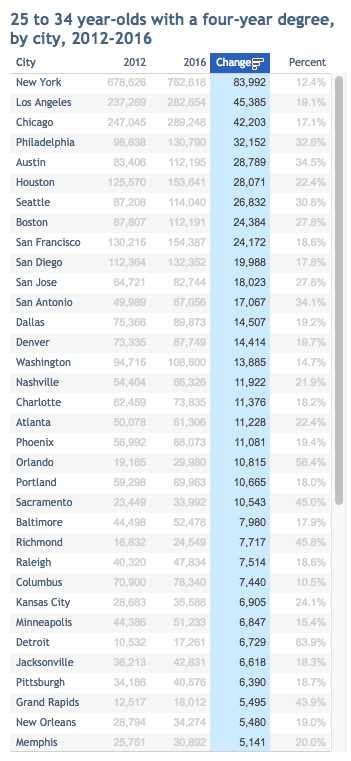
    According to City Observatory, between 2012 and 2016 the number of 25 to 34 year olds with a 4-year degree living in one of the 53 largest largest cities in the US increased by 19%. This is compared to a 4% increase in the overall population in these cities.

    This increase in young well-educated adults is also happening 50% faster in the largest cities. So the young and educated still seem to be demanding city living, even if the world is arguably still suburbanizing.

    Below is a snapshot of City Observatory’s latest data. I’ve sorted the list by total change in population (2012 to 2016). Happy to see Philadelphia near the top. If you do it based on percentage, Detroit wins with a 64% increase.

    For the full list of cities, check out City Observatory.

  • How sexy is your city?

    I recently penned an article for Building Magazine called How Sexy Is Your City? The subtitle is: The next generation of talent will require cities to take a next generation approach to city building.

    I know that we’re all hitting our limit in terms of people talking about millennials, so I’d like to reassure you that – excluding the actual article tag – the word “millennial” only shows up twice in the piece. 

    I also don’t write long-form articles very often. I’ve had people suggest that I do that periodically on this blog, but I find the time commitment to be exponentially greater than for the short, glib pieces I usually write here. 😉

    So if you can bear two more instances of the word “millennial” and you’ve been looking for something longer, you are in luck. Also, if you’d like to subscribe to Building, you can do that here.

    Image: Doublespace Photography via Building