Daily insights for city builders, delivered every morning at 6 AM ET. I’m Brandon Donnelly — a Toronto-based real estate developer and founder of Globizen. I’ve been writing here since 2013.

Tag: migration

  • Population growth across North American cities

    The Centre for Urban Research and Land Development at Ryerson University recently published the following chart on their blog:
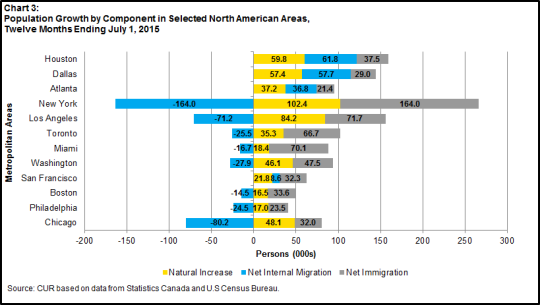
    It’s a look at population growth across a few North American cities, broken down according to natural increases, net internal migration from other parts of the respective country, and net immigration from outside of the respective country.

    When you sum up the pluses and minuses shown above, you get to population growth numbers that look like this:
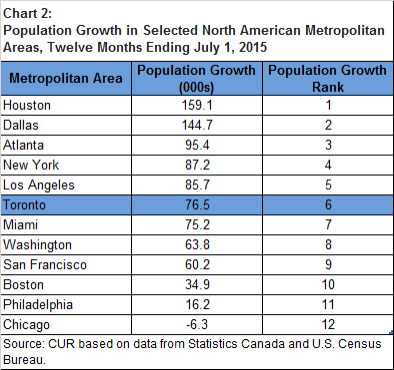
    Houston, Dallas, and Atlanta are monsters in terms of population growth. They’re obviously smaller than New York and Los Angeles, and so on a percentage basis they are really adding a lot of people. Much of this has to do with the ease in which housing can be added in those cities and their relative affordability.

    Toronto is competitive with New York and Los Angeles in terms of an absolute number, but again our base is smaller so on a percentage basis we are growing faster. The big story with Toronto is our dependence on immigration to grow.

    The one city on this list that might surprise some of you is Chicago. Toronto and Chicago share many similarities and are often compared. But when you look at how the Chicago metropolitan area is shedding people, you see that, at least in this regard, it’s in structural decline.
  • Not zoned for dancing

    Yesterday, when I was reading up on Toronto’s “TOcore” initiative, I came across a report from 2014 called Not Zoned For Dancing: A Comprehensive Review of Entertainment in Downtown Toronto

    It was prepared by five graduate planning students at the University of Toronto: Anna Wynveen, Brenton Nader, Carolyn Rowan, Chris Hilbrecht, and Kyle Miller. 

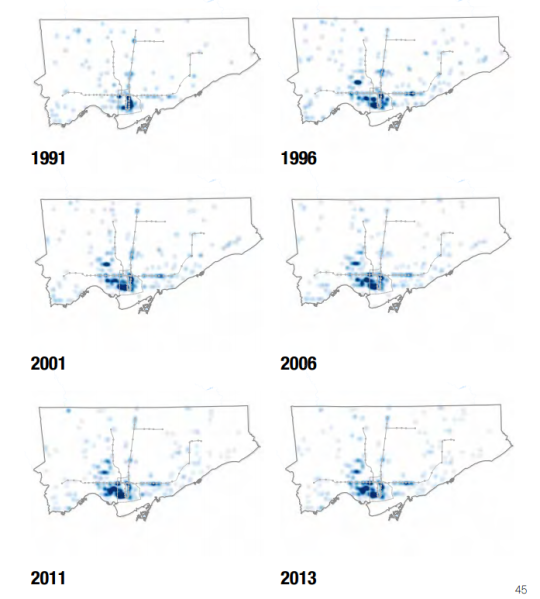
    The entire report is fascinating, but here’s one diagram that stood out to me:

    image

    It shows the migration of bars, clubs, and lounges westward, away from the downtown core, from 1991-2013.

    This migration doesn’t surprise me at all. I saw it happening and I understand the market forces at play here. There’s also the simple fact that nightlife is often viewed as a nuisance.

    But it’s worth calling this out. 

    Because I don’t think enough city builders appreciate the value of nightlife. It can and has served as a valuable catalyst for urban regeneration and I believe that it should form part of any city’s economic development strategy.

    A lot of cities are focused on things like bike lanes, public spaces, and on becoming the next Silicon Valley. And don’t get me wrong, those are all important things (though we could debate the Silicon Valley part). 

    But let’s not forget about nightlife.

  • Young, rich, childless, and white

    Whenever I’m not sure what to write about, I just read. That’s one of the big benefits of daily blogging – it forces me to do that.

    This morning I stumbled upon the blog of Jed Kolko. Jed is an economist and, up until 2015, he was Chief Economist and VP of Analytics at Trulia.

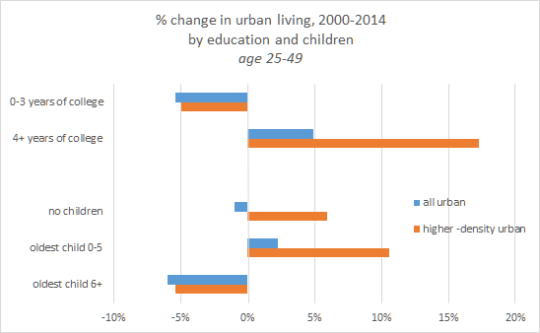
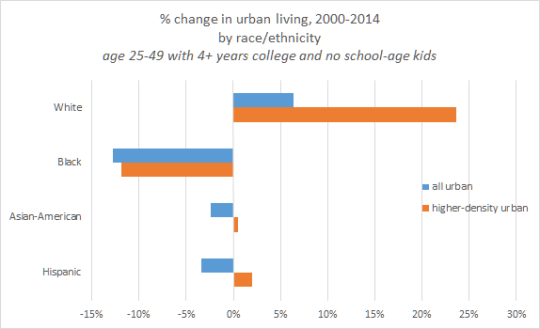
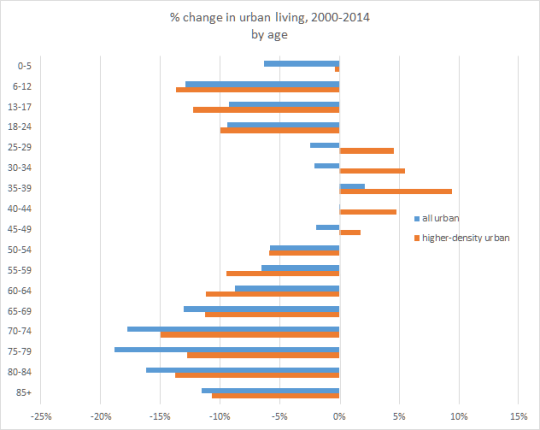
    His most recent post argues – naturally with lots of data and charts – that for all of our talk of (re)urbanization, it’s actually a specific subset of the population that is far more likely to be have urbanized between 2000 and 2014: the young, rich, childless, and white. (Note: His post is talking specifically about U.S. cities.) 

    Below are a few of his charts. 

    In all cases, the x-axis represents % change in urban living between 2000 and 2014. All of the data is from Public Use Microdata Samples (PUMS) – 2000 decennial Census and from the 2014 one-year American Community Survey (ACS).

    Here is age:

    image

    Household income:

    image

    Education and children:

    image

    And here is race/ethnicity:

    image

  • A look at net migration by age group in Vancouver

    I’ve written quite a few posts about family formation and, more specifically, about where Millennials will move once they start having kids

    Many seem to believe that – despite the current Millennial love affair with urban centers – much of this cohort is destined to repeat the pattern of the previous generation. Meaning, once the kids come along, they’re headed to the suburbs in search of bigger and more affordable housing.

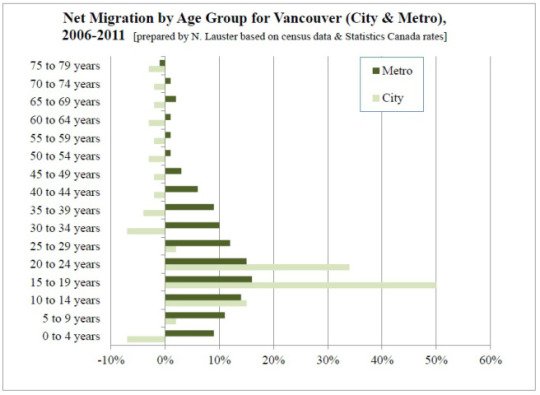
    If you look at the data, there’s a lot to support this prediction. Below is an interesting chart from Nathanael Lauster (Professor in Sociology at the University of British Columbia) that looks at net migration by age group for the City of Vancouver and the metro area.

    image

    What this chart shows is a flood of people in their late teens and early 20s migrating into the city (many of which are likely students), but then a fairly dramatic net loss of people leaving the city as they enter their 30s. The metro area, however, continues to grow – almost certainly because of people looking for more suitable family housing.

    But this data is from 2006-2011. We don’t yet have the 2016 census data. And I suspect that we will start to see an increase in the number of people opting to remain in the city across many different urban centers. 

    There are some very real economic pressures that successful cities today have to contend with. But I believe that the desire to remain in the city is there for a lot of young people.