
Daily insights for city builders, delivered every morning at 6 AM ET. I’m Brandon Donnelly — a Toronto-based real estate developer and founder of Globizen. I’ve been writing here since 2013.

Tag: miami

  • CloudKitchens has spent more than $130 million on property over the last two years

    According to a recent Wall Street Journal review of property and corporate records, Travis Kalanick’s ghost kitchen startup, called CloudKitchens, has spent over $130 million over the past two years buying more than 40 properties in about two dozen cities.

    Travis is co-founder and the former CEO of Uber and this latest startup provides commercial kitchens to restauranteurs who are looking for a low-cost way to launch delivery-only food concepts.

    In some ways, it can be compared to coworking spaces for delivery-only restaurants. Instead of renting a full restaurant space, you lease 200-300 square feet of real estate at a lower cost address. CloudKitchens then handles all of the distribution and fulfillment, effectively lowering the barriers to entry for food startups.

    Some of the properties that they have been buying include a vacant restaurant space in Miami Beach for $9.2 million (May 2020) and an industrial property in Queens, New York for $6.6 million (March 2020). They’ve also bought in cities like Portland and Las Vegas.

    As you might imagine, now is a pretty good time to be buying some of these properties. And if you think about it, there are some real cost advantages to what they are doing, not to mention some co-working-style arbitrage on the real estate.

    The company is apparently going to great lengths to conceal what and where they are buying. But what is perhaps more interesting is their asset-heavy approach. They’re buying lots of real estate, which is inline with what companies like Opendoor are doing, but is distinct from Uber’s asset-light approach.

    It is also different from what many other ghost kitchen startups are doing. It seems that most are leasing their spaces. There has to be a reason for this difference.
  • Super-prime property transactions in the first half of 2020

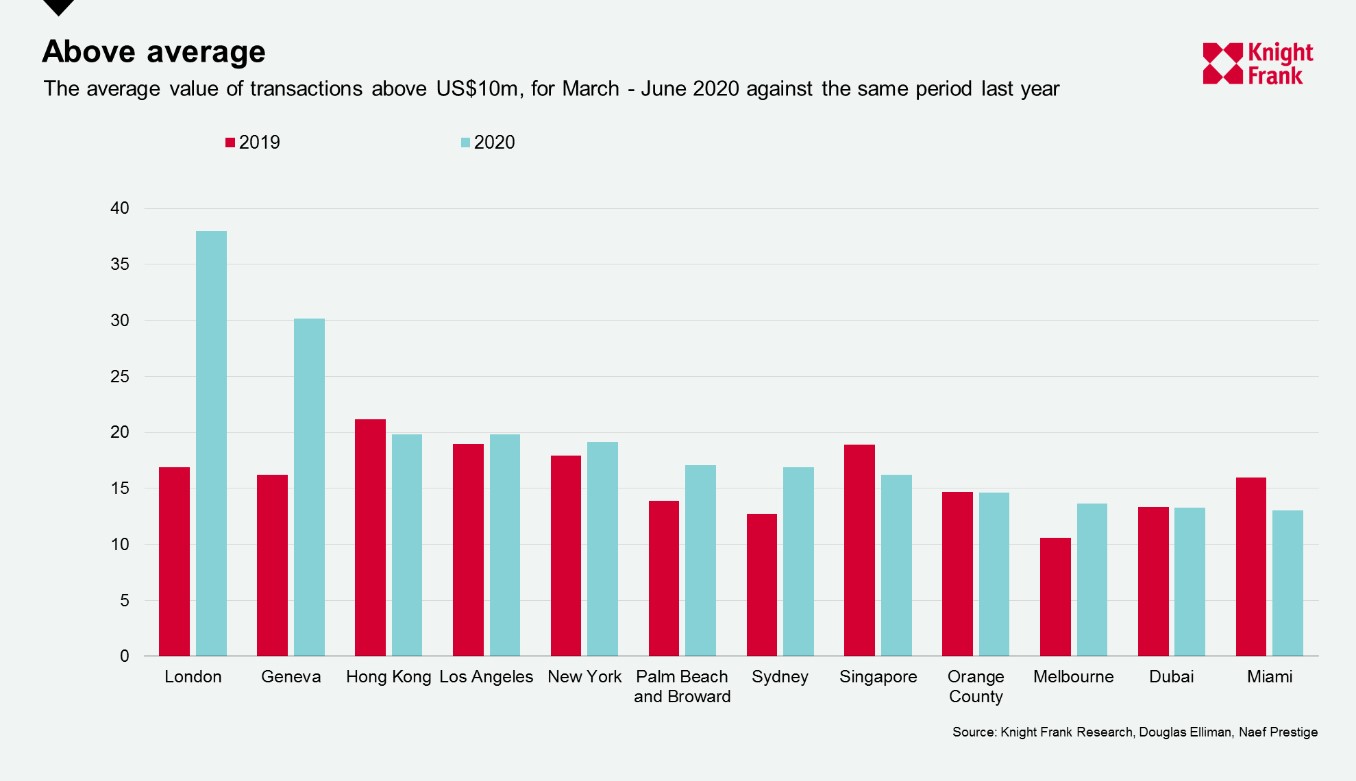
    This is a chart from Knight Frank showing the average value of “super-prime” residential real estate transactions in 12 global markets between March and June 2020, and versus the same period last year.

    Knight Frank classifies super-prime real estate as having a value greater than US$10 million and ultra-prime real estate as having a value greater than US$25 million.

    In this particular chart, London takes the top spot with an average super-prime transaction value of US$38 million. This is a big jump compared to 2019 where the average value was US$16.9 million.

    Typically it is Hong Kong that takes the top spot in this ranking, but this year it fell to third. Still, Hong Kong had the highest number of transactions with 60 super-prime sales taking place in the first half of 2020. This is down from 155 in the first half of 2019.

    Overall, Knight Frank recorded 281 super-prime transactions across these 12 cities in the first half of this year. This is, not surprisingly, a decline compared to last year, which saw 594 transactions over this same time period.

    But all things being considered and given some of these price increases, the super-prime market is certainly holding its own.

    Chart: Knight Frank

  • New York City isn’t dead

    I was speaking to some friends in New York City over the weekend and they said to me, “you know what Brandon, we don’t really go out at night anymore. It doesn’t feel safe. There are homeless people everywhere and they’ve started to get very aggressive, particularly against Asians.”

    They live in a good neighborhood in Manhattan.

    I was somewhat surprised to hear this, but at the same time, I don’t think for one minute think that New York City is dead. But some do, including James Altucher. James moved to Florida because of the pandemic and recently penned an article in the NY Post called, “New York City is dead forever.”

    That didn’t sit well with Jerry Seinfeld and so this morning he published a rebuttal op-ed piece in the New York Times. It has been making the rounds online today with people responding from both sides of the fence. Richard Florida responded with this tweet thread.

    If you’re a regular reader of this blog, you’ll know where I sit on this topic. I love technology, but sitting at home all day going from Zoom meeting to Zoom meeting is not the kind of life I aspire to live. I agree with Jerry. There’s no energy. In fact, it sucks the energy right out of me.

    With that, I’ll leave you with some more words from Jerry Seinfeld:

    There’s some other stupid thing in the article about “bandwidth” and how New York is over because everybody will “remote everything.” Guess what: Everyone hates to do this. Everyone. Hates.

    You know why? There’s no energy.

    Energy, attitude and personality cannot be “remoted” through even the best fiber optic lines. That’s the whole reason many of us moved to New York in the first place.

    You ever wonder why Silicon Valley even exists? I have always wondered, why do these people all live and work in that location? They have all this insane technology; why don’t they all just spread out wherever they want to be and connect with their devices? Because it doesn’t work, that’s why.

    Real, live, inspiring human energy exists when we coagulate together in crazy places like New York City. Feeling sorry for yourself because you can’t go to the theater for a while is not the essential element of character that made New York the brilliant diamond of activity it will one day be again.

    Photo by Florian Wehde on Unsplash

  • Was NYC’s urban density really the problem?

    I posted this chart on Twitter last night. It’s from the WSJ showing new weekly confirmed COVID-19 cases in Florida, New York, and the U.S. as a whole. Now, the first thing I will say is that I relinquished my hopes of becoming an amateur epidemiologist back in April. I have no idea how this is all going to play out. But as an urbanist, it is interesting to note that back in April, many believed that New York City’s urban density was a real problem and the almost singular cause of its high number of cases (despite many other big and dense cities around the world doing much better). There was also a belief (or hope) that warmer temperatures might have a positive impact on transmission rates. That’s maybe why Florida was doing relatively better. But things have flipped. Cases in Florida are up and California just surpassed NY for the US state with the most number of cases. So who knows what will happen next. But what I do know is that wearing a mask isn’t a big deal (I have mine with me all the time) and that big urban centers will be just fine. City Observatory recently published apartment search data suggesting that dense cities have actually been getting more, rather than less, attention in the wake of COVID. That doesn’t surprise me.

  • What drives attachment to cities

    The Knight Foundation recently published a report looking at what attaches people to the place in which they live. To get this information, they surveyed over 11,000 Americans, some of which live in urbanized areas and some of which just live in metro areas across the United States. This is interesting information to know at any time point in time, but you could argue that it’s even more important at a time like this, where everyone seems to be questioning everything about cities.

    Here are two of their key findings:

    • People who spend more time in the principal or main city of a metro area — whether as residents or as frequent visitors — tend to be more attached. This is is true both in terms of how they feel, but also in terms of how they act, such as how much they give back to the community. I suppose you could debate whether going to the city creates attachment or whether attached people tend to go to the city, but this association does seem somewhat intuitive to me. I am imagining a greater sense of place in principal cities.
    • People who choose to live in a place because of its quality of life tend to express more attachment than people who live in a place for other reasons — such as for work. About 40% of Miami transplants cited the climate as the primary factor for moving. Sounds right. Weather is pretty hard to control, but there are lots of other things that cities can do to improve quality of life. And it seems to be one of the stickier factors. Similarly, access to cultural activities and recreational amenities seem to lead to greater attachment.

    More specifically, here are how some people feel about their metro areas:

    This chart is showing the “perceived accessibility to quality features.” The left column is what they believe to be the national average. And the other columns are for Akron, Charlotte, Detroit, Macon, Miami, Philadelphia, San Jose, and St. Paul. Looking at one row in particular — affordable housing — we see that about 50% of Americans surveyed believe they have access to it. In comparison, only 29% and 12% of residents in Miami and San Jose, respectively, feel the same way.

    For a full copy of the report, click here.

    Chart: Knight Foundation

  • Mapping spring breakers

    The following video was published last week showing the “secondary locations of anonymized mobile devices that were active at a single Ft. Lauderdale beach during spring break.” Said differently, the company used anonymized mobile phone data to see where spring breakers went after they left the beach. This was in order to better understand how they may have contributed to the spread of COVID-19. If you can’t see the video below, click here.

    The video is astonishing for two reasons. One, it shows you the extreme reach of just one beach in South Florida. Imagine if they had analyzed all of the beaches up and down the coast. And two, a lot of you are probably freaked out that this sort of mobile phone data is available to private companies. If you’d like to learn more about how this all works, check out this opinion piece from the New York Times.

  • Safety and security per capita

    This is a city metric I haven’t seen before. City Observatory recently looked at the number of police officers (public) and security guards (private) per capita across American cities. They also ask a bunch of interesting questions. Why do some cities have far fewer police officers? Is high security an indicator for “anti-social capital?” (Social norms aren’t encouraging people to behave.) And do some cities simply have more cops because it is perceived to be necessary?

    Here is what they found:

    The average is about 3.3 police officers per 1,000. And in each case, city is defined as the metro area. The study relies on census data and, if we’re being precise, the data represents where people live as opposed to where they work. So some cities could be reporting a lower number simply because police officers tend to live outside of the metro area — perhaps because of housing costs. Either way, it’s interesting to consider why some cities spend a lot more on security than others and why Miami has so many security guards.

    Chart: City Observatory

  • City stereotypes

    The New Yorker recently published a “daily shout” on Instagram called, How You Know You’ve Made It, by City. It is essentially a series on city stereotypes, and it’s pretty funny. Sorry Cleveland. If you can’t see the embed below, click here.

  • One Thousand Museum, Miami

    Candace Taylor published an article today in the WSJ about the late Zaha Hadid’s One Thousand Museum tower in downtown Miami. The title: “Zaha Hadid’s Miami Tower Is an Architectural Feat. Is It Designed to Sell?”

    It’s an interesting case study, particularly for those of us in the industry. With only 84 units across 62 storeys, it is certainly “ultraluxury.” There’s also a helipad on the roof. Here is an excerpt from the article to give you a sense of the unit sizes:

    Louis Birdman, one of the project’s developers, said prices, which range from just under $5 million to $25 million, are negotiable. Each floor has only one or two units, ranging in size from about 4,600 square feet to 10,400 square feet and each has at least four bedrooms. “Given what’s going on in the market now, I think all of us developers are competing for a similar buyer, so there’s obviously flexibility on price,” he said.

    As you can probably glean from the above, the ultraluxury market has softened in Miami. But Candace is right: One Thousand Museum is an architectural masterpiece. If you’re in the market for a new four bedroom home in downtown Miami, now may be right time.

  • Making cities resilient to climate change

    This past fall, Goldman Sachs published an important report about “making cities resilient to climate change.” In it, they remind us that the scientific consensus is that the world has already warmed from the pre-industrial era (and will likely continue to do so) and that a great many of us live near water (and will likely be impacted going forward).

    About 40% of the world’s population lives within 100 kilometers of a coast, and about 10% of the world’s population lives in a coastal settlement that is less than 10m above sea level. Above is a list of some of those cities, along with their average elevation in meters. The cities with single digit elevations include Bangkok, Miami, Alexandria, and Amsterdam.

    Goldman’s prediction is that this need for “urban adaption” could lead to one of the largest infrastructure build-outs in history. And that cities all around the world should already be thinking about how they will finance and equitably execute on greater resilience (assuming they aren’t already).

    Click here to download a full copy of the report. The diagrams showing the average change in global mean surface temperatures against the pre-industrial period are something you should all look at it. The 2015-2019 change is pictured above.

    Charts: Goldman Sachs