Daily insights for city builders, delivered every morning at 6 AM ET. I’m Brandon Donnelly — a Toronto-based real estate developer and founder of Globizen. I’ve been writing here since 2013.
It’s raining here in Miami Beach this morning. But the city is still buzzing with Art Basel and everything else that is going on right now.
It’s been interesting to learn about some of the measures that Miami Beach is taking to deal with flood risk. The city is highly vulnerable to rising sea levels.
A post on that topic is in the works, but I don’t have time for it this morning. So instead, I’d like to share some of my photos. Many of them are already on my Instagram.
I particularly liked the work of South Korean artist Chul Hyun Ahn. He works primarily with light and the perception of depth.
I’m off this week to South Florida to check out Art Basel (among other things). This week isn’t a great week to be leaving the city since it’s the Toronto Real Estate Forum and lots of people are coming to the city for that. But I’ve wanted to go to Art Basel for over a decade, so it was about time I did that.
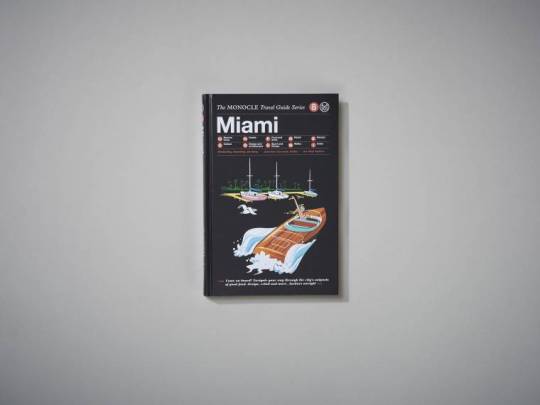
I also decided to pick up the new Monocle Travel Guide to Miami. This is the 8th city that they’ve covered and, as you might know from reading this blog, I’m a big fan of Monocle. (I’m still waiting for the Toronto edition, guys.)
As part of this guide launch – which was timed to coincide with Art Basel Miami Beach – they also released a short video that is worth watching.
When most people think of Miami they probably think of sun and flash. And that is certainly part of the DNA of the city. But Miami has also grown into a global city with important and extensive connections to Latin America. It’s also an incredible place for those who love art, architecture, and design. If you watch the Monocle video, I’m sure you’ll feel that.
There are thousands of people who read this blog via email or by following on Tumblr. The rest of the readership just stops by on the web and visits periodically.
But of the thousands of regular readers, I know that many do not click through to the comment section. And that’s a shame. Because oftentimes I find the comments more interesting than my actual post.
The initial post was about Millennial housing choices (and some stats on marriage and fertility rates). The comments provided some additional color on the trends, but they also got into mobile dating apps and whether or not it’s easier or harder to meet people in cities, today. It was a fun discussion.
This got me thinking and reminded me that people come to cities not only because of labor markets, but because of dating markets.
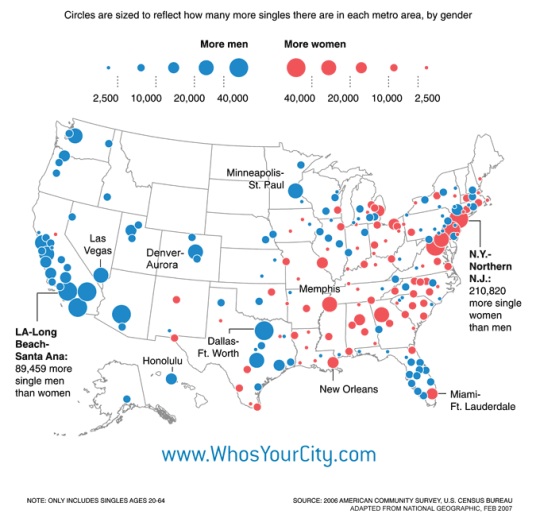
So for today’s piece, I thought I would post the following diagram from Richard Florida’s book, Who’s Your City? It shows how many more singles (aged 20-64) there are – according to gender – in the largest US metro areas.
I couldn’t find an equally detailed map for Canada, but based on this, it looks like Toronto is slanted towards single women and Calgary is slanted towards single men.
On my way back from Philadelphia
this past weekend I wrote a post called, The
Philadelphia (real estate) story. It was about how opposite the market is
in Philly compared to Toronto.
After writing that post and
because of a discussion in the comment section, I started thinking about condo
vs. rental apartment development across the US. Because unlike cities such as
Toronto and Vancouver, it struck me that – outside of maybe New York and Miami
– most U.S. cities are really not building a lot of for sale condos. And if
you’re from Toronto or Vancouver, I bet that feels odd to you.
But what exactly is that number?
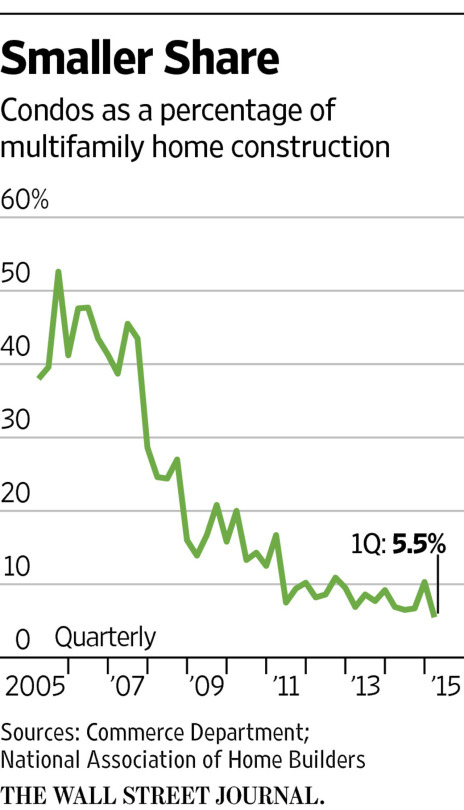
As of the first quarter of 2015, condos as a percentage of all new
multifamily (apartment) construction in the US was only 5.5%. That’s a tiny number and is down from
over 50% before the Great Recession, which means most
cities in the US really are building mostly rental. Last year the US built 264,000
multifamily units across 11,000 buildings.
Another obstacle cited by developers: construction loans. Matt
Allen, chief
operating officer of the Related Group, a developer based in Miami, said he can
get a construction loan for roughly 75% of the cost of building an apartment
complex. But lenders will cover only 50%, on average, of a condo complex’s cost
because of the greater risk, he said.
There’s a demand side
constraint:
As a result, the Federal Housing Administration, which
backs mortgages made to low-wealth buyers, tightened its lending standards in a
series of moves from 2008 to 2012. Under the new rules, in order for the FHA to
insure mortgages in a given condo complex, at least half of the units must be
owner-occupied and no more than half can be FHA-insured, among other
requirements. For condo projects under development, at least 30% of units must
be under contract for sale before the FHA will start backing mortgages there.
Mortgage giants Fannie Mae and Freddie Mac tightened
their standards as well.
And there are macroeconomic
factors:
On the entry-level end, tepid job growth early in the
recovery and the younger generation’s affinity for flexibility have fueled
demand for rentals. Apartment rents are up nearly 16% since 2010, according to Reis Inc.
Notwithstanding
the above, could this be a post-recession policy pendulum that has swung
too far in one direction?
I was browsing through my online reading list this morning (as I do every morning), and I stumbled upon this Dezeen article talking about a big new 6.5 million square foot development being proposed in Miami’s Park West neighborhood.
The goal of the project is to transform Miami into “Florida’s Silicon Valley.”
This sort of thing is happening all around the world. From Buffalo to Lisbon, cities everywhere are betting on tech, startups, and entrepreneurship to grow their economy in the 21st century. And I personally think that’s really exciting.
But as I was reading the article, I couldn’t help but think of an old essay that Paul Graham wrote back in 2006 called, How to be Silicon Valley. (Paul Graham is a famous Silicon Valley entrepreneur/investor).
In his essay Graham argues that to be or to replicate the model of Silicon Valley in your city, you basically need two types of people: rich people and nerds. The idea, of course, being that the nerds work on the cool new ideas and the rich people then fund them.
Using this logic, he specifically calls out Miami as a city where few startups happen and as a city not likely to become another Silicon Valley. Though there’s lots of money and rich people in Miami, there simply aren’t enough nerds. In Graham’s words: “It’s not the kind of place nerds like.”
But that was back in 2006.
The iPhone didn’t even exist yet. Things have since changed. Now there are successful tech companies like Snapchat (valuation north of $15 billion) that are based out of cities like Los Angeles. And I think you could argue that Los Angeles and Miami do share some similarities.
So while it may have seemed far fetched in 2006 for Miami to become a startup hub, is that really the case today?
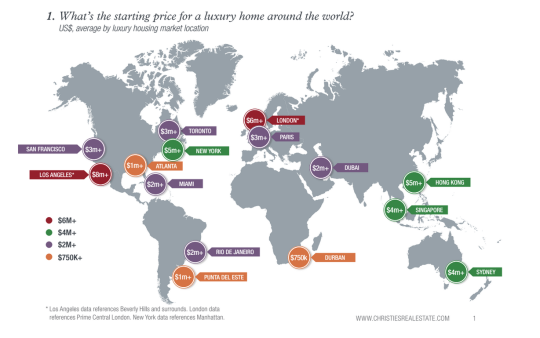
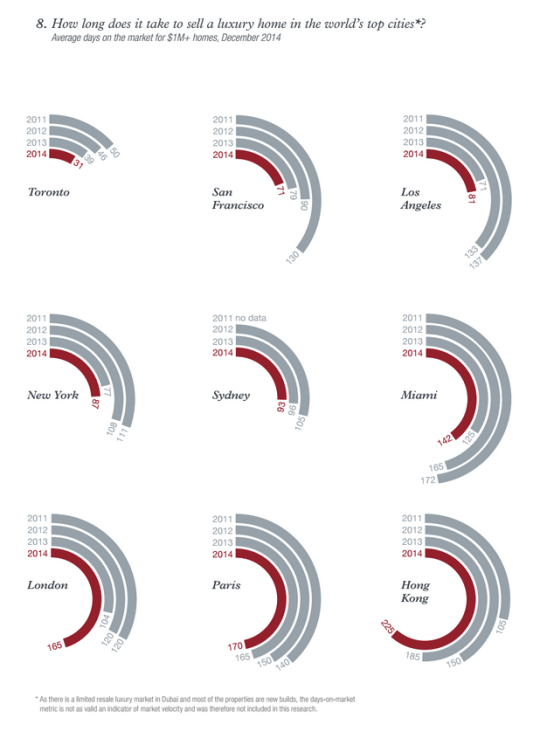
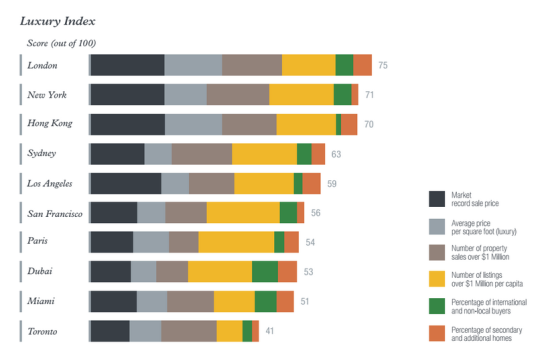
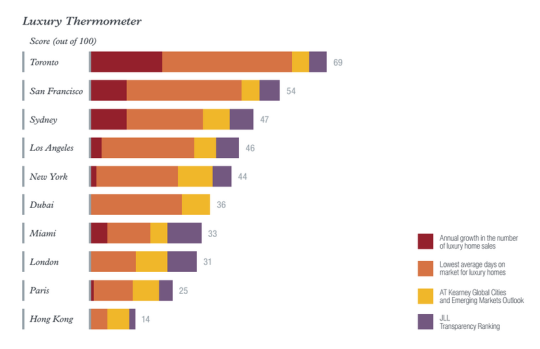
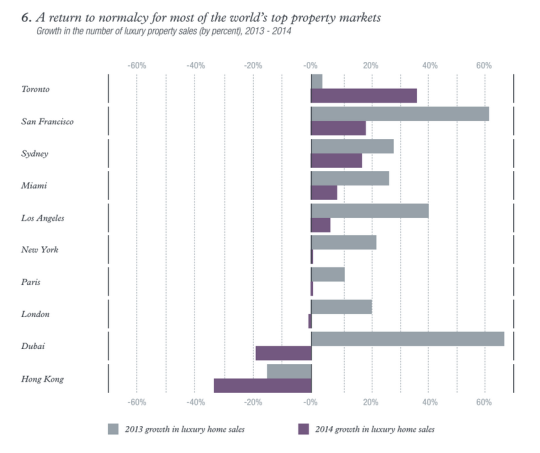
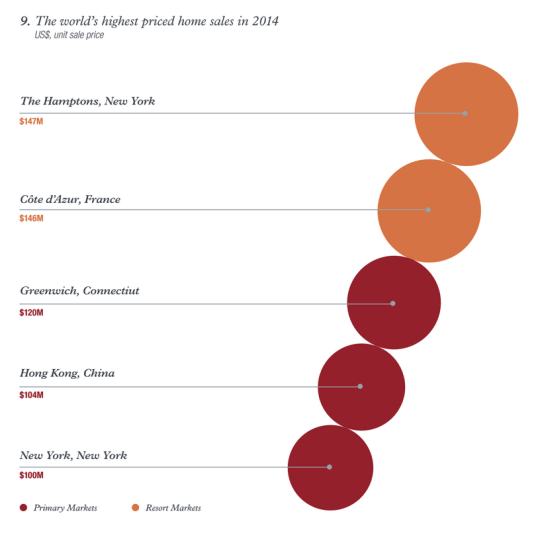
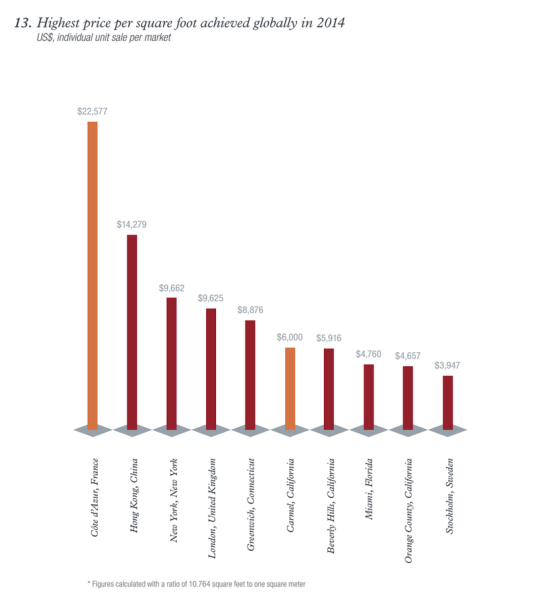
This morning I read through a real estate report called Luxury Defined. It’s a look at the global luxury real estate market across “the world’s top 10 cities for prime property” and about 70 regional and resort destinations.
It’s interesting to look at the trends and see how high-net-worth individuals (HNWIs) are choosing to allocate their funds in residential real estate. Here are some of the charts and diagrams that caught my eye as I was going through it (you may need to zoom your browser in):
If you’d like to download the full report, click here. It’s free, but you’ll need to enter your name and email address.
Break up outdoor spaces with comfort stations (not sure why they just have to be stations)
Design for active winter programming
These, of course, aren’t new design strategies. Cities have been built around their climates since, probably, the beginning of cities. It wasn’t until more recently that we started basically ignoring local climates and focusing more on what mechanical systems can do to make us feel comfortable.
But I think that was a mistake. I don’t think that mechanical systems are bad though. I just think that there’s a lot that we can do first – without mechanical systems – to address local climates.
If you’ve ever sat on a patio during a swing season (i.e. right now) where the wind was blocked and you were in the direct sun, you already know that there’s a lot that can be done without relying on active systems.
But the other thing I like about this post is that it acknowledges the fact that winter waterfronts require just as much, if not more, design attention than a warm-climate waterfront.
Saying that we’ll (insert cold-climate city name here) never be Miami or Barcelona or Sydney is just giving up.
Back in 2006 when I was fresh out of architecture school and looking for work, I knocked on the door of a design company based in London with my polished resume in hand. I was sleeping on a friend’s couch at the time and the company seemed like a perfect fit for me – so I went for it.
There’s no happy ending to this story though – because I didn’t get past the front door that day – but there’s never any harm in trying. As my friend told me the morning I went: fortune favors the bold.
They call themselves “a residential and hotel design company”, but their model is actually more unique than that. Founded in 1999 by John Hitchcox (a property developer) and Philippe Starck (a rockstar designer), the firm partners with local real estate developers around the world and creates value through design, branding, and marketing expertise – as well as through celebrity names like Philippe Starck and Jade Jagger.
What makes their model interesting is that, unlike the real estate developers they partner with, they’re not assuming the same level of risk (unless, of course, they co-invest). They get paid (well) for the design services and marketing expertise they provide, as well as the brand equity that they bring.
This is similar to what Donald Trump does with some (most?) of his developments now. Want the Trump name on your building? Pay $X. Want Philippe Starck at your condo sales launch? Pay $Y.
When I was in architecture school, I used to wonder why we didn’t talk about the importance of branding and marketing. I thought we should. Which is probably why I ended up in business school afterwards.
I think there’s a lot of potential in overlaps and hybrid business models, which is why I was excited to learn today that YOO has just launched a new architectural practice called YOO Architecture.
In keeping with the recent theme about cities, their brands, and the messages they send, I thought I would revisit an old essay (2008) written by Paul Graham (of Y-Combinator) called “Cities and Ambition.” In it, he talks about the various messages that cities send us, such as:
You should make more money (New York)
You should be better looking (Miami?)
You should be smarter (Cambridge)
You should be more powerful (Silicon Valley)
But the most interesting part of his argument is the belief that we are largely products of our environment. No matter how strong or formidable our personalities might be, the message a city sends us is hugely important. In fact, it might be impossible to escape it. Here’s how Paul puts it:
How much does it matter what message a city sends? Empirically, the answer seems to be: a lot. You might think that if you had enough strength of mind to do great things, you’d be able to transcend your environment. Where you live should make at most a couple percent difference.
But if you look at the historical evidence, it seems to matter more than that. Most people who did great things were clumped together in a few places where that sort of thing was done at the time.
You can see how powerful cities are from something I wrote about earlier: the case of the Milanese Leonardo. Practically every fifteenth century Italian painter you’ve heard of was from Florence, even though Milan was just as big. People in Florence weren’t genetically different, so you have to assume there was someone born in Milan with as much natural ability as Leonardo. What happened to him?
If even someone with the same natural ability as Leonardo couldn’t beat the force of environment, do you suppose you can?
I don’t. I’m fairly stubborn, but I wouldn’t try to fight this force. I’d rather use it. So I’ve thought a lot about where to live.
To some, this thought may depress you. I mean, if you happen to live in a city or place with the “wrong” message, you might feel as if you’re missing out. I know that thought certainly crossed my mind when I read his essay. But different messages resonate with different people, and so maybe the message your city is telling you is exactly the one you need to accomplish great things.
In Toronto, I’d say that the message is similar to that of New York: You should make more money. Oh, and also that you should buy more condos 😉
If you’re looking for the petition to Prime Minister Stephen Harper, click here.
Last Monday the Premier of the Turks and Caicos Islands, Rufus Ewing, was in Canada visiting with Prime Minister Stephen Harper. The purpose of the trip was to “boost ties” between the two countries. It was about trade, which most people would agree is a fairly typical kind of meeting.
However, this meeting struck a different headline in the media. And that’s because–for almost a century–there have been discussions and proposals put forward in this country to annex the Turks and Caicos Islands. The earliest record appears to be from 1917 when Prime Minister Robert Borden first suggested it.
Since then, the idea has been raised on many other occasions. In fact, both Nova Scotia and Saskatchewan have actually stepped forward and formally invited the Turks and Caicos to join their provinces. Here’s what Saskatchewan Premier Brad Wall had to say during this most recent visit:
“I think we want to be constructive in Saskatchewan. If the Prime Minister’s looking for a way to make this happen and doesn’t want to go through the challenge of creating a province or territory, and Turks and Caicos want to make this happen, just, you know, we’d like a tropical island.“
Presumably this approach would be easier than creating an 11th province or 4th territory. But despite these offers and efforts over the years, the idea has always been ultimately rejected. Following this week’s meeting, Foreign Affairs Minister John Baird stepped forward and also firmly rejected the idea:
"We’re not in the business of annexing islands in the Caribbean to be part of Canada. So that’s not something that we’re exploring. We’re not looking at any sort of formal association with the islands.”
But before I dive in, here’s a bit of background on the Turks and Caicos. The country is a collection of approximately 40 islands–most of which are uninhabited. They are a British Overseas Territory, but are self governing. However, from August 2009 to November 2012 the UK temporarily suspended its ability to self govern following allegations of corruption and fiscal mismanagement.
The land area of the country is approximately 613 square kilometres, which results in a population density of 51 people per square kilometre. For comparison, the land area of the City of Toronto alone (not the Greater Toronto Area) is almost equal at roughly 630 square kilometres. The population density averages around 4,150 people per square kilometre.
Now, onto why I believe we should be looking at a union. Here are 5 reasons.
1. They are open to the idea
Canada is not globally known as an imperialistic country and I’m not suggesting we change that. But here we have a case where the Turks and Caicos appears clearly open to the idea of some form of union. Why would we not consider it? And as long as they remain open to the idea, travellers will be able to continue placing the Canadian flag on their backpacks as a way to win friends overseas.
2. We’re aligned
Given that the Turks and Caicos is a British Overseas Territory, the country uses the common law system and the official language is English. (They’re missing French, but I’m sure that could be worked out.) We even share the same monarch. (Although, deep down inside I wish Canada was a republic.) These commonalities would make a proposed union all that much easier.
3. Vacationing and retirement
This is the obvious one that is getting most of the attention in the press. Canada is cold and we spend a lot of money traveling to warmer places. But if Canada had a province that was blessed with the weather of a place like the Turks and Caicos, I’d wager that it would receive a disproportionate amount of our travel and retirement dollars. All of a sudden you eliminate currency risk and the fear of foreign health care, which are both particularly important for retirees. This means that a lot more money would be kept within the Canadian economy. Sorry, Florida.
4. Access to education
53% of the labour force in the Turks and Caicos is made up of unskilled and manual labour. If they are serious about developing their economy beyond tourism, then I believe that education needs to become a significant part of their economic development platform. Thankfully, a union between our country and theirs would open up Canadian universities to the roughly 36,000 people who live in the Turks and Caicos Islands. Our universities are some of the most highly ranked in the world.
5. Economic development
Finally, let’s talk economic development.
Canada is one of the wealthiest countries in the world. And we consistently rank amongt the highest in the world in terms of education, transparency, quality of life and economic opportunities. It’s for these reasons that we’re perceived as a great place to live and invest. About one of the only things we don’t typically offer is great weather.
A union with the Turks and Caicos would obviously change that. But beyond just weather, it would also give Canada a foothold in an important region of the world and provide a stable locale for foreign investment. Similar to the way in which Miami has become the “Capital of Latin America”, the Turks and Caicos could become a meaningful center for trade and investment backed by Canadian stability.
This would benefit not only Canada, but also the Turks and Caicos, who have struggled over the years with fiscal mismanagement and corruption. In fact, the biggest challenge, I think, would be managing overdevelopment and ensuring that the growth and development happens in the most environmentally sustainable way possible.
Petitioning Stephen Harper
So there you have it, 5 reasons for why Canada should seriously consider a union and/or the potential annexation of the Turks and Caicos Islands. If you have any other ideas, or if you completely disagree with everything I said, I would love to hear from you in the comment section below.