Daily insights for city builders, delivered every morning at 6 AM ET. I’m Brandon Donnelly — a Toronto-based real estate developer and founder of Globizen. I’ve been writing here since 2013.

Tag: melbourne

  • Salt Lake City wants to turn Main Street into a pedestrian promenade

    Last year, I wrote about how Salt Lake City wants to build a new linear park around its downtown. That post can be found, here.

    Fast forward to today, and the city’s Department of Economic Development has just published a new comprehensive 215-page study that supports turning Main Street into a pedestrian promenade.

    Specifically, the area running from South Temple to 400 South, and including 100 South from Main to West Temple:

    As part of the study, they highlight a number of successful case studies from around the world, including 16th Street Mall in Denver, Bourke Street Mall in Melbourne, and Queens Quay here in Toronto.

    In the case of Denver, they cite the one-mile stretch as single-handedly generating over 40% of the city’s total downtown tax revenue! And in the case of Toronto, they refer to Queens Quay as a global destination. (Toronto readers, do you agree?)

    Like most city building initiatives, this vision is will take years to realize. But it’s interesting to note that, of the eight design alternatives included in the study, there is already one clear preference within the local community — option B.

    Option B is a pedestrian/transit mall, but with multi-use trails. In other words, it is a no-cars-allowed alternative that would still allow bicycles and scooters. Here’s the street section:

    If you’d like to download a copy of the full Main Street Pedestrian Promenade Study, click here.

  • Best new tall building of 2023

    The Quay Quarter Tower in Sydney has been just been awarded the “best new tall building” of 2023 by the Council on Tall Buildings and Urban Habitat (CTBUH). Deigned by 3XN and BVN, it’s a great adaptive reuse story.

    The project is a renovation and expansion of an existing 1970s building. And the team managed to retain 65% of the original structure (slabs, columns, and beams) and 95% of the original core.

    This results, according to their calculation, in 12,000 tons of embodied carbon savings. The equivalent of 35,000 flights between Sydney and Melbourne. At the same time, the team managed to add 45,000 m2 of new floor area to the site by grafting new slabs onto the existing ones.

    But let’s get back to these carbon savings.

    According to this site, there are 37 direct fights between Sydney and Melbourne each day. That’s about 13,505 flights per year, meaning that the carbon savings from not fully demolishing this building (and starting fresh) are equal to about 2.6 years of people not flying back and forth between these two cities.

    If you consider how long buildings typically last (this one was relatively young at under 50 years), it kind of makes buildings seem less bad. Of course, we’re only talking about and comparing embodied carbon. There’s also the ongoing operation of the building.

    In any event, a deserving project. Congrats to the team. For more on the project, click here.

    Photo via Dezeen

  • [Project Profile] High Street Apartments, Thornbury

    It is an overwhelmingly positive thing for cities when you can somehow figure out how to turn a site like this (which looks to have been a single-family home):

    Into 13 homes and new ground-floor retail that looks like this (non-Google street view images can be found here):

    This particular example is at 752 High Street in Thornbury, which is an inner suburb of Melbourne. Designed by Gardiner Architects, the build has 4 floors of residential, a 5th floor rooftop amenity, and a single elevator with a single wraparound staircase. It was also constructed out of cross-laminated timber.

    For more about that process, here’s a short video:

    If you watch the video, you’ll hear the architect talk about how his firm had been working on this project for about 8 or 9 years. I have no idea the backstory and I’m not about to speculate, but clearly 8-9 years is far too long for only 13 new homes. And the reality is that we often don’t make it easy to build this kind of infill housing.

    Broadly speaking, if you’re trying to encourage this scale of housing, I think at a minimum you want to look at 3 things: (1) the planning permissions need to be flexible and as-of-right, (2) you need to look at the local building codes to see if there are any obstacles in place that don’t necessarily make sense for this typology, and (3) you want to look at the impact fees being levied.

    It’s hard not to imagine our cities being better off having more apartments like High Street.

  • Australia 108

    One of my favorite YouTube channels is the B1M. Apparently it is the most subscribed-to channel focused on construction. If you don’t already subscribe, you can do that over here.

    Below is a recent video about Australia 108 in Melbourne. It’s still under construction, but it is topped out and it is now the tallest building in the country at over 300m. That makes it a “supertall.”

    When you’re building this tall, it can make a lot of sense to segment and occupy portions of the building before construction is fully complete. Among other things, it helps to manage risk. And that’s exactly what they’ve done here.

    The contractor building Australia 108 is Multiplex. They also happen to be our construction management partner on Junction House. Except our project is a bit more boutique than Australia 108.

  • Homes built in the past year

    I’m on a flight right now reading the latest issue of Monocle Magazine in a seat that barely accommodates the length of my femur. This month’s issue has their annual ranking of the top 25 cities in the world.

    Munich is first, which is not unusual for their ranking methodology. It generally scores well. Quality of life is high. Crime is low. The economy is strong. Beer gardens are fun. And you’re close to the Alps for snowboarding.

    One stat that caught my attention — and it’s not included for all of the cities — is the number of homes built in the past year. Presumably this is all housing units in the metro area — for sale, for rent, subsidized and so on.

    Here are their (clearly rounded) numbers. The order is as they appeared in the ranking, but again, not ever city included this stat.

    • Munich: 8,300
    • Tokyo: 150,000
    • Copenhagen: 5,000
    • Berlin: 11,000
    • Madrid: 1,600
    • Hamburg: 7,000
    • Melbourne: 5,100
    • Helsinki 4,400
    • Stockholm: 7,000 (18,000 in Greater Stockholm)
    • Sydney: 39,000
    • Hong Kong 17,000
    • Vancouver 22,600
    • Amsterdam 5,100
    • Kyoto 8,900
    • Dusseldorf 2,600
    • Barcelona 1,000

    Some of these numbers appear to stand out, such as the counts for Tokyo, Sydney and maybe Vancouver. But it’s hard to draw any conclusions around housing supply and housing affordability.

    Melbourne and Amsterdam allegedly have the same number of homes built over the past year, but according to Monocle the metro areas of Melbourne and Amsterdam have populations of 4.85 million and 2.4 million, respectively. This also says nothing about their growth rates.

    So which one is doing a better job of addressing housing demand? I’m not sure.

    But it was still interesting to see that Tokyo delivers somewhere around 150,000 homes a year. Tokyo is somewhat unique globally in that it’s a big city — one of the biggest — that somehow manages to gracefully balance both scale and quality of life.

    Photo by Elias Keilhauer on Unsplash

  • What’s happening in Melbourne?

    image

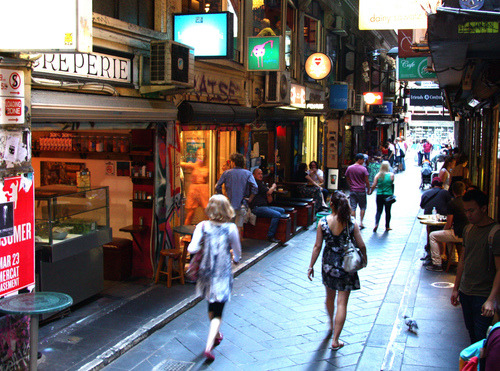
    I’ve never been to Australia, so take everything I’m about to say in this post for what it’s worth. I also don’t know much about Sydney and Melbourne, other than the fact that I’ve studied the latter’s laneways and the tremendous impact they’ve had on revitalizing the CBD.

    However, recently I’ve had a few close friends visit these cities for the first time and, since then, I have started noticing a trend. All of them come back and tell me the same thing, that they prefer Melbourne to Sydney. They say: “Yeah, Sydney is nice and beautiful and all, but it’s not all that exciting. Melbourne feels way more dynamic. Oh, and have you seen their laneways? You would love them.” That’s what they tell me.

    So that’s what I have in my head when I read that Melbourne is now the fastest growing city in Australia; that it’s one of the most liveable cities in the world; and that by as early as 2031 it could take Sydney’s place as the biggest city in the country. Below is a chart from The Australian. If you can’t see it, click here.

    //platform.twitter.com/widgets.js

    Some argue that this is happening because housing is cheaper in Melbourne (median dwelling price of ~$700,000 versus ~$1 million). And some argue it’s because the jobs are there and the city has become a cultural and sporting destination. Whatever the case may be, net migration is estimated to be somewhere around 100,000 people per year.

    My own view – and I’ve made this argument before on the blog – is that we shouldn’t underestimate the importance of cool shit when it comes to cities. People vote with their feet more than ever today. And for a growing segment of the population, cities are a consumer good.

    Indeed, in 2001, Edward Glaeser, Jed Kolko, and Albert Saiz penned a research paper called the Consumer city, where they argued precisely that. The premise was that historically we have tended to think of cities as being centers of production, but we should also be thinking about them as places of consumption.

    Here’s an excerpt:

    “But we believe that too little attention has been paid to the role of cities as centers of consumption. In the next century, as human beings continue to get richer, quality of life will become increasingly critical in determining the attractiveness of particular areas. After all, choosing a pleasant place to live is among the most natural ways to spend one’s money.”

    This is why those coffee shops and cool laneways matter. Some cities have unfair natural advantages. Los Angeles has weather. Vancouver has mountains. Montreal has poutine. But for the rest of us, the amenities typically form part of the built environment. They are a product of our choices.

  • LED neon lighting by Electric Confetti

    image

    Ever since I attended Art Basel Miami Beach last year, I’ve been determined to get a neon piece for my condo. I got inspired by all of the neon I saw at the show and so I told myself that I was going to get something made.

    I found a company in Vancouver called Endeavour Neon, but I never ended up pulling the trigger. It turns out that traditional neon lighting is pretty expensive. 

    However, I recently discovered a Melbourne-based company called Electric Confetti. Founded by designer Natalie Jarvis, the company makes LED neon lighting using flex tubes. Supposedly, this makes them more durable and more energy efficient. They’re also less expensive.

    I am trying to figure out shipping to Canada, but it looks like I might be finally getting my neon. I really like the banana (pictured above), but that might be an odd reference for a bedroom. I’ll sleep on it.

    I thought I would share with all of you in case you have a home, an office, or a project that could use some neon lighting.

  • With Vancouver voting “no” to transit tax, could Hong Kong now serve as inspiration?

    https://500px.com/embed.js

    Earlier today it was announced that Metro Vancouver voted “no” to a 0.5% sales tax increase that would have been used to fund a $7.5 billion regional transportation plan. 

    Roughly 62% of respondents said “no”. And not surprisingly, the percentage of people who voted “no” increased as you moved outward towards the suburbs. But even the City of Vancouver itself sided slightly with “no” at 50.81%.

    Since I’m not that plugged into the Vancouver scene, I’m not going to comment on this issue. But hopefully you all will in the comments below. I know that a lot of you are incredibly passionate about this.

    Instead, I’d like to pose two questions. 

    Firstly, why is it that Asian transit operators seem to be so much better than North American transit operators at recovering their costs through fares? (Urban density and car ownership likely have something to do with it). And secondly, why hasn’t Hong Kong’s famous “rail plus property” transit model been exported to North America?

    For those of you unfamiliar with Hong Kong’s Mass Transit Railway Corporation, here’s how much money they make (via The Atlantic from 2013):

    The Mass Transit Railway (MTR) Corporation, which manages the subway and bus systems on Hong Kong Island and, since 2006, in the northern part of Kowloon, is considered the gold standard for transit management worldwide. In 2012, the MTR produced revenue of 36 billion Hong Kong Dollars (about U.S $5 billion)—turning a profit of $2 billion in the process. Most impressively, the farebox recovery ratio (the percentage of operational costs covered by fares) for the system was 185 percent, the world’s highest. Worldwide, these numbers are practically unheard of—the next highest urban ratio, Singapore, is a mere 125 percent.

    In addition to Hong Kong, the MTR Corporation runs individual subway lines in Beijing, Hangzhou, and Shenzhen in China, two lines in the London Underground, and the entire Melbourne and Stockholm systems. 

    And here’s how they do it (also via The Atlantic):

    Like no other system in the world, the MTR understands the monetary value of urban density—in other words, what economists call “agglomeration.” Hong Kong is one of the world’s densest cities, and businesses depend on the metro to ferry customers from one side of the territory to another. As a result, the MTR strikes a bargain with shop owners: In exchange for transporting customers, the transit agency receives a cut of the mall’s profit, signs a co-ownership agreement, or accepts a percentage of property development fees. In many cases, the MTR owns the entire mall itself. The Hong Kong metro essentially functions as part of a vertically integrated business that, through a "rail plus property” model,  controls both the means of transit and the places passengers visit upon departure.  Two of the tallest skyscrapers in Hong Kong are MTR properties, as are many of the offices, malls, and residences next to every transit station (some of which even have direct underground connections to the train). Not to mention, all of the retail within subway stations, which themselves double as large shopping complexes, is leased from MTR.

    I believe that we could do this too. So hopefully we can have a great discussion about it in the comment section below.

  • How Melbourne reinvented itself one block at a time [Video]

    https://500px.com/embed.js

    Melbourne is famous in urbanist circles for the revitalization of its central area. In 1992, 40% of the buildings were empty above the first floor and only 5 (yes five) residents actually lived in the core. Everyone had fled to the suburbs and the city had hollowed out.

    Today, there are over 29,000 residents in the central area and Melbourne has become revered around the world for its vibrant public spaces and innovative laneway repurposing. 

    Here’s a quick 11 minute video that explains how they did it (via The Urbanist). Click here if you can’t see it below.

    [vimeo 131396094 w=500 h=281]

    What is clear from the video is that it took a lot of work convincing property owners and getting them to buy into the vision. Being able to repurpose the laneways often meant punching through blank walls at the base of buildings. And so there was pushback.

    Here in Toronto I’ve heard people say that we’re not Melbourne and we shouldn’t expect to have similar kinds of urban spaces. Well guess what, neither was Melbourne in the 1980s and 1990s. It was a dying city. But they made it happen.

  • Nominate your laneway for transformation

    image

    Some of you might be aware that I’m involved with a non-profit group here in Toronto called The Laneway Project

    Our mission is to transform the city’s under-utilized laneways into safe, vibrant, and people-friendly spaces – which is something that has been done with a lot of success in other parts of the world (see Melbourne above).

    Today I’m excited to announce two things.

    First, the group has received funding from the Ontario Trillium Foundation. This is great news because it’s obviously a lot easier to execute on a mission when you have some resources behind you.

    And that ties into the second announcement. 

    The funding received from the OTF is going to be used for 2 laneway transformation projects here in Toronto. Think of them as pilot projects that will help to reorient Torontonians into thinking about laneways as viable public spaces and to demonstrate that this group is about real action.

    Once the 2 laneways have been chosen, The Laneway Project will work with those local communities to come up with a vision and then an implementation plan. But before that can happen, there needs to be 2 laneways.

    So if you’re a community group, resident association, business improvement area, or some other passionate group, now is your chance to nominate your laneway. Get in touch with The Laneway Project before February 7th, 2015 by clicking here.

    Image: Melbourne Laneway via Flickr