Daily insights for city builders, delivered every morning at 6 AM ET. I’m Brandon Donnelly — a Toronto-based real estate developer and founder of Globizen. I’ve been writing here since 2013.
Here is another article/report thing from McKinsey talking about the “fast-growing food-delivery ecosystem.” In the US, the top food-delivery players are DoorDash, Uber Eats, and Grubhub (in this order).
What is clear is that these platforms are growing very quickly and that COVID-19 was of course great for the business of eating at home. The demand is there.
But what is also clear is that food-delivery is a low-margin business that depends on scale. Last-mile and single-point delivery is tough. This is despite the fact that consumers have shown to be willing to pay a fairly significant premium in exchange for the conveniences of on-demand meals.
Here’s a chart from McKinsey that looks at the unit economics of delivery apps:
It is a race to capture “stomach share.”
But surely this evolves and gets further optimized with the continued rise of things like “ghost kitchens” and maybe autonomous delivery robots.
I remember driving home one night during the thick of the pandemic and placing an order on Uber Eats for pickup. When I arrived, I found a small food truck and one lonely guy in the middle of an empty (and wintery) parking lot on Lake Shore East. He handed me my poke bowls and I was on my way.
This is what is happening behind our apps and it’s changing the way we eat.
McKinsey published a report last month on the future of electric vehicles and what that will mean for the industry. Many countries, cities, and companies have set some sort of electrification target for 2030. The US is targeting 50% EVs by 2030. Several countries have announced a flat-out end to ICE sales by 2030. And a number of OEMs have committed to the same.
But there are already cities, such as Oslo, which have reached EV majority. In July of this year, its passenger EV adoption figure was 66%, making Norway a global leader. What is clear is that the electrification of personal transport is well underway. Anecdotally, we are seeing that play out with the number of people now inquiring about electric charging infrastructure in our buildings (here in Toronto).
This move to electric will have many repercussions, including a major shift in the entire supply chain (which McKinsey outlines in their report). While ICE vehicles and EVs still both have things like tires, EVs require a whole slew of new and now growing components:
It is also going to force new public infrastructure:
But in parallel to the electrification of personal vehicles, we are also seeing a number of other trends and shifts. The electrification of public transport (Shenzhen has already electrified its entire bus and taxi fleets). The rise of micro-mobility (things like e-scooters). The ongoing push to discourage driving in urban centers. And the continuing goal of autonomous vehicles.
What all of this suggests to me is that the electrification of personal vehicles is only part of the story. The entire mobility landscape in our cities is changing and it will probably look a lot different by 2030.
Here’s a weekly round up of links and articles that you may find interesting. The topics cover the sorts of things that we usually talk about on this blog.
The latest Mackay Laneway House update is now live on the Globizen Journal. The ground floor steel is complete, with framing currently underway. The post has some background on the challenges faced in order to get to this stage.
Brick comparison. Here’s a recent tweet of mine. I’m curious if any of you can tell the difference between these two brick finishes and if you have a clear preference. One of them is stamped concrete and the other is real brick (precast concrete with brick slips).
Pools as art. Apparently this is a trend right now, but it’s not necessarily a new one. Pablo Picasso accidentally created one when he “signed” the bottom of one in Spain back in the early 1960s. A pool would be fun right now. [FT paywall]
Alley house in King’s Cross by architect David Adjaye is currently on the market for £6.5 million. Lots of black. I love the mint green room with the exposed concrete ceiling. Oh, and there’s a pool.
Nightclubs are, not surprisingly, really struggling. Most have been closed since March. Unlike restaurants, you can’t really hack together a solution with outdoor dining, heat lamps and takeout. They’re predicated on people being proximate to each other. [Sorry, another FT paywall]
Monocle has just published a new book about “gentle living.” It’s a guide to “slowing down, enjoying more and being happy.” I’m trying to do more of this, or at least be more mindful about it. It doesn’t always/usually work. Perhaps I need this book.
“Decade of the home.” Opinion piece about the current desire for suburban over urban locations. If you’re a regular reader of this blog, you’ll know that I am steadfast in my belief that urban life is going to prove to be incredibly resilient on the other side of this.
McKinsey report about the impact that lockdown is having on digital adoption, e-commerce penetration, and the overall customer experience. You’ll need to enter some information in order to download the PDF, but it’s free.
McKinsey Global Institute just published a “supply-side toolkit” for cities struggling with housing affordability. This seems to be every successful city.
The article includes a long list of potential tools. Some of them you may agree with. And others you may disagree with. But I am sure that many of them will be familiar to you. One of the tools in the toolkit is accessory dwelling units.
Of course, the overarching theme is that housing supply has not and is not keeping pace with housing demand:
California, for instance, added 544,000 households but only 467,000 net housing units from 2009 to 2014. Its cumulative housing shortfall has expanded to two million units.
Another one of the tools in the toolkit is “overcoming NIMBYism.” Here is an excerpt:
People who come to a city to work need to be able to find an affordable place to live there. But the voices of existing homeowners who want to preserve the status quo often drown out those of newcomers, young adults, low-income service workers, and renters who need more housing. After a 2009 audit found that neighborhood councils were not representative of the city’s broader population, Seattle replaced these bodies with a central Community Involvement Commission that includes mayoral and council appointees chosen to represent a broader set of stakeholders.
I am intrigued by Seattle’s move to create a central body and a new approach to public engagement – one that moves away from local district-councils. However, it appears that this Community Involvement Commission is still very much in its infancy.
If any of you are familiar with the Seattle market, I would be curious to hear your thoughts on it in the comment section below. I am, however, going to spend some time reading up on it.
The overarching thesis is that we are transitioning to a data-driven global economy:
“Flows of physical goods and finance were the hallmarks of the 20th-century global economy, but today those flows have flattened or declined. Twenty-first-century globalization is increasingly defined by flows of data and information. This phenomenon now underpins virtually all cross-border transactions within traditional flows while simultaneously transmitting a valuable stream of ideas and innovation around the world.”
One of the benefits of this shift is that it has become easier for emerging economies and individuals from all around the world to participate.
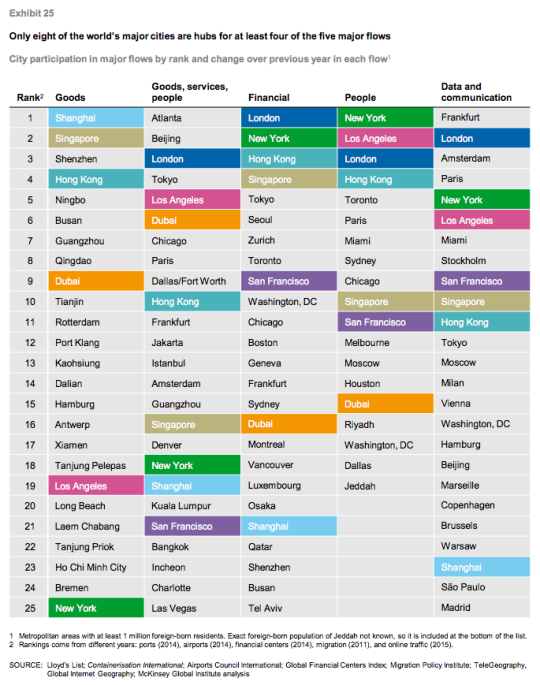
Of course, not all countries and cities are participating equally. In their report, McKinsey ranks the top cities according to five global flows. In each case a proxy was used:
“Unfortunately, data on global flows are not available at the city level. However, we have obtained data that serve as proxies for each of our five global flows. Container port volumes approximate goods flows; airport passenger volumes serve as a proxy for goods, service, and people flows; the ranking of cities in the Global Financial Centers Index by the Z/Yen Group provides an indication of financial flows; the number of foreign-born residents in a city measures people flows; and Internet bandwidth approximates data flows.”
Using this methodology, they believe that the world only has 8 truly global cities right now: New York, Los Angeles, San Francisco, London, Singapore, Shanghai, Hong Kong, and Dubai. They are the colored cities listed below:
I always take these city rankings with a grain of salt. This stuff is not easy to quantify and a lot depends on the methodology that you use.
For instance, Atlanta sits on the top of “goods, services, and people” because it has the busiest airport in the world according to passenger volume. (It’s the primary hub of Delta Air Lines.) But is that enough to assert that Atlanta is #1? Maybe. Maybe not.
In any case, the report is packed full of information. If you’d like to take a look, click here.
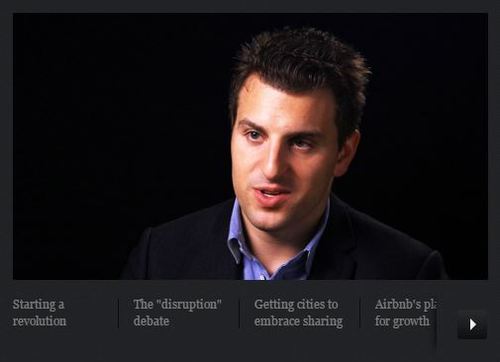
McKinsey recently put out a great interview with one of the founders of Airbnb, Brian Chesky, talking about the relationship between his company and cities. I thought it was fascinating. Click here to watch the video.
If you don’t feel like doing that, I’ve also pasted the interview transcript below and bolded some of the really interesting takeaways. Let us all know what you think in the comment section below.
It’s a currency of trust, and that used to live only with a business. Only businesses could be trusted, or people in your local community. Now, that trust has been democratized—any person can act like a brand.
Airbnb is a way that you can, when you’re traveling, book a home anywhere around the world. And by anywhere, I mean 34,000 cities in 190 countries. That’s every country but North Korea, Iran, Syria, and Cuba.
The reason we started was I was living with my roommate, Joe, in San Francisco, and I couldn’t afford to make rent. That weekend, the International Design Conference was coming to San Francisco. All the hotels were sold out. Joe had three air beds. We pulled the air beds out of the closet, we inflated them, and we called it the “Air Bed and Breakfast.”
The reason it’s grown so fast is, unlike traditional businesses, we don’t have to pour concrete. The infrastructure and the investment was already made by cities a generation ago. And so all of a sudden, all you needed was the Internet.
The ‘disruption’ debate
I never really loved the word “disruption,” because it suggests that maybe it’s the kid in a class who was disruptive, who probably didn’t add a lot to class. I think that we have a lot to add to society.
Over time, cities have gotten so big that the sense of community has gotten lost. And I think once you know everyone, that community can reemerge. And as far as our relationship with cities, we can’t succeed without a city. Or we can’t really thrive without a city. We don’t want to thrive in spite of a city. And I think if we work together, it’s going to be amazing. I think the people win. And I think if we don’t work together or if we fight, the loser isn’t really us or the city—it’s the people in that city.
Getting cities to embrace sharing
Fundamentally, the idea of the sharing economy is going to be great for cities. It means that people all over a city, in 60 seconds, can become microentrepreneurs. And they can be empowered. And they can make an income. Now, this is amazing, but it’s also complicated because there are laws that were written many decades ago—sometimes a century ago—that said, “There are laws for people and there are laws for business.” What happens when a person becomes a business? Suddenly these laws feel a little bit outdated. They’re really 20th-century laws, and we’re in a 21st-century economy.
It’s probably going to be a fair amount of work to revise some of the laws and rethink the way cities and platforms work together, but I think that work is worth it. Because what cities don’t have to do is invest billions of dollars in infrastructure to create jobs. Whereas historically, to create opportunities, cities would need massive projects and investments, these jobs only require the Internet. Now what they need to do is navigate the legal framework, which is typically outdated. We want to work with the cities. We’re not telling them that their laws are terrible. The world continues to change. Laws must continue to adapt for that world.
We want to help cities understand what our world looks like so they can modernize the laws to make sense. We’re not against regulation. We want to be regulated because to regulate us would be to recognize us.
Airbnb’s plans for growth
We want travelers to be able to book homes anywhere. Anywhere includes Asia. Asia’s a nascent market for us. Number two, we’re also looking at other use cases. Airbnb started as a way for travelers to find a budget way to vacation in a city. But now we’re starting to see people who aren’t on a budget. They want a much more high-end experience. And the third is that at the end of the day, if you’re traveling to Tokyo, you’re not traveling to Tokyo to stay in a home or a hotel. You’re traveling to Tokyo—if you’re on vacation—because you want to have an experience. And we’d love to do more to make that experience special and memorable.
The future of sharing: Your free time
I don’t think people would view the jobs created in the sharing economy as jobs. I don’t even know if they get counted as jobs when the White House has a new jobs report. They are jobs. As far as I can tell, people are working, they’re making income, and they depend on that income. Half of our hosts depend on it to pay the rent or mortgage. Maybe it’s a new kind of job. Maybe it’s like a 21st-century job. Tom Friedman talks about how in the future people may not have jobs. They’ll have income streams.
I believe that the sharing economy broadly can probably provide tens of millions of jobs or income streams for people all over the world. This is going to have a pretty big effect on the economy, mostly a good one.
The sharing economy started by democratizing and creating access to probably two of the biggest assets people have: their homes and then their cars. But I think the whole idea of ownership is changing. When my parents were young, owning things was a privilege, and there was a sense of romance to owning a house, owning a car.
Today’s generation sees that ownership also as a burden. People still want to show off, but in the future I think what they’re going to want to show off is their Instagram feed, their photos, the places they’ve gone, the experiences they’ve had. That has become the new bling. It’s not the car you have; it’s the places you go and the experiences you have. I think in the future, people will own whatever they want responsibility for. And I think what they’re going to want responsibility for the most is their reputation, their friendships, their relationships, and the experiences they’ve had.
So I think the biggest revolution will be in the biggest asset of all. The biggest asset is not a house. It’s not a car. It’s people’s time. People’s time may start with just gigs: waiting in line for you, delivering something for you. Over time, I think it’s going to move upmarket. And eventually, menial tasks become real trades, and real trades become art forms.
Somebody may say, “I cook a great brunch. I wonder if people would enjoy having brunch at my house?” And you could be able to book a brunch at someone’s house, instead of at a restaurant. That person isn’t trying to create a restaurant, they’re just allowing someone to have brunch. They build a reputation. One day, that person can be a Michelin-rated chef in their house.
Earlier this week I stumbled upon this entertaining article from the Guardian talking about how expensive housing is in London. The author’s tongue-in-cheek suggestion was to setup a new miniature London in the middle of nowhere where everyone could flock for affordable housing, but where many of London’s attributes could be exported: “We can all refuse to wear socks and sell each other overpriced cocktails in jam jars.”
But affordable housing is not the reason why people want to live in places like London and New York. If it were, they wouldn’t be coming. Instead, they come for lifestyle, wealth creation, and the dating market – among other things. However, at a certain point, usually when they form families and start to need/want more space, they start looking around.
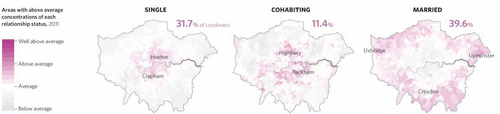
Here’s an infographic via the Atlantic showing how relationship status impacts where people tend to live in London. The purple areas indicate an “above average concentration” of a particular relationship status. As you can see, single people tend to live in the core of the city, and when they get married, they move out to the periphery. Intuitively, this probably makes sense to you.
However, I’m always curious as to whether this trend happens more because of consumer preference (people don’t want to raise kids downtown) or because of economic necessity (they can’t afford anything beyond a shoe box apartment). Because if it is largely out of economic necessity (and the Guardian article would suggest it is), then we’re not creating the inclusive cities and neighborhoods that all city builders like to talk about.
So how do we get better at this?
In my view, and I’ve argued this before, the first step should be about improving supply. That is: get more housing built. And the way to start doing that is to make land available and improve the approvals process for new developments. In a recent McKinsey report, they referred to my first point as “unlocking land.”
“Land cost often is the single biggest factor in improving the economics of affordable housing development. It is not uncommon for land costs to exceed 40 percent of total property prices, and in some large cities, land can be as much as 80 percent of property cost.”
The reason this is important is because most big cities operate with massive supply deficits. There simply isn’t enough housing. And so if you can address that at a fundamental level, you can actually do a lot to start improving affordability.