
Daily insights for city builders, delivered every morning at 6 AM ET. I’m Brandon Donnelly — a Toronto-based real estate developer and founder of Globizen. I’ve been writing here since 2013.

Tag: mark zuckerberg

  • TikTok’s revenue is apparently over $7 billion

    Last week, audio clips from an internal Q&A session at Facebook were leaked and published by the Verge. These meetings have historically always been private. In what I think was the right move, the company then decided to publicly livestream a subsequent Q&A session — you know, to show that they had nothing to hide.

    The media tended to focus on Mark Zuckerberg’s comments about the threat of Facebook being broken up by regulators. #BreakUpBigTech. Lots of people are also attempting to glean what this leak might signal about the company’s current corporate culture. But there are lots of other interesting soundbites.

    Here’s an excerpt from Zuckerberg about the Chinese social media app, TikTok:

    So yeah. I mean, TikTok is doing well. One of the things that’s especially notable about TikTok is, for a while, the internet landscape was kind of a bunch of internet companies that were primarily American companies. And then there was this parallel universe of Chinese companies that pretty much only were offering their services in China. And we had Tencent who was trying to spread some of their services into Southeast Asia. Alibaba has spread a bunch of their payment services to Southeast Asia. Broadly, in terms of global expansion, that had been pretty limited, and TikTok, which is built by this company Beijing ByteDance, is really the first consumer internet product built by one of the Chinese tech giants that is doing quite well around the world. It’s starting to do well in the US, especially with young folks. It’s growing really quickly in India. I think it’s past Instagram now in India in terms of scale. So yeah, it’s a very interesting phenomenon.

    TikTok now has over 1.4 billion installs outside of China according to TechCrunch. And in the first half of this year, it supposedly booked more than $7 billion in revenue (though most of it came from China). The company is also saying that it posted its first profit in June of this year.

    All of this is, indeed, “a very interesting phenomenon.”

    But it’s even more interesting because this is probably the first consumer-facing Chinese internet product with massive global adoption. And it has Facebook paying attention. They’re now the ones who have to play copycat — their version of TikTok is called Lasso. Of course, it’s not nearly as popular.

  • Libra expected to launch within Indian WhatsApp

    I was at a wedding last night (congrats, again, Kate + Rob) and a group of us started talking about Facebook, or, more specifically, how most of us have stopped using it all together. I deleted my account last year, but ended up having to create a ghost account with no friends just so that I could run social ads. But other than that, I don’t go on. This, of course, is a problem for Facebook. Here are some stats on its declining user base.

    This trend line could be one of the motivating factors behind Libra (Facebook’s new blockchain-based currency). Payment infrastructure, if successful, should be a lot stickier than social infrastructure. But being the classic underachiever that he is, Zuckerberg’s ambitions run even deeper than this. Max Read published a fantastic article on Libra in New York Magazine last week. Here is an excerpt:

    As far as I know, there’s only one other entity out there developing a blockchain-based digital currency for a billion-plus-member economy: China. The People’s Bank of China has been amassing blockchain and digital-currency patents as it develops its own cryptocurrency — loosely pegged to a basket of other currencies, just like Libra — which could help it more efficiently monitor and control capital flows. (So much for the decentralized, anarchist dream of cryptocurrency.) Facebook doesn’t want to compete with Mastercard, or even with Goldman Sachs. It wants to be the currency platform Mastercard operates on. Facebook’s payment product is a whole new currency because its long-term competition isn’t PayPal or Visa or even WeChat, but the renminbi, the euro, the yen, and the dollar.

    Libra is expected to be first available to Indian WhatsApp users. The goal is to gain a foothold in the $689 billion global remittance economy, of which $80 billion flowed to India last year (2018). In the short-term, this probably won’t make any or much money for the company. But it should get people using and bought in to Libra in the medium-term.

    If you’re looking for more on Libra, including what checks and balances can expected to be in place regarding your privacy and personal information, have a listen to this podcast:

    Photo by Nitin Mendekar on Unsplash

  • Architect Jeanne Gang named to the TIME 100 list

    Architect Jeanne Gang (of Studio Gang) has just been named to the TIME 100, which is Time magazine’s annual list of the world’s most influential people. Jeanne is the only architect to be included in the 2019 list.

    Jeanne was named to the “Titans” category, which typically honors those who are at the top of their respective field. She sits alongside Mark Zuckerberg, Tiger Woods, and LeBron James in this year’s TIME 100.

    Past honorees within the architecture profession include Elizabeth Diller, David Adjaye, and Bjarke Ingels. All, stars.

    The list is in its 16th year. But it’ll be the first year where there will also be a day-long conference. (Lynne and Marc Benioff, of Salesforce, acquired the magazine in 2018 for $190 million in cash and are making some changes.)

    Congratulations Jeanne.

    Full disclosure: Studio Gang is the design architect for our One Delisle project in midtown Toronto.

  • What motivates us

    Earlier this week it was announced that Instagram founders Kevin Systrom and Mike Krieger have resigned from the company. Supposedly it had to do with weakening independence from the parent company, Facebook. But I’m not really in a position to comment on the specifics.

    Fred Wilson wrote a good post about the news this week. The point he makes is that it is extremely rare for founders to stay on, at least for extended periods of time, after their company has been acquired. So it is actually quite remarkable that Instagram’s two founders stayed on for 6 years.

    But what I really want to talk about today is this quote from Fred’s post: 

    “The truth is that many entrepreneurs don’t make for great corporate citizens. Entrepreneurs like to be in charge, to be able to move quickly without a lot of friction, and they like to feel a deep sense of ownership in what they are working on.”

    It stood out to me for two reasons. One, because I agree with it. And two, because it reminded me of Daniel Pink’s book, Drive: The Surprising Truth About What Motivates Us. His overarching argument is that motivation is intrinsic and that we are best driven by the following: autonomy, mastery, and purpose.

    That sounds pretty similar to the things that entrepreneurs also seem to like.

  • Value of distribution and reach for consumer facing products

    image

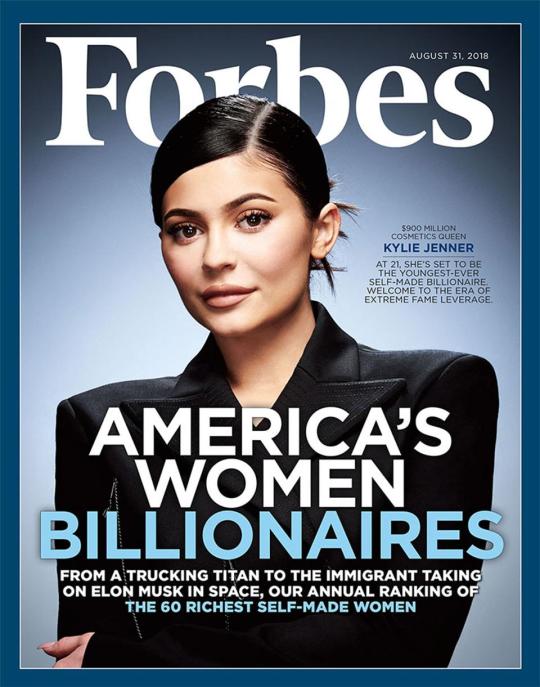
    Forbes recently pegged social media influencer Kylie Jenner’s net worth at somewhere around $900 million. That makes her the youngest (she’s 20) person on Forbes’ annual ranking of “America’s Richest Self-Made Women.” 

    And if the trend line continues, she’ll be the youngest self-made billionaire, ever. Mark Zuckerberg apparently holds that title right now. But he was a classic underachiever and only became a billionaire at age 23.

    Most of Kylie’s net worth is derived from Kylie Cosmetics, which launched less than 3 years ago, but did an estimated $330 million in revenue last year. Forbes values the company at almost $800 million. And Kylie owns every bit of it. 

    The reason I am mentioning this today is because I was fascinated by the above Forbes article. It’s such a powerful example of social media leverage. Forbes put it differently: “Social media has weaponized fame.” 

    Kylie has 111 million followers on Instagram (plus many more on her other social channels) and that’s really the most important part of this equation. She has the distribution and reach to acquire boat loads of customers. It doesn’t matter what you’re selling if nobody knows you’re selling it.

    The rest of her business is pretty much outsourced. Seed Beauty (out of Oxnard, California and Nanjing, China) handles the manufacturing, packaging, and shipping fulfillment. Shopify (headquartered in Ottawa) is her e-commerce platform.

    We could of course have a debate about whether a celebrity-fueled business is really all that sustainable. And perhaps there’s risk in relying so heavily on social for customer acquisition. But youngest billionaire is youngest billionaire.

    Image: Forbes

  • Selective decision making

    Consistency is what builds brands.

    Whether you’re a city, company, or a person, doing the same thing over and over again is what reinforces your identity. That’s why Steve Jobs always wore a black mock turtleneck, why Mark Zuckerberg always wears a gray t-shirt and hoodie, and why Tom Ford always wears a white shirt and a black jacket. They are continually building their own distinctive brand.

    I’ve always found this concept really appealing.

    Maybe it’s because I had to wear a uniform every day of my life until I went to University, or maybe I just like the concept of personal branding. Either way, there are a bunch of things that I have stuck with for a long time. For example, I’ve worn the same cologne since I was 19. I bought it in Italy one summer and I really liked it. And it now always reminds me of Europe. So I keep wearing it.

    But the other reason why consistency can be good for you is that it reduces the number of decisions that you need to make on a regular basis. That’s why President Obama also wears more or less the same thing every day:

    You also need to remove from your life the day-to-day problems that absorb most people for meaningful parts of their day. “You’ll see I wear only gray or blue suits,” [Obama] said. “I’m trying to pare down decisions. I don’t want to make decisions about what I’m eating or wearing. Because I have too many other decisions to make.” He mentioned research that shows the simple act of making decisions degrades one’s ability to make further decisions.

    The research he’s talking about comes from people like Kathleen Vohs, professor at the University of Minnesota, and Barry Schwartz, professor at Swarthmore College, who concluded that the more decisions we make – even pleasant and enjoyable ones – the quicker we get to what’s called “decision fatigue." We simply exhaust our ability to make effective decisions.

    This, to me, is a really important lesson. Because the way I look at it, we live in a world of constant noise. Our phones are always chirping. There are 132 different types of toothpaste at the store. And everywhere we turn, somebody is trying to sell us something. So maintaining a certain level of simplicity and minimalism in your life can actually be an incredibly difficult task.

    More and more I’m finding this to be the case. So maybe it’s time I start wearing the same thing every day. Do you have any tips for living life, simply?