Daily insights for city builders, delivered every morning at 6 AM ET. I’m Brandon Donnelly — a Toronto-based real estate developer and founder of Globizen. I’ve been writing here since 2013.

Tag: mapping

  • Mapping 15-minute cities

    This is an interesting map to play around with. It allows you to see how many 15-minute neighborhoods and cities there are around the world. And it works by calculating the average time it takes to walk or bike to the closest 20 points of interest in 10,000 cities. These points include all of the usual suspects like places of work, schools, healthcare institutions, grocery stores, and so on. A blue cell indicates an average walk time < 15 minutes, and a red cell indicates an average walk time > 15 minutes. The darker the color, the shorter or longer the average time in minutes.

    By this measure, it’s hard to beat many/most European cities. Here are Paris and Barcelona:

    The city propers are completely blue, and you have to go pretty far out (or up into mountains) to find areas that don’t have 15-minute conveniences.

    Toronto has a strong core and isn’t terrible overall, but expectedly, we aren’t as uniform and as deep blue as Paris and Barcelona:

    Where things get really interesting, though, is when you look at cities like Dallas and Houston:

    It’s clear where these cities stand on walkability.

  • Population-weighted densities, compared

    Boy, population densities can be so misleading. The typical approach is to just take the number of people and divide it by a given area. This then gives you something like X number of “people per square kilometer.” The problem with this approach is that there are countless factors that can skew your result.

    Hong Kong, for instance, is really dense. But as a city, it also has a lot of green space, mountains, and other undeveloped areas. Only about a quarter of Hong Kong’s land is developed. So when you divide total people by its administrative boundary area, it is going to appear less dense than it really is.

    One alternative approach is to use a method known as population-weighted density. The way this works is that you take the average densities of smaller more granular subareas and then weight them by the population of each subarea. It is a little more complicated to calculate, but the overall intent is to try and capture a density figure that more accurately reflects what the average person experiences on the ground.

    And this is exactly the method that Jonathan Nolan decided to use in his new website CityDensity.com. What his site allows you to do is compare population-weighted densities across various cities, and then see how it tapers off as you move outward from their city centers.

    Once again, it is hard to beat Paris’ supremely dense mid-rise built form:

    Well, that is, until you check out Hong Kong:

    Charts: CityDensity.com

  • A figure-ground map of Paris by building period

    This is a great tweet and link:

    The link is to a figure-ground map of Paris that allows you to filter its buildings by period of construction. Here’s what all of the periods and all of the buildings look like:

    Once you play around with the map, it will become obvious that the second half of the 19th century and the early 20th century was a prolific building period for Paris (1231 hectares of area). This is what Samuel was getting at in his tweet.

    I would love to see a map like this for every city in the world.

  • A mapping of restaurant “chaininess”

    This is an interesting study by Clio Andries (assistant professor at the Georgia Institute of Technology) and Xiaofan Laing (city planning graduate student). It looks at restaurant “chaininess” across the United States.

    To do this, they mapped over 800,000 restaurants and looked for, among other things, restaurants with the same name. If the same restaurant name shows up in multiple locations, it is considered to be a chain.

    Looking at the above snapshot of San Francisco, a yellow dot represents what is thought to be an independent restaurant and a dark purple/maroon dot represents a chain.

    San Francisco has a very high percentage of independent restaurants. In their study, the city receives a chainess score of 28, compared to the national average of 1,247. (Some cities in the southeastern US are in the 1,900s).

    One of the interesting takeaways from this study is that there appears to be a correlation between chaininess and built form. Generally speaking, the study revealed that auto-centric communities tend to have more chain restaurants, versus more independent restaurants in pedestrian-centric communities.

    This is perhaps intuitive if you’ve ever driven and traveled across the US, but it is interesting to consider what is actually leading to this food and beverage outcome. Density certainly plays a role.

  • 3D mapping of US precipitation

    Alasdair Rae is back with another set of interesting maps. This time he maps out precipitation levels across the United Kingdom and the United States using cool 3D extruded mappings. He calls them rain shadow maps. Above is showing the average annual precipitation in the contiguous US from 1981 to 2010. The higher the peaks the higher the precipitation. Not surprisingly, the highest values are in the Pacific Northwest with over 4,064 mm (160 inches) of precipitation per annum. Some of the patterns here are also really interesting. Note California’s Central Valley.

  • Beer over water and the contributions of John Snow

    The work of John Snow is instrumental to the field of epidemiology. In the mid-19th century, during what was the third major outbreak of cholera, he created the following map showing the clusters of cholera cases in London’s Soho neighborhood. Stacked rectangles were used to indicate the number of cholera cases in a particular location. This was a major breakthrough for the fight against cholera because, at the time, it wasn’t clear what was causing it. According to Wikipedia, there were two main competing theories. There was the miasma theory, which posited that cholera was caused by bad particles in the air. And there was the germ theory, which posited that cholera could be passed along through food and/or water.

    By mapping the clusters of cases, Snow discovered a concentration of incidents in around the intersection of Broad Street and Cambridge Street (now Lexington Street) where a water pump was located that drew water from the Thames. This led Snow to the conclusion that it was maybe a bad idea to offer up polluted river water as drinking water. And sure enough, when the pump was shut off and residents were directed to other nearby pumps, the incidences of cholera began to decline. The germ theory had proven to be true.

    The first time I saw John Snow’s map was in architecture school. Perhaps many of you have seen it as well. It is often used to illustrate the potential of visual representations to not only tell a story, but to teach the creator what that story actually is. In hindsight, it may seem obvious that polluted river water is something that we maybe shouldn’t drink, but it wasn’t at the time. This map helped people understand that. Today, we have far more sophisticated tools available to us, but we still have a lot to learn and we’re doing that every day — particularly during a pandemic.

    One other thing worth mentioning is that there are a few exceptions to Snow’s findings. Supposedly, many of the workers in a nearby brewery were able to completely avoid the cholera infection during the outbreak by only drinking their own brew. Some say it is because the brewery had its own water source, whereas others say it is because the brewing process — the water is boiled — kills the cholera bacteria. Either way, I think the moral of this story is pretty clear: when in doubt, choose beer over water.

    Map: Wikipedia

  • A mapping of development potential in Toronto

    I first met Monika Jaroszonek in 2017, right before she started RATIO.CITY. Since then she has developed some pretty incredible tools for the city building space.

    Yesterday the company published this interactive visualization looking at development potential across the City of Toronto. The mapping looks for the following:

    The tool then ranks each development site – AAA, AA, A – according to how many of the above criteria it meets.

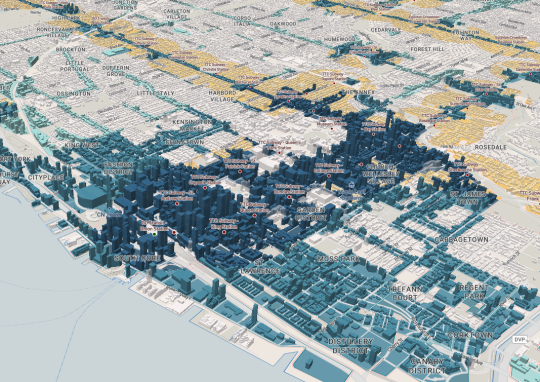
    It also flags land that it refers to as “Missed Opportunity.” These are lands located within 500m of a Major Transit Station, but that are designated as Neighbourhoods (considered stable) or Employment (whole other discussion).

    Based on this filter, about 5.6% of the City’s land is a “Missed Opportunity” and about 1.2% is AAA.

    When you look at the visualization, that is one of the first things you will probably notice; a lot of our transit infrastructure is currently underutilized as a result of land use policies.

    Image: RATIO.CITY

  • Street-level intelligence and analytics

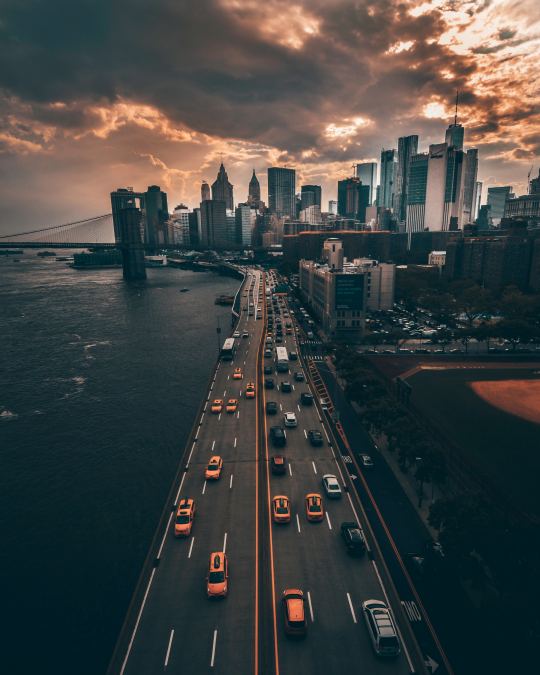
    I discovered a company yesterday called CARMERA, which just raised a $20 million Series B funding round. They call themselves a “real-time, street-level intelligence platform” and their flagship product, called Autonomous Map, provides HD maps and real-time navigation data to autonomous vehicles. That’s the way AVs work. They need maps like CARMERA’s to function. Here is an overview of what is supposedly the largest AV taxi service in the world. It is a partnership between CARMERA and Voyage.

    One of the interesting things about this product is that it is cleverly powered through another one of their products: a free fleet monitoring tool for commercial operators. So fleet managers use this service to keep track of their actual human drivers and, at the same time, CARMERA uses the vehicles to collect the data it needs for its Autonomous Map. They call it “pro-sourcing” the data (a play on crowdsourcing).

    It is perhaps a good example of “single user utility.” The product you’re making often has to be valuable to a single user before scale is reached. In this case, Autonomous Map would be a hard sell without a critical mass of pro-sourced data. It solves the perennial chicken-and-egg problem when creating new marketplaces.

    Finally, I think many of you will be interested to know that CARMERA has also announced a partnership with the New York City Department of Transportation. As part of this, the company will be handing over the data they have on pedestrian density analytics and real-time construction detection events. Part of their mission is to “automate cities” and better street analytics will certainly help to open up a new world of city building possibilities.

    Photo by Yeshi Kangrang on Unsplash

  • A language map of Toronto

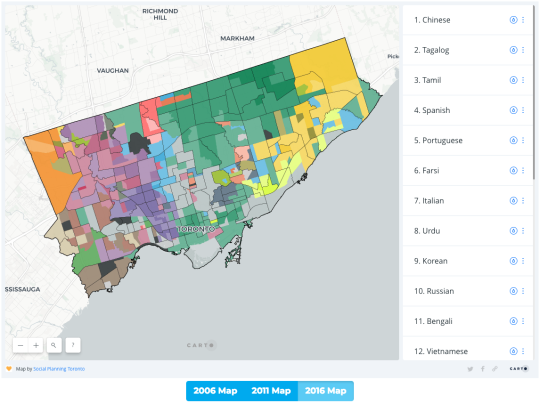
    This is a language map of Toronto showing the most commonly spoken non-official languages at home. (It only counts individuals who reported speaking a single non-official language most commonly at home, as opposed to multiple ones.) The map you see below is based on 2016 census data, but if you’d like to check out the previous census years, as well as an interactive version, you can do that here at Social Planning Toronto.

    image

    The top languages are also listed on the right of the map, with the exception of the gray areas. These areas indicate census tracts where English > 90%. I don’t know why French shows up as #13, since this map is supposed to be non-official languages.

    In any event, green represents Chinese (includes Cantonese, Mandarin, and so on). Sky blue is Tagalog. And yellow is Tamil. I’ll let you play around with the map to explore the others. There shouldn’t be many surprises if you know Toronto well, but it’s still interesting to explore the clustering and the percentages. Some of the census tracts have a single non-official language representing 90%+ of the responses.

    The biggest gains over the last decade – following the same methodology as the above mapping – were Tagalog, Farsi, Bengali, Arabic, and Pashto. And the biggest declines over this same time period were Italian, Tamil, Urdu, Punjabi, and Polish. But this data is only for the City of Toronto and so I suppose that a decline could also be because of people relocating to other parts of the region.

    A big part of Toronto’s strength comes from exactly what you see in this map: the world in a city.

  • One hour drive

    I’m taking next week off so that I can respond to emails from various places in Ontario and Quebec instead of from my desk. The out of office messages really fly at this time of year, so it’s usually a pretty good time to try for a recharge.

    Because of that, this post feels appropriate. 

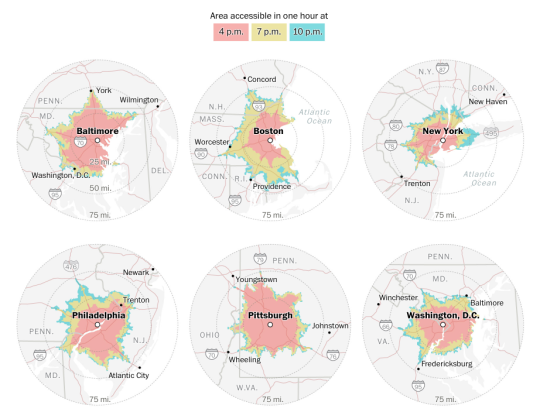
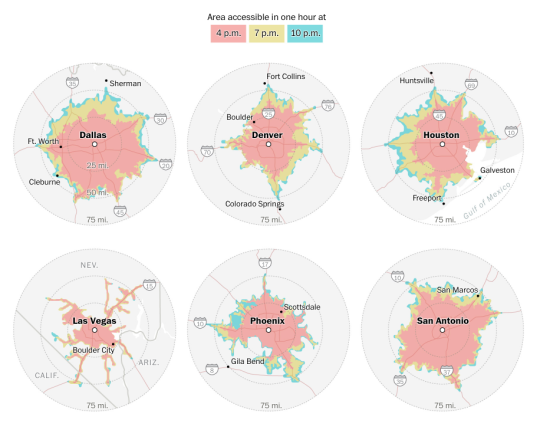
    Sahil Chinoy of the Washington Post recently looked at anonymous cell phone and vehicle data (from Here Technologies) to see how far you could drive in one hour if you were trying to escape the downtown of various U.S. cities on a Friday afternoon in the summer.

    This exercise was done for 3 departure times on July 28, 2017: 4pm, 7pm and 10pm. The mappings all leverage 3 years of historical speed data.

    Here is a first set of maps showing a few cities in the northeast and in the mid-atlantic. Every city is shown at the same scale so that they can be easily compared.

    image

    And here is a second set of maps showing a few, more car-oriented, cities.

    image

    Not surprisingly, older transit-oriented cities like New York don’t do well in this contest. No matter what time you leave, it’s hard to make it past 30 miles. Whereas in the case of Vegas, it doesn’t really matter what time you leave. You should be able to clear 50 miles.

    That’s the other interesting thing to note about these maps – the spread between distances at the various times.

    I’m sharing these because I’m a sucker for diagrams, but I don’t think they tell the whole story. The modal splits and the population and employment densities are all very different across these cities. New York’s core competency is in moving lots of people in trains, not in cars.

    Although, perhaps the ironic thing about these diagrams is that a tighter drive radius might actually say something about how efficiently land is being used.