Daily insights for city builders, delivered every morning at 6 AM ET. I’m Brandon Donnelly — a Toronto-based real estate developer and founder of Globizen. I’ve been writing here since 2013.

Tag: lrt

  • Why light rail isn’t a waste of money

    Last weekend a friend of mine sent me an article from The Economist talking about why trams, streetcars, and light rail are a waste of money. The argument is basically that steetcars are expensive, less efficient, and that – despite North America’s renewed interest in them – we should instead be spending our scarce public dollars on more buses.

    Here’s a snippet from the article:

    …but cash spent on streetcars displaces spending on other, more cost-effective forms of public transport like buses, which offer cheaper and more-efficient service but are considerably less sexy. The capital cost per mile of a streetcar is between $30m and $75m, while a rapid bus service costs anywhere between $3m and $30m, according to the American Public Transportation Association.

    Now, there’s no question that buse routes are initially cheaper to implement. You don’t have track to build. But I don’t agree that the cost structure is quite that simple if you consider the number of people you need to move in your city. I struggle to see buses as a more efficient service.

    The big difference between modern light rail and buses is capacity. Toronto’s new streetcars will move about 3 times as many people as your typical bus. So you’d need to triple the number of buses and triple the number of drivers – adding to your labor costs – if you want to have a chance at moving the same number of people. 

    Streetcars are also electric, which means they run on a renewable energy source. We’re in the process of making this switch with private transport, so why go backwards when it comes to public transport? You can certainly run electric buses as well, but then you’re building overhead power lines and bringing up your initial costs.

    I think the challenge is that when people think of light rail, they think of slow lumbering streetcars. I agree that many of these lines are inefficient and I’ve written about it. But there are a number of ways to implement light rail. And when done well it can efficiently move a lot of people for costs that are far less than a subway.

    Image: Aecom
  • All streetcars are not created equal

    With Toronto preparing to deploy the first batch of its new streetcars this summer, there’s been a lot of talk about streetcars in general. Rob Ford has said he wants to get rid of them all together and I hear a lot of other people expressing similar frustrations: Streetcars are rolling stop signs. Streetcars block 2 lanes of traffic. Why don’t we just use more buses? Streetcars cause traffic. And so on.

    So what should we do?

    First, let me start by saying that buses suck. I’m a huge proponent of public transportation in cities, but there’s nothing quite like a rush hour bus ride to have you question your economic status in life. Bus routes have also been shown to have little economic development value, where as fixed rail lines (such as streetcar, LRT and subway) generally increase surrounding property values and spur investment.

    Second, my view is that streetcars themselves as a transportation technology aren’t the problem. It’s our execution. I’ve touched on this topic before on ATC, but I’d like to reiterate a few points here. 

    The value of light rail is that it’s a relatively inexpensive way (compared to subway) of efficiently moving a lot of people. But in order to do that, you need deploy it in a sensible way. In my mind, that primarily involves 3 things: giving streetcars their own dedicated lanes (grade separation), having a reasonable number of required stops, and streamlining the onboarding and off boarding process. Today, we don’t do a great job at most of these things (although our new streetcars will use a proof of payment model).

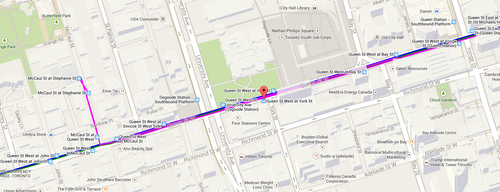
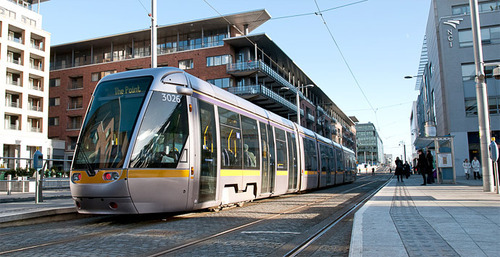
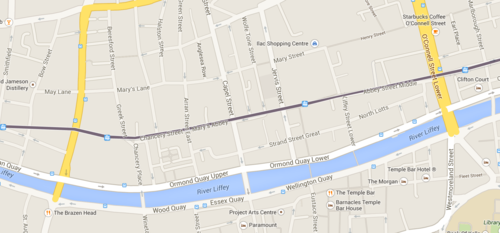
    Take a look at this comparison between Dublin’s Luas light rail system and Toronto’s streetcar system. Both images are at the same scale. Notice the dramatically different stop spacing. Much of the Luas system also runs on its own dedicated lanes.

    Dublin:

    image

    Toronto:

    image

    Every time a Toronto streetcar stops it generates waste. Cars are forced to stop behind it. Everyone on the streetcar has to sit and wait while somebody fumbles through their change looking for a token. But there are other ways to do this. There are ways to make light rail more subway-like, despite the fact that it may be above ground.  And so I don’t think we should be so quick to write off all streetcars.

  • Transit vehicle capacities compared

    I was cruising the twitter sphere yesterday when I came across the following chart, outlining the various transit vehicle capacities here in Toronto. It was created by Cameron MacLeod of #CodeRedTO, which is a grassroots group advocating for “a rational, affordable, and achievable rapid transit strategy for Toronto.”

    image

    On the left you have the vehicle type and then you have the capacity in terms of number of seats and standing room. The planned capacity is essentially the sum of those two numbers and the “unsafe crush load” is the number of people you could fit if you really put your back into it.

    Articulated buses refer to the longer (1.5x) bendy ones and, similarly, ALRV streetcars are the longer, articulated version of our regular streetcars. The low-floor streetcar is similar to what Toronto will be getting. And SRT is the Scarborough Rapid Transit system.

    The chart also compares between vehicle types: How many cars would you need to move the same number of people? How many buses? And so on. As one example, you would need 15.9 buses or 982 cars to move the same number of people as the Yonge subway line!

    What’s missing from the above chart though is light rail transit (LRT), which is comparable to the linking of up to 3 low-floor streetcars. In the case of the under construction Eglinton Crosstown LRT line, the planned capacity is 750 people!

    This is an hugely important takeaway because many people, including our own Mayor, do not properly distinguish between streetcar and light rail. The two are not one and the same. LRT has the potential to move a lot more people.

    In fact, at 750 people, the Eglinton Crosstown could move more people than the Sheppard subway line, which is only operating on 4 cars (as compared to 6 on our other subway lines).

    So while it’s all fine and dandy to bang our fists on the table and advocate for subways, they don’t make economic sense in all parts of our city. With the Sheppard line, we’ve been leaving capacity on the table and wasting taxpayer money.

    Of course this chart is also useful for those outside of Toronto. What I like about it is that it clearly shows the tool chest available to cities when it comes to building transit. Every city and neighborhood is different. And I think it’s important to have intelligent conversations about what makes sense in each.

    Thank you to Cameron and #CodeRedTO for allowing me to post their work.

  • Turning St Clair and Spadina into LRT

    I’ve talked before about how Toronto doesn’t currently have any true light rail transit lines. LRT does not equal what we have on St Clair Avenue. The stops are spaced far too close together. It’s just a streetcar on its on right of way.

    This is better than a streetcar that doesn’t have its own right of way, but it could be better. So here’s an idea for better optimizing some of the transit infrastructure we already have: let’s convert the St Clair and Spadina streetcar lines into true LRT.

    Here are 3 things we could do.

    1.

    First, we need to get rid of some stops. Let’s take the stop spacing being proposed for Eglinton Avenue and apply it to St Clair Avenue and Spadina Avenue. By stopping less, it means performance goes up. Think about how much time is wasted every time the streetcar has to stop for people to get on and off. This is why New York has express trains.

    Alternatively—and instead of actually getting rid of some stops—we could also just operate two types of stops: rush hour stops and off-peak stops. In the case of off-peak stops, the streetcar would simply skip them during rush hour. The cost of implementing this would be signage and consumer education.

    2.

    Second, we finally roll out a better payment system. While tokens do give me a kind of 1960s nostalgia, I hate change and I hate fumbling with microscopic tokens in my pocket. Why isn’t there an app for this?

    But more importantly, if we had a better payment system we could transfer the point of payment from the actual streetcars to the stops themselves. This would mean that you’d need to pay in order to gain access to the stop itself. The benefit of this though is that it streamlines onboarding. Customers can now just walk onto the streetcar, like they do on the subway.

    And if you’re thinking about those times where you give up waiting for a streetcar and just hail a cab, well we could simply make the fare refundable if you leave at the same stop. This type of system would also open up the possibility of distance based fares (see London, Tokyo, etc.)

    3.

    Third, put the LRT lines on the subway map and operate them with the same rigour. Right now the customer experience gap between subways and streetcars is huge. Subways run on time and streetcars are completely hit or miss. There’s an excuse for streetcars that run mixed in with traffic, but I don’t see why we can’t make light rail (using its own right of way) just as predictable as subways. I used to take the LUAS in Dublin everyday and it was a fantastic experience.

    We really need to start taking transit more seriously in Toronto. I don’t know about you, but I’d much rather be known around the world for having the best transit system than for having a debaucherous mayor.

  • There’s no light rail in Toronto

    Next City published an interesting article this morning on the politics behind Rob Ford’s subway obsession. I encourage you to have a read if you’re interested in politics, transit and/or the increasing polarization of North American cities (core vs. suburbs). It’s called Canada’s Strangest Straphanger.

    There are a number of great take-aways from the article, but I’d like to highlight one that I’m not sure many Torontonians realize: There’s currently no light rail (LRT) in the city. We have streetcars, of course. But no light rail. There’s a difference.

    Here’s an exert from Next City:

    “It is true that most people in Scarborough don’t want a light rail. They want a subway, and the reason they want it is that there is no light rail in Toronto,” says Jay Young, SSHRC postdoctoral fellow in the Department of History at McMaster University in Hamilton, Ontario. “We just have streetcars and subways and they think light rail is a streetcar, when actually it’s very close to a subway in terms of having its own right of way.”

    This may seem like semantics, but it’s not. Again, one difference is that light rail has its own right of way and streetcars compete with vehicular traffic. The other significant difference is station spacing. Streetcars stops are spaced similar to bus stops, which let’s say averages around 250m. LRT stations on the other hand are often in the range of 400-600m. This makes them similar to subways.

    It’s for this reason that even though the St Clair streetcar has its own right of way, I would not personally consider it a true LRT. As someone who lived in midtown for over 3 years, I can tell you that the stations are way too close together and that it’s highly inefficient during peak times – much like the rest of our streetcar network.

    Given the constant debates going on this city about light rail vs. subways, I think it’s important that we’re clear on definitions. Light rail has the potential to be an effective (read: cheaper and faster) way of delivering rapid transit to a greater number of people in the city. Before we dismiss that proposition, let’s please understand what it is.