Daily insights for city builders, delivered every morning at 6 AM ET. I’m Brandon Donnelly — a Toronto-based real estate developer and founder of Globizen. I’ve been writing here since 2013.

Tag: los angeles

  • A self-fulfilling prophecy in the 6

    [soundcloud url=”https://api.soundcloud.com/tracks/190951409″ params=”auto_play=false&hide_related=false&show_comments=true&show_user=true&show_reposts=false&visual=true” width=”100%” height=”450″ iframe=”true” /]

    More so than any other genre of music, there seems to be a longstanding tradition in hip hop of promoting the city in which you’re from. From Los Angeles to Atlanta to New York, I’ve always admired the way that hip hop artists promote and showcase their cities.

    For a long time in Toronto we didn’t have that. Our hip hop scene was too embryonic and we just didn’t have artists who were both big enough and willing to take the lead. Or at least, that’s what I was lead to believe as an outsider who candidly doesn’t really follow the scene.

    But all that has changed.

    Earlier this month, Pitchfork published an interesting article by Jamieson Cox called: Views From The 6 – Inside Drake’s Toronto. It talks all about Drake’s love affair with this city and it even has a map of all the areas of Toronto that have been featured in his videos.

    But at one point in the article Jamieson argues that – like many hip hop cities – Drake’s depiction of Toronto is more fantasy than reality:

    His mythological Toronto is a metropolis where everyone knows your name and exes are always lurking around the corner, a forest of penthouses with a panoramic view, a park-studded playground where the skies are free of ambient light and the highways are always clear. Like many hip-hop locales, it’s a city closer to the realm of theory—and fantasy—than reality. 

    However, at the end of the day, I don’t think that matters. Similar to how your mind actually believes that wine tastes better out of an expensive glass, I think a big part of city branding has to do simply with how you’re supposed to feel. What is Toronto supposed to be like? How am I supposed to experience this?

    I love what Drake is doing. Because if everyone thinks it’s supposed to be a certain way, eventually that becomes a self-fulfilling prophecy.
  • The most segregated cities in North America

    The Martin Prosperity Institute here in Toronto just released a new research study called Segregated City: The Geography of Economic Segregation in America’s Metros

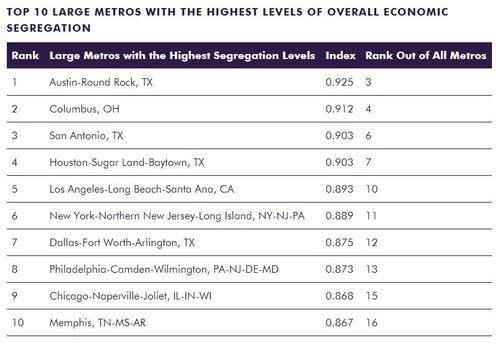
    The report looks at the physical sorting and separation of advantaged and disadvantaged groups within cities. And it did so across 70,000+ Census tracts in the US and in terms of 3 different dimensions: income, education, and occupation.

    Here are the most segregated “large metros” in the US:

    image

    Table Source: MPI

    And here are some of their broader findings – taken verbatim from page 9 of the study (click here for the full report):

    Economic segregation is positively associated with population size and density. It is also positively correlated to two other sets of factors that follow from metro size and density: how people commute to work and the breakdown of liberal versus conservative voters.

    Economic segregation tends to be more intensive in high-tech, knowledge-based metros. It is positively correlated with high-tech industry, the creative class share of the workforce, and the share of college grads. In addition, it is associated with two key indicators of diversity, the share of the population that is gay or foreign-born, which tend to coincide with larger, denser and more knowledge-based metros.

    Economic segregation is connected to the overall affluence of metros, with positive correlations to average metro wages, income, and economic output per capita.

    Race factors in as well. Economic segregation is positively associated with the share of population that is black, Latino, or Asian, and negatively associated with the share that is white.

    Economic segregation is associated with income inequality and even more so than with wage inequality. Its effects appear to compound those of economic inequality and may well be more socially and economically deleterious than inequality alone.

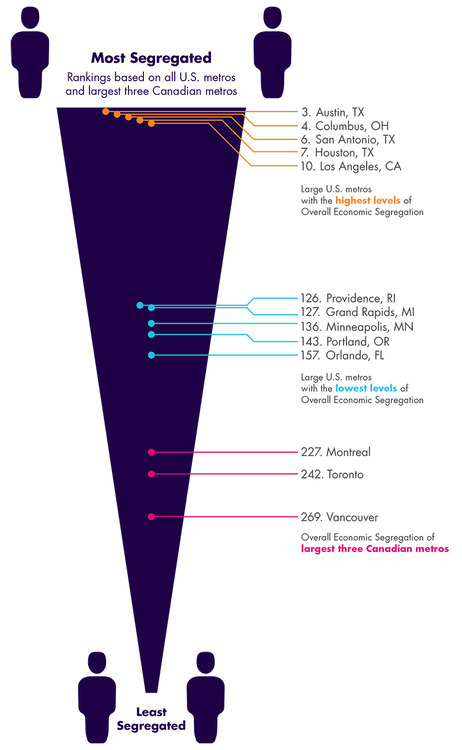
    The research team also looked at how Canada’s 3 largest metros – Toronto, Montreal, and Vancouver – compare to those in the US in terms of segregation. 

    The finding was that Canadian cities are overall less segregated than US cities, but that it should still be considered an area of concern. The most segregated of Canada’s 3 largest metros was found to be Montreal.

    image

    Image Source: MPI

    My view is that our economy is going through a profound shift right now. We’re transitioning from the industrial age to the information age. And in its wake, we’re seeing a number of disruptions, one of which appears to be rising inequality and segregation. 

    That’s not to say that I think this transition is a bad thing (I don’t think it is), but I do think we should be carefully considering and designing our future.

  • Urban Engines launches app

    [youtube https://www.youtube.com/watch?v=FZ8ODREybcs?rel=0]

    About 9 months ago I wrote about a new startup called Urban Engines that was trying to improve urban mobility by using big data to optimize transit usage. 

    Last Tuesday the app launched in 10 cities across North America. So if you’re in Boston, Chicago, Los Angeles, New York, Portland, Seattle, San Francisco, Toronto, Vancouver, or Washington D.C., you can go ahead and download it right now.

    The biggest “wow factor” is probably the augmented reality feature that allows you to hold your phone up and see transit information overlaid on top of the street in front of you.

    But more fundamentally, the real potential lies in the platform’s ability to collect data on the way people move in cities and on how transit lines are performing, so that it can be fed back to improve overall efficiency.

    That’s why the company is also working with cities to give them 24/7 analytics and reporting on how every bus, car, and train is performing in their networks.

    My hope is that with better data at our disposal, we’ll be able to elevate the discussions around transit and transit planning. Without great data, it’s too easy for these discussion to become political.

  • Where Uber operates and where it’s banned

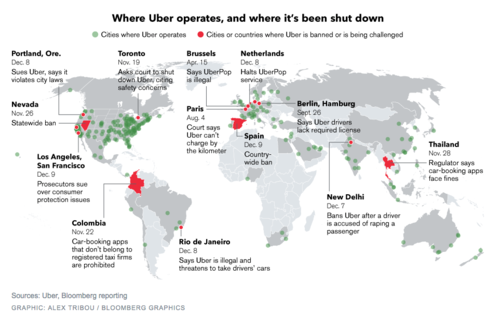
    Earlier this month, Bloomberg published this map showing where Uber operates and where it’s been banned (or is being challenged). You can click on the map for a larger version.

    image

    Uber operates in about 250 cities across the world. But it’s being challenged in a lot of them, including Portland, San Francisco, Los Angeles, Toronto, Rio de Janeiro, Paris, Berlin, as well as others.

    I don’t want to dismiss any of the safety concerns that have arisen lately, because those are very serious and they need to be addressed. Life safety is paramount. But I continue to believe that banning a service that many people clearly want to use isn’t the right solution.

    On top of that, I think it could lull many of the local taxi communities into a false sense of security about the future. Uber is moving incredibly quickly. UberX launched in Toronto in September of this year. And UberPOOL – their new carpool service – is likely next.

    With these releases, Uber is working towards a specific vision for the future: Their goal is to eliminate the need for private vehicle ownership. Should they be successful, this will not only impact taxis, but also car manufacturers and urban mobility in its entirety.

    So as difficult as it might seem right now, I think urban leaders would be better served trying to figure out how to harness these innovations. Cities have been trying for decades to get people out of their cars. Uber wants to do the same.

  • Comparing taxis to ride sharing services

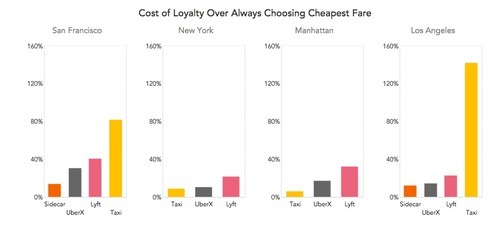
    This morning I woke up to a post from venture capitalist Fred Wilson talking about the cost of loyalty when it comes to local transportation markets. More simply, it was a cost comparison between regular city taxis and ride sharing services such as a UberX, Lyft, and Sidecar in San Francisco, Los Angeles, and New York.

    The data was sourced from whatsthefare.com and looks like this:

    The way to understand this chart is to think about it as the answer to this question (from whatsthefare.com): If I were to take 1,000 rides over my lifetime with one individual service, how much more would I pay than if I compared prices and always picked the cheapest option?

    What you should immediately see is that regular taxis are far more expensive in San Francisco and Los Angeles compared to all of the ride sharing services. In the words of Fred Wilson: “That is crazy. They are going to go out of business in those markets with that pricing.”

    In my words: They are fucked.

    I wonder where Toronto would place against these cities. My gut tells me that we would be closer to San Francisco than New York. And if that is the case, I think you can figure out what that means.

    I thought this would be an interesting post given yesterday’s point about our cities being multi-modal. We urbanites have many more options at our disposal than we did only a few years ago. And if they’re cheaper and more convenient, we’re going to use them. I think that’s a good thing.

  • Thoughts on megacities in the developing world

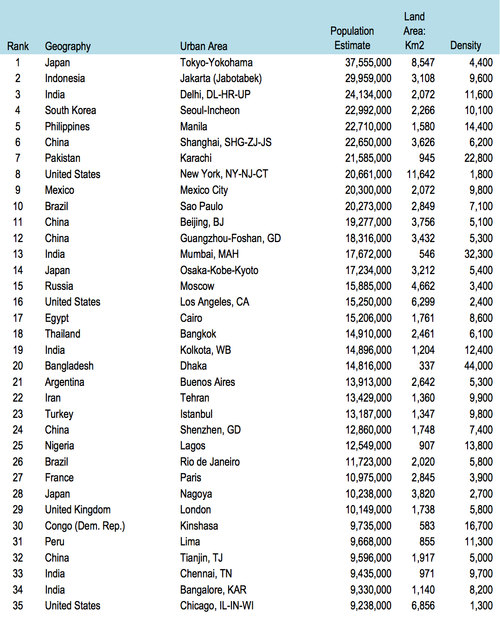
    Without a question, we are living in an urban era. More people now live in cities than anywhere else on the planet and I’ve repeatedly argued that cities are our most important economic engine. As a result of these demographic and economic shifts, we’re seeing megacities at a scale the world has never seen before. Below is a list of the top 35 largest urban areas in the world.

    image

    The top urban area is Tokyo-Yokohama, with a population of roughly 37.5 million people. That’s almost the same as the state of California and is more than the entire population of Canada, which sits at just over 35 million people. London, which, during the 2nd half of the 19th century, would have been the largest urban area in the world is now the 29th largest.

    But at the same time, London arguably remains the most important global city–a title that can only really be rivalled by New York. Which raises an important distinction. One that Aaron Renn clearly identifies in this recent article for New Geography: Just because a city is a megacity, doesn’t mean it is or will ever be a global city. In fact, Renn argues that many of the world’s largest megacities will never “turn the corner” and become leaders of the global economy.

    For that to happen, he believes that the city needs to belong to a country on the rise:

    Moscow was the capital of the Soviet Empire. New York and Los Angeles came of age when America was the rising, and ultimately dominant, economic colossus. It’s the same for Paris and London, two borderline megacities, which rose as imperial capitals. 

    But how much of this is driven by the country and how much of it can be driven by the city itself, upwards? Could it be the city that ultimately empowers the country to rise? I ask these questions because Renn frames his argument as if “national hyper growth” is the only prerequisite that will allow the struggling and underdeveloped megacities to pull themselves up and into the developed world.

    But the problem is that there’s no clear path to prosperous maturity for these megacities.  They are so huge, and their problems so immense that they are difficult to even conceptualize, much less do something about.  The amount of needed infrastructure provision alone – water, sanitation, drainage, transport, telecom, electricity, parks, schools, etc. – is staggering. And that doesn’t even touch arguably more difficult problems like corruption and good governance. Absent national hyper growth – a la Japan or Korea – of a level that creates a plausible claim to being the world’s rising economic power, or the proceeds of empire, it seems unlikely any of these cities will ever succeed. By contrast, smaller cities have a much more addressable problem space.

    Now, I don’t disagree that the problems in these cities seem almost insurmountable. I’ve been to places like Dhaka, Bangladesh. I’ve witnessed first hand the challenges facing megacities in the developing world. 

    But to assume that these cities are lost causes without the nation itself lifting it up, seems almost self defeating and overly pessimistic. It also strikes me as a bit of a chicken and egg scenario. Because if cities are our economic engine, then “national hyper growth” seems difficult without also getting our cities right.

    What comes first?

    Yes, there are and will be reforms that need to happen at the federal level but, at the same time, I think there’s a lot that can and should happen from the ground up. Perhaps that’s part of the reason Singapore has been so successful. As a city-state, its reforms were both top down and bottom up. 

    I want to believe that with the right reforms, policies, and leadership, any country can create a framework in which its cities are able to thrive. And that it’s not just the result of imperial rule or some other circumstance. From good and transparent governance to developed financial markets, there are many things that cities need to truly prosper. But when you get it right, the results can be remarkable. 

    Chart: Demographia

  • How could cities better connect all their residents to economic opportunity?

    image

    This blog post is a submission to a group blogging event being put on by Meeting of the Minds and Living Cities. The focus is on urban opportunity. Click here for more information about the event.

    Since the beginning of time, the purpose of cities has been to bring people together to socialize with one another and to generate wealth. And, today, more than ever, the potential returns of being smart and being in a global city are huge. Cities are our economic unit. They are what’s driving the global economy.

    But as the world continues to urbanize at an unprecedented rate and as the global economy becomes increasingly concentrated in select urban centers, how do we ensure that all city dwellers are connected to the economic opportunities being made available by this new information age?

    Here are 3 suggestions.

    First, we need broad and equitable access to education. I was deliberate in talking about the “returns of being smart.” Education and the right skills are even more critical today, because the labour market is not what it used to be. In Edward Glaeser’s book, Triumph of the City, he talks a lot about Detroit and how the greatest thing the city–and the car industry–did in its history was create lots of high paying jobs for people with little or no education. However it was also possibly the worst thing Detroit did because, today, the city is now stuck with that legacy. And those same high paying jobs for people with little or no education aren’t coming back. The labour market has changed. 

    Second, we need to ensure that people living in cities have the opportunity to be physically connected. That our cities offer strong transportation and mobility options and that our cities are designed to be inclusive. When I was visiting a friend in Los Angeles a few years ago and lamenting about the traffic, he responded by telling me that LA traffic is merely a socioeconomic problem. If you have the means, you get to live in desirable central neighborhoods where your commute is entirely reasonable. And if you don’t have the means, well, then you get stuck with a horrible 2-hour commute. We know that the rich will always outbid the poor for housing in any city, but as much as possible, we need to give people physical mobility so that they can then achieve economic mobility.

    At the same time, the design of individual neighborhoods and buildings matters a great deal. If you’ve ever watched The Human Scale, you’ll likely remember the line:

    “First we shape our cities and then our cities shape us.”

    As one example, the documentary talks about how masterfully modernist architecture from the 60s and 70s achieved extreme forms of social isolation. It cleansed the urban environment of any sort of public life and brought it all up into disconnected towers. The problem was that it was far too rational. The power of cities lies in their organic and evolving nature. And when you constrain them with mechanisms such as single use zoning and other restrictions, you stifle their potential to generate economic opportunities for their residents–which, as we’ve said, is one of the main reasons people choose to live in cities in the first place. 

    Finally–and this is a bit of a tie in for everything we’ve been talking about–we need to be proactive about inequality. Research shows that there’s a direct correlation between income inequality and social mobility. The more income inequality a city or country has, the less intergenerational social mobility it has–not to mention that it also leads to more crime and other negative externalities. This is a complex issue though, and I won’t pretend that it can be easily solved with a better public transit and more bike lines. It’s something much deeper and more broad. This one is about a belief that cities should be designed to enhance everybody’s quality of life and to make everybody richer, not just a few.

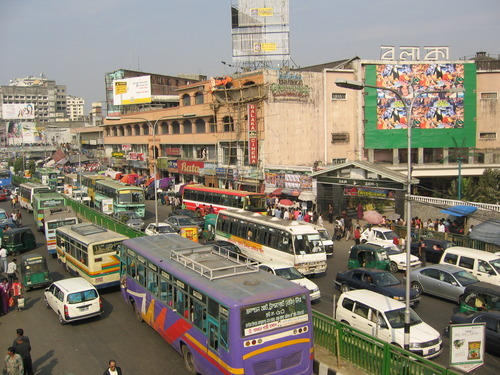
    Photo: Wikimedia

  • SKATE city videos

    Two weeks ago I wrote a post called “Skateboarding and the city.” If you liked that post, I recommend you take a look at this 5 minute video called SKATE Toronto. It’s part of a series where local skateboarders provide a guided tour of their city.

    [youtube=http://www.youtube.com/watch?v=SEb4QvJzFVU&w=560&h=315]

    You’ll find similar videos for New York, Los Angeles, Miami, Philadelphia, Hong Kong, etc. What I like about them (other than the skating, of course) is that they clearly demonstrate the unique way in which skateboarders examine and engage with cities.

  • Taking the bus

    According to Salvador Dalí and Margaret Thatcher I’m a loser and a failure. I came across these quotes on Tumblr (via goingurban) this morning:

    “A man of forty who still rides the metro is a loser.” -Salvador Dalí

    “A man who, beyond the age of twenty-six, finds himself on a bus can count himself as a failure.” -Margaret Thatcher

    Now as much as I like dislike buses (and prefer the train varietal), I’ve made it pretty clear that I’m a believer in mass transit.

    If anything, I think these quotes show how much the world has changed, although perhaps only in certain geographies. Depending on where you live (I’m thinking Los Angeles or, maybe, Oklahoma City), it probably still sucks not to have a car.

    That’s too bad.