Daily insights for city builders, delivered every morning at 6 AM ET. I’m Brandon Donnelly — a Toronto-based real estate developer and founder of Globizen. I’ve been writing here since 2013.

Tag: london

  • The top 30 cities for tech and startup companies

    The third edition of Savills’ annual Tech Cities report is now out. Savills is a global real estate company headquartered in London and a few years ago they started looking and what makes a successful “tech city.” As always, you should take these rankings with a healthy dose of scepticism. But this one is based on over 100 individual metrics across 6 main categories:

    • Business environment (such as the size of the financial services industry)
    • Tech environment (such as the amount of inward VC investment)
    • City buzz and wellness (is it a cool place to live?)
    • Talent Pool (is the city creating and attracting young/smart talent?)
    • Real estate costs
    • Urban mobility

    Here are the top 30 cities for tech and startup companies:

    New York takes the top spot, supposedly because of its deep talent pool and position as one of if not the capital the world. But my friends in the Bay Area tell me that their housing shortage is also starting to impact SF’s tech dominance.

    Generally, the report finds that the above “tech cities” should see their GDP rise by 36% over the next decade, compared to 19% for other developed cities. I’m not sure how much of this has to do with tech, but the above list does differ from what you’d see in a more conventional global cities index. Here you have Austin ahead of global cities such as Hong Kong. And you have Toronto ahead of cities like Tokyo and Paris.

    One takeaway that shouldn’t come as a surprise to readers of this blog is the rise of Chinese cities in the index. Beijing is ahead of New York, London, and San Francisco by a wide margin in terms of annual VC investment. And Chinese cities as a whole are starting to take a greater share of global VC dollars (second chart below).

    If you’d like to download a PDF of the full report, you can do that here.

    Image: Photo by Jason Briscoe on Unsplash
  • Archival street life footage

    Guy Jones is a videographer who specializes in archival footage, or at least that is what his YouTube account suggests. He edits old videos and makes them more watchable by doing things like adding sound and slowing them down to a natural rate. 

    (Older films often appear sped up because they were recorded at less than 24 frames per second and then later played at 24 or more frames per second.)

    I’ve blogged about one of his videos before. This one of New York City in 1911. But he has so many other fascinating films on his channel – including a frozen Ottawa from 1942 – that I figured I would share it in its entirety today

    For the city builders in the room, here are some street life videos of Paris in la Belle Époque (1896-1900), New York City in 1927, and London in 1967. Among other things, it is fascinating to see how quickly the car crept its way into our cities.

    The video of Paris is all horses and moving walkways. The video of New York City (1927) is all cars. And if you look at the other video of New York from 1911, you’ll see a city in the midst of that transition.

  • The next 15 megacities

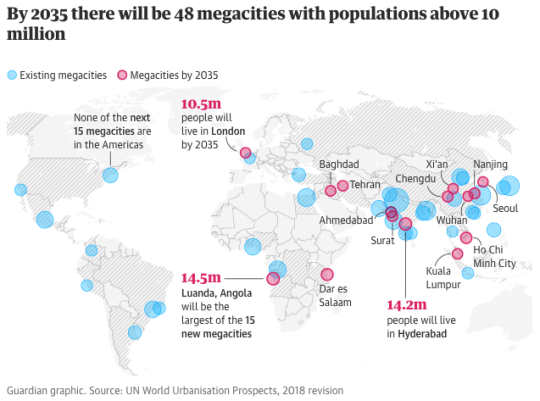
    The Guardian is running a series right now called: The next 15 megacities. A megacity is typically (but loosely) defined as a city (or metropolitan area) with a population of at least 10 million people. 

    By 2035, another 15 cities are expected to become megacities according to the United Nations. Hence the above series. None of these new entrants will be in the Americas. And only one – London – is anticipated to be in the West.

    The first city in their series is Baghdad. The second is Dar es Salaam. And the third, and latest, is Tehran. They are such interesting reads.

    I have said this before on the blog, but the pace of growth in many of these cities is astounding. Dar es Salaam – one of the fastest growing cities in the world – is adding about half a million people ever year.

    For the full megacities series, click here.

  • Average January temperatures by global city

    In Edward Glaeser’s book, Triumph of the City, he argues that the average temperature in January is the single best variable to predict which U.S. cities have grown the most over the last century. Indeed, from July 2015 to July 2016, 10 of the 15 fastest growing large metro areas in the U.S. were in the south. Follow the sun and sprawl.

    Given this phenomenon, I thought it would be interesting to look at the world’s most influential cities (i.e. global cities) through this lens. Because let’s face it, New York and London aren’t all that warm in January. 

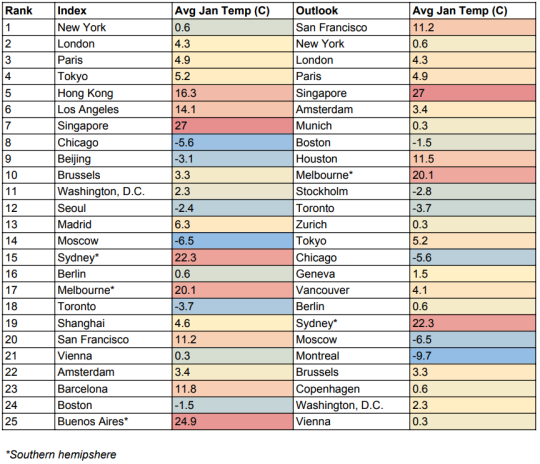
    Below are the top 25 global cities (taken from A.T. Kearney’s 2018 Global Cities Report), along with their average January temperature (taken from here). Note, there are two rankings. On the left is their global cities index. And on the right is their global cities outlook, which evaluates current potential. Cities that improved their economics & governance made the biggest leap on the right.

    image

    First of all, it’s interesting to see San Francisco jump so significantly in their outlook ranking. This has everything to do with tech and innovation. It’s also important to note that a handful of the above cities are located in the southern hemisphere, so “average January temperature” doesn’t mean the same thing (probably should have normalized to their winter).

    Montreal wins the award for the coldest city in this ranking. And there’s really only one city, Singapore, with a tropical climate. Though there are others, such as Hong Kong and Sydney, that would fall under subtropical. All of this isn’t enough for us to start inferring anything, but perhaps colder and more temperate climates aren’t such a bad thing for economic growth.

  • How London became the center of the world

    Some of you may want to debate the “center of the world” title (New York may be more deserving), but Laura Parker of National Geographic recently published a great essay describing the tremendous growth that London has seen over the last 30 years thanks to in part the deregulation of the financial services industry. Here is an excerpt:

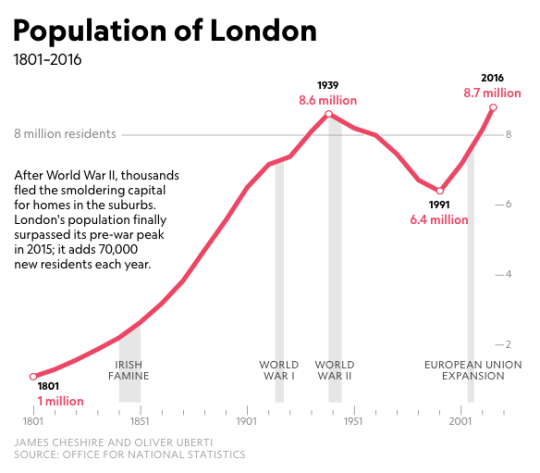
    As the manufacturing industry splintered, the docks of what was once the world’s largest port fell victim to shipping modernization and closed. The death in 1965 of Winston Churchill, the great prime minister, marked “the last time that London would be the capital of the world,” the Observer noted. Population continued a downward slide, bottoming out at 6.7 million in 1988. By then London’s fortunes had changed with deregulation of the financial services industry, known as the Big Bang, along with the shift to electronic trading, which enabled London to rival Tokyo and New York. A new financial district rose on the ruins of the West India Docks on the Isle of Dogs, a marshy nub that juts into the Thames. Canary Wharf, as the district is called, became London’s first modern large-scale regeneration project.

    According to National Geographic, London’s population grew by about 1.2 million between 2006 and 2016. That’s a pretty incredible number and is why the city estimates that they need about 66,000 new housing units a year just to keep up the growth. Like many supply constrained big cities, they’re not meeting that target.

    For the full essay, click here. It comes packaged with some incredible photographs by Luca Locatelli.

  • Project Profile: Coal Drops Yard

    A new retail district called, Coal Drops Yard, opened this week in King’s Cross, London. The architecture is by Heatherwick Studio and the project is absolutely stunning. I love the idea of taking the roofs of the existing buildings and delaminating them to create the new spaces. It is a good example of old meets something new and cool. Here is a short video that I think many of you will enjoy. If you can’t see it below, click here.

    [youtube https://www.youtube.com/watch?v=iLUGxPP0iNw&w=560&h=315]

    Image: Heatherwick Studio

  • Unzipped wall on King Street West

    image

    Last night I checked out the Unzipped Toronto exhibition, which is the relocated Serpentine Pavilion (pictured above) that was designed by Bjarke Ingels Group in 2016. 

    It was initially housed in Hyde Park London, but it’s now on King Street West Toronto. Westbank purchased the “unzipped wall” after it was installed in London and supposedly it will eventually find a permanent home in Vancouver.

    The official opening of Unzipped Toronto is September 15th, 2018. It will be free and open to the public. If you’d like to get a complimentary ticket, you can do that here

    The timing of all this lines up with condo sales for Bjarke Ingels’ first project in Toronto. I believe that will be starting this fall. And I am sure they will end up setting some new records for the King West submarket.

  • A more distributed startup geography

    The Economist recently argued that Silicon Valley’s innovation hegemony is waning and that it is a product of two factors: there appears to be more innovation happening elsewhere (good news), but that innovation in general also seems to be harder to achieve (bad news). Here is an excerpt from the article:

    Other cities are rising in relative importance as a result. The Kauffman Foundation, a non-profit group that tracks entrepreneurship, now ranks the Miami-Fort Lauderdale area first for startup activity in America, based on the density of startups and new entrepreneurs. Mr Thiel is moving to Los Angeles, which has a vibrant tech scene. Phoenix and Pittsburgh have become hubs for autonomous vehicles; New York for media startups; London for fintech; Shenzhen for hardware. None of these places can match the Valley on its own; between them, they point to a world in which innovation is more distributed.

    Part of the problem, of course, is rising costs in the Bay Area. Everything from the cost of living to the cost of operating a business. The article cites a recent survey where nearly half of all respondents said they are planning to leave the Bay Area in the next few years. This is up from 34% only two years ago.

    I don’t doubt that rising costs are causing some people to look to other cities, as well as other countries in the case of draconian visa policies. But I am suspect of the claim that we’ve heat peak “innovation” – however you want to define that.

  • Tech salaries and brain drain

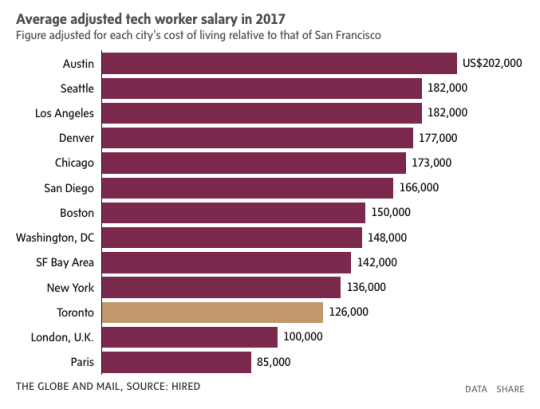
    The Globe and Mail recently ran an article arguing that tech salaries in Toronto are significantly less than those in the US and that it is leading to “alarmingly high rates” of brain drain. The claim is that the average tech salary in 2017 was US$73,000 in Toronto, compared to US$140,000 in the Bay Area or US$129,000 in New York City. 

    However, if you adjust these salaries for each city’s cost of living, the numbers look like this (chart taken from the same article):

    Now all of a sudden Toronto is lumped together with the Bay Area and New York City. It was adjacent to London even when you didn’t adjust the salaries. As Tobi Lütke – CEO of Shopify – points out in his Twitter rebuttal of the article, housing is the determining factor in this adjustment: “Toronto is a very expensive city, and Austin isn’t.”

    Lütke also points out, in case you’re in the market, that Canadian-based Shopify pays its tech employees well above market, provides stock compensation, and is currently “hiring like crazy”. But perhaps more importantly, he stresses the importance of Canadians building the economy of the country in which they are from. I feel exactly the same way.

  • The City as a Place for People

    The City of London Corporation recently published a report called “The City as a Place for People”, which talks primarily about itself and how great London is as a magnet for talent. 

    But as self-serving as it may be – the report is timed to be ahead of this year’s MIPIM – there appears to be some data and interviews backing up the claims.

    58% of “institutional investors” said that London is the best European city for business. Dublin was next at 22%. 

    A separate survey of 2,568 “corporate decision makers” in Europe revealed that 21% of respondents felt that London was the best European city for business, followed by Paris (13%) and Frankfurt (7%). When asked which city had the best talent pool, the responses were fairly similar.

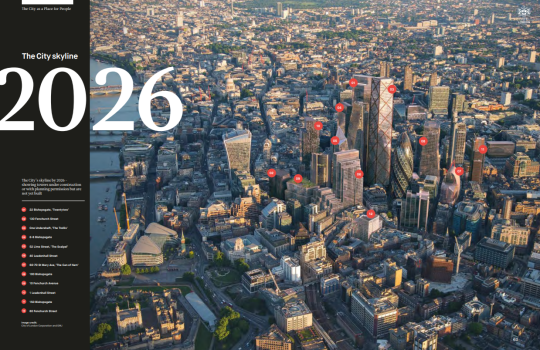
    Also included in the report is a rendering of the City’s skyline by 2026. These are always fun to see. Here is a screen grab:

    image

    It is showing all towers under construction and all towers with their planning permissions in place. If you’d like to download the full report, you can do that here.