Daily insights for city builders, delivered every morning at 6 AM ET. I’m Brandon Donnelly — a Toronto-based real estate developer and founder of Globizen. I’ve been writing here since 2013.
“…the pandemic and its aftermath have also created a rare openness to doing things differently. Seizing this opportunity won’t be easy, or a short-term affair. But if we can be certain of anything, it’s that cities will adapt and evolve, and that they have the potential to come back stronger.”
– Kearney 2020 Global Cities Report
The Kearney 2020 Global Cities Report is out and it incorporates two main rankings: their Global Cities Index (GCI) and their Global Cities Outlook (GCO).
The former is intended to be a snapshot of where things stand today and the latter is intended to be a forecast of where things might be heading.
Here’s their GCI:
And here’s their GCO:
Note: The big mover in their GCO is Toronto, jumping nine spots to take second place behind London.
Not surprisingly, their business as a travel company has been heavily impacted by COVID-19. Last year, the platform saw 326.9 million nights and experiences booked, with 251.1 million being booked in the first nine months of 2019. This year, nights and experiences are down to 146.9 million for this same nine month period. Revenue is correspondingly down from $3.7 billion for the first nine months of 2019, to $2.5 billion for the first nine months of this year.
But what is also clear from their data is that people still really want to travel and have new experiences. As soon as April passed and the Northern Hemisphere entered the normally busy Q3 travel season, domestic travel began to quickly ramp back up. For many, this likely took the place of international travel. See above chart.
Of greater concern might be all of the regulation that now surrounds short-term rentals. As of October 2019, about 70% of the platform’s top 200 cities (by revenue) had some form of regulation impacting short-term rentals. But at the same time, no one city accounts for more than 2.5% of the platform’s revenue. So there’s strong geographic diversification.
If you’d like to take a look at the company’s S-1, you can do that over here. And for those of you who might be curious, these are Airbnb’s top 10 cities based on revenue:
Whenever you see a best-of-anything ranking, you should probably ask yourself what the hell “best” even means. In this case, Resonance Consultancy is ranking the world’s cities based on six alliterative categories: place, people, programming, product, prosperity, and promotion.
Some of these metrics are qualitative, but many are, in fact, quantitative. Number of COVID-19 infections in 2020; number of direct destinations served by the city’s airports; number of foreign-born residents; number of top-rated restaurants (TripAdvisor); most Instagram check-ins, and so on.
The result is this list of the world’s best cities:
London
New York
Paris
Moscow
Tokyo
Dubai
Singapore
Barcelona
Los Angeles
Madrid
Rome
Chicago
Toronto
San Francisco
Abu Dhabi
I arbitrarily chose the top 15 cities in order to make sure that Toronto was included in this ranking. If you’d like to download a full copy of the 2021 World’s Best Cities report, you can do that over here. I recommend you check out their performance criteria.
Toronto, for example, performs very well when it comes to “people.” That’s fairly consistent across most of these rankings. But it didn’t fare so well when it comes to “place.” That category includes things like the average number of sunny days and the number of high quality sights & landmarks.
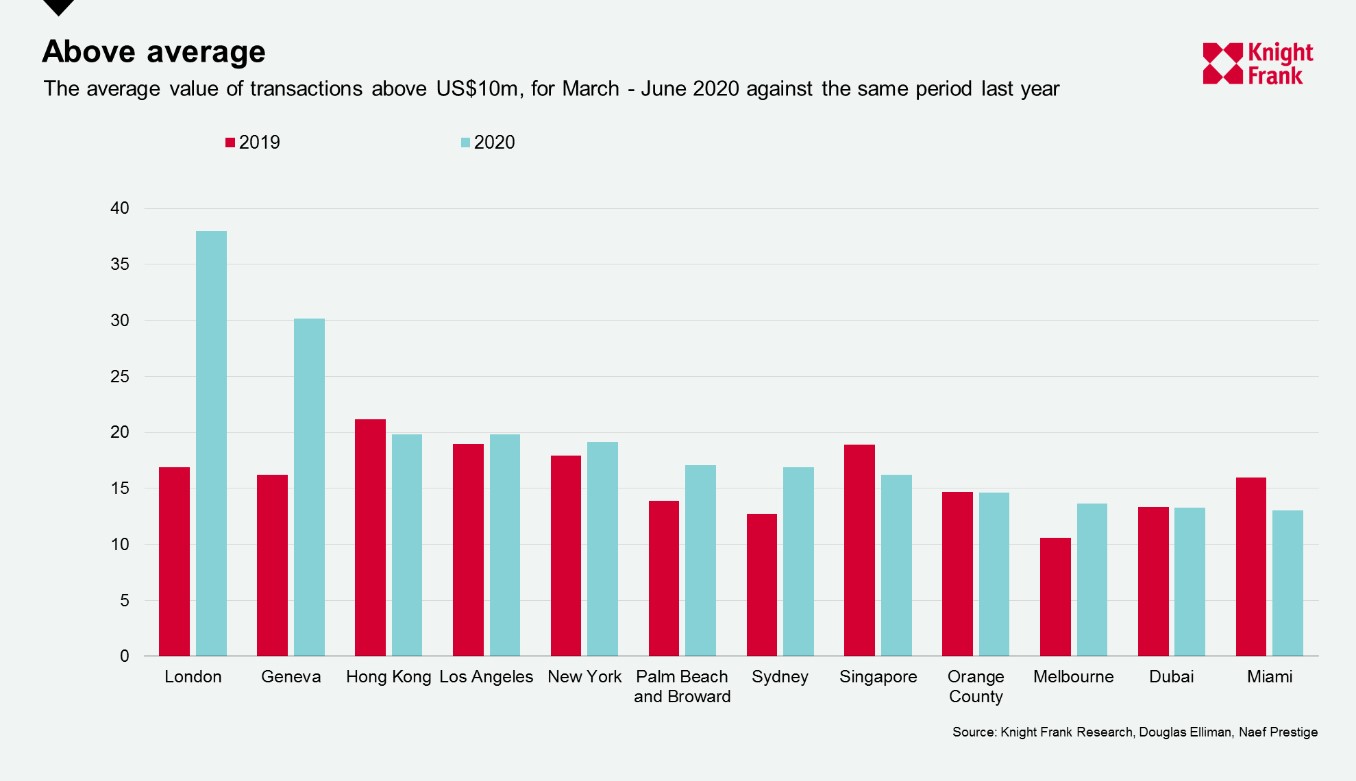
This is a chart from Knight Frank showing the average value of “super-prime” residential real estate transactions in 12 global markets between March and June 2020, and versus the same period last year.
Knight Frank classifies super-prime real estate as having a value greater than US$10 million and ultra-prime real estate as having a value greater than US$25 million.
In this particular chart, London takes the top spot with an average super-prime transaction value of US$38 million. This is a big jump compared to 2019 where the average value was US$16.9 million.
Typically it is Hong Kong that takes the top spot in this ranking, but this year it fell to third. Still, Hong Kong had the highest number of transactions with 60 super-prime sales taking place in the first half of 2020. This is down from 155 in the first half of 2019.
Overall, Knight Frank recorded 281 super-prime transactions across these 12 cities in the first half of this year. This is, not surprisingly, a decline compared to last year, which saw 594 transactions over this same time period.
But all things being considered and given some of these price increases, the super-prime market is certainly holding its own.
This Thursday is the launch of a brand new city event called the WRLDCTY Virtual Festival (vowels, clearly, suck). Presented by Vancouver-based Resonance Consultancy, the “host cities” are New York, London, Hong Kong, Los Angeles, and Toronto.
The idea is to bring together thought leaders and city lovers from all around the world on a virtual platform for three days. The speakers include people like Richard Florida, Bjarke Ingels, and Dan Doctoroff.
The other thing they’re doing is offering up over 20 virtual urban experiences. Think yoga on Santa Monica Pier, burlesque in Brooklyn, and graffiti art tours in Toronto. It’s clearly no substitute for actual travel, but this is the best we’ve got right now and we’re all trying to adapt.
A general admission ticket is free, but some of the headline events require a pro pass and if you’d like to do some virtual networking and chat with other guests in the “Community Center,” you’ll also need that same pass. Here’s the full agenda.
A team of researchers at UCL recently surveyed 2,500 households across the UK to see how the design of their homes and neighborhoods has impacted their experience during lockdown (May to June 2020).
Perhaps most notably, the report, called Home Comforts, found that people living in housing built in the last 10 years were more likely to feel uncomfortable during lockdown (1 in 5), compared to those living in homes built before 1919 (1 in 7).
On top of this, people living in Victorian era housing were more likely to say that their neighborhoods were meeting their everyday needs, which seems to translate into convenient access to basic amenities (5 to 10 minute walk).
So what does this tell us?
That people want more ornament and clearly defined Zoom-friendly rooms? That the Victorians were better at city and community building? Or maybe that Londoners living in low-rise pre-1919 housing are generally well-established and have the ability to afford more conveniences? It’s likely a bunch of different things.
There’s no denying that the way we build our homes and our neighborhoods has, for better or for worse, changed over the last 100 years. But let’s not forget that it’s easy to romanticize the past and the things we used to do. I’m sure it wasn’t puppy dogs and ice cream for all of the Victorians.
At the beginning of this year (which seems like eons ago), I wrote about a CityLab series that Feargus O’Sullivan was doing on the vernacular home designs of a handful of European cities. Cities like London and Berlin.
Well, after a brief pause, that series is back in the form of a CityLab “storythread.” It’s now called, “The Iconic Home Designs That Define Our Global Cities.” In it, he explores the various floor plans, housing typologies, and tenures that you might find around the world. Everywhere from from Singapore to Reykjavik.
The most recent article is all about Prague’s communist-era apartments. Apparently people call these paneláks because they were initially built using some sort of collection of prefabricated panels. They were a quick and dirty housing solution for a city and country that were rapidly urbanizing starting in the late 1950s. (See, prefab works.)
But what I find most interesting about the story of these paneláks is how their reputation seems to have changed and evolved over time. They proved to be a far more adaptable form of housing than you might initially think, going from written off and ready for demolition, in some cases, to then becoming a form of aspirational housing.
Part of this allegedly had to do with a handover from state ownership to private ownership, which maybe goes to show you that architecture and design, alone, aren’t enough when it comes to housing innovation. You really need to consider the whole picture.
But regardless, it is clear to me that tastes do change, and housing is no exception. Renewal is an integral part of urban life. And one generation’s trash might be another generation’s treasure.
Here’s a weekly round up of links and articles that you may find interesting. The topics cover the sorts of things that we usually talk about on this blog.
The latest Mackay Laneway House update is now live on the Globizen Journal. The ground floor steel is complete, with framing currently underway. The post has some background on the challenges faced in order to get to this stage.
Brick comparison. Here’s a recent tweet of mine. I’m curious if any of you can tell the difference between these two brick finishes and if you have a clear preference. One of them is stamped concrete and the other is real brick (precast concrete with brick slips).
Pools as art. Apparently this is a trend right now, but it’s not necessarily a new one. Pablo Picasso accidentally created one when he “signed” the bottom of one in Spain back in the early 1960s. A pool would be fun right now. [FT paywall]
Alley house in King’s Cross by architect David Adjaye is currently on the market for £6.5 million. Lots of black. I love the mint green room with the exposed concrete ceiling. Oh, and there’s a pool.
Nightclubs are, not surprisingly, really struggling. Most have been closed since March. Unlike restaurants, you can’t really hack together a solution with outdoor dining, heat lamps and takeout. They’re predicated on people being proximate to each other. [Sorry, another FT paywall]
Monocle has just published a new book about “gentle living.” It’s a guide to “slowing down, enjoying more and being happy.” I’m trying to do more of this, or at least be more mindful about it. It doesn’t always/usually work. Perhaps I need this book.
“Decade of the home.” Opinion piece about the current desire for suburban over urban locations. If you’re a regular reader of this blog, you’ll know that I am steadfast in my belief that urban life is going to prove to be incredibly resilient on the other side of this.
McKinsey report about the impact that lockdown is having on digital adoption, e-commerce penetration, and the overall customer experience. You’ll need to enter some information in order to download the PDF, but it’s free.
It used to be the case that cities had a habit of catching fire and burning down. Toronto had the Great Fires of 1849 and 1904. Chicago had the Great Fire of 1871. And the same can be said about many other cities. In fact, you probably weren’t considered a real city until you had some sort of “Great Fire.” But as Derek Thompson points out in this recent Atlantic article about urban comebacks, disasters have a way of forcing positive change:
The 21st-century city is the child of catastrophe. The comforts and infrastructure we take for granted were born of age-old afflictions: fire, flood, pestilence. Our tall buildings, our subways, our subterranean conduits, our systems for bringing water in and taking it away, our building codes and public-health regulations—all were forged in the aftermath of urban disasters by civic leaders and citizen visionaries.
As Charles Dickens famously described, British cities in the early years of the Industrial Revolution were grim and pestilential. London, Birmingham, Manchester, Leeds—they didn’t suffer from individual epidemics so much as from overlapping, never-ending waves of disease: influenza, typhoid, typhus, tuberculosis.
It’s somewhat unfortunate, but oftentimes we need something to break before any action is taken. There’s a bias toward the status quo. Otherwise, it becomes a question of, “what did we do last time? Well that worked just fine. Let’s do it again.” But hopefully all of this makes you at least a little optimistic about the future. Because history has taught us that when faced with adversity, we don’t typically turn our back on our cities. Rather we turn around and make them better.
I received an email this week from a senior real estate executive who was sharing the fact that, in response to COVID, he had decided to give up driving completely. He was now cycling everywhere — whether for work or for personal errands. And it was doing wonders for his health and his overall well-being.
Indeed, this feels like some sort of golden era for urban cycling. Back in May I wrote about how Toronto City Council had just approved the largest ever one-year expansion of bike lanes. Some 40 km. When have we ever moved this quickly and without months (okay, years) of painful debate? Probably never.
Of course, it’s not just Toronto. This is happening all over the world. Here are some of the numbers (taken from this recent Journal article):
Paris added 400 miles of pop-up bike lanes across the region — all of which didn’t exist before the pandemic – some of the streets being tracked have seen a doubling in usage
Oakland closed almost 10% of its streets to cars
Montreal is adding an additional 70 miles of pedestrian and cycle paths
Bogota is the midst of planning for 47 miles of temporary bike lanes
The UK has fast tracked over $315 million in capital spending for bike infrastructure — referring to this as a “once-in-a-generation” opportunity
New York’s bike share service (Citi Bike) saw year-over-year usage surge 67% in the first 10 days of March alone — before any shelter-in-place rules were even imposed
There are obvious reasons for this rush to build out cycling infrastructure. We’re in the midst of a global health crisis and people are staying away from public transit in big numbers. But I think it’s also important to keep in mind that in many / most cases, there is really no other viable mobility solution. You cannot take all the people that used to ride the tube in London and plop them into cars. There isn’t enough space.
So cities all around the world are doing the sensible thing and acting fast to make sure that it’s safer for people to move about on bikes. But as we all know, humans tend to have a bias toward the status quo. And so when this is all said and done, I suspect that many of these pop-ups will end up sticking around. And that will be a good thing for cities.