Daily insights for city builders, delivered every morning at 6 AM ET. I’m Brandon Donnelly — a Toronto-based real estate developer and founder of Globizen. I’ve been writing here since 2013.

Tag: light rail transit

  • Bordeaux’s tramway network

    I was very impressed by Bordeaux’s tramway network. It felt like no matter where you were in the city, there was a tram gracefully passing you by. Here’s a high-level summary of the system:

    • The network has 4 lines and a total route length of 77.5 km.
    • The first line opened in 2003.
    • The network has 130 stops, which crudely results in an average stop spacing of around 600 m.
    • The system pioneered ground-level power supply for the trains, which means no overhead wires. Supposedly this caused some issues upfront, but now it seems to be working just fine.
    • Most of the network runs on a dedicated right-of-way (en site propre). Meaning, the trains don’t compete with car traffic. Many of the lines are quite beautiful too – see above video.
    • In 2018, the network carried close to 100 million people. This is in a city of ~260k people and a metro area of ~1.4 million people (2020).

    The key differentiators for me are (1) the stop spacing and (2) the fact that most of the system runs on its own dedicated right-of-way. These are two reasons why Toronto’s streetcars perform so poorly. They stop too frequently. And most of the lines have to compete with traffic.

    So why bother? Walking can be faster.

    Bordeaux shows that — if you implement light rail correctly — you can actually move a ton people efficiently. With surface rail, you can also build out a robust network in a relatively short period of time.

    Twenty years isn’t that long in city-building years. It has already been 10 years since Toronto was first promised SmartTrack.

  • Fundamental and enduring

    I admire Warren Buffet’s humility:

    In the physical world, great buildings are linked to their architect while those who had poured the concrete or installed the windows are soon forgotten. Berkshire has become a great company. Though I have long been in charge of the construction crew; Charlie [Munger] should forever be credited with being the architect.

    This is an excerpt from his recent letter to Berkshire Hathaway shareholders, which, this year, he opens up with an obituary to his late partner, Charlie Munger.

    I don’t agree with everything Warren says and writes. He, for instance, doesn’t seem to like crypto and streetcars. Though, surely, he’d really dig my CryptoParisian.

    That said, I never miss his letters and his thinking has been broadly instrumental in how I tend to think about real estate.

    If you take his description (same letter) of what Berkshire does, and replace businesses with properties, this is what you get:

    Our goal at Berkshire is simple: We want to own either all or a portion of [properties] that enjoy good economics that are fundamental and enduring. Within capitalism, some [properties] will flourish for a very long time while others will prove to be sinkholes. It’s harder than you would think to predict which will be the winners and losers.

    This is a good way to think about real estate.

  • Phase one of Montreal’s REM is now open

    The first phase of Montreal’s new Réseau express métropolitain (or REM) just opened it up. It is a 17 km light-rail line that includes five stations running from Brossard in the south (A1 above) to Gare Centrale in downtown Montreal. Eventually this network — which is distinct from but connected to the city’s existing metro network operated by STM — will span 67 kilometers and have a total of 26 stations. To put this into perspective, Montreal’s current metro totals 69.2 kms. So this is a near doubling.

    As with most big city building projects, Montreal’s REM is being and will continue to be criticized. Back in 2016, the project had an estimated total project cost of $5.9 billion. By 2021, this number had increased to $6.9 billion. Today, who knows what the number will be. But it will be more. The reality is that everything went up, by a lot, over the last five years. During the pandemic, we were seeing 30-40% cost increases on some of our construction line items.

    What’s perhaps most noteworthy about this project is its delivery model. It is being delivered through a partnership with the the Caisse de dépôt et placement du Québec (CDPQ):

    Under the pact, the Caisse’s infrastructure arm is assuming $3.5-billion of the project’s $6.9-billion construction cost while Quebec is committing $1.28-billion and the Canada Infrastructure Bank is providing a $1.28-billion loan. The balance consists of a $295-million payment from Hydro-Québec for the line’s electrification, while the Autorité régionale de transport métropolitain, the transit authority for the Montreal region, is pledging $512-million.

    Provincial and local governments will provide continuing operating subsidies for the REM to make sure the Caisse earns its required return on the project, currently pegged at 8 to 9 per cent. The pension fund manager will get 72 cents for each passenger-kilometre travelled on the light rail system. Without such a subsidy, fares would climb to a level few passengers could afford.

    It’ll be interesting to see how this approach stands the test of time. As I understand it, CDPQ wants to continue building and operating transit in other cities around the world. I don’t know any of the specifics other than what I have read online. But from the outside, things seem to be working. The first phase of the REM broke ground in April 2018, and the opening ceremony was held this month (July 2023). That’s basically warp speed in transit timelines.

    Map: Montreal REM

  • Rail + property — let’s try it again, okay?

    The Eglinton Crosstown line is going to open, here in Toronto, sometime next year — I think. And I’m sure that it is going to be a massively beneficial addition to Toronto’s transit network. But at the same time, we should be talking about this:

    Urban transit stations shouldn’t look like this. It’s a missed opportunity, both in terms of the foregone housing (and other uses) that could be on top of these stations and the additional value that could have been captured from these air rights. Transit is a crucial lever for land values and development overall, and so it’s no wonder that many of the best transit authorities around the world think in terms of “rail + property”.

    So what happened here?

    I don’t know exactly. But I do know that nearly a decade ago I called up Metrolinx and said, “Hey, so I’m a developer who can build things. I see that you’re building a number of exciting transit stations along Eglinton. Want me to build on top of them for you?” Now obviously Metrolinx wasn’t going to be able to sole-source to Brandon, but regardless, I thought it should happen and I just hoped to be in the mix.

    In 2015, things did start to happen. Avison Young, on behalf of Metrolinx, issued a request for proposal to developers for 4 sites/stations along the line. There were two at Keele Street, one at Weston Road, and one at Bathurst Street. And at the time, it was thought that these sites could generate somewhere between $14-22 million (speaking of reasonable).

    I think it was also being viewed as a bit of a pilot. If things went well with these 4 initial sites, then this same approach was going to be rolled out across all suitable sites on the line. I’m not sure what happened with the RFP or the broader intent — maybe some of you know — but it clearly didn’t pan out as planned.

    That’s too bad. But I suppose done is better than perfect. Plus, now we’re building the Ontario Line and so we have another opportunity to get it right. And right means lots of density on top of stations — both directly on top and all around it.

  • Warren Buffet doesn’t like crypto and streetcars

    I have a great deal of respect for Warren Buffet. Much of what I know (or think I know) about investing has come from listening to and watching him and his partner Charlie Munger. Surely they have got to be the most successful investors living today.

    But there are some things that I don’t always agree with them on. The first and most obvious one is crypto. Warren thinks it is speculative rat poison and I think it is the future of the internet. I understand where he is coming from in that it does not produce cash in the same way as say a farm or an apartment building. But that doesn’t mean it won’t have value.

    The second one, as I have learned today, is maybe streetcars. As a rule, Warren doesn’t typically engage in local politics. But he recently decided to break that rule through a letter he wrote to the editor of the Omaha World-Herald, lobbying against a new $306 million project that I believe is going ahead regardless.

    Here’s an excerpt from the letter:

    “Residents can be far better served by extended or more intensive service by the bus system,” Buffett wrote. “As population, commerce and desired destinations shift, a bus system can be re-engineered. Streetcars keep mindlessly rolling on, fuelled by large public subsidies. Mistakes are literally cast in cement.”

    I should, however, be clear that (1) I know nothing about Omaha and this streetcar project, and (2) “streetcars” can be nuanced. There are streetcars that compete with car traffic and have short station spacing, and there is light rail transit on its own dedicated tracks and with farther station spacing. One size does not fit all.

    Here in Toronto, we have lots of the former and they generally move you around at the slowest possible speeds. Sometimes it is faster to just walk. But we are also getting a new light rail line next year and that should move much faster. I can also tell you that when I worked in Dublin many years ago, I took their Luas to the office every day and loved it.

    Again, I don’t know the specifics of Omaha’s streetcar project. Maybe Warren is right or maybe he is wrong. And that’s why I was careful to say “maybe” above. But I do know that in the right urban contexts and when done well, I am a fan of light rail transit.

  • Below grade at Yonge & Eglinton

    I often hear people lamenting about all of the construction that is taking place right now at Yonge & Eglinton in midtown Toronto. But that’s kind of what happens when you build a new subway line (okay, a partially buried light rail transit line). Above is a recent drone video that Metrolinx released showing the progress at Eglinton Station (I think I would have gone with a little Booka Shade for the soundtrack instead). I bet that most of you will be surprised to see how much is happening beneath street level. If you can’t see the above video, click here.

  • Project Profile: New Central Library, Calgary

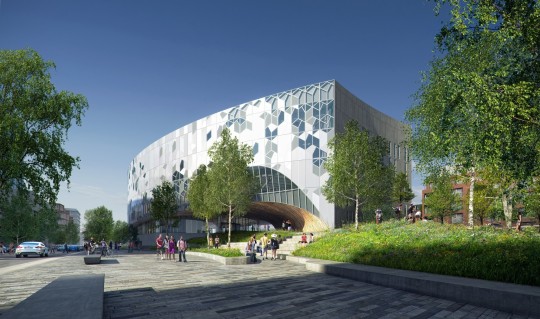
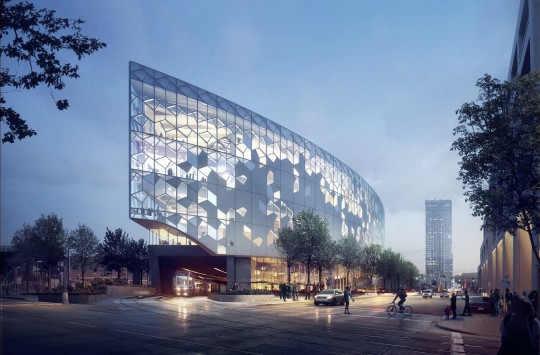
    The City of Calgary opened up its New Central Library this past week on November 1st, 2018, after a five-year construction process. 

    Designed by Snøhetta (design architect) with Dialog (architect of record) and Entuitive (structural engineer), the building was previously named one of “the 12 most anticipated buildings of 2018″ and one that will surely serve as a landmark for the city.

    One of the most interesting things about this project, for me, is how it both gives back and integrates with the broader urban fabric. 

    It is both a library and public plaza, and it sits atop the city’s busiest LRT line. About 40% of the site area is taken up by tracks (and probably setback), which means that the structural system of the building was forced into 12m (~40 foot) clear spans (done in concrete). It is the first time in the city’s history that an active LRT line has ever been encased and built over.

    It is a magnificent building and reason enough to visit Calgary, if you aren’t already there. I am hoping to get out there and photograph this project sometime soon.

    Images: Snøhetta and Entuitive 

  • Red streetcar tracks

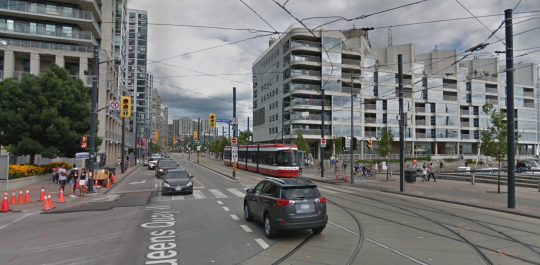
    A few months ago when I wrote about “Toronto’s great streets” I mentioned that Queens Quay West – while magnificent – has had its share of issues. Cyclists and pedestrians often find themselves battling for space. And drivers are consistently driving in the wrong places.

    Part of the problem, I think, is that the turning radii (among other things) are a bit atypical and unusual compared to the rest of the city. And so if you’re at all in mental autopilot, it can be fairly easy to make a wrong turn. You really have to be paying attention.

    Below is a screenshot from Google Street View showing the foot of Lower Spadina, looking east on Queens Quay West. If you’re making a left turn from the former onto the latter, you need to end up on the left (north) of the streetcar tracks (even though the tracks themselves might be directing you elsewhere).

    There’s lots of signage telling you not to drive onto the tracks, but that hasn’t really been working. So the tracks were recently painted in bright red. You can see what that looks like here. Some people are still getting mixed up, but it’s certainly more noticeable.

    What I am wondering today is whether all of this signage and paint should be considered a symptom of poor design. In other words: Should good design require few instructions? Or, is this simply a normal part of iterative city building?

    What do you think?

  • The Scarborough Subway Extension is a mistake

    Last weekend over dinner, a friend of mine asked me what I thought about the Scarborough Subway Extension debate going on in Toronto right now. Costs are coming in higher than initially projected and the usual back and forth is taking place. Transit blogger Steve Munro has a good post on this called Spinning a Tale in Scarborough.

    I haven’t written much about the Scarborough Subway, but I do have a strong opinion. I believe it’s a mistake. I am not saying that we shouldn’t be building higher order transit in Scarborough – we absolutely should – but it does not need to be an expensive subway line. There are more sensible solutions.

    Here are a few things to consider:

    Light rail transit (LRT) does not equal streetcar. As an avid user of the King streetcar, I’ll be the first to admit that something needs to be done to address the city’s busiest streetcar routes. They are broken. But this is not what was being previously contemplated for Scarborough. True LRT – which Toronto does not yet have – is far more effective at moving people.

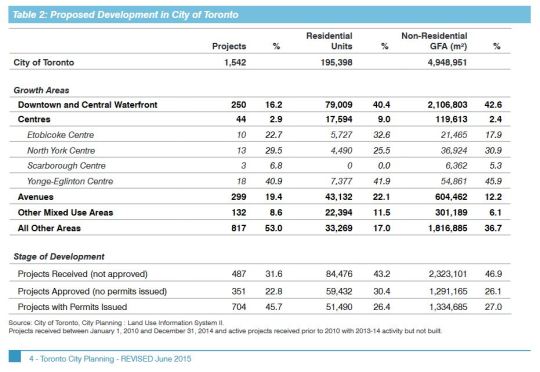
    Scarborough Centre is seeing almost no new residential and commercial development. In fact, the “Centres” in general are not seeing much development. The largest share is happening downtown, along the central waterfront, and along the “Avenues.” We shouldn’t ignore this when making our investment decisions. Transit and built form go hand in hand. 

    I also do not buy the argument that we are building this subway in anticipation of demand 50 or 100 years from now. We are not in a position to be proactive about our infrastructure. We are desperately playing catch up and there are already lots of high growth and high density areas in the city which today are completely underserved by higher order transit. 

    Finally, a new subway line with low ridership will mean higher operating cost subsidies to keep it afloat. And at the rate that Scarborough Centre is growing today, this would likely continue for many years into the future. Not only is this debate about spending money today, it is about spending money well in the future, month after month.

    So let’s be clear: the Scarborough Subway Extension debate is about politics. It is not about transportation planning.

  • 3 changes to John Tory’s SmartTrack transit plan

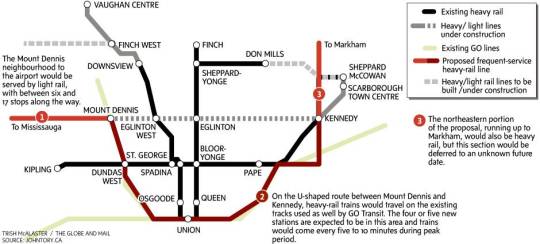
    Last week Oliver Moore of the Globe and Mail announced that Toronto mayor John Tory’s SmartTrack transit plan is evolving to feel less like SmartTrack and more like what Metrolinx had been planning all along.

    Here’s the map from the Globe and Mail:

    The 3 big changes are as follows (and numbered accordingly on the above map):

    1. 

    The western end of the line will be replaced by an extension of the Eglinton-Crosstown LRT (currently under construction) running from Mount Dennis to Pearson Airport. This is what was originally proposed.

    2. 

    The “U” running from Mount Dennis in the west, down through downtown, and up to Kennedy in the east is what remains of the original SmartTrack line and will operate as some sort of “heavy rail” service on existing GO Transit lines. The original election campaign plan was to run trains every 15 minutes, but that was deemed too infrequent to attract riders, so now Metrolinx and everyone is trying to figure out how to get it down to every 5-10 minutes and feel more like subway.

    3. 

    The extension north of Eglinton Avenue to suburban Markham (in the northeast) is being pushed out and will be dealt with sometime in the future. Keeping the first phase of SmartTrack south of Eglinton on both ends is beneficial in avoiding the issue of SmartTrack and the Scarborough subway extension cannibalizing each other. (In my opinion, this issue is a perfect example of what happens when transit planning becomes too political.)

    The net result is a plan that is looking less and less like the original SmartTrack. I’m not complaining though because I have never been a big supporter of SmartTrack. I have always thought we should be focusing on the downtown relief subway line and on allowing Metrolinx to just execute on its regional express rail (RER) strategy.

    For more on this topic, check out Steve Munro’s post, SmartTrack: Now You See It, Now You Don’t! He’s far more of an expert than I am on these sorts of issues.