Daily insights for city builders, delivered every morning at 6 AM ET. I’m Brandon Donnelly — a Toronto-based real estate developer and founder of Globizen. I’ve been writing here since 2013.

Tag: lifestyle

  • Canada announces high-speed rail between Quebec City and Toronto — finally!

    The train from Paris to Marseille takes just over 3 hours:

    To drive this same distance, it would take just over 8 hours:
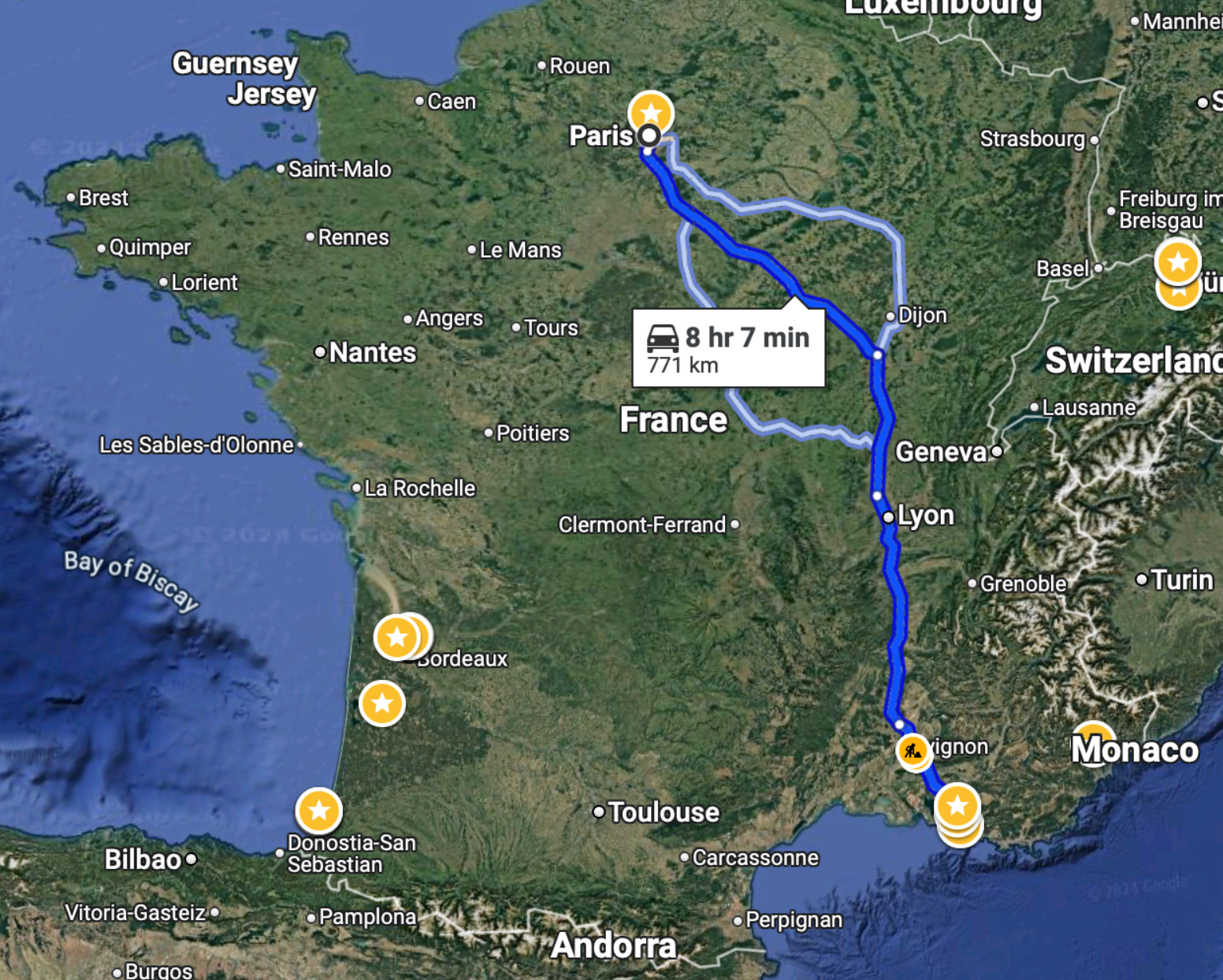
    So unless you had a very specific reason, I don’t know why you’d ever want to drive this route. I certainly hate long drives and would avoid this at all costs.

    On a related note, the Canadian government announced this week that it will actually be moving forward with a high-speed train linking Québec City to Toronto, stopping in Peterborough, Ottawa, Montréal, Trois-Rivières, and Laval. And unlike previous announcements, it will actually go pretty fast — upwards of 300 km/h, which is comparable to what the TGV does on the above route.

    There are three consortia currently competing for this contract, but apparently the federal government has already chosen a winning bidder. An announcement is expected next month. At the same time, the project office owns all of the bids, and so there’s a chance that elements from each of them could be used in the final project.

    According to official messaging, the design alone is expected to take some 4 to 5 years, which is an eternity and way too long. But at least we seem to be moving forward. This rail link is a no brainer. It will compress the geography of an importantly bilingual corridor with nearly 20 million people — about half the population of Canada! It’s our megalopolis.

    Now we just need to move forward with urgency and with an unwavering commitment to creating the best high-speed rail service in the world. Let’s not accept mediocrity. And let’s not cancel it once we’ve already sunk millions into it. That would be a terrible outcome for such an obviously important nation-building project.

    LFG.

  • I think Roman Mars would appreciate Utah’s new state flag

    Utah got a new state flag over the weekend that looks like this:

    And I immediately thought of this TED Talk by Roman Mars. For those of you who don’t know, Roman is the creator of 99% Invisible and a great lover of well-designed flags. His general rules of thumb are to keep things super simple and to use meaningful symbolism. And I’m fairly certain that he knows what he’s talking about because, in his talk, he refers to the Canadian flag as the gold standard for flags.

    In the case of Utah’s new flag, the symbols are this. The blue at the top is meant to represent Utah’s wide-open skies and lakes. The white in the middle represents its snowy mountains (of course). The red stripe is meant to represent Southern Utah’s red canyon landscape. The hexagon is meant to reference a honeycomb. And finally, the beehive is there because, well, Utah is the beehive state.

    Utah has long enjoyed this reference to beehives. Supposedly, it was early pioneers who started throwing around this reference because they believed it symbolized working together, perseverance, and overall industry. And that’s why the state’s official motto is, “Industry.” So I’d say that they used/kept the right meaningful symbolism.

    Though when I first saw the new flag, I immediately wondered whether the hexagon and honeycomb could have been made just a little simpler. Was the yellow fimbriation, for example, really needed within the blue hexagon? But the more I look at it, the more I like it and the more I think that Roman Mars would be happy with how this turned out. What are your thoughts?

  • Real estate company? No, a lifestyle brand.

    This past weekend a rooftop restaurant, pool, and entertainment venue called LAVELLE opened upon atop 629 King Street West here in Toronto. It’s on the rooftop of a condo by Freed Developments, that for some reason is no longer called the Thompson Residences.

    Here’s a sampling of their Instagram to paint you a picture:

    imageimageimageimage

    I mention this not because I went, but because I think it’s interesting to see how Peter Freed is evolving his company and brand. He is best known as a real estate developer. But what he wants to do and what he is doing is turning Freed Developments into a “vertically and horizontally integrated progressive lifestyle company.”

    According to this recent press release, LAVELLE is the first venture of Trademark Hospitality Inc., which itself is “a branch of Freed Hospitality.” This is him selling not just selling a place to live, but selling a particular lifestyle and a certain community – and then taking an active and ongoing role in the programming of it.

    The other example that comes to mind is that of Equinox Fitness. I’m sure you all know this company, but what you may not know is that it’s owned by a real estate development firm called Related. The New York-based company acquired them in 2005 (closed in 2006) for about half a billion dollars. 

    Here’s why they did it (excerpt from this press release):

    Related and Equinox have historically shared similar visions. Both companies are known for their commitment to lifestyle, service, innovation and design, and have a passionate following amongst dedicated upscale consumers. The companies’ respective customers have similar demographic and psychographic profiles and both foster fiercely loyal clientele who are passionate about their brands.

    Related has redefined the residential marketplace, created the benchmark for sophisticated urban living and has been committed to quality fitness facilities in its buildings since the mid-eighties. Since its inception 15 years ago, Equinox has been widely recognized for being an industry innovator and for delivering an unparalleled fitness experience.

    Both companies will enjoy a number of key strategic opportunities from the partnership. Related will secure a well known brand as a quality anchor tenant for key current and future developments. This will also help Related to enhance the quality of its amenities and facilities available to residents.

    So this is not a new thing. In both of these cases, the goal is to create a brand and identity centered around a precise lifestyle. I mean, Related even mentions “psychographic profiles” in their news release. They know who their audience is, just as Freed does.

    Another way of looking at this is how it ties into what I see as a broader shift away from just development to more city building. It’s not just about throwing up a building and then moving on. It’s about trying to foster a certain kind of community and lifestyle. We may not all agree on what that community should be, but overall I think it’s an exciting direction for cities.

    If you’re taking a similar approach in your business (or even if you’re not), I would love to hear from you in the comments below.

  • Condo building identities according to Instagram

    I am very interested in the social side of buildings. What I mean by that is that we usually focus on the quantitative side. We look at sale prices. We look at average prices per square foot. We look at reserve fund balances. And as I recently argued, this is all very important stuff. I think we should do much more to make this data publicly available.

    But there’s also a side to buildings that’s harder to measure: the human side. Sale prices and staged MLS listings don’t tell you what the people who live in the building are like. What the vibe will be like at the pool during the summer. If you can expect to find dog poo in your elevators. But when you live in a multi-family building, I think most people will tell you that the qualitative side also matters.

    So this morning, I thought I would run a little experiment and pull the top Instagram photos for a random sampling of relatively new condo buildings in Toronto. These are public photos that have been uploaded and tagged with that building’s location ID. 

    Obviously there’s an inherent bias since I figure Instagram users probably lean towards Millennials. Also, the top posts could be easily skewed by a small number of heavy influencers. But I still thought it would be interesting to see if any particular identities started to emerge. And I do see some differences that reflect what I would have expected. I wonder how these might relate to the original marketing for the buildings.

    What do you think of the photos below?

    Feel free to do the same for your building and post the photo in the comments below. That could make for a really interesting discussion. My building is the first photo.

  • Fred Wilson on where the New York tech ecosystem is heading

    Venture capitalist Fred Wilson is the poster boy for the New York tech industry. And this morning he posted an interesting video on his blog of a recent talk he did at Google NYC.

    At the 4:50 mark he begins talking about the evolution of the tech sector in New York and how it became what is probably the second most active startup hub in the United States.

    Given yesterday’s post on talent and the recent CityAge conference I participated in, I thought this video would make a great follow-up. There’s talk of lifestyle, diversity, gender equality, and talent within cities.

    Fred is heavily involved in growing and improving computer science education in New York, which is a perfect example of how cities can better leverage the people and talent they already have – as opposed to just focusing on bringing in new talent. Coding is a valuable skill to possess.

    I also found it interesting that Fred ended up in New York precisely because his wife wanted to live in New York. And that had a lot to do with all of the things you can do in the city, outside of work.

    If you can’t see the video below, click here.

    [youtube https://www.youtube.com/watch?v=_fZCrasNIfQ?rel=0&w=560&h=315]

  • The business of cities

    Over the past few months on this blog, I’ve started to introduce business terms into the way I describe and talk about cities. I’ve referred to residents and visitors as customers of a city, experiences within a city as products and services, and cities themselves as businesses. Until now though, I hadn’t explicitly talked about this parallel or fleshed it out in any sort of detail. But I think it’s an interesting one so I’d like to do a bit of that today.

    The reason I started referencing cities with business terms is because I think it speaks to 3 important characteristics of cities. First, cities, just like businesses, are in direct competition with each other. We rank cities. We compare GDP per capita. And they fight, or at least should, to attract the best people and to achieve economic dominance.

    Second, city prosperity can be ephemeral. We tend to think of cities as being quite permanent–centuries old–but history is littered with failed cities or cities that simply lost their economic importance (see Detroit). Consider this: The center of trade at one point was the Mediterranean Sea. Then, as the New World emerged, it shifted to the Atlantic. And now, one might argue that it’s moving over to the Pacific (and Asia). Either way, these macro shifts push certain cities to thrive and others to decline. The time horizon is longer than, say the rise and fall of Blackberry, but it’s similar nonetheless. Nothing is guaranteed.

    Third, cities have become centers of lifestyle and consumption. That’s why I previously argued that any economic development strategy should consider lifestyle, and whether or not people actually want to live in the place. In business terms, you need to offer products and services that people actually want. You need to respond to customer needs.

    And if you think of cities in this way, I think you’ll come to the conclusion that, just like businesses, strong cities require strong leadership and management. They need to ensure that they’re delivering the right products and services to their customers and that they’re staying ahead of the innovation curve.

    The switching costs may be higher for cities compared to, again, something like a mobile phone, but that doesn’t mean people won’t eventually vote with their feet and leave for somewhere better.