Daily insights for city builders, delivered every morning at 6 AM ET. I’m Brandon Donnelly — a Toronto-based real estate developer and founder of Globizen. I’ve been writing here since 2013.

Tag: laneways

  • Rise of rental

    image

    Last month Oxford Properties submitted a site plan application for the redevelopment of the rundown Cumberland Terrace in Toronto’s Yorkville neighborhood. If you’d like to browse the full application (including all the drawings), you can do that here.

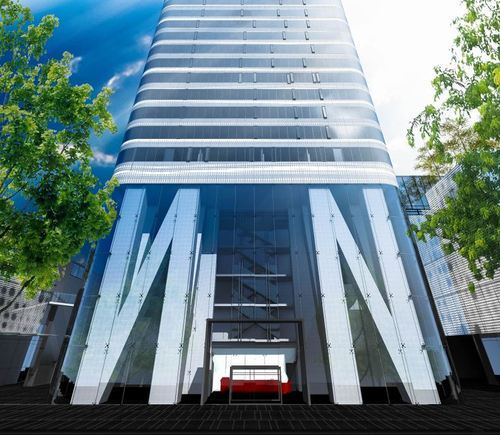
    The proposal is a departure from previous plans and now includes 3 buildings: a 4.5 storey building, a 2.5 storey building, and a midblock 54 storey residential tower (the lobby is shown above). There will be both retail and residential uses.

    For those of you familiar with the mall, it should go without saying that Cumberland Terrace is in desperate need of redevelopment. So I’m not going to talk about that today. Instead, I’d like to mention 2 other points that stood out to me about the application.

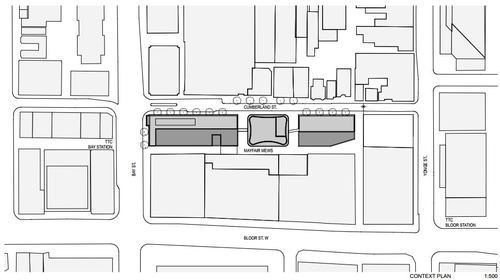
    The first is the 2 midblock connections on either side of the tower, running from Cumberland Street to Mayfair Mews in the rear (see below). Yorkville has a history of intimate laneways, and so it’s nice to see some of this being carried through in a new development. It also opens up the opportunity for an improved Mayfair Mews.
    image

    Secondly, it’s somewhat surprising to see that the 54 storey residential tower is being proposed as rental. Toronto doesn’t build a lot of purpose-built rental apartment buildings. There are some (from the likes of Morguard and Concert Properties), but we haven’t done it at scale for decades. And that’s largely because the demand for condos has been so great.

    But recently I’ve been noticing a renewed interest from the real estate community in multi-family rental assets. Cadillac Fairview also proposed a 65 storey rental building at the north west corner of Yonge Street & Queen Street last year – though they later withdrew their application.
    image

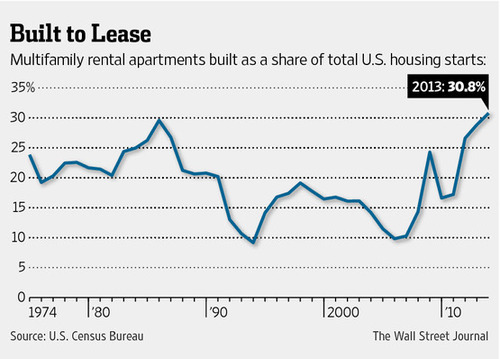
    In the US, rental apartments as a share of all new housing is also at record highs – over 30%. And that’s partly because credit remains tight (certainly compared to pre-2008) and economic growth has been tepid. But also because of demographic changes. People are having fewer children, later in life, and so many are putting off buying.

    So I think we’re going to see even more rental apartments being built in Toronto in the coming years.
  • Learning from Melbourne

    Earlier this week my good friend Gabriel Fain emailed me a bunch of photos from his recent trip to Melbourne. Gabriel and I went to architecture school together here in Toronto and we often go back and forth on city building issues.

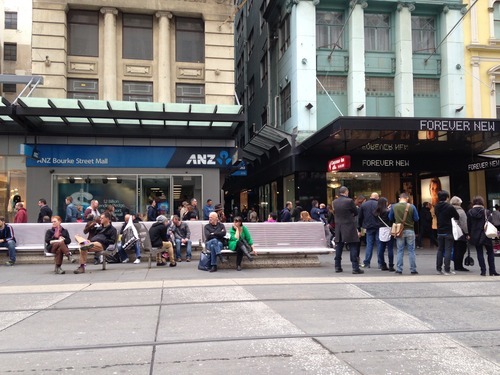
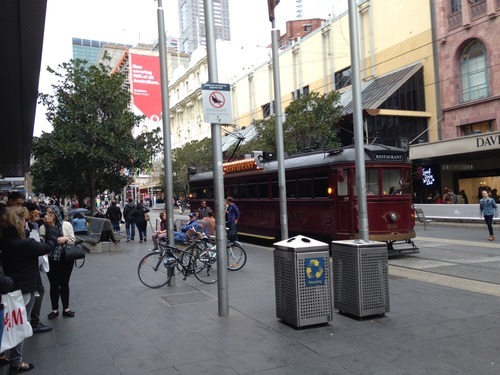
    Here are the photos he sent me of Bourke Street in Melbourne:

    image

    image

    The comparison he drew in his email was to that of Bloor Street in Toronto, except with a few major differences: Bourke Street is pedestrian only (except for a tram running down the middle of it). It has no curbs. There’s lots of inviting seating. And the connecting cross street laneways are fully activated. He then ended by saying that "Toronto is light years behind Melbourne and Sydney in the terms of the quality of the public space.“ 

    I replied and asked if I could turn his email into an ATC post. He responded by saying that he was hoping I would, and then sent me another photo – this time of one of the laneways:

    image

    Melbourne’s laneways and arcades are celebrated around the world. What was once just residual space, became a catalyst for the revitalization of the city’s central business district in the 1990s and a major tourist destination. But all it really took was a change in thinking. It took somebody to believe that the space used for garbage collection, could also be used for a thriving culture of intimate al fresco dining.

    In Toronto, I think we’re headed in the right direction in terms of our thinking, but that we’re not yet being bold enough. The recent revitalization of Market Street in my neighborhood (St. Lawrence) is a wonderful example of putting pedestrians first and a wonderful street overall. Like Bourke Street, it also doesn’t have curbs (this is how you know pedestrians matter). But it was also a prime candidate for a pedestrian-only street. Especially given that Market Lane to the north is already one (though in desperate need of renewal). 

    For a number of reasons though, pedestrian-only streets are difficult to accept here in Toronto. I’ve been shot down many times in real estate meetings for arguing that we should have them in our city. Oftentimes people say it’s because of our harsh climate. But in my view, that’s all the more reason to have them. When the weather is nice, we should be enjoying our public spaces to the fullest. Why only build to the worst case scenario? Plus, they work in Scandinavia.

    We’ve also done it before. In the early 1970s (when I wasn’t around), a portion of Yonge Street was piloted as a pedestrian-only mall – a remarkably forward-thinking achievement for that era of city building. So I’m confident that it can be done and that we’ll one day do it again.