Daily insights for city builders, delivered every morning at 6 AM ET. I’m Brandon Donnelly — a Toronto-based real estate developer and founder of Globizen. I’ve been writing here since 2013.

Tag: land prices

  • Land prices and transaction volumes are, as you’d expect, down

    Bullpen Consulting just released its Q3-2024 high-rise land report for the Greater Toronto Area. Here’s a figure showing average high-density land prices (on a per buildable square foot) by quarter since 2018:

    Here’s their summary data broken out by Toronto versus the Greater Toronto Area:

    And here’s a list of all the land transactions last quarter:
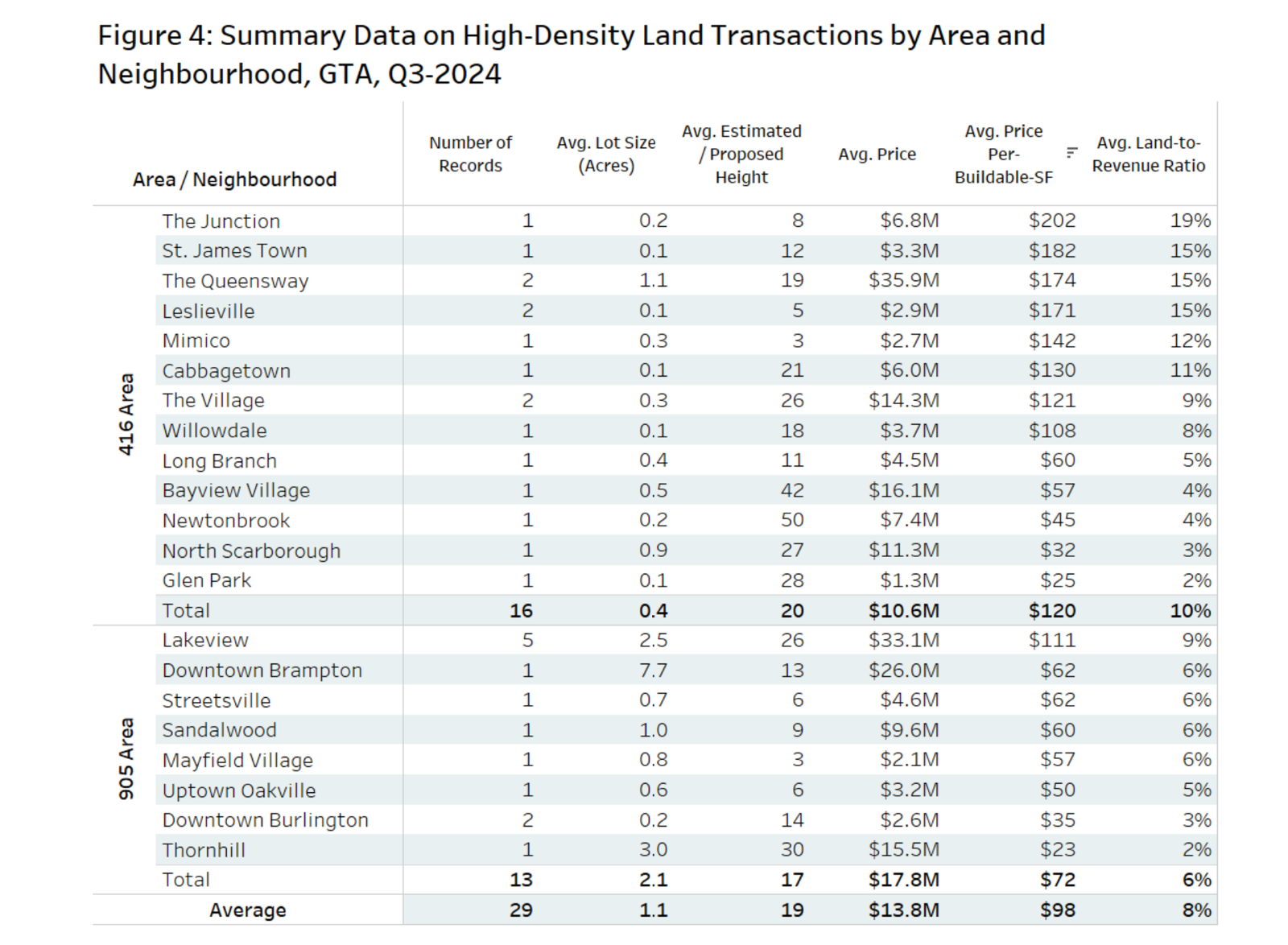
    At the highest level, the average high-density land trade last quarter across the GTA was at around $98 per buildable square foot. This is down 13% from $112 pbsf in Q3-2023. And going back to the first chart in this post, there also seems to be a longer-term decline in high-density land prices.

    But as Bullpen rightly points out in their report, there are limits to what can be gleaned from data like this. And that’s because land transactions can be structured in countless ways. Did the vendor provide cheap financing? Was there a delayed close? Are there any unique site conditions that could be impacting value? The list goes on.

    So even though prices and transaction volumes are down (which is what one would totally expect right now), it still doesn’t feel like this data accurately reflects what’s going on in the market today. I think the reality is worse.

    If you’d like to join Bullpen’s mailing list, here’s their website.

    Figures: Bullpen Research & Consulting

  • Land prices can be weird

    Jeremiah Shamess of Colliers made the claim this week that land values in some areas of the Toronto region are down 25%. He then shared a chart from Alan Leela showing how various factors have increased or decreased land values since 2020.

    Broadly speaking, a revenue increase and/or more development density should increase land values; whereas something like inclusionary zoning, which is a cost to the project, should decrease land values. Indeed, this is one of the arguments in favor of inclusionary zoning: “Don’t worry about the additional cost to the project because landowners will simply pay for it through reduced land prices.”

    In theory, all of this is correct.

    Land is (or should be) the residual claimant in a development pro forma. Start with your revenue, subtract your costs, and then see what is left over for the land. (Though keep in mind that what is left over for the land could be $0 or even a negative number.)

    But as I have argued before in the context of inclusionary zoning, I don’t think things always play out so neatly in the market. Put differently, if the cost impact of inclusionary zoning is something like $44 psf, I don’t think all landowners suddenly drop their prices accordingly — especially in a rising market where developers are competing fiercely for land.

    They don’t care about your residual value model. Many or most will just hang on to their number and wait for someone to pay it.

    So what I am saying with all of this is that, yeah, there are factors that put either downward or upward pressure on land values. But how it all actually plays out in the market tends to depend on the macro environment and what else is going on at the time. And right now we are at a point in the cycle where there is clearly downward pressure on land values.

  • Mid-rise development land is more expensive

    As is the case every quarter, Bullpen Research & Consulting and Batory Management have just published their latest Greater Toronto Area land insights report (for Q3-2022). The average price per buildable square foot (pbsf) in this report remains the same as in Q2 at $95.

    But once again, it’s important to keep in mind that this represents a fairly small sample size (34 land sales in the quarter versus 46 in Q2); that the range in land pricing can be significant across the GTA (here it is $24-274 pbsf); and that there can sometimes be a lag between a deal being struck and actual closing. Here is the summary data:

    Another interesting data point from the report is land price compared to building height. The average price for high-rise development land was $88 pbsf, and the average price for mid-rise development land (5-15 storeys) was $131 pbsf.

    This once again speaks to the cost differential between high-rise and mid-rise housing. The mid-rise scale is certainly a desirable form of infill, but it is also a more expensive form of housing.

  • A question of land value

    Let’s say that we have a piece of development land worth $100. That is the market value of the land based on its highest and best use at this particular point in time. Now let’s assume that the land was just encumbered with a new burden: inclusionary zoning. All of a sudden there is now a requirement to make available X% of any residential units built at 50% of average market rents for the area.

    Technically, the land is now worth less than $100. And there is a school of thought out there that, in instances like this one, the price of all land should automatically reset downward to offset and account for the inclusionary zoning burden. But as I have argued before on the blog, land prices tend to be fairly sticky, unless the owner is distressed and really needs to sell.

    So what can often happen is that the land owner will stubbornly cling to the original $100 number. The thinking being, “I was once told that my land is worth $100 and so that’s the minimum price I’m willing to accept.” In this scenario, you may need a broad increase in rents in order for a transaction to occur. This way the market rate units might be able to fully subsidize these new affordable units, preserving any margins and justifying the original $100 number.

    Of course, the impact of inclusionary zoning is a hotly debated topic and there are a number of variables to consider. And so I will leave it at that for today. The real purpose of this post is to consider another permutation. Let’s once again say that we have a piece of development land worth $100. But instead of being owned by 13 siblings — and 3 cousins that live abroad and can’t be reached other than by fax — it’s owned by the government.

    In this case, the government wants to sell the land and is considering two options. It can either (1) sell it for $100 and maximize immediate taxpayer revenue or (2) it can sell it for $80 with the condition that the buyer agree to deliver X% of affordable units (and a bunch of other goodies and positive externalities). I would also add that this fictitious town is experiencing what some might call a housing crisis.

    If you were a private sector actor, you would probably choose option 1. You would take the additional $20 and retire to Florida (I’m off by a few zeros). But this is the government we’re talking about and presumably the government is thinking about the broader public good. Which option do you think is better at maximizing that?

  • Additional thoughts on land prices

    Daniel Hertz over at City Observatory just published a post talking about why land costs are so important when it comes to home prices. More specifically though, his post is intended to refute a claim that multifamily housing is always going to be more expensive than single family housing.

    The key concept here – which is critical to understanding urban real estate economics – is that home values are essentially made up of two things: the land and the improvements (i.e. the building). 

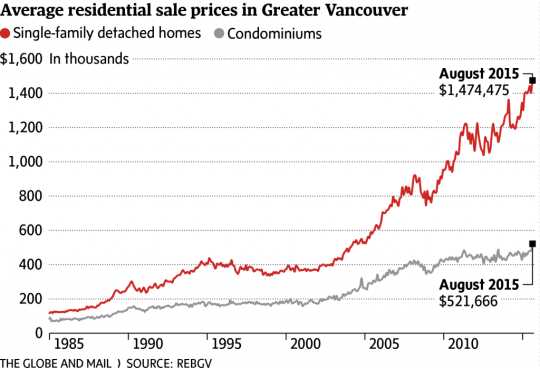
    When home prices rapidly appreciate, as has been the case in cities like Vancouver (see below) and Toronto, it’s not the building, but the land that’s really driving the price up. 

    And as you can see from the chart below (which Daniel shared in his post), it is possible for multifamily housing to be less expensive than single family housing. 

    image

    So why was someone arguing that multifamily housing is more expensive?

    Well if you look at just construction costs, then this is generally true. Single family housing is typically wood frame construction, whereas multifamily housing is usually reinforced concrete or some other material that allows you to build up. In these latter cases, the price per square foot to build is going to be higher.

    But Daniel’s argument is that when you build multifamily housing, you also begin to amortize the cost of the land over more housing units. So you begin to use land more efficiently and that offsets the higher construction costs.

    However, two thoughts come to mind.

    First, the value of a piece of land is entirely dependent on what you can build on it. And the more you can build on it, the more the land is worth. So as densities increase, so do land prices.

    Second, a big part of why condominiums are so much more affordable is that they’re smaller. In 2014, the average condo size in Metro Vancouver was estimated to be 840 square feet. I couldn’t find the average size of a detached house in the city, but let’s assume for a second that it’s 2,500 sf. 

    If that were the case, then a detached house, despite being more expensive overall, would still be cheaper on a per square foot basis. You would be paying less for every square foot of livable space. True that doesn’t make the house more affordable, but I think it’s a bit unfair to compare apples (small condo) to oranges (large house).

    So what I would really like to see is a graph of all-in low-rise and high-rise per square foot prices over time and for various cities. Because I would be curious to see at what point – if ever – they intersect.