Daily insights for city builders, delivered every morning at 6 AM ET. I’m Brandon Donnelly — a Toronto-based real estate developer and founder of Globizen. I’ve been writing here since 2013.

Tag: labor markets

  • I really want to live over there

    One way to describe cities is to call them labor markets. Historically, people have chosen to live in cities because they have provided economic opportunities (among, of course, many other things). That’s why the data is very clear: wages are higher in larger cities.

    But what we have also seen over the last few years — and what is causing a lot of dislocation in real estate markets — is an untethering of work. More people are working from home and from locations that offer greater lifestyle benefits (or greater tax benefits).

    We spoke recently about what this divide between in-person and remote work might mean, but regardless of this outcome, I think there’s an important truth here: Lots of people would like to live somewhere else. (In my case, my daydreams take me to Paris.)

    And for the first time ever, really, it is possible for more people to do this and stay connected to work somewhere else. Earlier innovations, such as the streetcar or car, also compressed geographies and empowered people to travel greater distances. But now the catchment area has seemingly expanded to the world.

    I’m not saying anything particularly novel here, but I do think it’s important to point out that this desire exists in many of us. Because this tension between “I do work here” but “I really want to live over there” seems like it’s only increasing.

  • We’re all going back to offices — most of us anyway

    I was speaking with a writer from the Globe & Mail today about the future of office. We were half talking about a new AAA strata office building — called Capital Point — that we (Slate) are in the midst of launching in the Metrotown neighborhood of Burnaby, BC. And we were half talking about whether or not we’re all going to return to offices.

    This is one of the great debates of the pandemic but, as I mentioned in my 2021 predictions post, I think it’s overblown. The longer I work from home and spend my entire day on video calls (only to start actual work in the evening), the more I become convinced that this is a suboptimal arrangement for productivity, collaboration, personal motivation, employee morale, and talent retention (among many other things).

    We have complete conviction around great offices in the right locations. That’s why Amazon and whoever else continue to build. They’re rightly looking past this period of dislocation (12-24 months of suck). Again, this is not to say that there won’t be some changes and that certain pre-existing trends haven’t been accelerated, because they have been. But I believe that humans will continue to cluster for work.

    In fact, it’s hard to disentangle cities and offices. Cities are labor markets. It’s where agglomeration economies take hold and where people come to improve their socioeconomic standing in the world (as well as meet people and have fun). To say that we no longer need to come together in person for work is to say, in a way, that we no longer need cities. We can all decentralize.

    That is not a bet that I am prepared to make.

    For more information about Capital Point and to register for the project, click here.

  • The rise of tech outposts

    What happens when wages and real estate prices become too high in a city? Companies start growing in lower cost locations. We’ve all seen this before. 

    Fred Wilson recently blogged about this “spillover effect”, citing a New York Times article talking about the growth of tech offices in Phoenix. As someone who sits on the board of many technology companies, he was noticing a thematic trend:

    “A big theme of board meetings I’ve been in over the past year is the crazy high cost of talent in the big tech centers (SF, NYC, LA, Boston, Seattle) and the need to grow headcount in lower cost locations.”

    We talk a lot about housing prices on this blog, and so I think it’s useful to see how this, along with high wages, also impacts companies. The two are interrelated.

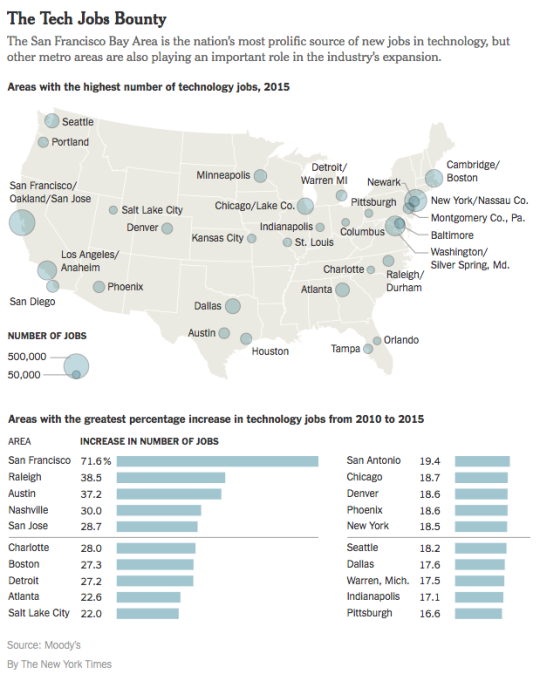
    Below is a chart from the NY Times article showing the US cities with the highest number of technology jobs and the most growth from 2010 to 2015. 

    San Francisco is in a league of its own. But overall, the growth is in tech and many cities are adding lots of technology jobs. Look at Detroit and Boston right beside each other (Detroit obviously has a smaller starting base). And look at how Miami is nowhere to be found.

    Of course, one interesting question is whether these new outposts – such as Phoenix – can truly come into their own and carve out a niche:

    “We don’t want to be San Francisco’s back office — we need more creators here,” said Scott Salkin, a founder and the chief executive of Allbound, which is based in Phoenix, makes sales software and has offices down the hall from Gainsight’s.

    Even with the high cost of living, it’s hard to supplant the coastal hegemony. That’s where people go to chase riches. As comedian Daniel Tosh likes to say, “the middle of the country is for people who gave up on their dreams.”

    Though for some, living in a place like Denver or Salt Lake City and snowboarding every weekend is a better outcome than living in a studio apartment and commuting an hour to work.

  • Technology is eating the world

    Large Gantry Crane on Sunset by Sasin Tipchai on 500px.com

    https://500px.com/embed.js

    Earlier today the comment section of an old post I wrote about UberX was revived with a discussion around technology and what it means for human capital.

    The concern expressed was that technology and machines are going to put us all out of a job. And it stemmed from a discussion around driverless cars. Clearly we are headed in that direction and so eventually we will no longer need to drive or have people drive us around. This means that something that was once a job will no longer exist.

    But I am not yet convinced that it will be as dire as some believe it will be – though it could very well necessitate some significant structural changes in the economy.

    Here are two things to consider:

    Marc Andreessen has written and tweeted a lot about the topic of “robots eat all jobs” and his argument is that this line of thinking often revolves around something called a lump-of-labor fallacy. This is the idea that there is a fixed amount of work to be done. And so when technology replaces humans, we are just making the labor pie smaller.

    But the reality appears much different. Human wants and desires increase and we find new ways to put people to work. One of the examples I’ve heard Marc give, that I really like, has to do with buildings. In the past, there used to be a guy whose only job was to shovel coal into a furnace. He physically heated the building. But eventually technology did away with that requirement and that job. Is that not progress? Or should we go back to that in order to put people to work?

    All this said, unemployment and job displacement are still serious issues for cities and countries. Which is why some people – including many capitalists – believe that minimum wages will not be enough going forward. We will also need to look at things like a “basic income guarantee” to redistribute wealth and ensure that, no matter what, everyone has a certain amount of money to live.

    At first blush, this doesn’t feel right. But I think it’s important to remain open minded and engage in discussion. Hopefully we can do a bit of that today in the comments below.

  • Cities with the most single men and women

    There are thousands of people who read this blog via email or by following on Tumblr. The rest of the readership just stops by on the web and visits periodically.

    But of the thousands of regular readers, I know that many do not click through to the comment section. And that’s a shame. Because oftentimes I find the comments more interesting than my actual post.

    Take for example yesterday’s post on The Millennial Dream

    The initial post was about Millennial housing choices (and some stats on marriage and fertility rates). The comments provided some additional color on the trends, but they also got into mobile dating apps and whether or not it’s easier or harder to meet people in cities, today. It was a fun discussion.

    This got me thinking and reminded me that people come to cities not only because of labor markets, but because of dating markets. 

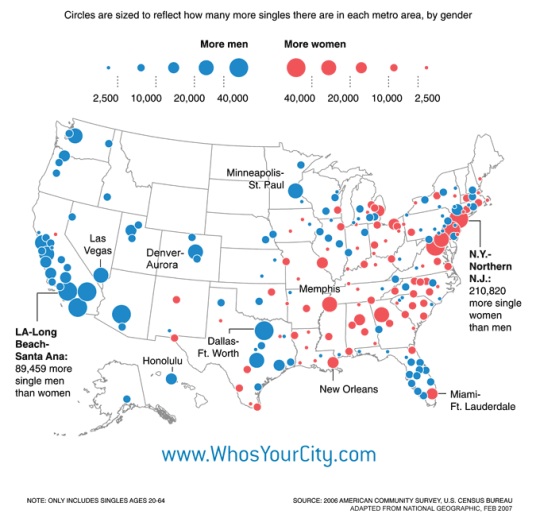
    So for today’s piece, I thought I would post the following diagram from Richard Florida’s book, Who’s Your City? It shows how many more singles (aged 20-64) there are – according to gender – in the largest US metro areas.

    I couldn’t find an equally detailed map for Canada, but based on this, it looks like Toronto is slanted towards single women and Calgary is slanted towards single men.

    Does the above look right to you?