Daily insights for city builders, delivered every morning at 6 AM ET. I’m Brandon Donnelly — a Toronto-based real estate developer and founder of Globizen. I’ve been writing here since 2013.
Knight Frank just published the 2024 edition of its annual wealth report and, it turns out, that 2023 was a reasonably good year for rich people. Below are some of the charts that I found interesting as I flipped through the report.
The first is their Prime International Residential Index, which tracks the pricing of the most desirable and expensive properties in the following 100 locations. Generally, they define this as the top 5% of each market.
Moving on, this is how much square meterage that US$1 million will buy you in select city and second-home locations.
These are the cities that saw the greatest cross-border investment flows into commercial real estate.
This is their prime property price forecast for 2024.
This is what it looks like for prime rents.
And finally, this is how much net wealth you need in order to join “the 1% club” in select countries/territories.
To download a full copy of Knight Frank’s 2024 Wealth Report, click here.
Global super-prime ($10m+) residential sales bounced back in Q1 2023, with 417 sales across the 12 markets tracked in Knight Frank’s new Global Super-Prime Intelligence report. That’s up 11% on the 376 recorded in Q4 2022 and the highest volume since Q2 last year.
The biggest market in Q1 this year was Dubai (88 sales), followed by Hong Kong (67), New York (58), Los Angeles (46), Singapore (37) and London (36). While volumes rose in Q1, the total value of sales fell 4% to $7.2 billion. The most expensive average super-prime sales took place in Geneva ($23.8m) and London ($20.4m)
What is perhaps most interesting, though, is how central Dubai has become in the flows of global capital. In 2019, Dubai accounted for 2% of all super-prime sales in the 12 markets that Knight Frank tracks.
Today, looking back at the most recent 12-month period, Dubai now accounts for 17% of all super-prime sales, placing it ahead of London, New York, and Los Angeles.
Part of this jump likely has something to do with the “housing disaster” that Dubai was going through back in 2019. But even still, it is impressive to see just how quickly the city has managed to build and position itself as an alpha global city.
I much prefer walkable cities, but clearly there are enough other people who don’t care about that sort of thing.
Knight Frank just published the 17th edition of its annual “The Wealth Report.” I have spoken about this report many times before on the blog because I generally find them really interesting. So today I’d like to share two items from this latest one.
The first item is their most recent Prime International Residential Index (PIRI). What this does is track prime residential prices across 100 key city, sun, and ski locations. “Prime”, in case you are wondering, is defined as the most desirable and most expensive properties in each market — generally the top 5%.
Look at Dubai go:
When I see a chart like this I usually start at the top and then immediately start scanning for Toronto. Here, it’s more or less in the middle with a 4.1% increase. Totally reasonable. Prime property in Auckland and Wellington, on the other hand, didn’t fair as well in 2022.
The second item is this very wonderful diagram showing flight connectivity before Covid (12 months to March 2020) and then post-Covid (12 months to December 2022):
The way to read this diagram is that the most connected cities — ranked by the number and quality of flight connections — get pushed toward the center. They also get bigger. Less connected cities, on the other hand, slide toward the edges. All of the cities also generally gravitate toward their main regional connections.
The most obvious change is the greatly weakened connectivity of Chinese cities. This is not surprising given their zero-Covid approach. Moscow also seems to get rightly pushed out to the side.
Another story is the continued rise of both Singapore (to the likely detriment of Hong Kong) and Dubai. I have only been to Dubai once, and I couldn’t figure out how to navigate its sea of roads and highways, or how to locate an actual city center where humans walk around (though the historic Bur Dubai area was interesting).
But there is no denying that Dubai has become a pretty important global city.
Each year in March, Knight Frank publishes something called, The Wealth Report, which typically includes things like its Prime International Residential Index (PIRI) and a general overview of what ultra high-net-worth individuals (UHNWIs) are up to with their money.
(An UHNWI is typically defined as someone with a net worth greater than $30 million. And as of last year, there were nearly 400,000 of them around the world, with Hong Kong being the city with the most.)
In anticipation of this year’s report, Knight Frank has just published the key findings of an “Attitudes Survey.” This is them talking with and surveying private bankers, wealth advisors and family offices about some of the key themes for 2023.
Here are a few of my takeaways:
Globally, about 1/3 of UHNWI wealth is allocated to primary and secondary homes. This is expected. Generally the richer you become, the more your net worth gets diversified away from your primary residence. It is also worth noting that of this 1/3 allocation, more than a quarter is being held outside of their country of residence. This outside-of-country-of-residence percentage is highest for UHNWIs in the Middle East (41%).
The average UHNWI owns 4.2 homes around the world, with UHNWIs in Asia owning the most: an average of five homes. This is the kind of stat that might provide motivation for a foreign buyer ban, but I continue to believe that there are other bigger drivers impacting housing affordability/supply across our global cities.
About 15% of UHNWIs said that they want to purchase a residential property this year (2023). This is down from 21% last year. Inline with bullet point number one, the greatest appetite/stated intent is coming from the Middle East. (Related article: The new Gulf sovereign wealth fund boom)
Real estate was identified as the top investment opportunity. About 1/3 of UHNWIs want to invest in real estate — either directly or indirectly — in 2023. And the top asset classes are: healthcare, logistics/industrial, office, multi-family rental apartments, and hotels. It is interesting to see office in the top three. A positive sign that it is maybe being viewed as an oversold opportunity.
Finally, environmental sustainability is being increasingly considered by UHNWIs when it comes to investment properties: 57% are considering energy source(s), 33% are considering opportunities for refurbishment, and 30% are considering the materials used/the embodied carbon footprint inherent to the asset.
Knight Frank just released the 16th edition of its Wealth Report along with the disclaimer that, with everything going on in Ukraine right now, this outlook is of “little relative importance” and kind of doesn’t matter in the grand scheme of things. In any event, it includes the latest edition of their Prime International Residential Index (PIRI 100), which looks at the annual % change in luxury residential prices around the world. The chart is interactive, but I screenshotted (above) the top risers and fallers. Toronto is 4th in the Americas and 7th globally with a 20.3% year-over-year increase. Miami is also no surprise and came in 4th globally. The top three cities were Dubai, Moscow, and San Diego. Thankfully though, the number two city is in serious jeopardy right now and I suspect that its position will look quite different next year. Money will go where it feels safe and secure.
London has a breed of specialist developers that are known as rooftop or airspace developers. What these developers do is build on top of existing and occupied buildings — mostly residential. Firm examples include Upspace and Apex Airspace. According to this recent WSJ article, the city is also making moves to relax regulations so that more of these top-ups can be completed.
Brokerage Knight Frank estimates that in central London alone there are probably 23,000 buildings that could support a few extra floors, resulting in upwards of 41,000 new homes. I have done early feasibility studies for similar projects here in Toronto and they’re not simple to execute. But building structures are typically constructed with a factor of safety and so, in some/most cases, you can build a little on top without doing any additional reinforcing. (Note: I am not a structural engineer.)
In any case, the benefits of airspace projects are obvious. You’re creating additional supply in a tight housing market like London. Similar to Toronto’s laneway housing program, it’s not going to completely solve the larger problem of affordable housing. But every bit of new housing helps, regardless of where it lands on the spectrum of affordability.
One of the drawbacks, which is the headline of the above WSJ article, is that penthouse residents are getting demoted in the process. They’re going from penthouse to sub, or sub-sub, or sub-sub-sub penthouse. They also need to endure a bit of construction right above them. Cry me a river?
But what is also important to point out is that there are lots of buildings out there which are facing capital expenditure shortfalls. They have maintenance and repair demands that simply aren’t adequately funded. Adding additional floors can be a way for these buildings to generate that cash and, in some cases, residents are even partnering with airspace developers to share in some of the profit upside.
Not surprisingly, these sorts of arrangements are seemingly being met with a fair bit of support. Because in these instances, your options are basically as follows: Either you cut a repairs and maintenance check right now or you support a bit of development and then hopefully you’ll be the one receiving a check in the future. I suspect we’ll be seeing a lot more of this, not just in London, but in cities all around the world.
The latest (15th) edition of Knight Frank’s annual The Wealth Report was published last month. I find these interesting because they give you a global view of how and where capital is flowing into real estate (specifically prime real estate). London, for example, did rather well last year despite the pandemic. Buyers from the around the world spent nearly $4 billion on what is commonly referred to as “super-prime properties.” This is real estate with a sale price of US$10 million or more. London saw 201 super-prime properties trade hands last year, with an average price of $18.6 million and with 31 of these transactions being at or above $25 million. This is an increase compared to the year prior (2019), which I suppose is something given that the UK’s housing market was more or less frozen between March and May of last year. These figures put London at the top, ahead of New York and Hong Kong, when it comes to super-prime real estate sales in 2020. (London figures via the Financial Times.)
Another interesting thing that you’ll find in the report is a city ranking that Knight Frank calls their City Trifecta. What this index does is take Knight Frank’s City Wealth Index (which considers where wealth is currently concentrated) and then adds in two other dimensions: innovation and wellbeing. The idea here is that innovation should drive future economic growth and wealth, and that wellbeing (quality of life) is pretty important when it comes to the future competitiveness of our global cities. When you look at the world’s top cities through this lens, the ranking starts to differ from what you may be used to seeing with cities like London, New York, and Hong Kong at the top (see above chart). Now you have Munich taking the number one spot; Boston and Toronto in 5th and 6th position, respectively; and cities like Zurich jumping up ahead of cities like Hong Kong. These kind of rankings always need to be looked at with a critical eye, but they can be interesting nonetheless.
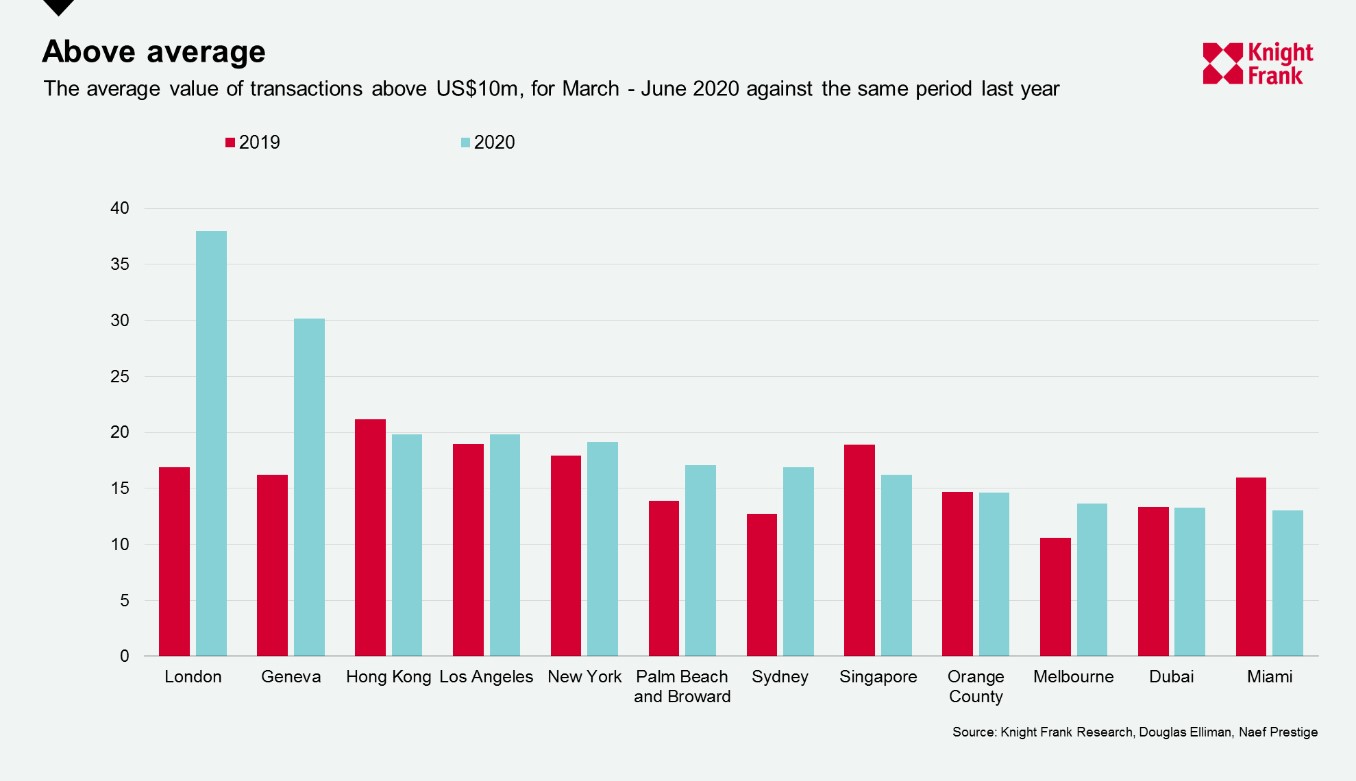
This is a chart from Knight Frank showing the average value of “super-prime” residential real estate transactions in 12 global markets between March and June 2020, and versus the same period last year.
Knight Frank classifies super-prime real estate as having a value greater than US$10 million and ultra-prime real estate as having a value greater than US$25 million.
In this particular chart, London takes the top spot with an average super-prime transaction value of US$38 million. This is a big jump compared to 2019 where the average value was US$16.9 million.
Typically it is Hong Kong that takes the top spot in this ranking, but this year it fell to third. Still, Hong Kong had the highest number of transactions with 60 super-prime sales taking place in the first half of 2020. This is down from 155 in the first half of 2019.
Overall, Knight Frank recorded 281 super-prime transactions across these 12 cities in the first half of this year. This is, not surprisingly, a decline compared to last year, which saw 594 transactions over this same time period.
But all things being considered and given some of these price increases, the super-prime market is certainly holding its own.
The below graphs are taken from a recent (June 2019) report by Knight Frank on “prime” residential pricing across the world. They define “prime” as generally being the top 5% of each market by value. What these graphs show are the spread between the average price of a prime property and the top price achieved in that market.
The most expensive market is Hong Kong. The average price of a prime property in 2018 was USD 4,251 per square foot (or USD 45,760 per square meter) and the top price achieved was in 2016 at USD 28,154 per square foot (or USD 303,051 per square meter).
Using the 2018 average, a 350 square foot studio apartment would run nearly USD 1.5 million (or almost CAD 2 million), assuming there are “prime” studios available in the market. Remember, we are talking about the top end of the market.
If you’d like to download a copy of the full report, you can do that over here.
Here’s a chart from Knight Frank’s 2019 Global Affordability Monitor that I think you’ll find interesting:
It compares real home price growth and real household income growth (after tax) over the last 5 years for 32 world cities. The bolded percentages represent the former and the non-bolded percentages represent the latter.
Consider the variations here.
Amsterdam saw a real home price change of 63.6%, but a household income change of only 4.4% (although the circle looks to be in the wrong spot if this number is correct).
Moscow, on the other hand, saw flat home prices (0.1%) and a 22.7% increase in household income.
Though San Francisco is the star in terms of income growth.
Sao Paulo, unfortunately, saw a dramatic decline in both home prices and incomes. It’s in the bottom left corner.
When I look at this chart, I don’t see a strong correlation between household incomes and home prices. And the proportions of the chart tell you that the y-axis is moving more than the x-axis.
But if the top number exceeds the bottom number, then you could come to the conclusion that housing affordability has gotten worse over the last 5 years.