Daily insights for city builders, delivered every morning at 6 AM ET. I’m Brandon Donnelly — a Toronto-based real estate developer and founder of Globizen. I’ve been writing here since 2013.

Tag: joe cortright

  • Segregation and income inequality in cities

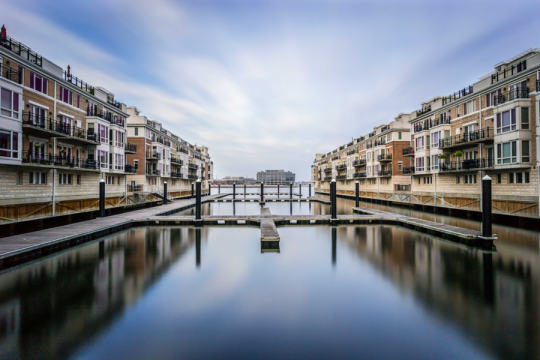
    Photograph Baltimore Harbor by Wes Bunton on 500px

    Baltimore Harbor by Wes Bunton on 500px

    Given what is going on in Baltimore and other cities in the US right now, I thought it would be worthwhile to share an interesting article from City Observatory talking about income disparity and racial segregation in cities.

    There are significant racial income gaps in the United States (as well as in Canada). According to City Observatory, the average black household earns 42% less than the average white household in America. There is, of course, lots of regional variation, but this is what it looks like nationwide.

    The interesting thing about this racial income gap though, is that there’s one factor that seems to account for the bulk (up to 60%) of the variation: residential segregation. In other words, the more segregated a city becomes, the more this black/white income disparity increases.

    Here’s a snippet from Joe Cortright of City Observatory:

    …there are good reasons to believe that high levels of segregation impair the relative economic opportunities available to black Americans. Segregation may have the effect of limiting an individual’s social networks, lowering the quality of public services, decreasing access to good schools, and increasing risk of exposure to crime, all of which may limit or reduce economic success. This is especially true in neighborhoods of concentrated poverty, which tend to be disproportionately neighborhoods of color.

    We also know that there are all kinds of negative externalities associated with income inequality. Therefore, there’s a strong case to be made for addressing segregation and the spatial organization of our cities. 

    I recommend you read the City Observatory article for a more nuanced explanation of the above relationship.
  • Where the jobs are being created in cities

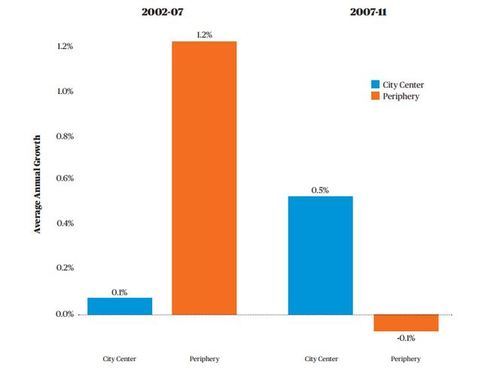
    According to a new report released by City Observatory, US cities have officially reversed a 50-year trend towards decentralization.

    We know that urban living has been seeing a renaissance over the last decade or so, but as recently as 2002 – 2007 (pre-Great Recession), the suburbs and peripheral areas were still seeing significantly higher job growth: 1.2% per year in the periphery versus 0.1% in the city center. The “city center” is defined as a 3 mile radius around the center of the city in this study.

    However since 2007 things have flipped:

    image

    Chart Source: City Observatory

    Why is this happening? Here’s a snippet from City Observatory:

    The strength of city centers appears to be driven by a combination of the growing attractiveness of urban living, and the relatively stronger performance of urban-centered industries (business and professional services, software) relative to decentralized industries (construction, manufacturing) in this economic cycle. While it remains to be seen whether these same patterns continue to hold as the recovery progresses, (the latest LEHD data on city center job growth are for calendar year 2011), there are structural forces that suggest the trend of center-led growth will continue.

    In some ways, it just makes intuitive sense. People started returning to cities and so the jobs followed (although there were also structural changes to the economy). 

    The big question, however, is whether this trend will continue? My bet is on yes. What do you think?

  • Weird as a competitive advantage

    image

    Joe Cortright of City Observatory recently reposted an article that he wrote back in 2010 called, Keeping it Weird: The Secret to Portland’s Economic Success.

    In it he talks about a “weirdness index” that he developed for CEOs for Cities that measured and ranked 50 American cities across 60 different behavioural indicators. San Francisco and Salt Lake City come out as the weirdest, and Portland ranked 11th out of 50. The most “normal” part of the US was the Midwest. Normal meaning behaviours that are most similar to the national average.

    He then goes on to talk about weird as a competitive advantage. Here are a few snippets:

    When it comes to economic success in today’s economy, the key is to differentiate yourself from your competitors. Harvard Business School’s Michael Porter counsels businesses that “competitive strategy is about being different.” And the late, great urbanist Jane Jacobs told us, “The greatest asset that a city can have is something that’s different from every other place.”


    True entrepreneurship is about deviant behavior: starting a business that makes a product that no one else has thought of or thinks there’s a market for. Entrepreneurs and open-minded, experimental customers go hand-in-hand.


    We shouldn’t do things just to be different, but we should never be dissuaded from trying something simply because it is different or would make us different from other places.

    What this all comes down to is the simple fact that what is weird today, might very well become the norm tomorrow. But you need to be open enough to allow that to happen if you want to be the place that generates those news ideas.

    Could you have imagined that selfies would become as ubiquitous as they have? That would have been pretty hard to predict. It used to be the case that people were afraid to use their real name on the internet. Now we share our entire life online, including our faces.

    Image: Flickr