Daily insights for city builders, delivered every morning at 6 AM ET. I’m Brandon Donnelly — a Toronto-based real estate developer and founder of Globizen. I’ve been writing here since 2013.

Tag: jeremiah shamess

  • I finally got a road bike

    I did it. I finally got (well, ordered) a new and more serious road bike.

    I have been planning to do this since last year. I almost bought a friend’s Cervelo a few weeks ago, but I took it to Gears on King Street and they immediately told me it was too small for me. The frame was 58cm and apparently I need 60cm.

    So I instead ordered a new Cannondale CAAD13. It’s one that my serious cycling friends — people like Jeremiah Shamess — tell me is a good “starter bike.”

    I’m excited to get going. In the winter, I am, as most of you know, all about snowboarding. But I need something active/challenging for the summer that I can be equally fanatical about. Maybe that thing will be cycling.

    The one thing I do need to give some more thought to is cycling to the office. I know a bunch of people who do this, but they tend to go to the gym and then shower before heading to their desk. I’m not sure I want to make this my morning routine.

    Either way, I guess it’s time to dust off my Strava. If any of you are into cycling, hit me up on Twitter/X.

    Photo: Cannondale

  • Land prices can be weird

    Jeremiah Shamess of Colliers made the claim this week that land values in some areas of the Toronto region are down 25%. He then shared a chart from Alan Leela showing how various factors have increased or decreased land values since 2020.

    Broadly speaking, a revenue increase and/or more development density should increase land values; whereas something like inclusionary zoning, which is a cost to the project, should decrease land values. Indeed, this is one of the arguments in favor of inclusionary zoning: “Don’t worry about the additional cost to the project because landowners will simply pay for it through reduced land prices.”

    In theory, all of this is correct.

    Land is (or should be) the residual claimant in a development pro forma. Start with your revenue, subtract your costs, and then see what is left over for the land. (Though keep in mind that what is left over for the land could be $0 or even a negative number.)

    But as I have argued before in the context of inclusionary zoning, I don’t think things always play out so neatly in the market. Put differently, if the cost impact of inclusionary zoning is something like $44 psf, I don’t think all landowners suddenly drop their prices accordingly — especially in a rising market where developers are competing fiercely for land.

    They don’t care about your residual value model. Many or most will just hang on to their number and wait for someone to pay it.

    So what I am saying with all of this is that, yeah, there are factors that put either downward or upward pressure on land values. But how it all actually plays out in the market tends to depend on the macro environment and what else is going on at the time. And right now we are at a point in the cycle where there is clearly downward pressure on land values.

  • The inclusionary zoning shortfall

    Colliers recently hosted a webinar about inclusionary zoning here in Toronto. On the panel was Jeremiah Shamess (SVP at Colliers / moderator), David Bronskill (partner at Goodmans), Giulio Cescato (senior planner at IBI Group), and Richard Witt (principal at BDP Quadrangle). I wasn’t able to attend (either because of a critical meeting or because I was off attending to a gluttonous lunch burrito), but the slides are now available online. I was going through them this morning and I came across this chart from NBLC:

    What you are seeing here is a comparison between a typical market development before IZ and a development after IZ. As you can see, soft costs remain the same, hard costs remain the same, and the profit margin remains the same. What changes is the overall revenue. Market revenue goes down because you now have fewer market-rate units and a new IZ revenue is added, which is the revenue generated from the addition of affordable units to the project.

    But when you add up the market revenue and the IZ revenue, you don’t get back to the same economic equilibrium. In other words, there has been a destruction of value, and so something is going to have to give in order for this project to pencil and remain financeable. Otherwise, no development will take place. This shortfall is the red box area in the above graph that says, “impact of inclusionary zoning.”

    We have discussed this red box gap a lot on the blog, because how you think this gap gets filled might determine how you think of inclusionary zoning as a policy tool. In this particular instance/graph, the gap is filled by a reduction in the value of the land. Everything else remains static. So what is effectively happening in this model is that the landowner, who has decided to sell their land to the above developer, is now the one who has to indirectly pay for this new affordable housing.

    This may seem like a sensible way to go about it. I mean, people who own land must be rich. Let’s make them pay. But is this actually what is going to happen in practice and over extended periods of time? Soft costs — things like development charges — are always going up. Why aren’t land values perpetually declining in order to offset these additional costs? It is largely because market revenues have also been increasing. Housing keeps getting more expensive. And that is what has been keeping the market going.

    I suspect that over an extended period of time, the same thing will happen here.

  • Building cool things is not as easy as it may seem

    There was a good discussion on Twitter this morning about small-scale commercial uses in residential neighborhoods, like the coffee shop shown above on Shaw Street. In most residential neighborhoods in Toronto, this kind of commercial activity is not permitted if you were to try and initiate it today. The small convenience stores and bodegas that remain are often legal non-conforming uses. And while generally considered desirable in their current confirm, if you were to try and make a change, you could get caught in some municipal red tape where your grandfathered status suddenly no longer applies.

    That is exactly what happened in the case of the above coffee shop and, from the discussions that happened on Twitter this morning, it is a problem that is not unique to Toronto. Alex Bozikovic wrote about this coffee shop and this project in the Globe and Mail over seven years ago. Getting it approved and built was no easy task. And my friend Jeremiah Shamess — who renovated a similar and formerly commercial corner building in the area — ran into the exact same challenges.

    But let’s consider the other side of this argument for a minute. It’s easy to look at a great and well-designed neighborhood coffee shop like this one and say to yourself that it is obviously a desirable use and that we should be encouraging more of them in our residential neighborhoods. But what if it was a noisy late-night bar, a nail salon, or a massage parlor? Would your opinion change? Would it change if you were an immediate neighbor? It is perhaps easy to see why the fear of the things we don’t want has led us to sterilize our neighborhoods to the point where we no longer allow the things that we may in fact want.

    And herein lies the immense frustration that many of us have with our land use policies. There are countless examples of obviously desirable uses and built forms that are exceedingly difficult to execute on because of the barriers that we ourselves have put in place. Whether it’s a cool neighborhood coffee shop or new affordable housing, there are far too many examples of these sorts of projects being stuck in some kind of planning ether — sometimes for decades. We say and know that we want these things, but then it is frequently the case that we can’t get out of the way so that they can actually happen.

  • What to do about Hong Kong’s land supply problem?

    My friend Jeremiah shared this ULI article with me this morning, which talks about Hong Kong’s land supply problem. The interesting thing about this problem is that only 9.3 square miles of the city’s land (out of ~424 square miles) is actually developed (and about 60% of the region’s area is water). The rest has been preserved for parks, farmland, and so on. And that is certainly a remarkable characteristic of Hong Kong. It doesn’t take very long to escape its hyper-urbanism and be in the countryside.

    Preserving greenspace is of course vital. But at what point do population and growth pressures justify the unlocking of some of that land for development? This is the question that Hong Kong appears to be asking itself. At the same time, it is looking at developing other islands (such as Lantau, which I understand is a pretty lush place); reclaiming (i.e. creating) additional land; and positioning the city as part of a planned “Greater Bay Area.” 

    If it were up to you, how would you suggest that Hong Kong deal with these pressures? The city is already fairly adept at building up.

    Photo by Annie Spratt on Unsplash

  • When everyone thinks you’re wrong

    Sunset by Paolo Mastrogiacomo on 500px.com

    https://500px.com/embed.js

    I was recently talking to my good friend Jeremiah Shamess about the current state of development land sales in Toronto (he does this for a living) and he said something to me that I found really interesting.

    He said that because the market is so competitive, you can really only win development sites in one of two ways. Either you’re willing to spend the most money or you see something and have a vision that nobody else sees.

    And it was this second piece that really stood out to me because it reminds me of one of my favorite investing frameworks.

    Warren Buffet is famous for saying that you should be fearful when others are greedy and you should be greedy when others are fearful. And what I’m about to talk about is really that same core philosophy.

    Here’s how venture capitalist Fred Wilson put it (reiterating something that Bill Gurley said):

    I saw Bill Gurley say that you can only make money by being right about something that most people think is wrong. His logic was that you can’t make money by being wrong. And you can’t make money by being right about something everyone else knows. So you have to be right about something that most people think is wrong. I really like that framework.

    But this doesn’t just apply to technology companies or stocks. It applies to city building, most industries, and probably most things in life if you think about it.

    If all you’re doing are things that everyone else is doing, then how can you expect to outperform? You’re going to revert to the mean.

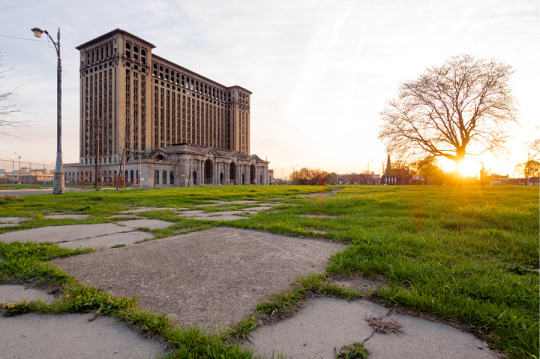
    Take, for example, billionaire Dan Gilbert and Detroit. Not everyone believes that Detroit will come back. In fact, I suspect there are probably more people who think it won’t come back, than people who think it will. Otherwise, it would already be back.

    But Gilbert is unquestionably long on Detroit (via Forbes):

    As you’ve likely heard, over the past four years Gilbert has become one of Detroit’s single-largest commercial landowners, renovating the city with the energy and impact of a modern-day Robert Moses, albeit bankrolled with his own money. He’s purchased and updated more than 60 properties downtown, at a total cost of $1.3 billion. He moved his own employees into many of them–12,000 in all, including 6,500 new hires–and cajoled other companies such as Chrysler, Microsoft and Twitter to follow.

    If/when Gilbert proves to be right about Detroit, then he will have been right about something that most people thought was wrong. And because of that, he will no doubt make a lot of money.