Daily insights for city builders, delivered every morning at 6 AM ET. I’m Brandon Donnelly — a Toronto-based real estate developer and founder of Globizen. I’ve been writing here since 2013.

Tag: italy

  • Shutdown and restart

    Very few of us have a mental model for the macro conditions that we are living through right now. We have been through economic downturns, but most of us haven’t lived through a pandemic. I am an optimist and I know that we will get through this and normalcy will return. But one of the questions that we’re all asking ourselves right now is: What will “normalcy” look like on the backend?

    Here is an interesting piece of evidence for the current shutdown:

    https://twitter.com/biancoresearch/status/1240793859455700992?s=20

    When I see pictures of our cities, like these from Italy, I can’t help but think of the life that normally plays out in the streets. The conversations. The chance encounters. And even the smells. Some of that activity has moved to every single balcony in Italy and that is a beautiful thing. But it’s no substitute for true street life. Thankfully, we know that public life will both return and prevail.

    Along the way there will be changes. There are going to be winners and losers. Some companies are going to go bankrupt. And there will be adjustments that we have made that will invariably stick. Are we all going to video conference more? (The obvious one.) Will we all travel less? Will this macro event accelerate our transition to a knowledge-based digital economy? I’m sure it will. Also consider all of the new companies that are being started right at this very moment.

    But as I said on Twitter today, we are social beings. That is one of the reasons why we choose to live in cities. And I am certain that isn’t going away.

    Photo by Kristijan Arsov on Unsplash

  • How temperature impacts the transmission of COVID-19

    The Financial Times published the following chart last night. It shows the cumulative number of COVID-19 cases around the world, across the number of days since the 100th case in that particular country. The message here is that most western countries appear to be on a similar trajectory. (The grey dotted line represents a 33% daily increase.) Whereas in Asia, and in particular Hong Kong and Singapore, they have seemingly managed to slow the spread.

    Now, there are a number of possible explanations for the outliers; everything from stricter quarantine rules to more rigorous testing. There’s also an argument that Hong Kong and Singapore were better prepared as a result of the SARS outbreak in 2002. (More on these explanations, here.) But the other factor at play seems to be climate.

    A recent study (by Jingyuan Wang, Ke Tang, Kai Feng, and Weifeng Lv) has concluded that, like the flu, the transmission of COVID-19 appears to be significantly impacted by both air temperature and relative humidity. In their research, they looked at the reproductive number (R), or the severity of infectiousness, for all Chinese cities with more than 40 cases between January 21 to 23, 2020. (Large-scale government interventions began on January 24, 2020 and would have therefore skewed the numbers.)

    What they found was that for every one degree Celsius increase in temperature and every one degree Celsius increase in relative humidity, the reproductive numbers drop by 0.0383 and 0.0224, respectively. Air temperature, in other words, has more of a positive impact on containing spread than relative humidity — which feels right. That is also apparent when you look at the above charts. Take note of Korea, Iran, and Italy near the top left corner of the temperature chart.

    If you’d like to download a full copy of the research paper, click here.

  • Trade patterns in global cuisine

    In 2017, the US restaurant industry generated about $560 billion in annual revenue. By comparison, the movie industry generates some $30 billion a year. Food, and eating out, is a big business.

    A recent paper by Joel Waldgogel of the University of Minnesota has tried to estimate the “implicit cuisine trade” associated with this industry. To do this, he used restaurant data from TripAdvisor and sales figures from Euromonitor.

    Domestic consumption of a foreign cuisine was considered an “import.” And foreign consumption of a domestic cuisine was considered an “export.” Here’s what he discovered (graph from the Economist):

    Italy is, by far, the biggest net “exporter.” And the US is the biggest net “importer.” If you exclude fast food, the US “deficit” balloons to approximately $140 billion.

    I guess everybody does really love Italian food. For the full paper, click here.

  • Holding back the sea, in Venice, maybe

    Venice has been keeping flood records for 150 years, though it is generally understood that the city has been regularly flooding since the very beginning. It usually happens between the fall and the spring and the earliest record is believed to be from the 6th century.

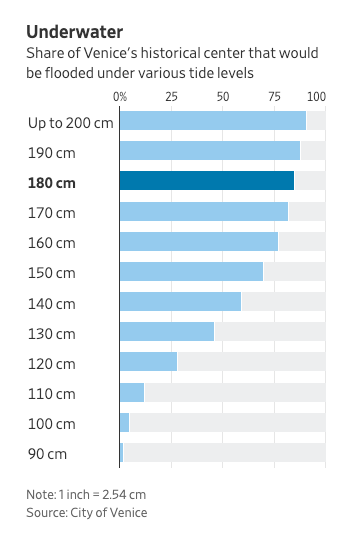
    This past week, Venice saw its acqua alta (or high water) peak at 187cm (6’2″) above its normal level. This is the second highest number on record and is just below its 1966 peak. At these numbers, about 80% of the historic center is underwater. Here is a chart from the WSJ explaining that:

    Venice has been working on a flood management project called MOSE since the 1980s. The name is an acronym, but there’s a deliberate biblical reference here. Remember when Moses parted the red sea?

    The project has been mired in engineering delays and corruption scandals, and so it’s not yet operational. If it were, it would have, in theory, protected the city this past week. 2022 is the anticipated completion date, but I don’t know if that’s realistic or not.

    The system consists of 78 mobile gates that fill with water and sit flat on the seabed when the tide is low. When a high tide is predicted, the gates are then to be pumped with air so that they rise (hinged on one side) and close off the three inlets that connect the Venetian Lagoon to the Adriatic Sea.

    As I was reading about this project and everything else that has been going on in Venice this past week, I became curious about how exactly the Dutch have been managing to hold back the sea. I mean, a big chunk of the Netherlands sits below sea level.

    If you’re also curious, here’s a video that explains how they do it.

  • Boom babies (of China)

    A few years ago I wrote a post talking about “depression babies.” In it, I cited a research paper that looked at the impact of macroeconomic shocks on people’s willingness to take on financial risk in the future. The term “depression babies” stems from the Great Depression and how it is believed to have impacted risk taking, savings rates, and probably many other things.

    I was reminded of this when I read this recent article in the WSJ talking about how the Chinese have started spending — and taking on the debt — like Americans, particularly among Chinese under 30. It is the inverse of the depression baby phenomenon. In this case, it is arguably years of economic expansion leading to greater comfort around financial risk.

    Here are a couple of figures from the article:

    JPMorgan estimates China’s ratio of household debt to gross domestic product will climb to 61% by 2020. That’s up from 26% in 2010 and higher than current levels in Italy and Greece.

    The level in the U.S. is about 76%, after falling from 98% in 2006, according to the International Monetary Fund.

    By another measure—the ratio of household debt to disposable income—China appears to have already surpassed the U.S. Its ratio reached 117.2% in 2018, up from 42.7% in 2008, according to calculations by Lei Ning, a researcher at the Institute for Advanced Research at Shanghai University of Finance and Economics. The U.S. peaked at 135% in 2007 and dropped to 101% in 2018.

    Not surprisingly, the article goes on to talk about how this dramatic increase in household debt might be something to worry about. Maybe. I’m not an economist. But I do think this is designed to boost the Chinese growth machine and I do think it makes them less reliant on other countries — such as, maybe, the United States.

  • Why you should sometimes ignore your customers

    In business we are told to listen to our customers. Be customer-centric. In city building we are told to listen to the community. Be community-focused. And there’s no question that these mantras exist for a reason. They are paramount.

    But when should you not listen?

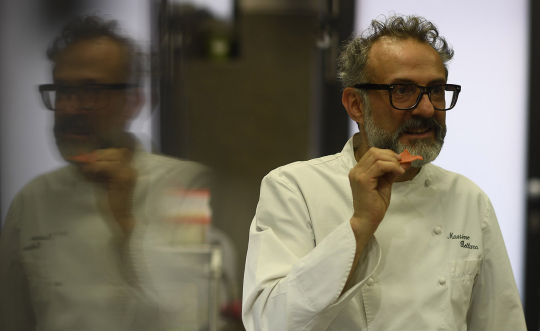
    I watched a Chef’s Table documentary last night on Massimo Bottura (pictured above), who is the owner and operator of Osteria Francescana in Modena, Italy. Osteria Francescana is a 3 star Michelin restaurant and widely ranked as one of the best restaurants in the world.

    But it wasn’t easy for Massimo at the beginning. His goal was to bring the Italian kitchen into the 21st century and so his plates are often creative takes on classic Italian dishes. His restaurant blends the old and new; food and contemporary art.

    This approach upset a lot of people at the outset. Massimo was seen almost as a traitor who was turning his back on traditional Italian cooking within provincial Modena. Don’t mess with centuries of tradition they would say. Grandma knew best, son.

    Because of this, his restaurant sat empty in the early years, to that point that he was ready to close its doors. The only reason he kept it open was because his wife encouraged him to give it one more year. She said: This is the kind of food you want to make. If you don’t try, you’ll regret it.

    So he gave it another year and luckily he got a few breaks, including a glowing review by a well known food critic from out of town. Once this hit, the Modenese started to quickly rethink their distaste for Massimo’s idiosyncratic dishes. Before long, his restaurant was full.

    So what changed? It wasn’t the dishes. It was perception. The out of town critics and positive reviews gave people permission to like the dishes. This is critical because nobody needs permission to like tradition. It’s tradition, after all. There’s little risk in that.

    But there’s risk in liking something new that hasn’t been done before. Change creates uncertainty. And if Massimo’s wife hadn’t encouraged him to stick with it just a bit longer and ignore the naysayers, the world may not have one of its top restaurants.

    Sometimes we don’t know what we like and want until we are shown.

    Image: Osteria Francescana 

  • Sicilian town is giving away free houses

    https://500px.com/embed.js

    Buy real estate. It always goes up. That’s the mantra, right?

    Few things in life are that black and white.

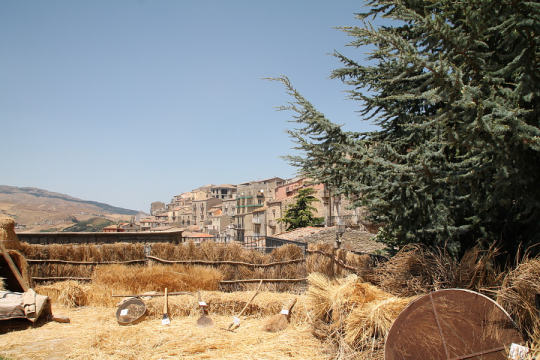
    A small town in Sicily called Gangi is in the midst of a novel urban renewal experiment. They are giving away houses for free to people who will agree to renovate them within a 4 year time period.

    Here’s the “free houses” notice from the Comune Di Gangi explaining how it works and who to contact. You have to be an Italian or EU citizen to participate.

    Free can be a powerful business model, as we see all the time with tech companies. And sometimes cities and towns aren’t all that different.

    So if you’re looking for a vacation home or want to move to Sicily, now might be a great time.

  • How much does it matter what message a city sends you?

    In keeping with the recent theme about cities, their brands, and the messages they send, I thought I would revisit an old essay (2008) written by Paul Graham (of Y-Combinator) called “Cities and Ambition.” In it, he talks about the various messages that cities send us, such as:

    • You should make more money (New York)
    • You should be better looking (Miami?)
    • You should be smarter (Cambridge)
    • You should be more powerful (Silicon Valley)

    But the most interesting part of his argument is the belief that we are largely products of our environment. No matter how strong or formidable our personalities might be, the message a city sends us is hugely important. In fact, it might be impossible to escape it. Here’s how Paul puts it:

    How much does it matter what message a city sends? Empirically, the answer seems to be: a lot. You might think that if you had enough strength of mind to do great things, you’d be able to transcend your environment. Where you live should make at most a couple percent difference.

    But if you look at the historical evidence, it seems to matter more than that. Most people who did great things were clumped together in a few places where that sort of thing was done at the time.

    You can see how powerful cities are from something I wrote about earlier: the case of the Milanese Leonardo. Practically every fifteenth century Italian painter you’ve heard of was from Florence, even though Milan was just as big. People in Florence weren’t genetically different, so you have to assume there was someone born in Milan with as much natural ability as Leonardo. What happened to him?

    If even someone with the same natural ability as Leonardo couldn’t beat the force of environment, do you suppose you can?

    I don’t. I’m fairly stubborn, but I wouldn’t try to fight this force. I’d rather use it. So I’ve thought a lot about where to live.

    To some, this thought may depress you. I mean, if you happen to live in a city or place with the “wrong” message, you might feel as if you’re missing out. I know that thought certainly crossed my mind when I read his essay. But different messages resonate with different people, and so maybe the message your city is telling you is exactly the one you need to accomplish great things.

    In Toronto, I’d say that the message is similar to that of New York: You should make more money. Oh, and also that you should buy more condos 😉

    What message does your city tell you?

  • The Human Scale

    Earlier today I stumbled upon a documentary called “The Human Scale.”  I haven’t watched it yet, but I’m planning to rent it from iTunes later this weekend. Here’s the trailer. Click here if you can’t see it below.

    [youtube https://www.youtube.com/watch?v=5CyLNS_ljHw]

    One of the things that’s so fascinating about studying cities right now, is that it feels as if we’re at a major turning point with respect to how we think about them. We’re coming off a long period (decades) of infatuation with the car, where planners and engineers predominately cared about one thing and one thing only: efficiently moving cars in and around cities.

    But having now fully built out cities around the car, we’ve come to realize two important things. First, that it’s virtually impossible to keep up with the demands of the car. No matter how many highways and roads you build, there always seems to be gridlock. And second, by focusing so closely on the car, we’ve built cities that aren’t great places for people.

    If you take a look at this short clip from The Human Scale (featuring Siena, Italy), I think you’ll immediately see how differently we used to build our cities and how disruptive the car has been to them. 

  • Florence vs. Atlanta [Mapping]

    As I was browsing Tumblr this morning, I came across this image (linked from Quora):

    image

    On the left is portion of Florence. And on the right is a single highway interchange in Atlanta. Both maps are at exactly the same scale.

    It’s a stark reminder of how varying land use patterns can be. On the left you have a dense and walkable city, and on the right you have an area that would be entirely inhospitable to pedestrians.