Daily insights for city builders, delivered every morning at 6 AM ET. I’m Brandon Donnelly — a Toronto-based real estate developer and founder of Globizen. I’ve been writing here since 2013.

Tag: investment

  • A sensible purchase price

    “Investing is an activity in which consumption today is foregone in an attempt to allow greater consumption at a later date. “Risk” is the possibility that this objective won’t be attained.” -Warren Buffet

    Warren Buffet published his annual letter to Berkshire Hathaway shareholders this past Saturday. I always enjoy reading his letters and I have been doing it for years. If only he wrote a daily blog.

    One of the things he talks about in this year’s letter is why Berkshire wasn’t very acquisitive in 2017:

    In our search for new stand-alone businesses, the key qualities we seek are durable competitive strengths; able and high-grade management; good returns on the net tangible assets required to operate the business; opportunities for internal growth at attractive returns; and, finally, a sensible purchase price.

    That last requirement proved a barrier to virtually all deals we reviewed in 2017, as prices for decent, but far from spectacular, businesses hit an all-time high. Indeed, price seemed almost irrelevant to an army of optimistic purchasers.

    Some of you in the real estate game might be feeling similarly. But he ends the section with these words of advice: 

    In the meantime, we will stick with our simple guideline: The less the prudence with which others conduct their affairs, the greater the prudence with which we must conduct our own.

    Buffet has a way of simplifying things. He also, clearly, has a way of remaining disciplined.
  • The 2×2 investment matrix

    Today I am thinking about product/market fit.

    Product/market fit is startup speak for being in a good market and having a product that satisfies the needs of that market. This may sound intuitive, but having the best product doesn’t matter if there’s no market for it. I like this line from Marc Andreesen: “Markets that don’t exist don’t care how smart you are.”

    So the first takeaway is to create products that people care about. Sounds simple enough. But another reason why this is a thing worth talking about is that markets evolve and there’s always a chance that you can unlock a new market that nobody else is servicing. That’s obviously riskier, but it’s an ideal scenario.

    Below is another way of thinking about that. It’s a quote from Andy Rachleff.

    “Investment can be explained with a 2×2 matrix. On one axis you can be right or wrong. And on the other axis you can be consensus or non-consensus. Now obviously if you’re wrong you don’t make money. What most people don’t realize is if you’re right and consensus you don’t make money. The returns get arbitraged away. The only way as an investor and as an entrepreneur to make outsized returns is by being right and non-consensus.”

    It’s a lot scarier to be charting new territory and sitting in the non-consensus camp. Consensus is comforting. But this is how the game works. I try and remind myself of this on a regular basis. I would like to say more, but I will leave it at that for today’s post.

  • A new kind of homeownership

    Yesterday Andreessen Horowitz announced an investment in the startup Point. They led an $8.4 million Series A round.

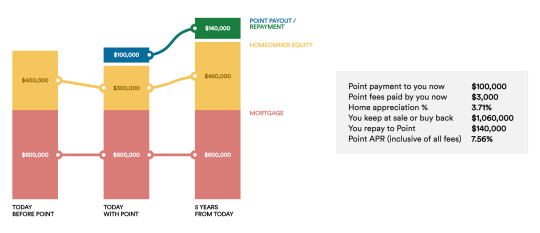
    Point is an alternative to traditional home equity loans and HELOCs. The way it works is that you actually sell a portion of your property. Here’s an example:

    In this scenario, the home is worth $1M. Point makes an offer to buy 10% of today’s value in exchange for 20% of the home’s future appreciation on a 5 year term. You pay a 3% fee when the $100,000 (10%) is paid out, but you don’t make any monthly payments. You just give up potential future appreciation. (If the home doesn’t appreciate, Point doesn’t make money.)

    What’s interesting about this model is that traditionally “housing” has meant one of two things. Either you own 0% of the home (i.e. you rent) or you own 100% of the home (usually with the help of a mortgage).

    Point is making it easier for you to potentially own 95% or 90% of your home. They are taking an equity stake, which is why there are no monthly payments associated with it. 

    The investment angle is that homeowners get to diversify their wealth out, and (Point) investors get to diversify in, without having to worry about actually managing the property.

    Would you use this as a tool to unlock your home equity wealth?

  • Toronto’s rapid transit network by 2031

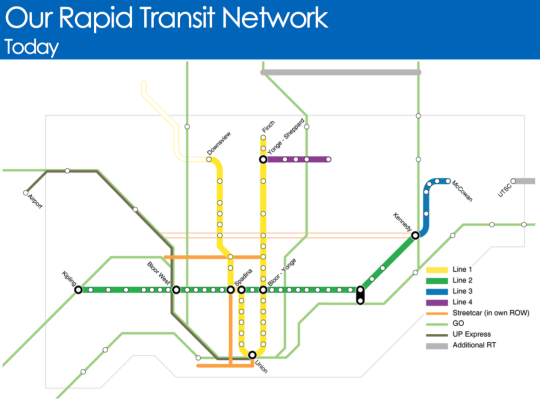
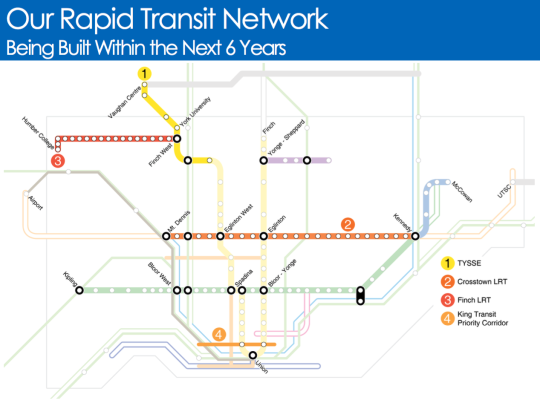
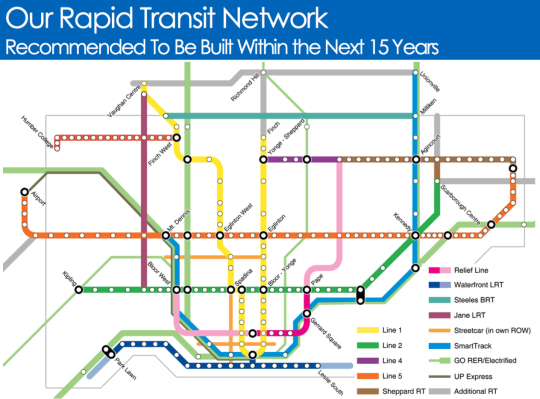
    Starting today and running until the end of March, the City of Toronto, the Toronto Transit Commission, and Metrolinx will be hosting several public meetings as they work towards planning out this city and region’s rapid transit network.

    Below are a few of the key maps from their presentation.

    Here is what Toronto’s rapid transit network looks like today (the hollow lines represent projects in construction):

    image

    Here is what will be built within the next 6 years:

    image

    And here is what they are recommending should be built within the next 15 years:

    image

    It’s hard not to get excited when you see maps like this. Of course, it’s a lot easier to draw lines on a map then it is to fund and execute on projects like this.

    But I think it all starts with us acknowledging that these initiatives are critical to both our economic competitiveness as a city region and our quality of life as citizens of it. Because if this is something we really want, then we can absolutely make it happen.

    Click here if you’d like to see the full presentation and also the public meeting dates/times.

  • When everyone thinks you’re wrong

    Sunset by Paolo Mastrogiacomo on 500px.com

    https://500px.com/embed.js

    I was recently talking to my good friend Jeremiah Shamess about the current state of development land sales in Toronto (he does this for a living) and he said something to me that I found really interesting.

    He said that because the market is so competitive, you can really only win development sites in one of two ways. Either you’re willing to spend the most money or you see something and have a vision that nobody else sees.

    And it was this second piece that really stood out to me because it reminds me of one of my favorite investing frameworks.

    Warren Buffet is famous for saying that you should be fearful when others are greedy and you should be greedy when others are fearful. And what I’m about to talk about is really that same core philosophy.

    Here’s how venture capitalist Fred Wilson put it (reiterating something that Bill Gurley said):

    I saw Bill Gurley say that you can only make money by being right about something that most people think is wrong. His logic was that you can’t make money by being wrong. And you can’t make money by being right about something everyone else knows. So you have to be right about something that most people think is wrong. I really like that framework.

    But this doesn’t just apply to technology companies or stocks. It applies to city building, most industries, and probably most things in life if you think about it.

    If all you’re doing are things that everyone else is doing, then how can you expect to outperform? You’re going to revert to the mean.

    Take, for example, billionaire Dan Gilbert and Detroit. Not everyone believes that Detroit will come back. In fact, I suspect there are probably more people who think it won’t come back, than people who think it will. Otherwise, it would already be back.

    But Gilbert is unquestionably long on Detroit (via Forbes):

    As you’ve likely heard, over the past four years Gilbert has become one of Detroit’s single-largest commercial landowners, renovating the city with the energy and impact of a modern-day Robert Moses, albeit bankrolled with his own money. He’s purchased and updated more than 60 properties downtown, at a total cost of $1.3 billion. He moved his own employees into many of them–12,000 in all, including 6,500 new hires–and cajoled other companies such as Chrysler, Microsoft and Twitter to follow.

    If/when Gilbert proves to be right about Detroit, then he will have been right about something that most people thought was wrong. And because of that, he will no doubt make a lot of money.

  • Art and apartments

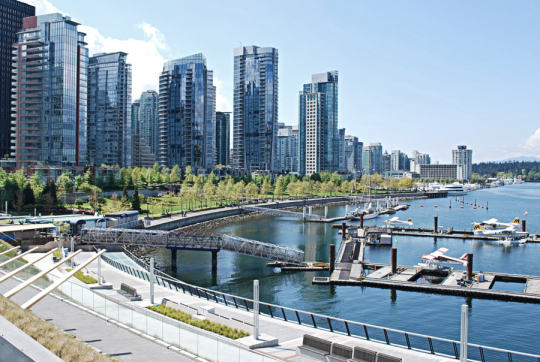
    Photograph Vancouver by Marc M on 500px

    Image Source: Vancouver by Marc M on 500px

    According to a recent Bloomberg article, this is where the rich are putting their money today:

    “The two greatest stores of wealth internationally today is contemporary art….. and I don’t mean that as a joke, I mean that as a serious asset class,” said Fink. “And two, the other store of wealth today is apartments in Manhattan, apartments in Vancouver, in London.”

    In case you wondering, Laurence Fink is the founder and CEO of BlackRock Inc., which today is the largest asset manager in the world. They have over $4.77 trillion in assets under management according to their website. That’s a mind boggling number.

    And if you read the Bloomberg article cited above, you’ll see that this interest in both art and apartments represents a shift away from gold as the de facto safe haven.

    “Historically gold was a great instrument for storing of wealth,” the chairman of BlackRock Inc. said at a conference in Singapore on Tuesday. “Gold has lost its luster and there’s other mechanisms in which you can store wealth that are inflation-adjusted.”

    What’s interesting and probably most relevant to the Architect This City community though is this investment focus on apartments.

    When people talk about a possible housing bubble in Canada they often cite house prices to median household income as a key ratio. The question then becomes: How can house prices be such a high multiple relative to local incomes?

    That’s relevant, but it’s not the entire story for cities like New York, London, and Vancouver. That ratio alone assumes that real estate isn’t a global investment vehicle. And for some people people it is exactly that.

  • Core counties > outlying counties

    Recent US Census Bureau data has once again confirmed that there’s a growing preference for living in urban cores. More specifically:

    It finds that population growth has been shifting to the core counties of the USA’s 381 metro areas, especially since the economic recovery began gaining steam in 2010. Basically, the USA’s urban core is getting denser, while far-flung suburbs watch their growth dwindle.

    To put numbers to these statements, core counties in the US grew approximately 2.7% and outlying counties grew approximately 1.9% from 2010-2013. Most of the growth came from net migration, as opposed to higher birth rates.

    The two big factors at play–which will be obvious to readers of this blog–appear to be both a desire to live in amenity rich and walkable communities and a continuing trend towards marrying and having kids later in life, which can often be the trigger for moving to the suburbs.

    But the big question is whether or not this trend is here to stay or if it’s an ephemeral fad caused by a bunch of over-educated and under-employed Millennials refusing to grow up. I would argue that it’s not a fad.

    If there’s a clear consumer preference for urban neighborhoods, then I don’t think people are just going to pick up and leave overnight. As long as there’s adequate housing within the means of growing families, I think they’re going to stay in or go to the areas in which they truly want to live.

    There are also many other macroeconomic trends reinforcing this shift. Just yesterday, Richard Florida wrote an article in Atlantic Cities talking about how venture capital investment is shifting away from the suburbs, towards city centers and walkable communities. These companies (receiving investment) are the next generation of employers and they’re starting in core areas.

    I’ll take that as a leading indicator.

  • Transit rant

    Transit planning is absolutely and utterly broken in Toronto. Over the past few years, it has become abundantly clear that our current methods are completely ineffectual. We’re entirely useless at delivering transit infrastructure to the most important economic region in Canada. 

    The process is deeply political, and with all three levels of government involved, as well as countless agencies, we’re getting absolutely nothing done. And when we do manage to achieve some level of progress, such as provincial funding for the Scarborough subway line, it turns out that fact and evidence would suggest we’re actually headed in the wrong direction.

    It’s an unfortunate situation that we’ve gotten ourselves into, because transit and infrastructure have such a profound impact on productivity levels and our economy as a whole. And yet we’re just sitting back while our politicians fight over transit investment according to what best suits their voter bases.

    Politicians should not be making these decisions. At this point they’ve proven their inability to make effective progress and so I believe we need to strip them of this responsibility. Part of the problem is that we have a mismatch of time horizons: politicians need quick wins, while transit investment is a long term game.

    What we need is an entity – ideally one entity – that isn’t reliant on ad hoc funding hand outs. It needs a sustainable funding source and the power to make decisions about where infrastructure investments will be made in our region. We can’t continue to screw this up. Transit is far too important.