Daily insights for city builders, delivered every morning at 6 AM ET. I’m Brandon Donnelly — a Toronto-based real estate developer and founder of Globizen. I’ve been writing here since 2013.

Tag: investment

  • How much is development land worth?

    As we have talked about many times before, the best answer to this question is that it’s worth whatever money is left in your pro forma once you’ve accounted for everything else. This is what is called the “residual claimant” in a development model. And it means you start with your revenue, you deduct all project costs, including whatever profit you and your investors need to make in order to take on the risk of the development, and then whatever is left can go to pay for the land.

    This is the most prudent way to value development land; but of course, in practice, it doesn’t always work this way. In a bull market, the correct answer to my question might be, “whatever most market participants are willing to pay.” And sometimes/oftentimes, this number will be greater than what your model is telling you, meaning you’ll need to be more aggressive on your assumptions if you too want to participate. (Not development advice.)

    Given that determining the value of land starts with revenue, one way to do a very crude gut check is to look at the relationship between land cost and revenue. This is sometimes called a land-to-revenue ratio. And historically, for new condominiums in Toronto, you wanted a ratio that was no greater than 10%. Meaning, if the most you could sell condominiums for was $1,000 psf, then the most you could afford to pay for land was $100 per buildable square foot.

    However, this is, again, a very crude rule of thumb. I would say that it’s only really interesting to look at this after the fact. Because in reality, things never work this cleanly. For one thing, there is always a cost floor. Don’t, for example, think you can buy land in Toronto for $80 pbsf and sell condominiums for $800 psf, because this will not be enough to cover all of your costs. You will lose money.

    Secondly, there are countless variables that have a huge impact on the value of development land. Things like a high required parking ratio, development charges and other city fees, inclusionary zoning, and so on. All of these items are real costs in a development model, and so they will need to be paid for somehow.

    Typically this happens by way of higher revenues (in a rising market), a lower land cost (in a sinking market), or some combination of the two. But in all of these cases, it means your land-to-revenue ratio must come down to maintain project feasibility. This is why suburban development sites typically have a lower ratio — too much loss-leading parking, among other things.

    Of course, there are also instances where the correct answer could be a land-to-revenue ratio approaching zero, or even a negative number. In this latter case, it means your projected revenues aren’t enough to cover all of your other costs, excluding land. For anyone to build, they will require some form of subsidy. And this is basically the case with every affordable housing project. They don’t pencil on their own. (For a concrete example of this, look to the US and their Low-Income Housing Tax Credits.)

    So once again, the moral of this story is that the best way to think about the value of development land is to think of it as “whatever money is left in the pro forma once you’ve accounted for everything else.” Because sometimes there will be money there, and sometimes there won’t be.

    Photo by Jannes Glas on Unsplash

  • France’s rental ban on energy-inefficient homes

    One of the things that you’ll notice on real estate listings in France is an Energy Performance Diagnostics (EPD) rating. In French, it gets reversed, and so it’s a DPE (diagnostic de performance énergétique). What it tells you is how much energy the dwelling (or building) consumes and how much greenhouse gas it emits. And it is a requirement on all real estate listings and for all dwellings, except those that are occupied for less than 4 months per year. The output of this diagnostic is a rating from A (best) to G (worst).

    According to FT, this is how primary residences in France rank today:

    Less than 5% of homes are rated A and B (the most energy efficient). And many more are rated G and F. Beyond just being energy inefficient, this is potentially a problem because there are penalties and restrictions for the lowest rated homes, one of which is that you are not allowed to rent out the property. Right now and as of January 1 of this year, the upper consumption limit is 450 kWh per square meter per year. Go above this and the home becomes ineligible.

    This number is also planned to reduce over time:

    • January 1, 2023: Rental ban on properties with G+ energy label
    • January 1, 2025: Rental ban on all properties with G energy label
    • January 1, 2028: Rental ban on all properties with F energy label
    • January 1, 2034: Rental ban on all properties with E energy label

    Now here’s what this is thought to mean for overall rental supply:

    By 2028, 5.2mn homes rated F and G, or 17 per cent of total housing stock, will become ineligible for rental. By 2034, all E properties will also be excluded, amounting to about 40 per cent of homes.

    This raises an interesting question: Is it more important to have energy-efficient homes or to have greater overall supply? Now obviously the goal and ideal scenario is both; lots of affordable homes that are also energy efficient. And presumably, one of the objectives of this rental ban is to stick/carrot owners into investing in energy measures. But it’s not exactly obvious as to how many owners will be able to renovate their homes in time, and how many homes will become ineligible for rent. This will be an interesting policy to watch as it plays out.

  • More retailers are buying real estate in New York

    Last week we spoke about how many businesses don’t want to own their own real estate, but that some do. We then spoke about Prada’s recent acquisition of 720 and 724 Fifth Avenue for $835 million. However, they’re not the only ones. According to New York’s The Real Deal (thank you John Bell for the article), last year saw the following transactions:

    • Swiss fashion house Akris bought a property from SL Green for $40.6 million
    • Japanese coffee retailer Geshary bought a property on Fifth Avenue from the Riese Organization for $38 million
    • And Dyson bought a building in Soho for $60 million

    Now, some, or a lot of this, is strategic. New York is New York, and global brands need to be there. Another part of this is that there was less competition last year. Fewer real estate companies wanted to buy retail and office buildings, and so end users seem to have stepped in at what they presumably saw as favourable prices.

    But it’s also not totally foreign for retailers to want to own their own real estate. Perhaps the most famous example is McDonald’s, which owns its own real estate and then leases it out to franchisees. Though as I alluded to last week, it’s important to know what business you’re ultimately in. And McDonald’s knows it’s in the real estate business.

  • Software eats real estate

    At the beginning of this year, a16z announced that they co-led a $175 million investment in the real estate company Loft. Based in São Paulo, Loft is doing in Brazil what Opendoor is doing in the US. They are bringing more liquidity to the residential real estate marketplace, and it turns out that the need for this is even greater in Brazil. That has apparently made Loft one of the fastest growing real estate companies in the world today. Here are some interesting facts about residential real estate in São Paulo. And here is a talk by Alex Rampell (general partner at a16z) on how software is going to eat the real estate world.

  • Transit investment & density (in San Francisco)

    This recent Streetsblog article about the possibility of turning the M Ocean View line in San Francisco into a kind of subway is a good reminder about the always important connection between transit investment and density. The question I always pose to myself is, “If I were a private company deciding where to spend the money on a new and expensive subway line, what would I look for?” Most of us recognize that population and employment densities would be near, if not at, the top of the list.

    Of course, if the company were fully private, then we would run the risk of low-density / unprofitable areas of the city not being serviced by transit. For a variety of reasons, that’s not an ideal outcome, which is why transit operators are mostly subsidized. The challenge is that the way we plan transit in most — or all? — cities has become so highly politicized today. That’s how we end up with the wrong transit technologies in areas that don’t have the density to properly support them.

    Now, I don’t know the specifics of the M Ocean View line. (Maybe some of you do and will provide those thoughts in the comments below.) So this is not a post about what may or may not be appropriate in this particular instance. But it is a commentary on the importance of fiscal prudence and sound transportation planning.

    Photo by Lance Anderson on Unsplash

  • Homeschooling is one of the fastest growing trends in education

    Earlier this week, Union Square Ventures announced that it was leading a Series A investment in an online education marketplace targeted at K-12 students. The platform is called Outschool, and you can think of it as a form of homeschooling.

    Today, there about 55 million K-12 students in the US, with around 9% enrolled in private schools. Charter schooling is on the rise (somewhere around 3 million students), but so is homeschooling (similarly around 2.5 million students). Data here.

    Homeschooling, at least in the US, largely started within religious groups. But that is starting to change and it is becoming more widely adopted. USV has made a bet that this trend will continue.

    If you look at Outschool’s model, you’ll see that it shares a lot of similarities with other successful internet marketplaces. It is direct-to-consumer (the internet has a way of getting rid of intermediaries). The courses are significantly cheaper than traditional classroom schooling ($10-15 per course). And the supply-side of the marketplace (the teachers) is far more open and accessible to non-traditional participants.

    USV gives the example of a human rights lawyer who is teaching on the platform and now earning more than $10,000 per month in additional income. I’ve never enjoyed online classes, but now that we have reliable video chat, maybe that starts to change.

    In any event, where my mind goes with all of this is the impact on our built environment. We are heading toward more flexible spaces and we are doing a lot more from home.

  • Uber’s seed investors made this much money

    $UBER went public on Friday. Notwithstanding the initial stumble, Uber will go down in history as one of the most lucrative venture capital investments of all time.

    The stock is down from its IPO price of $45 per share, but at that price, the initial seed investment of $510,000 that First Round Capital made back in 2010 was worth about $2.5 billion on Friday.

    Here is a list of some of the other notable investors from Uber’s seed round and what their initial investments grew to over the course of 9 years (chart from the WSJ):

    Of course, for every Uber, there are many more failed companies. And for every investor who turns $5,000 into nearly $25 million, there are many more who decided to pass on the opportunity.

    In the case of Uber, many early investors couldn’t see how the product could go mainstream. It initially started upmarket with limousines, which was actually a clever way to hack the chicken-and-egg problem that plagues marketplaces.

    Many also wondered how many metro areas outside of San Francisco had the kind of urban density and supply and demand drivers to support this kind of a service.

    Today, some nine years later and many billionaires later, lots of people — including myself — are still wondering: Will Uber turn out to be a great (i.e. profitable) business? Hindsight is always 20/20.

  • How Opportunity Zones may have impacted real estate prices

    The Tax Cuts and Jobs Act of 2017 (US) created something known as Opportunity Zones. These are low-income and high-poverty census tracts that are designed to attract investment by offering a number of different tax benefits. I first wrote about it on the blog, here.

    Now that some time has passed since the final Opportunity Zones were announced, Zillow Economic Research decided to look at the possible impact of this designation on real estate values. In other words: To what extent, if at all, are the tax benefits getting capitalized into the value of the properties?

    Below is a chart showing the year-over-year change in the 12-month moving average sale price for low-income census tracts that were (1) eligible and selected as an Opportunity Zone; (2) eligible and not selected; and (3) not eligible.

    My understanding is that the “not eligible” category represents census tracts with similar characteristics to the other two categories but, for whatever reason, were not eligible to become an Opportunity Zone. There are criteria.

    The program is still quite new, but what Zillow found was that the eligible census tracts (green and yellow lines) seemed to exhibit similar sale price increases after the Act was signed, but before the final Opportunity Zones were announced. Once the final Zones were announced, sale prices in the selected category (green line) began to surge and move away from the pack.

    This may be evidence that the tax benefits are starting to get capitalized, or it may not be. One question I have is about why pricing in the selected Opportunity Zones seems to be a lot more volatile — even before the Act was announced.

  • Tech and the North American office market

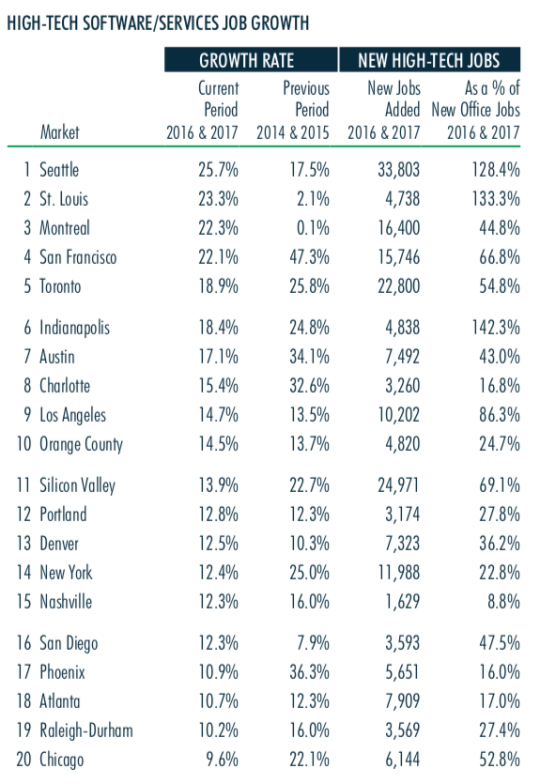
    CBRE recently published this report looking at the impact of the “high-tech software/services industry” on the North American office market. 

    Here are a few highlights:

    – Since 2010, tech has created ~1.1 million jobs in the US at an annual growth rate that is 3x the national average.

    – Seattle currently has the fastest tech job growth in North America. This is the first time in 7 years that San Francisco hasn’t been at the top of their list.

    – Silicon Valley, Toronto, New York, and Los Angeles all added more than 10,000 tech jobs from 2016 to 2017.

    – The biggest “momentum markets”, relying on 2016 and 2017 data, are Montreal, St. Louis, and Seattle.

    – Over the past two years (Q2-2016 to Q2-2018), Atlanta, Los Angeles, Orange County, Seattle, and Portland have all seen double-digit rent growth.

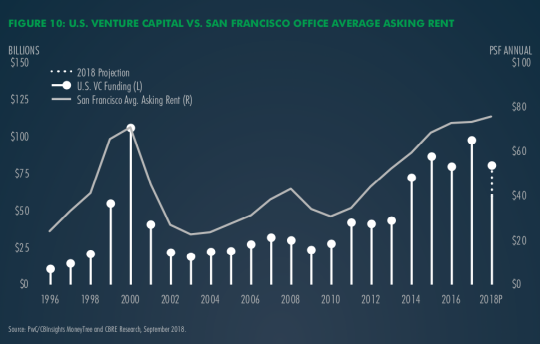
    One figure that also stood out for me was this one here showing the relationship between US venture capital investment and the average asking rent for office space in San Francisco.

    If you’d like to download the full report, click here. You’ll need to sign up for an account with CBRE, but it’s free to do that.

  • Two sides of the same bitcoin

    Warren Buffet recently said in a Yahoo Finance interview that when you buy cryptocurrencies you’re not actually investing. Instead, you’re speculating – speculating that “somebody else will come along and pay more money tomorrow.” Investments need to generate a return. And nobody is at all clear on how to value these crypto-assets. This is noteworthy, of course, because it’s Buffet.

    But I thought Fred Wilson wrote a good rebuttal on his blog where he points out that, while, yes, a discounted cash flow model isn’t going to be very useful in helping you determine value in this instance, what we are actually seeing is, “the creation of a new internet, built upon protocols that allow for decentralized networks to form…” We’ve talked about this many times before on the blog.

    So where I stand on this debate is that I agree with both Warren and Fred. I don’t see crypto-assets as something I want to start putting a lot of money into right now because I don’t know how to calculate what the IRR may be. But at the same time, if crypto-assets are creating decentralized infrastructure that will one day power the “new internet”, I am positive this new internet will eventually create businesses that will fit into Warren’s definition of an investment.