
Daily insights for city builders, delivered every morning at 6 AM ET. I’m Brandon Donnelly — a Toronto-based real estate developer and founder of Globizen. I’ve been writing here since 2013.

Tag: internet

  • The birth of tall buildings

    As an architecture and city lover, it’ll probably surprise you that I’ve never been to Chicago. I think it may have to do with the fact that it has always felt like a sister to Toronto–another Great Lakes city of comparable size. And when you travel, you often want something novel.

    But that’s no excuse. 

    Thankfully I’m happy to report that last week I booked a trip to Chicago for this August. I’ll be there for an extended long weekend. But since it’s for a bachelor party, it remains to be seen how much archi-touring I’ll actually get a chance to do.

    Chicago is a hugely important city in the world of architecture and city building. From Frank Lloyd Wright to Mies van der Rohe to Louis Sullivan, the city has deep architectural roots.

    When most people think of skyscrapers they think of New York. But in actuality, if there’s one city that gave birth to the modern skyscraper I would argue that it was Chicago. And it was made possible by the steel industry.

    Before the late 19th century, tall buildings were largely built with their exterior walls supporting most of the loads. This meant that the taller you went, the thicker the walls had to be near the bottom of the building. This is why older buildings often feel so heavy and permanent.

    But when structural steel became widely available, a new building form was created. All of a sudden architects and builders could create relatively light weight structural steel frames to support the building. The skin, or outside of the building, was no longer carrying the weight.

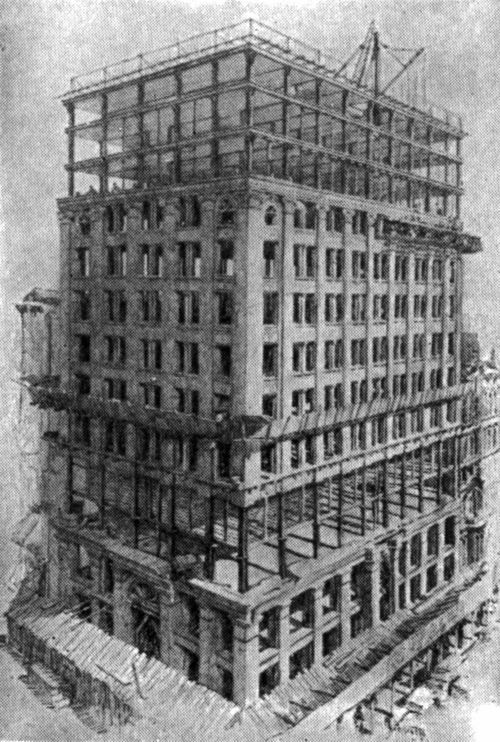
    That made images like this possible:
    image

    For most of us today, this building under construction looks fairly typical. First the structure goes up and then it gets clad with its window and exterior skin. But at the time, this sort of construction technique–with the 3rd and 4th floors still unenclosed and the upper floors finished–would have blown people’s minds. It was an entirely new way of building.

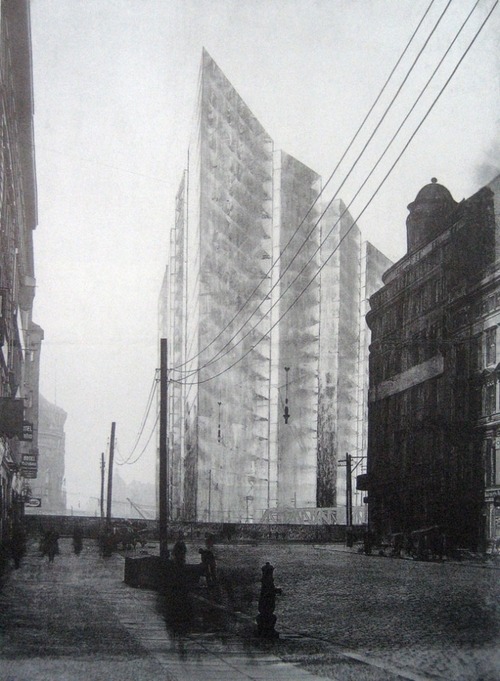
    Steel framed buildings removed the technical limitations of building tall and also opened up entirely new possibilities for architectural expression–such as the all glass building. Today, there’s a lot of criticism around our glass buildings. But it’s interesting to note that it started as the futuristic dream of architects.
    image

    Freed from the technical limitations of load-bearing exterior walls, architects such as Mies van der Rohe began dreaming of transparent, all glass buildings. For them it represented modernity. It was the future. Above is an early charcoal sketch of that dream by Mies.

    But our fixation with glass and transparency has never been because of environmental efficiency. It was about light, transparency and feelings of modernity. So as sustainability becomes increasingly critical, we should remember that there’s still lots of innovating left for us to do.

    Art and architecture has always been a representation of the time and era in which it was created–which is one of the reasons I’m so interested in technology today. It’s our era. It’s our “structural steel”. And it’s going to impact our cities.

    When posterity looks back on us and what we’ve done, I’m sure that will be clear.
  • How mobile apps are going to help us build better cities

    image

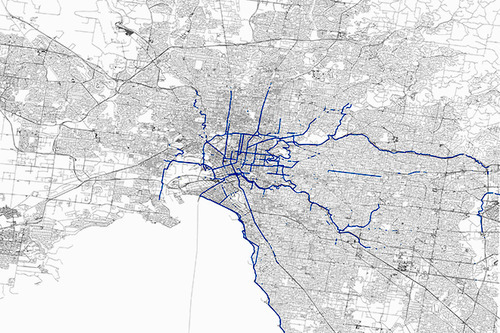
    Some of you might know that I’ve recently started using a mobile app called Strava. It’s a platform that allows you to track your runs and bike rides, as well as those of your friends. It tells you your speed, elevation changes, and it also maps your trips–among many other things. Here’s what my 50 km ‘Ride for Heart’ looks like from last Sunday.

    But what’s even more interesting is how cities are starting to use the data this app collects:

    For $20,000 a year, transportation planners and others can access Strava Metro, which provides an unprecedented look at where and how people are biking. It can tell them where they speed up and slow down, for example, or where they might stay in the street or ride on a crosswalk. That information can reveal where bike lanes or traffic calming measures would be useful, and if those already installed are effective.

    It’s a perfect example of how “tech” is infiltrating so many other sectors. Mobile technology and networks are generating huge amounts of data and it’s happening at an increasing rate. We’re gaining insights into the way people live that simply wasn’t possible before. Some of this information will inevitably be misused, but a lot of it will be used to improve the way we live our lives.

    I know that the City of Toronto also has its own proprietary cycling app and is hoping to collect similar sorts of data from it. But intuitively, I don’t think they’ll be able to compete with the scale of a platform like Strava. Though I certainly applaud the initiative.

    The information age is an exciting time.

    Image: Strava via Wired

  • The high cost of transacting

    This past Sunday I was over at my father’s place for dinner and we were talking about the high transaction costs associated with buying and selling homes. That is, we weren’t talking about the high price of homes in Toronto, we were only talking about transaction costs and barriers to market liquidity.

    For example, let’s say for the sake of simplicity that you own a home that’s worth $1 million and you’d like to sell it and buy a different home that also happens to be worth $1 million. In this case, you’d be making an entirely lateral move. You’re not down sizing or up sizing, you just want a different home–perhaps because you’d prefer a different neighborhood.

    In order to do this, you’re going to be faced with a number of costs. But the 2 most significant are real estate commissions and Land Transfer Taxes (both provincial and municipal). You only pay Land Transfer Taxes in Toronto when you buy (take title) of a new property, but they’re unavoidable, unless you’re a first time buyer, in which case you’d qualify for a bit of a rebate.

    Real estate commissions are technically optional, but 70-90% of the market in North America still uses a a real estate agent to sell their home (based on the estimates I’ve found). Typically a seller pays around 5% of the sale price. So in this example, you the homeowner would be paying around $50,000 in real estate commissions.

    Land Transfer Taxes would be roughly $32,000, and so you’re looking at a total somewhere around $82,000 in order to make this lateral move. This, of course, does not include legal fees or any other moving costs you might incur. It’s a hell of a lot of money and it’s a significant barrier to transacting.

    But my hunch is that we’ll eventually see real estate commissions come down. No real estate agent wants to hear this, but I think it’s almost inevitable. The internet, as a disruptive force, is bound to make it happen.

  • Wrapping my head around Bitcoin

    There’s been a lot of talk about Bitcoin over the past year, particularly as of late when the value of one bitcoin peaked at over USD $1,200.

    Truthfully, it’s only been over the past few months that I’ve really started to wrap my head around how Bitcoin works and what the implications of it might be. But the more I learn about it, the more it strikes me as something enormous in the making.

    If you’re not yet familiar with Bitcoin, you can check out this video (simple version) or this video (complicated geek version).

    Essentially though, it’s a decentralized and open source digital currency that’s managed using networked computers, as opposed to any one government. And functionally, it works as a distributed public ledger that logs every single bitcoin transaction. What this means is that when you buy or sell something using bitcoin, no exchange of bitcoin actually takes place. Instead, the distributed public ledger (called a block chain) gets updated to show who owns which coins both today and previously. 

    This is potentially a big deal for 2 reasons.

    The first is that many people view Bitcoin as the first internet native currency. The decentralized architecture of Bitcoin matches the decentralized architecture of the internet. And so it has the possibility of becoming the transactional protocol for the internet and global commerce.

    The second reason (and this is where your mind will really get blown) is that transactions can be logged in the block chain/ledger with additional information embedded into each bitcoin. What this means is that you can use Bitcoin to create contracts, such as deposits, escrows, loans and so on. And since Bitcoin is designed to function in low trust environments (ie. where nobody knows each other), there’s an opportunity to really optimize the way we buy and sell almost anything.

    In fact, if you dig deeper into what’s being contemplated with Bitcoin, you’ll find things like “smart property.”

    “Smart property is property whose ownership is controlled via the Bitcoin block chain, using contracts. Examples could include physical property such as cars, phones or houses.”

    Of course, it’s still early days for Bitcoin. But if it truly does become the transactional protocol for the internet, then I certainly do think we’ll see dramatic changes in the way we buy things like cars and real estate.

  • Do our computer pundits lack all common sense? The truth in no online database will replace your daily newspaper, no CD-ROM can take the place of a competent teacher and no computer network will change the way government works…. What the Internet hucksters won’t tell you is tht the Internet is one big ocean of unedited data, without any pretense of completeness. Lacking editors, reviewers or critics, the Internet has become a wasteland of unfiltered data.

    Newsweek from the 90s via Chris Dixon