Daily insights for city builders, delivered every morning at 6 AM ET. I’m Brandon Donnelly — a Toronto-based real estate developer and founder of Globizen. I’ve been writing here since 2013.

Tag: internet

  • Read, write, own

    I have been following Chris Dixon for many years and, yesterday, I learned that he has written a new book called, Read Write Own: Building the Next Era of the Internet. It is a book about web3 (crypto things) and the title is based on thinking about the evolution of the internet in terms of these three phases:

    The first act, called the “read era”, circa 1990-2005, democratized information. Anyone could type a few words into a browser and read about almost any topic through websites.

    The second act, the “read-write era”, roughly 2006-2020, democratized publishing. Anyone could write and publish to mass audiences on social networks and other services through posts.

    The third act, the “read-write-own era”, 2020-present, is democratizing ownership. Anyone can become a stakeholder in a digital service or network, gaining power, governance rights, and economic upside previously reserved for only a small number of corporate affiliates, like stockholders and employees.

    The book won’t be out until March 2024, but if you’re interested, maybe you want to pre-order it or at least get it on your radar. I immediately put this in my queue and I’m looking forward to welcoming it to the pile of books next to my bed.

    Full disclosure: I don’t get anything if you pre-order this book. I’m only putting this out there because I have a high degree of conviction about this coming shift and because, in the future, I want to be able to look back at posts like this one here. I think they’ll age well.

  • It sounded stupid when I said it

    https://twitter.com/DocumentingBTC/status/1553901007964442624?s=20&t=gRvygaF5RVVcIY-d_IHHeQ

    Click here if you can’t see the embedded tweet above.

    This is your daily reminder that many/most of the things that are ubiquitous today were once difficult to explain and understand (in the above example it’s email and the internet). Once a new idea or technology becomes widely adopted, its inner workings and technical aspects tend to recede into the background.

    Most people, for instance, probably aren’t familiar with all of the various internet protocols and how they work. Could you explain the difference between TCP and IP and SMTP? If you can’t, it doesn’t matter. The various protocol layers of the internet now work behind the scenes to power our daily lives. And the innovation that continues to be built on top of them is getting increasingly more user friendly as time goes on.

    The same thing will happen with crypto, which is talked about today in much the same way as the above folks are talking about email and the internet. New ideas will continue to emerge and we will all start deriving more and more utility from it (beyond just NFT art). And at that point, most people will stop caring about how all the sausages are made. They’ll just like eating them.

    P.S. One of the nice things about blogging every day is that I’ll be able to look back on this post in ten years and see how right or wrong I was.

  • From free CDs to a decentralized internet

    This is a great Twitter thread by Chris Dixon talking about why Web 3 — the next major iteration of the internet — is kind of a big deal. In it, Dixon refers to Web 1 as the period from about 1990 to 2005. This is the period of time that started out with CompuServe and AOL sending us all free CDs in the mail and most of us using a dial-up modem to access the internet. Web 2 was the period from about 2005 to 2020. It is the iteration of the internet that gave birth to social media as most of us know it today. If you subscribe to this timeline, then we are in year one of what’s next. Maybe it’ll also run for another 15 years or maybe it won’t. But either way, getting in on the ground floor is usually a pretty valuable thing. When Dixon tweets, I listen.

  • The internet is no longer American

    This is the topic of Benedict Evan’s latest blog post, which is all about the internet, regulation, and the rise of China, as well as other countries. The internet is now deeply ingrained in everyday life. As of 2017, about 40% of Americans had met their partners online. We do everything online. But 80-90% of the world’s internet users are now outside of the US. There are more smartphone users in China than in the US and western Europe combined. And venture capital dollars have started to diversify away from just the US (see above chart). All of this — but mostly Tiktok — has Americans questioning how best to handle and how best to regulate.

    Here’s an excerpt from Benedict’s post:

    Both of these are captured in Tiktok. This is the first time that Americans have really had to deal with their teenagers using a form of mass media that isn’t created in their country by people who mostly share their values. It’s from somewhere else. That’s compounded by the fact that the ‘somewhere else’ is China, with all of the political and geopolitical issues that come with that, but I’d suggest that the core, structural issue is that it’s foreign. This is, of course, a problem that the rest of the world has been wrestling with since 1994, but it comes as something of a shock in Washington DC. There’s an old joke that war is how God teaches Americans geography – now it’s regulation.

    For the full post, click here.

    Image/facts: Benedict Evans

  • Internet traffic is up 36% in Toronto

    Most of us are using the internet and our phones a lot more these days. According to Cloudflare — who recently published these stats on how the pandemic has impacted internet usage — traffic is up about 36% in Toronto between early January and late March 2020. Here is a heatmap of the city:

    Similar maps are available for other major cities across the world. The red areas are places where internet traffic has declined and the green areas are where internet traffic has increased. Looking at Toronto, you can see that usage in the financial core of the city has, not surprisingly, declined. This makes sense. Most people are now at home using the internet there.

    It would be interesting to see some sort of split between residential and commercial usage, because my mind is associating these red areas with businesses. And when you do that, some cities, like Toronto and New York, appear very monocentric; whereas others, like Berlin, appear far more polycentric.

    The other thing Cloudfare looked at was internet activity by category (as of March 2020). What is also not surprising is that kids content is way up, and leads by a wide margin. For you real estate folks, you should also note that apartment searches seem to be down and are not far off from air travel. Now would be a suboptimal time to move.

    Much of this probably won’t surprise you, but it is revealing nonetheless.

  • Intimacy at a distance

    In 1956, Donald Horton and Richard Wohl coined the term parasocial interaction to describe the psychological relationship that people were starting to have with TV personalities. Though radio had already started this phenomenon, the television brought with it an entirely new dimension. People started to really feel as if they knew that person on TV. They had become a friend.

    But as Christopher Mims points out in this recent article about loneliness during the coronavirus pandemic, the problem with parasocial interaction is that it’s entirely one-sided. It also isn’t real: “Sitting around the house watching television, parasocializing with our favorite news anchors or sitcom characters, didn’t confer the same benefits as socializing with real people.”

    The internet has further enhanced the way we parasocialize. Similar to how TV built on radio, the internet has built on TV. Instead of just scripted television shows, we now have Instagram Stories, TikTok videos, inappropriate Snaps, and many other methods of communication, some of which are maybe a little less scripted.

    Of course, we also see our real friends online and those people we know, but never actually spend time with, maintaining only a loose “relationship” via the occasional emoji reaction. Mims argues that this has created a new kind of “mental equivalence.” It has become harder for our minds to distinguish between our real friends and our parasocial friends.

    Recently, we have all become familiar with terms like “flatten the curve” and “social distancing.” But what is clear as we all start isolating ourselves at home — whether mostly or entirely — is this: it sucks. Even with all of the tech and social media that we now have available to us, we cannot replace what it’s like to give someone a hung, look them in the eyes, and have a meaningful conversation.

    That said, the Italians seem to have really mastered this whole self-isolation thing with their balcony orchestras and internet videos like this one here:

    Stay strong, friends. Normalcy will return.

  • Protocols, not platforms

    Yesterday, Jack Dorsey published the below tweetstorm about Twitter’s efforts to create a decentralized internet protocol for social media. What does this mean? Think along the lines of the Simple Mail Transfer Protocol (or SMTP). Some, or many, of you may not know what this is, but you almost certainly use it every day. It is fundamental to modern email communication. It is how emails get sent.

    I would encourage you to click through to the entire thread. It all feels very topical. We are living in a world of recommendation algorithms and content designed to “spark controversy and outrage.” Arguably, this is the result of social media companies being platforms (i.e. proprietary systems), as opposed to being based around open protocols. Twitter is trying to change that by funding a team. And that feels like a great — and timely — idea.

    Full disclosure: I own $TWTR.

  • Shadow Stalker

    The Shed in Hudson Yards has an exhibition on right now called Manual Override. It features the work of five artists. One of those artists is Lynn Hershman Leeson, who is known for exploring the relationship between humans and technology (naturally, she lives in the Bay Area). Her piece at the exhibition is called Shadow Stalker.

    The way Shadow Stalker works is that you enter your email address — a single data point. The installation then pulls up all of the publicly accessible information associated with your email address. Things like your name, age, address, phone numbers, where you were last seen, and more.

    She refers to this information as your “digital shadow.” It is all of the personal information that is publicly accessible because of the internet. And it is the kind of the information that is already used for things like “predictive policing.” Software that predicts where crime is likely to occur.

    I am fairly public as a result of this blog. Already this year I have written over 75,000 words. So I can only imagine what the internet knows about me. Probably a lot. But of course, I am volunteering a lot of this information. What does the internet know about us that we didn’t explicitly tell it?

    If you’re interested in learning more about Shadow Stalker, here’s a video.

  • Attract and extract

    Chris Dixon’s recent piece on why decentralization matters is currently making the rounds online. It clearly explains the first two eras of the internet and how the third era is developing as we speak. Cue decentralized cryptonetworks.

    I particularly like how he describes the relationship that centralized platforms – like Facebook – have to their users and to their complements (other businesses, software developers, creators, and so on). 

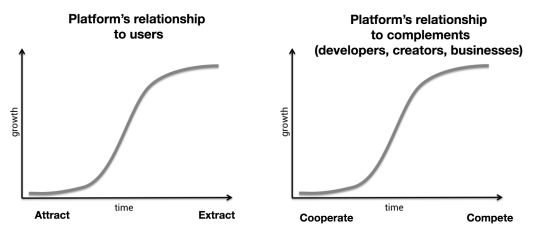
    Here are two graphs from his article:

    In the early days it’s all about cooperation and doing everything you can to attract users. The platform gets more valuable the more users are on it and so the immediate goal is to build up the network effects and lock people in.

    But as the platform grows, the relationship flips (top of the S-curve). In Dixon’s words, it becomes a zero-sum game whereby to continue growing the platform starts extracting data from its users and competing with its complements.

    The promise of cryptonetworks is that they will do away with many of these negative externalities, but at the same time empower the kind of sophistication that we see today with centralized platforms.

    The venture capitalists are circling because a fundamental shift in the architecture of the internet will mean disruption. I’m following it because I want to understand how it may apply to real estate and the built environment.

  • What happened (in tech) in 2017

    I am still catching up on reading after being mostly offline last week, minus short windows where I would go online to upload these daily blog posts.

    Here is a post that Fred Wilson wrote on new year’s eve about “what happened in 2017.” It has become a tradition of his to write a “what happened” post on the last day of the year and a “what is going to happen” post on the first day of the new year. He then uses these posts to keep track of how well he does on his predictions for the year.

    His three headlines for 2017 were: (1) crypto; (2) the beginning of the end of white male dominance; and (3) the tech backlash (i.e. tech is the new Wall Street). It is worth a read. Crypto was an obvious one, but he has been writing about it – and investing in the space – for years. Of particular interest in this post is how he positions it as the basis for Internet 3.0 (the decentralized internet).

    What is also clear from the post is just how ingrained tech has become in our everyday lives and how much it reaches beyond simply the tech industry. I have been saying this for years, which is why I spend a lot of time writing about it on this blog.