Daily insights for city builders, delivered every morning at 6 AM ET. I’m Brandon Donnelly — a Toronto-based real estate developer and founder of Globizen. I’ve been writing here since 2013.

Tag: innovation

  • The MFA is the new MBA

    Harvard Business Review recently published a conversation between Roger Martin – who is the former dean of the Rotman School – and Tim Brown – who is CEO of the global design firm IDEO. The title of the talk is “Capitalism Needs Design Thinking.” But I decided to call this post something else after reading Roger say this:

    My friend Dan Pink argued in an HBR piece in 2004 that the MFA is the new MBA. I wrote to Dan to say that if that’s the case we have a problem because America pumps out a mere 1,500 MFAs a year versus 150,000 MBAs. Thirty MFAs per state per year is just a rounding error. This is one of the reasons I was so keen on transforming business education. It’s a huge infrastructure: 27% of all graduate students in America are in an MBA program. If they’re all being taught how to analyze things to death, that’s going to affect how they’ll shape the future of business.

    But what this conversation is really about is the future of democratic capitalism, which is why I think it’s a nice tie-in to yesterday’s Architect This City post about startups and inequality.

    I’m very worried about the fact that in America we’ve now gone 24 years without the median household income rising — it was the same in 2013 as it was in 1989. That’s unprecedented in American history. The longest that’s ever happened before is when it took just under 20 years to recover, after the Great Depression. This long period of stagnation has coincided with the top 1% of the economy doing spectacularly.

    And so while it’s easy to point fingers at the tech community and say that it’s to blame for rising income inequality, the reality, I think, is that there are other more fundamental issues that need addressing. Roger and Tim believe that design thinking can help. Here’s another great snippet from the former:

    I think the way that government generally works is to think, think, think, think, and then finally create legislation that brings about some change, and then they ignore their legislation and say okay, we’re finished with that. Then people go and figure out how to game that legislation, and the government doesn’t do anything about it. Whereas if they had a design view of it, they’d say when they passed a bill, that’s just the best idea we’ve got now, we have to go see how it works in practice, and then fix it. That’s just not the mentality.

    Technology is having a profound impact on the world. And it’s something that is very visible. But part of the challenge is that governments aren’t keeping up. They are almost never out in front.

    So when something new comes along, like Airbnb or Uber, the reaction is to just stop it. It doesn’t conform to the rules and regulations currently in place, and so it shouldn’t exist.

    But as Roger and Tim point out, maybe we need to look at our rules and regulations as simply part of an iterative process (like designers do). Because if we did that, maybe we’d be better equipped to transfer the benefits of innovation over to society as a whole.

    Image: HBR
  • Are startups causing inequality?

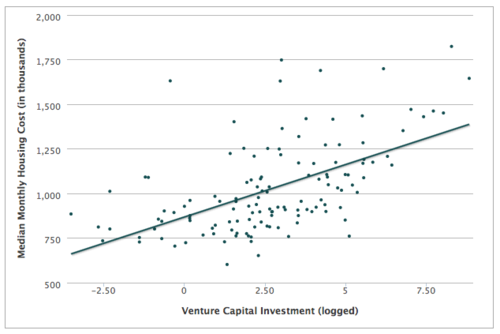
    Earlier this week Richard Florida published on article on CityLab talking about the relationship between tech innovation (in cities) and inequality. Specifically, the article deals with the correlation between venture capital investment and a variety of factors, such as monthly housing costs, wage and income inequality, and so on.

    The intent of the piece was to address the growing backlash against tech workers – in places like San Francisco – who have become the symbol for the growing gap between the rich and poor.

    The strongest correlation appears to exist between venture capital investment and housing costs. As the amount of venture capital goes up, so do housing costs – which probably shouldn’t surprise you. The rich start outbidding the poor for housing. Note: The two outlying dots at the top right, in the graph below, are Silicon Valley and San Francisco.

    image

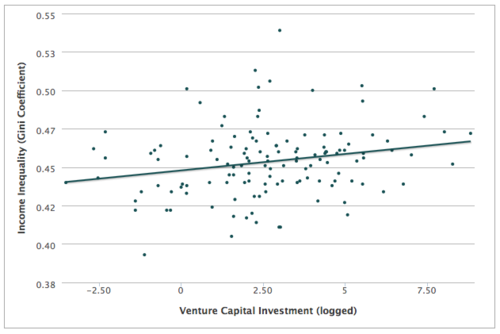
    But when it comes to inequality, the relationship isn’t so clear. For wage inequality, there seems to be a relationship. But for the broader income inequality measure, the relationship is fairly weak. Here’s the graph:

    image

    So this is not as black and white as it might seem. Regardless, Florida ends the piece with the following statement (that I think is spot on):

    It’s time to stop pointing fingers and get on with the far more important task of harnessing the urban tech revolution to create a new urban middle class and a more inclusive urbanism—one in which many more workers and residents can participate, and one from which many more can benefit.

    The answer is not to stop innovating. That would be counterproductive. We should be be encouraging innovation, but at the same time figuring out how best to harness it for society as a whole.

    Tomorrow, I’ll touch a bit more on how we might go about doing that. I have a post planned that I think will tie in really nicely to this discussion. So stay tuned.

  • A revolution in personal mobility

    In the spirit of Startup Weekend, I thought it would be interesting to go back in time and pretend to pitch one of the most disruptive innovations of the 19th century: the automobile.

    Typically pitches start by first outlining the problem. The idea is to make your audience aware of the pain point, so that they feel excited when you ultimately pitch your solution.

    In the case of cars, the incumbent technology would have been horses. So I can imagine somebody standing up and talking about how horses are slow and how they drop stinky poo all over our city streets. And that the time has come for a revolution in personal mobility! Enough of this crap! 🙂

    But while many of us probably can’t imagine a world without cars, try and put yourself in the shoes of somebody at the end of the 19th century who can’t imagine a world without horses. And then think about all the things we have subsequently done to make cars thrive:

    • We paved roads and created networks of freeways.
    • We invented rules of the road to ensure that people were operating these new devices properly.
    • We created a licensing system to ensure that anybody who was operating a car was doing so relatively safely and following the rules that had been created.
    • We created schools that taught people how to be better drivers.
    • We started insuring cars for when accidents inevitably happened.
    • We started having to accept fatal car accident and pedestrian deaths.
    • We built networks of gas stations. As of 2004, there were 168,000 retail locations selling gas in the United States.
    • We had to give over large land masses to parking. In fact, we reorganized entire cities so that the car could be better accommodated.
    • And we setup government transportation divisions to make sure the needs of the car were always being met.

    This is a long list of things we had to do to make cars possible and I’m sure there are many others that I have missed. Today, we all know how disruptive cars have been and we’re certainly questioning many of the things we have done. But we also accept this list as being largely normative.

    However, before they were the norm, they were insurmountable challenges. How will we teach everyone how to drive these new cars? How will we minimize accidents? How will we make it easy for people to refuel their cars? Where will people store them when they’re not using them?

    There were a lot of moving parts to figure out. 

    Which is why people like Paul Graham have argued that the best ideas almost have to live in your unconscious mind. Because your conscious mind would simply reject them as viable options as soon as you started thinking about all the required moving parts. I guess that’s why they say there’s a very fine line between crazy and brilliant.

    Image: Benz Velo

  • The threat to big box retailing

    image

    Earlier this week, I was having a conversation with a number of smart real estate people about the future of retail in today’s internet and smartphone world. This, of course, isn’t a new topic. The industry has been discussing it for years. And while internet retailing still accounts for a relatively small percentage of overall retail sales (~10%), we all know that change is coming.

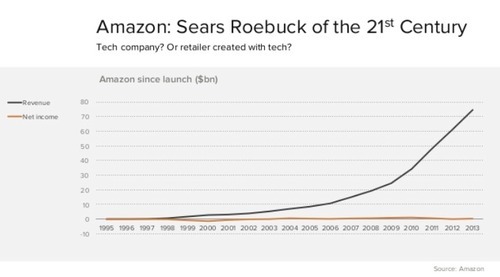
    One company that came up during our discussion was not surprisingly Amazon.com. But the initial comment was that they don’t make any money. Fortunately for me I had just gone through a presentation by venture capitalist Benedict Evans the night before called: Mobile is eating the world. And so I pulled out my phone and presented this slide:

    image

    The fact that Amazon operates with basically no net income is on purpose. Look at their revenue growth! So I wouldn’t dismiss them as being a fad. They may only account for 1% of all US retail sales today, but I’d put money on that percentage growing.

    The other reason I bring up Amazon is because, in some ways, I think of them as the online equivalent of a big box store. Just like a Walmart or Costco, where you can buy everything from tires to groceries to prescription drugs, I buy a lot of different things, besides just books, off of Amazon.com. You might do the same as well. And this is where I see the immediate threat to offline retailing and retail real estate: big box stores.

    In the second half of the 20th century, big box stores were incredibly disruptive to the retail landscape (and to cities). They used cheap land on the outskirts of cities, cheap buildings, and economies of scale to offer rock bottom prices to consumers. The value proposition was about cheap, not about differentiation. But as cheap as they may be, the internet can still do it cheaper.

    And retailers know this, which is why I think they all now sell groceries. Groceries have a very low online penetration. Basically everybody still buys groceries in-person. So if you offer that, you have a reason to draw people inside your store, where they will hopefully buy all the other stuff that they need. But as the online value proposition continues to get stronger, I think we’ll see many other, more significant, changes.

    Image: Flickr

  • The will to try new things

    image

    I’m a big fan of wine. But in particular, I like and I support Ontario wines. And last night I was in Niagara-on-the-Lake for the Stratus Vineyards annual harvest party. It happens every year and, as the name suggests, it kind of marks the end of the growing season for the vineyard. I say kind of because not all varietals have been harvested by this time.

    At one point during the evening, I was speaking with the winemaker, J-L (Jean-Laurent) Groux, who is a native of the Loire Valley in France and first learned how to make wine in Burgundy and Bordeaux. And I asked him: why Niagara? Why did you bring your talent to Niagara? (When he came, Niagara would have had a great reputation for crappy wines.)

    He first responded by saying that he had been traveling around the world to different wine regions, and Niagara just so happened to be where he was when he ran out of money. But he went on to say that he saw Niagara as a place of opportunity. It was a region on the rise and he knew that he would have the creative freedom to experiment and do whatever he wanted.

    And that just wasn’t the case in France where tradition dictated. Good for Niagara.

    But as he was telling me all of this, I couldn’t help but think that it’s the classic business story of incumbents and disruptors. I’m not saying that French winemaking will get disrupted. I’m just saying that in a world of established wineries, corporations and other groups, it would seem impossible for them to be threatened in any way by upstarts. They, the incumbents, have more money, more people, and more resources all around.

    But what they sometimes lose along the way, is the will to try new things.

  • Taking a picture of the world, every day

    This morning I finished watching the rest of Steve Jurvetson’s Spark 2014 talk, which I shared with you all yesterday. And so I’ve got technology on the brain right now.

    I’ve said this many times before on ATC, but I truly believe that the pace in which technology is infiltrating “non-technology” companies is only going to increase. The video clip of Flux.io is a perfect example of that. After watching that demo yesterday, I immediately thought a handful of consultants that real estate developers use on projects that the Flux platform could replace.

    image

    So today I thought I would share another company that Steve talks about in yesterday’s video called Planet Labs. Planet Labs’ mission to image the entire world and make it universally accessible to people. But unlike Google and Microsoft – who already offer satellite photography – Planet Labs has figured out a cost effective way to do it on a daily basis.

    Because the problem with services like Google Maps and Bing is that they’re updated too infrequently. If I go to Google Maps right now, the building I live in doesn’t even exist in their aerial photography of Toronto – it’s still a parking lot. So there are limits to what you can do with this information.

    But once you increase the image frequency to daily, you create all sorts of new opportunities. You could track the number of cars in every parking lot in the world to measure retail activity (an example Steve gives in his talk). You could track changing water levels. You could track deforestation. You could track urbanization in China. And the list goes on. Here’s a blog post from Planet Labs that gives a few examples of the benefits of daily imaging.

    To return to my earlier point, consider the fact that every potential use case I’ve just outlined is in an industry that most of you wouldn’t consider to be tech. And yet Planet Labs is clearly a technology company. So the key insight here is really to focus less on the way things are done and classified today, and more on the way they could be – and likely will be – done in the future.

    Image: Planet Labs

  • Toronto’s “Instagram for doctors” raises $4 million

    image

    Earlier this week it was announced that Fred Wilson and his firm Union Square Ventures have just led a $4M Series A round of venture funding in the Toronto-based startup Figure1. Figure1 is essentially “Instagram for doctors.” Here’s how it works (via WSJ):

    Today, more than 125,000 health-care professionals use Figure 1 to view or share free medical imagery, including photos of patients with personally identifiable details blurred out or excluded; x-rays; charts; and still images taken from MRI or CAT scans, for example.

    The app’s users include board-certified doctors, registered nurses, medical and nursing students, physicians’ assistants, and others who use the app and share images for teaching and studying purposes, or even to request community feedback about a possible diagnosis.

    With this round, USV is now up to 3 investments in the Toronto/Waterloo region (I think of us as one center). The other 2 are Kik (out of Waterloo) and Wattpad, which is actually headquartered here in the St. Lawrence Market.

    What’s exciting to me about all of this is that it’s further evidence of a growing and thriving Toronto/Waterloo startup ecosystem. And while to some it may not seem like a big deal for yet another mobile app to receive funding, it’s actually great news.

    Because as these companies grow and become successful, they’ll not only create new jobs in the region, but also create a tremendous amount of wealth and expertise. And when this wealth and expertise gets reinvested into future startups, you end up with a powerful snowball effect. That’s how startup ecosystems are built.

    It’s also great to see companies staying put, because the pull towards more established startup hubs can be significant. When my friend Evgeny raised a Series A round from Andreessen Horowitz last year, he told me that they asked him to move 500px down to California. As is the case with a lot of VCs, they like their portfolio companies to be nearby.

    But ultimately 500px decided to stay headquartered here in downtown Toronto. And they did that for a few reasons: There’s lots of great engineering talent here and it usually comes at a discount relative to California (5-15%). He also finds that employees here are more loyal. There’s less turnover. In California, everyone is looking for that next best startup to join. Here 500px gets to be that big fish in a small pond.

    Anyways, a big congratulations to the Figure1 team. I hope they continue crushing it and that they stay put in Toronto. If you’re a healthcare professional, you can click here to download the app.

  • Rules are made to be broken. So which one is next?

    Jevon MacDonald of StartupNorth published an interesting article today called, You are supposed to break the rules. It talks about entrepreneurship and how great companies are built by disregarding the way things are done today.

    And I think it’s for that reason that many stupid sounding ideas (think Airbnb and its initial idea of offering air mattresses) actually turn out to be great ideas. In reality, they weren’t stupid ideas. They just contravened the norm, and that made them sound stupid. It made people feel uncomfortable. And as humans, we tend to have a bias towards things that reinforce our existing view of the world.

    In any case, Jevon talks about some of the “big rules” that are being broken today. His list includes:

    But really he’s talking about Uber, Tesla, and Airbnb. They are the startups breaking those rules. However, that’s old news for most of us. What’s more interesting are the following two takeaways.

    The first is his prediction that startups are going to start running into more and more regulatory hurdles. In other words, we’re going to see more, not less, litigation. And I think he’s right. As technology starts to creep into other industries (like it has with the taxi industry, the car industry, and the hospitality industry), we’ll probably see a lot of incumbents fighting to hold on.

    The second interesting takeaway for me was that out of his list of “big rules”, the real estate industry (i.e. the MLS) is the only one that doesn’t have a formidable disruptor attached to it. Which makes me wonder: Is something like Opendoor.com inevitable?

  • The birth of tall buildings

    As an architecture and city lover, it’ll probably surprise you that I’ve never been to Chicago. I think it may have to do with the fact that it has always felt like a sister to Toronto–another Great Lakes city of comparable size. And when you travel, you often want something novel.

    But that’s no excuse. 

    Thankfully I’m happy to report that last week I booked a trip to Chicago for this August. I’ll be there for an extended long weekend. But since it’s for a bachelor party, it remains to be seen how much archi-touring I’ll actually get a chance to do.

    Chicago is a hugely important city in the world of architecture and city building. From Frank Lloyd Wright to Mies van der Rohe to Louis Sullivan, the city has deep architectural roots.

    When most people think of skyscrapers they think of New York. But in actuality, if there’s one city that gave birth to the modern skyscraper I would argue that it was Chicago. And it was made possible by the steel industry.

    Before the late 19th century, tall buildings were largely built with their exterior walls supporting most of the loads. This meant that the taller you went, the thicker the walls had to be near the bottom of the building. This is why older buildings often feel so heavy and permanent.

    But when structural steel became widely available, a new building form was created. All of a sudden architects and builders could create relatively light weight structural steel frames to support the building. The skin, or outside of the building, was no longer carrying the weight.

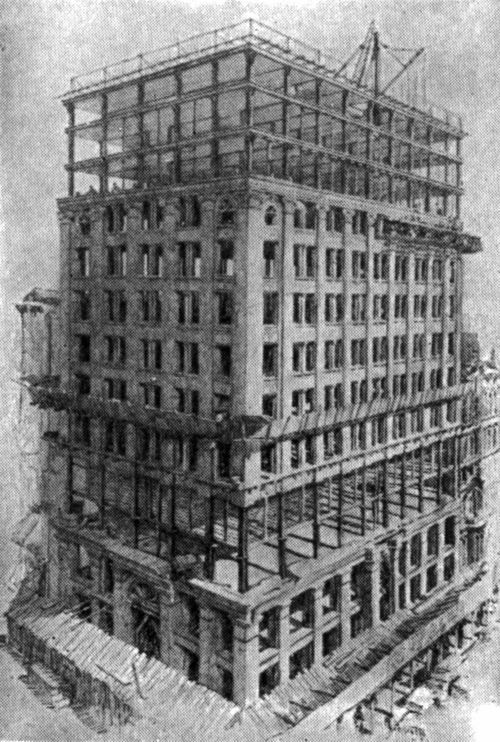
    That made images like this possible:

    image

    For most of us today, this building under construction looks fairly typical. First the structure goes up and then it gets clad with its window and exterior skin. But at the time, this sort of construction technique–with the 3rd and 4th floors still unenclosed and the upper floors finished–would have blown people’s minds. It was an entirely new way of building.

    Steel framed buildings removed the technical limitations of building tall and also opened up entirely new possibilities for architectural expression–such as the all glass building. Today, there’s a lot of criticism around our glass buildings. But it’s interesting to note that it started as the futuristic dream of architects.

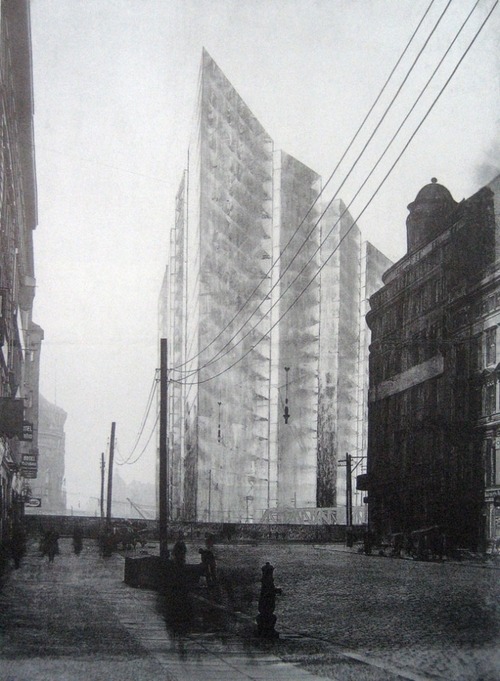
    image

    Freed from the technical limitations of load-bearing exterior walls, architects such as Mies van der Rohe began dreaming of transparent, all glass buildings. For them it represented modernity. It was the future. Above is an early charcoal sketch of that dream by Mies.

    But our fixation with glass and transparency has never been because of environmental efficiency. It was about light, transparency and feelings of modernity. So as sustainability becomes increasingly critical, we should remember that there’s still lots of innovating left for us to do.

    Art and architecture has always been a representation of the time and era in which it was created–which is one of the reasons I’m so interested in technology today. It’s our era. It’s our “structural steel”. And it’s going to impact our cities.

    When posterity looks back on us and what we’ve done, I’m sure that will be clear.

  • Culture in our society and economy

    Last week I was reading the blog of James S. Russell, who used to be the architecture critic for Bloomberg News. He’s no longer the architecture critic, because Bloomberg got rid of his column:

    My column, along with almost all cultural coverage, was eliminated at Bloomberg late last year in favor of a yet-to-be completed revamping that focuses on luxury and lifestyle. 

    Obviously, the decision saddens me personally, but it’s also a regrettably powerful signal that culture doesn’t matter in our society and economy.

    As someone who spent a great deal of time studying art, architecture and design, his post really resonated with me. This is a depressing thought. It may be hard to measure the ROI of the arts, but that doesn’t mean there isn’t a return.

    Ironically, Bloomberg–the former mayor of New York–understood this:

    As Mayor of New York, Michael Bloomberg, the company’s founder, championed arts as valuable to the vibrancy of the city and as a powerful force for economic development. The city has seen unprecedented growth in arts facilities, thanks both to his administration’s efforts and his personal philanthropy. His post-mayoral activities are intended to nurture cities as fields of wealth creation by helping them become cauldrons of innovation, which he recognizes is entwined with vibrant cultural and lifestyle trends.

    That sounds about right.