Daily insights for city builders, delivered every morning at 6 AM ET. I’m Brandon Donnelly — a Toronto-based real estate developer and founder of Globizen. I’ve been writing here since 2013.

Tag: india

  • Building new cities

    On this blog, we often talk about city building in the context of doing things to help improve a city — whether that be a development project, a new public art mural, or an interesting local business. These interventions help to build a city. But even more specifically, the term has, for many, come to mean building up a city in a positive way.

    But there is another way to think about city building. You can think of it in terms of building actual new cities. We’ve spoken about some of these before, namely this one in California and this odd one in Saudi Arabia. But apparently it is becoming more common. According to The Economist, the world is now building more new cities than it has in the last 80 or so years:

    Egypt’s “New Administrative Capital” is part of a rush of city-building. Firms and governments are planning more settlements than at any time in the post-war period, with many already under construction. Ninety-one cities have been announced in the past decade, with 15 in the past year alone. In addition to its new capital in the north, Egypt is building five other cities, with plans for dozens more. India is considering eight urban hubs. Outside Baghdad, Iraq, workers have just broken ground on the first of five settlements.

    In some cases, it is being done as a solution to urban congestion. If this city is too expensive and unaffordable, just create a new one. This appears to be part of the idea with the above city outside of San Francisco. Of course, new cities can also be created for ideological reasons, or for political purposes, which was the case with Brazil’s capital city, Brasilia.

    Here, the idea was to move the federal capital away from the country’s populated southeast region to a more geographically neutral location in the middle of the country. It also turns out that seeding a new city with government institutions is a good way to get one of these started. Existing cities do, after all, benefit from network effects.

    History points to characteristics shared by successful projects. State institutions can help anchor cities, as Brasília (in Brazil) and Chandigarh (in India) showed in the 20th century. Although both have had problems, people in Brazil and India are voting with their feet. Brasília’s population is growing at 1.2% a year, more than double the national average. Chandigarh, a state capital, is now India’s fourth-richest region on a per-person basis.

    But putting money, ego, and ideology aside, when does it actually make sense to start a new city in lieu of just expanding (or addressing the problems in) the one(s) you’ve already got? Population size can’t be the only factor in determining whether a city is “full”, because Tokyo seems to do just fine as the largest metropolitan area in the world.

    If it hasn’t already been done, I think this would make for an interesting research project. Until then, there’s this (paywalled) Economist article.

  • Nearly half of the world’s population now lives in a country with a fertility rate below replacement levels

    Prior to COVID, many projections had the world’s population plateauing sometime in the second half of the 21st century. This is expected to happen because about half of the world’s population now lives in a country where the fertility rate is less than the replacement rate of 2.1 children for every woman. See above chart from The Economist.

    At the start of the pandemic, there was talk of a possible COVID baby boom. People were/are stuck at home and so that would surely translate into more sex among partners. But that doesn’t appear to have been the case for many countries. According to The Economist, births fell by 15% in China last year. The same drop was recorded in the United States last year between February and November.

    Because of this trend, the above projections are now being adjusted and pulled forward, with some predicting that the world’s population could plateau as early as the 2050s. That’s only about 30 years from now, which means that quite a few of us could end up living in a world with a declining population. This is likely to have both positive and negative consequences.

    There are nearly 8 billion people in the world today with China and India being the countries with the greatest numbers. But it’s interesting to consider how recent this figure really is (compounding takes time to gain momentum).

    The world didn’t hit a billion people until the 19th century, and the second billion was only reached by the 1920s, which in the grand scheme of things, isn’t that long ago. Since then the global population has exploded with about 6 billion people being added in only the last 100 years. That’s pretty wild when you think about it.

    P.S. I recently discovered a site called outline.com. It allows you to read, highlight, and annotate articles that you find online. But it also seems to allow you to read articles behind paywalls. Perhaps some of you will find that useful.

    Chart: The Economist

  • Libra expected to launch within Indian WhatsApp

    I was at a wedding last night (congrats, again, Kate + Rob) and a group of us started talking about Facebook, or, more specifically, how most of us have stopped using it all together. I deleted my account last year, but ended up having to create a ghost account with no friends just so that I could run social ads. But other than that, I don’t go on. This, of course, is a problem for Facebook. Here are some stats on its declining user base.

    This trend line could be one of the motivating factors behind Libra (Facebook’s new blockchain-based currency). Payment infrastructure, if successful, should be a lot stickier than social infrastructure. But being the classic underachiever that he is, Zuckerberg’s ambitions run even deeper than this. Max Read published a fantastic article on Libra in New York Magazine last week. Here is an excerpt:

    As far as I know, there’s only one other entity out there developing a blockchain-based digital currency for a billion-plus-member economy: China. The People’s Bank of China has been amassing blockchain and digital-currency patents as it develops its own cryptocurrency — loosely pegged to a basket of other currencies, just like Libra — which could help it more efficiently monitor and control capital flows. (So much for the decentralized, anarchist dream of cryptocurrency.) Facebook doesn’t want to compete with Mastercard, or even with Goldman Sachs. It wants to be the currency platform Mastercard operates on. Facebook’s payment product is a whole new currency because its long-term competition isn’t PayPal or Visa or even WeChat, but the renminbi, the euro, the yen, and the dollar.

    Libra is expected to be first available to Indian WhatsApp users. The goal is to gain a foothold in the $689 billion global remittance economy, of which $80 billion flowed to India last year (2018). In the short-term, this probably won’t make any or much money for the company. But it should get people using and bought in to Libra in the medium-term.

    If you’re looking for more on Libra, including what checks and balances can expected to be in place regarding your privacy and personal information, have a listen to this podcast:

    Photo by Nitin Mendekar on Unsplash

  • Relationship between female literacy and total fertility rate

    This recent post by Sam Karam at NewGeography illustrates the relationship between female literacy and total fertility rates in Sub-Saharan Africa, India, and China. The overarching argument, which won’t surprise any of you, is that, “higher female literacy is a reliable predictor of lower fertility and improved prosperity.”

    The following graph uses data from populyst, the UN Population Division and UNESCO. The time period for the dataset varies by country but approximately corresponds to the latest 2000′s. All Sub-Saharan countries are represented, except for the Congo, Somolia, and South Sudan.

    image

    Noteworthy about this dataset is that the biggest decline in the total fertility rate happens precipitously after female literacy reaches and exceeds 80%. What is also interesting, but not surprising, if that the countries with the lowest gender equality rankings tend to also have high fertility rates. And that’s because low gender equality tends to translate into lower female literacy rates. 

    According to populyst, the above phenomenon – precipitous decline in TFR with rising female literacy – has already proved itself out in China. 

    Based on data from the World Bank, China’s total fertility rate dropped from 6.38 in 1966 to 2.75 in 1979. And since the one-child policy was only enacted in 1979, it doesn’t appear to be driven by that. (I would have initially expected some sort of surge in births prior to that policy.) From 1982 to 2000, the female literacy rate in China rose from 51% to 87%. Today it is 99.6%, which is basically the same as it is for males.

    For a more detailed look at the above data, check out this populyst post.

  • The biggest international buyers of American homes

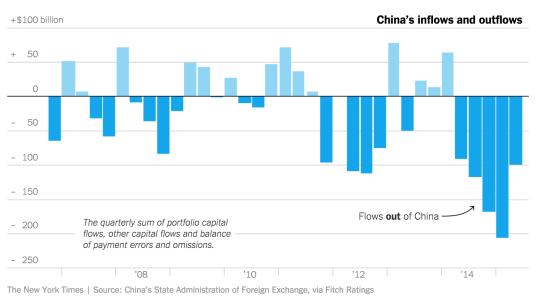
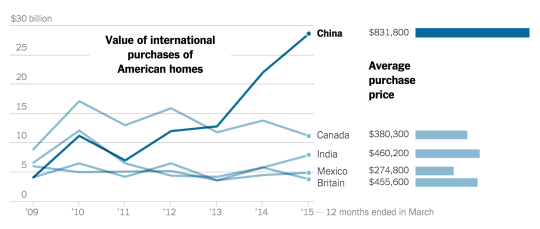
    A reader recently sent me a New York Times article talking about Chinese buyers flooding into the US residential real estate market. This is something that I’ve written about before, but I liked the “graphic” section called The Roots of China’s Real Estate Rush.

    Here are two of the graphs:

    imageimage

    The second chart shows you just how much more significant Chinese buyers are compared to the next biggest foreign customer of American homes: Canadians. And with the Canadian dollar where it is, it is no surprise that we are trending downwards. That doesn’t seem to be the case with the Chinese.