Daily insights for city builders, delivered every morning at 6 AM ET. I’m Brandon Donnelly — a Toronto-based real estate developer and founder of Globizen. I’ve been writing here since 2013.
I was having a discussion last night with a few friends about ethnic self-identification. In a multicultural city like Toronto where more than half of the population was born elsewhere, it’s an interesting topic.
For new immigrants, I can understand that there often remains a strong connection to the home country and culture.
However, for subsequent generations, the attachment seems to manifest itself and wane (which I think is a natural tendency) in a variety of different ways. I am sure it partially depends on how determined the parents are to preserve the lineage vs. fully assimilate. In any event, it’s a somewhat subjective phenomenon.
The best data I could find on this is from the 2006 Canadian census (I couldn’t find anything similar from the 2011 census). However, the question on the census was not about ethnic self-identification, per se, but rather how each respondent would classify the ancestry of their parents.
There were a total of 31,241,030 responses. Some people gave a single response and some people selected multiple ethnic origins, which was allowed.
In total, 10,066,290 people selected “Canadian.” Roughly 1/3 of the country. However, only 5,748,725 selected it as a single response. So only about 18.4% of respondents identified their parents as being only Canadian. The remaining group of people who selected Canadian also selected some other ethnic origin.
The reason I pick out this stat is because – to answer my own question at the beginning of this post – I would self-identify as being only Canadian. I feel no emotional attachment to any other country.
I would never support any other country at the Olympics and I would never fight for any other country.
In terms of my background, my father wasn’t born here and so I am 1st/2nd generation on that side, depending on how you define 1st generation. However, on my mother’s side, I would be 3rd/4th generation Canadian.
How do you self-identify? There’s no right or wrong answer here.
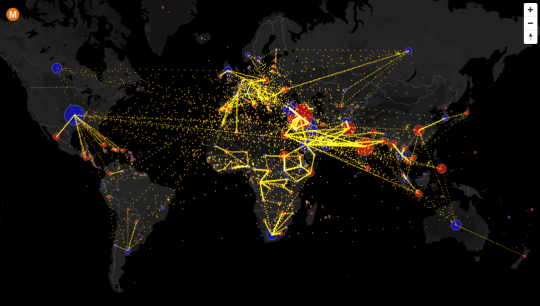
In that version, you can hover over a country to see the total net migration number (+/-) and you can click on a country to see where people are moving to and from. A blue circle indicates positive net migration (greater inflows) and a red circle indicates negative net migration (greater outflows).
All of the data is from the United Nations Population Division. And though the numbers are estimates, it’s a fascinating look at global migration. For instance, look at the outflow from Syria.
It would also be interesting to see these numbers on a per capita basis because some countries certainly punch above or below their weight in terms of migration. Off the top of my head, I’m thinking of Canada and Australia vis-à-vis the US.
I’m listening to The Foreign Desk this morning while I have my coffee. Steve Bloomfield is interviewing two different politicians: one who believes Britain should remain in the EU and one who believes Britain should leave the EU.
(Each interview is about 15 minutes short.)
The back and forth is largely centered around two things: the economy and immigration. Will the British economy be better off in or out of the EU? And on the immigration front, will “in” translate into millions of Turks flooding into Britain should Turkey join the EU?
My general view is that a strong economy should trump concerns over foreigners. But I don’t feel as if I know enough about this precise topic to take a firm position.
Regardless, I very much enjoyed The Foreign Desk episode this morning and I would be open to discussing this issue in the comments below if any of you are also interested.
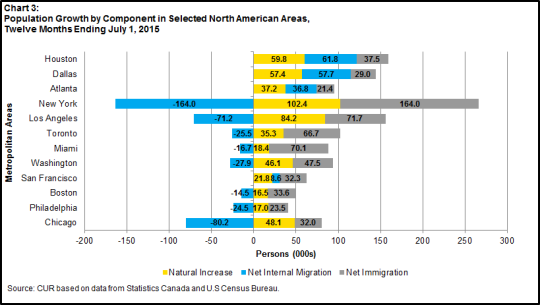
The Centre for Urban Research and Land Development at Ryerson University recently published the following chart on their blog:
It’s a look at population growth across a few North American cities, broken down according to natural increases, net internal migration from other parts of the respective country, and net immigration from outside of the respective country.
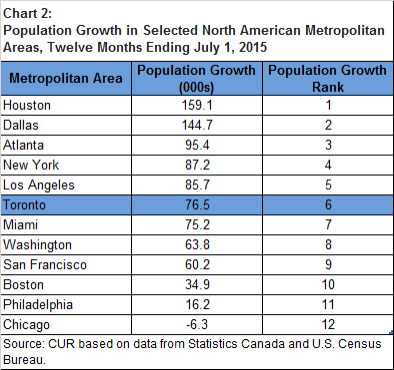
When you sum up the pluses and minuses shown above, you get to population growth numbers that look like this:
Houston, Dallas, and Atlanta are monsters in terms of population growth. They’re obviously smaller than New York and Los Angeles, and so on a percentage basis they are really adding a lot of people. Much of this has to do with the ease in which housing can be added in those cities and their relative affordability.
Toronto is competitive with New York and Los Angeles in terms of an absolute number, but again our base is smaller so on a percentage basis we are growing faster. The big story with Toronto is our dependence on immigration to grow.
The one city on this list that might surprise some of you is Chicago. Toronto and Chicago share many similarities and are often compared. But when you look at how the Chicago metropolitan area is shedding people, you see that, at least in this regard, it’s in structural decline.
The article starts by talking about how rising anti-Chinese sentiment in the late 19th and early 20th century eventually lead to the U.S. passing new immigration laws. These laws explicitly restricted Chinese laborers from moving to the U.S. and even made it difficult for legal residents to return after a visit home to China.
However, embedded in these laws was a small loophole:
But, as MIT legal historian Heather Lee tells it, there was an important exception to these laws: Some Chinese business owners in the U.S. could get special merchant visas that allowed them to travel to China, and bring back employees. Only a few types of businesses qualified for this status. In 1915, a federal court added restaurants to that list. Voila! A restaurant boom was born.
“The number of Chinese restaurants in the U.S. doubles from 1910 to 1920, and doubles again from 1920 to 1930,” says Lee, referring to research done by economist Susan Carter. In New York City alone, Lee found that the number of Chinese eateries quadrupled between 1910 and 1920.
This is fascinating on so many levels.
For one, it’s always interesting when small loopholes have unintended consequences. It is doubtful that anyone could have predicted a Chinese restaurant boom.
Secondly, despite the U.S. being a nation of immigrants, you see here a long history of trying to keep immigrants out. In the early 20th century, the fear was Chinese laborers who worked for low wages. Today, it’s Mexican laborers who work for low wages.
Finally, it’s amazing to look back at the foundation that these early Chinese entrepreneurs no doubt created. Today, Asian Americans are often considered a “model minority.” The Pew Research Center refers to them as “the highest-income, best-educated and fastest-growing racial group in the United States.”
When it comes to Ivy League admissions, they’ve even been called the “New Jews” – referring to the fact that many believe that top tier schools have systematically biased admissions against both Jews and Asians because of their tendency to overachieve relative to “white Americans.”
And to think that this may have all started, at least partly, with a Chinese restaurant boom.
UrbanToronto.ca recently published an extended interview / discussion with urbanist Richard Florida about cities and, in particular, the future of Toronto. What it’s doing wrong. What it’s doing right. And what it should be doing to properly position itself for the future.
What became clear to me after reading the interview is that Toronto is really at an inflection point. We are transitioning into a much bigger global city and we have yet to fully embrace the city that we are quickly becoming:
“…the city was—and is—still too dominated by a NIMBYist, faux-progressive left that refuses to engage with having to build a dense, transit-oriented, and inclusive city.”
The interview is packed with information and it’s definitely worth a read this morning. There’s a lot I agree with, including his views on transit and his positions on the Island Airport and the Gardiner East – which is a topic that is near and dear to me.
In case you don’t have time to read the full interview, below are 3 excerpts.
First, on the Gardiner East:
“There’s also a learning curve to Mayors, and I think they tend to get a better understanding of urbanism over the course of their tenures,” Florida adds, hoping that Tory, self-described as an “ideologue on very few issues,” will make pro-urban decisions as his time in office continues. “For one thing, I really hope that he reverses his decision on the Gardiner,” Florida continues, highlighting Tory’s controversial support for renovating—as opposed to demolishing—the eastern portion of the Gardiner Expressway as an example of especially poor urban policy.
Second, on the need for a true urban agenda at all levels of government:
Offering prescriptions for the future, Florida calls for a “virtual moratorium on road-building,” arguing that the perpetuation of an automobile culture hinders a city’s creative capacity, with little exchange of ideas and culture occurring when people are sitting in their cars, and not engaging with life on the street. “The city also needs a more committed Federal partner,” Florida adds, calling for a ’ministry of cities’ to help provide a vision for growth and fund urban infrastructure projects.
And third, on the value of Toronto’s openness:
“A huge reason for the city’s continued success—as we trudge along despite our lack of urban vision and reactionary tendencies—is the fact that we continued to be so open to newcomers, allowing a great deal of global creative energy to be harnessed. It means we can fuck up a lot, but as long as we continue to remain open, we’ll have an important edge.”
There’s a lot of great discussion fodder here. I would love to hear your thoughts in the comments below.
In his words, Toronto has become the success story that it is precisely because we are good at taking in lots of immigrants and making them economically productive.
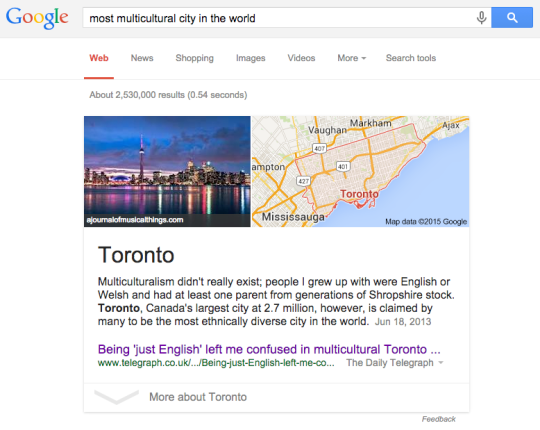
Sure, there are many things that we could be doing better, but you don’t get to be the most multicultural city on the planet without doing a lot of things right. More than half of this city is now foreign born. The term “visible minority” is quickly expiring.
And more than anything else, this accomplishment is arguably what has allowed us to become the global city that we are. Click here for a fascinating chart from the Toronto Star that allows you to see the number and source of immigrants that have come to this city over the last half century.
But of course, Toronto is not alone in this accomplishment.
Urban economist Edward Glaeser wrote a great essay back in 2005 called Urban Colossus: Why is New York America’s Largest City? It’s an incredibly interesting read for those of you interested in cities and so I definitely recommend it.
But the crux of his argument is that New York is the largest and most dominant city in America because of geography – specifically its deep harbor – and because of its success in manufacturing.
What this meant is that New York became the center of shipping in the country and the point of entry for the majority of immigrants coming into the United States. But since transportation costs were still relatively high at the time, most immigrants arrived in New York and stayed in New York.
Luckily, New York had a robust manufacturing economy – notably because of sugar refining, publishing and printing, and the garment industry. This allowed the waves of immigrants flooding into New York to become economically productive.
From 1850 to 1920, the population of the New York grew about 800% from roughly 700,000 people to over 5.6 million people.
So the moral of the story is simply that immigration has and will continue to play a pivotal role in the shaping of our cities. Canada has a sub-replacement fertility rate somewhere around 1.61 births per woman (2012). This is lower than that of United States, which is around 1.88 births per woman.
That means that without immigration, we do not grow. We shrink. And that’s usually not a great thing for economies.
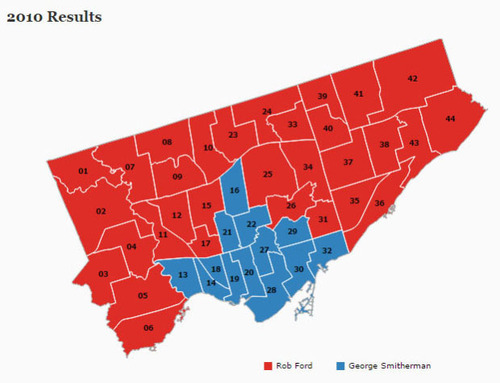
In 2010, Toronto voted for its new mayor, Rob Ford, like so:
It was basically the core of the city (old Toronto) versus all of the boroughs. And it was perfect ammunition for anyone who believed that Toronto’s amalgamation was a mistake. (I personally don’t think it was.)
Yesterday, Toronto did better.
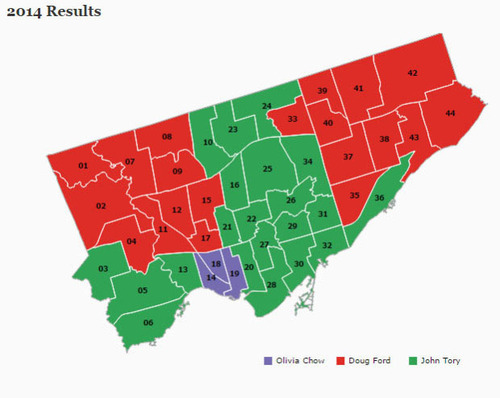
While we’re still a divided city — with Etobicoke and Scarborough largely remaining loyal to Ford Nation — we’re not quite as divided as we were 4 years ago:
However, there is one thing that Torontonians did largely agree on last night: the next mayor should be white and male. And this got the Guardian Cities out of the UK asking why one of the most multicultural cities on the planet (apparently we’re third behind Luxembourg City and Dubai), continues to elect middle-aged white guys.
Now, I’m not a fan of the article. And I take offence to the way Toronto is portrayed. But it did get me thinking. And I thought it would be interesting to see how some of Toronto’s demographic data overlays on top of these election maps.
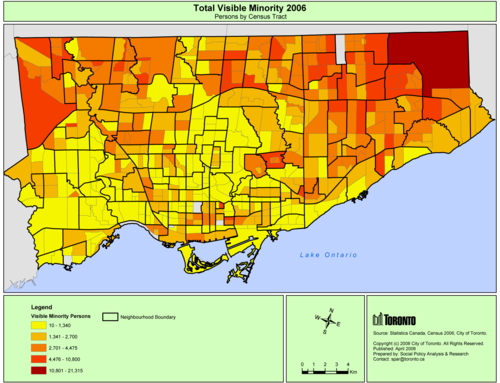
Looking at 2006 census data (2011 isn’t available in map form yet), here is a map showing the total number of visible minorities broken down by census tract. The darker the red the more visible minorities.
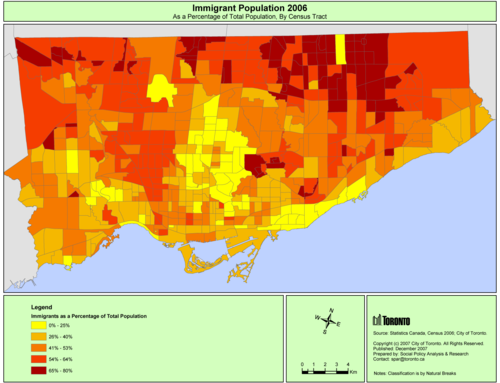
And here is a map showing immigrants as a percentage of the population. Again, the darker the red, the higher the percentage.
What should be apparent from these maps is that Ford Nation is actually, in some ways, immigrant and visible minority nation. In the above map, the darkest red areas indicate that immigrants represent anywhere from 65-80% of the population. That’s a significant number.
So why didn’t this group vote for the Hong Kong-born Olivia Chow? It’s because she wasn’t telling them the right story. Rob and Doug Ford, on the other hand, were.
After yesterday’s post about Toronto, I had a friend ask me on Facebook what it is exactly that I think happened to make this city so much cooler. Was it because of one iconic building like Toronto’s new City Hall? Was it because of our recent condo boom? Or was it something else? What changed exactly?
My response was that it’s a generational thing. Let me explain.
Toronto used to have the reputation of being a boring and staid city, and that’s because it was a boring and staid city. In the immediate post-war years, Toronto was overwhelmingly Protestant and the immigration policies at the time were specifically designed to exclude anyone who wasn’t white and from Western Europe or America. If you were Asian, Southern or Eastern Europe (especially Jewish), then you were at the bottom of the entry list.
Prime Minister Mackenzie King reflected the national mood when he observed that “the people of Canada do not wish to make a fundamental alteration in the character of their population through mass immigration.” Discrimination and ethnic selectivity in immigration would remain. “Canada is perfectly within her rights in selecting the persons whom we regard as desirable future citizens. It is not a ‘fundamental human right’ of any alien to enter Canada. It is a privilege. It is a matter of domestic policy.”
In the 1950s and 1960s, Canada started to slowly open up, but only because it needed to. It was in need of labour to fuel its robust post-war economy. Reluctantly, Canada began to look for workers in places like Italy. Initially, Canada had hoped to attract more northern and Germanic-like Italians, but with the European economy picking up, it was the southern Italians who came in the greatest number. In the 1950s, Canada’s Italian population jumped from around 150,000 to 450,000.
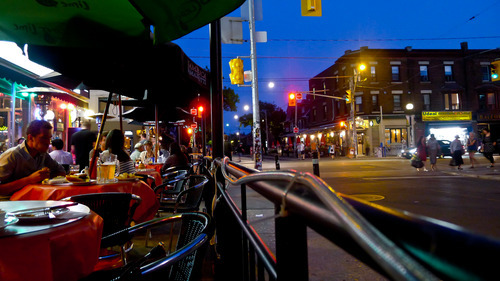
But this influx of espresso drinking Catholics was hard for Toronto to adapt to at first. They were so alien compared to Toronto’s population at the time. They wanted to do weird things like eat outside on patios, and that just wasn’t the way we did things here in Protestant and conservative Toronto. We ate inside. That’s where food belonged.
My best friend’s father – who’s also in the real estate development business – once told me that when he first moved to Toronto in the 1970s the real estate business was virtually run by two groups of people: Italians and Jews. In other words, the people building our city were the people that we were once afraid to let come here in the first place.
But in their quest for wealth and a better life (I have so much respect for people who are able to build something from nothing), these new Canadians also reshaped Toronto both physically (through building) and socially (by doing crazy things like eat outside on patios). They were not only building new lives for themselves, they were also rebuilding Toronto. They helped us grow up and not be so stuffy. And I absolutely believe that we’re a better city because of it.
However, I think the true impact of their efforts is happening right now through the next generation – their children. Millennials and Generation Xs (at least the younger ones) don’t remember when Italians were considered aliens. They remember growing up with martini bars on College Street (which is the original Little Italy for those of you unfamiliar with Toronto). They know a different and cooler version of this city.
But most importantly, those subsequent generations are now old enough (and have a lot more generational wealth behind them) to reshape this city even further. And with much deeper roots here, they have the passion to do just that. When I went to graduate school in the US, my parents were afraid I would never come back. That’s what they told me. But the more I traveled and the more I lived outside of Toronto, the more I wanted to come back.
Just like those early wave of pioneering aliens who got us to dine al fresco and taught us that if we shop on Sundays we’re not going to go straight to hell, I feel like I too want to shape this city. I want to make it even better. No city is perfect, but if there’s something you don’t like about Toronto, then here’s my advice to you: Go change it. I can tell you it’s possible, because new immigrants with no money managed to do it.
The first person who can tell me (in the comments below) which restaurant the patio shown above belongs to will get a free Architect This City t-shirt. If you’re from Toronto, this should be an easy one.
Right now, there are brilliant students from all over the world sitting in classrooms at our top universities. They’re earning degrees in the fields of the future, like engineering and computer science. But once they finish school, once they earn that diploma, there’s a good chance they’ll have to leave our country. Think about that.
Intel was started with the help of an immigrant who studied here and then stayed here. Instagram was started with the help of an immigrant who studied here and then stayed here. Right now in one of those classrooms, there’s a student wrestling with how to turn their big idea—their Intel or Instagram—into a big business. We’re giving them all the skills they need to figure that out, but then we’re going to turn around and tell them to start that business and create those jobs in China or India or Mexico or someplace else? That’s not how you grow new industries in America. That’s how you give new industries to our competitors. That’s why we need comprehensive immigration reform.