Daily insights for city builders, delivered every morning at 6 AM ET. I’m Brandon Donnelly — a Toronto-based real estate developer and founder of Globizen. I’ve been writing here since 2013.

Tag: housing

  • Japan’s solution to housing affordability

    image

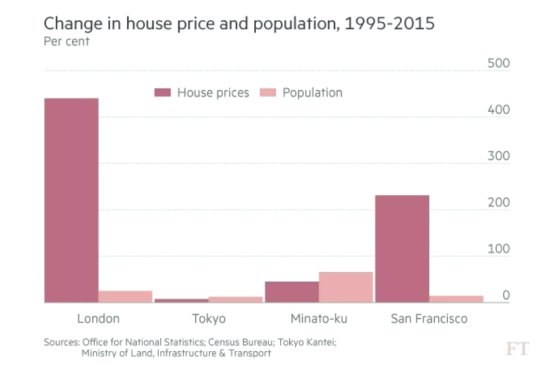
    There’s a debate among urbanists as to the full impact of housing supply on overall affordability. But it should make intuitive sense that as new people move to a city and as new jobs are created, there will be a need for additional housing. Here is an excerpt from Vox citing a recent FT article talking about how Japan may have figured out the solution to rising home prices:

    The reason, argues Financial Times writer Robin Harding, is that Tokyo does a better job of allowing housing supply to keep up with housing demand. In 2014, Tokyo issued permits for 142,417 new housing units. In contrast, the entire state of California — which has three times the population of Tokyo — issued permits for only 83,657 new housing units. Little wonder that demand for housing has outstripped supply in the Bay Area.

    In the United States, local housing markets are plagued by grassroots “Not In My Back Yard” (NIMBY) activists who organize to stop efforts to build town homes and apartment buildings in their local neighborhoods. Because every construction project is located near somebody, the result tends to be that little housing gets built anywhere.

    I don’t have a copy of the FT article and I do firmly believe that supply matters a great deal, but I think there are also a number of other factors that need to be taken into consideration here. Japan has a depopulation problem. The country has lost about 1.4 million people since 2010

    They also have fairly insular views around immigration. They are over 3.5x larger than Canada in terms of population and yet they take in fewer immigrants each year. So I think it’s worth looking at this conclusion closely. (This is me trying to avoid confirmation bias.)

    Image: Vox

  • Create things people love

    I just finished listening to this podcast about venture capital and consumer products. One of the underlying questions is whether we are currently in a “consumer downturn.” Rebecca Kaden of Union Square Ventures (USV) talks about the importance of “platform shifts” for venture returns. These are moments where a new technology hits the marketplace and there’s a corresponding mass consumer adoption. When and where will that next shift occur? Maybe it’ll be in real estate.

    I like the discussions at 10:00 and 13:50. The first deals with the importance of non-paid customer acquisition strategies for consumer products. Rather than relying on bought attention, you really need organic growth strategies, which is often an indication that people are passionate about your product. This is arguably more important when you’re fundamentally reliant on massive growth/scale, but whether we’re talking about software or a home, I still believe it’s paramount. Create things people love.

    The second point is about commerce, Amazon, and how USV avoids investing in companies that are unlikely to ever win against Bezos. Kaden’s position is that Amazon’s advantage is and has been more executional than structural. They are simply really good at doing things better. But Amazon wins at logistics, speed, and value. They are not as focused on experience, entertainment, and discovery. And people still want that.

    I’ll stop there. If you can’t see the podcast below, click here.

    [soundcloud url=”https://api.soundcloud.com/tracks/507691569″ params=”color=#ff5500&auto_play=false&hide_related=false&show_comments=true&show_user=true&show_reposts=false&show_teaser=true&visual=true” width=”100%” height=”300″ iframe=”true” /]

  • Reintroducing Junction House

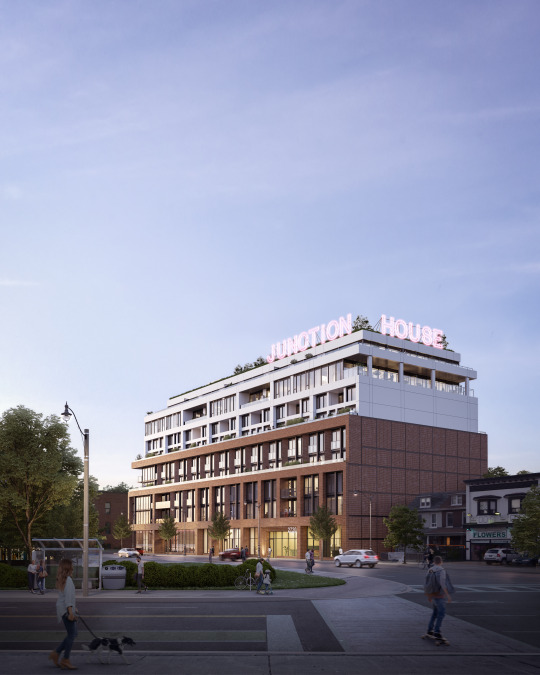
    Today we released the above rendering for Junction House and announced that sales will begin this fall.

    144 condominium homes. A mix of 1, 2 and 3 bedroom suites, including our Two-Storey House Collection and our Laneway House Collection. Prices starting in the $400s.

    One of our partners also happened to serendipitously send me this Globe & Mail article today talking about the increasing demand for and shortage of mid-rise housing:

    “The market is substantially undersupplied in mid-rise,” said Mr. Hildebrand, who notes that mid-rise projects in the GTA [Greater Toronto Area] were just 31 of 2017’s new launches, accounting for 3,833 units (12 per cent of the total).

    Stephen Price, CEO of Graywood Developments, went on to say this in the article:

    “There’s a huge appetite for medium density in Toronto. Many don’t want to live in the downtown core, this buyer is more interested in being in a community and there is a greater propensity to buy larger more livable units.”

    Given the huge influx of inquiries we received today after the above announcement was made, I would say that feels right. And our focus at Junction House is very much on “larger and more livable.”

    If you’re at all interested in a new home at Junction House, I would encourage you to get on our priority list, here.

  • Unpacking the family condo

    John Lorinc has a piece in the Autumn 2018 issue of University of Toronto Magazine that is worth a read. It covers families in Toronto being priced out of the low-rise housing market and/or making the conscious decision to live in an apartment or condo.

    He raises an important question:

    The big question hovering over this generational transition is all about city-building, and whether increasingly dense metropolitan regions such as Toronto and Vancouver can figure out how to turn all those newly sprouted forests of highrises into true communities that are both affordable and appealing to the wide range of people who call these cities home.

    The reality seems to be that more people in this city – out of economic necessity and/or because of a lifestyle preference – are choosing to raise a family in multi-dwelling housing. I live in a condo and my neighbors are raising a child two doors down from me.

    I am sure that we will continue to see more of this and I am sure that we will get better at designing for families. We are trying to do our part with the 2-storey homes that we have incorporated into our Junction House project. 

    I would, however, like to respond to the underlying tone in the article that but for developers being stubbornly resistant to larger 3-bedroom apartments in this city, we would have a myriad of new condominiums filled with families.

    The reality is that there are market and structural forces (including cultural biases) that steer what gets built.

    There are affordability considerations. Larger condos cost more money than smaller condos. And that prices out many families, particularly if there are cheaper alternatives available in the form of low-rise housing. 

    The reason we appear to be at an inflection point today is because the cheaper alternatives are disappearing. (This of course returns us to the broader question of overall housing affordability.)

    There are also timing and financing considerations that likely create a supply-side bias. Most lenders require that a certain number of condo units be pre-sold before construction starts. 

    This means that, as a developer, you need people that can both afford what you’re selling and that are willing to buy three to five years out, and perhaps even longer. That can be difficult for many families.

    Lastly for this post, there’s the GST/HST New Housing Rebate in Ontario, which I have argued before on the blog could be incentivizing smaller suite sizes and could use a refresh for today’s home prices.

    All of this is not to say that we shouldn’t be designing for urban families and that we shouldn’t be focused on delivering more affordable housing to this and other cities. Those are two very important things.

    It is simply to say: there’s a lot going on here that needs to be unpacked. 

  • Housing supply and displacement in San Francisco

    Joe Cortright recently wrote about a study by Kate Pennington (UC Berkeley), which looked at the impact of housing production on legal eviction in San Francisco. The goal was to figure out if new housing supply actually causes displacement.

    To do this, Pennington went block-by-block and looked at new housing projects, as well as over a decades’ worth of eviction notices. 

    The relationship between the two was found to be “statistically indistinguishable from zero.” In other words, the “monthly probability of an eviction notice” does not change when new housing supply is completed nearby.

    Some have been critical of her findings and some have questioned whether legal eviction notices are, in fact, the right proxy for displacement.

    But I agree with Joe Cortright in that this still feels like a meaningful relationship to understand, especially when we’re talking about a tight housing market like San Francisco’s.

    Photo by Matthew Cabret on Unsplash

  • Unzipped wall on King Street West

    image

    Last night I checked out the Unzipped Toronto exhibition, which is the relocated Serpentine Pavilion (pictured above) that was designed by Bjarke Ingels Group in 2016. 

    It was initially housed in Hyde Park London, but it’s now on King Street West Toronto. Westbank purchased the “unzipped wall” after it was installed in London and supposedly it will eventually find a permanent home in Vancouver.

    The official opening of Unzipped Toronto is September 15th, 2018. It will be free and open to the public. If you’d like to get a complimentary ticket, you can do that here

    The timing of all this lines up with condo sales for Bjarke Ingels’ first project in Toronto. I believe that will be starting this fall. And I am sure they will end up setting some new records for the King West submarket.

  • How Singapore fixed its housing problem

    There are a number of affordable housing plans being thrown around in Toronto right now given that we have a municipal election coming up this fall. 

    From what I have read, the plans are largely centered around surplus and/or available public land and possibly some subsidies. 

    These subsidies are very important because the money has to come from somewhere. This is often overlooked.

    In light of these debates, I thought I would share a short Bloomberg video that my friend Evgeny shared with me this morning all the way from Tokyo.

    The video is about how Singapore fixed its housing problem. If you can’t see it embedded below, click here.

    [youtube https://www.youtube.com/watch?v=2cjPgNBNeLU?rel=0&w=560&h=315]

    It strikes me as being very Singaporean.

  • The real reason people oppose new development

    image

    A good friend of mine just sent me this fascinating research paper called: Opposition to Development or Opposition to Developers? Survey Evidence from Los Angeles County on Attitudes towards New Housing. It is a study out of UCLA that was published earlier this year by Paavo Monkkonen and Michael Manville.

    For the paper, they conducted a survey-framing experiment with over 1,300 people in Los Angeles County to test how strongly they felt about a number of common anti-housing sentiments; arguments such as traffic congestion, neighborhood character, and strain on local services. 

    However, they also introduced another argument: large developer profits. And interestingly enough, they discovered that respondents were 20 percentage points more likely to oppose a new hypothetical housing development when the survey was framed around the developer making a lot of money.

    Here is a table from the paper showing the various frames, as well as the percentage of people who supported, had no opinion, and who opposed. Note that under the “developer” frame, the opposition number is 48%.

    image

    So their “takeaway for practice” is as follows: “Housing opposition is often framed as a form of risk aversion. Our findings, however, suggest that at least some opposition to housing might be motivated not by residents’ fears of their own losses, but resentment of others’ gains.”

    Photo by Cameron Stow on Unsplash

  • Supreme Court dismisses TREB appeal

    Last Thursday the Supreme Court of Canada announced it would not hear an appeal from the Toronto Real Estate Board regarding a 2016 Competition Bureau decision aimed at giving consumers greater online access to information, such as historical (home) sale prices.

    I am not at all surprised by the Supreme Court’s decision and I have said pretty much all I want to say on this topic – over here. But since I believe this is a positive outcome for real estate consumers, I wanted to mention it on the blog because it appears to be a final decision.

    Some sites, such as Zoocasa, have already started publishing sold prices. Good.

  • Photogenic neon in the Junction

    We just finished putting up some additional signage at the future sales office for Junction House. Clean and minimal, but fun. I am pretty pumped with the way everything turned out. Creative and photos by Vanderbrand. Instagram story mashup and failed neon photo by me.

    This week I learned that properly photographing neon takes a bit of work. The neon “Junction House” sign is actually all white when you see it in person. Apparently it has something to do with the frequency. 

    I’m going to go back one evening with my tripod and Fuji and see if I can do better.