Daily insights for city builders, delivered every morning at 6 AM ET. I’m Brandon Donnelly — a Toronto-based real estate developer and founder of Globizen. I’ve been writing here since 2013.

Tag: housing supply

  • New rental supply needs to double in Toronto

    This week, RBC Economics published a study on Canada’s rental market where they argued that the pace of new supply needs to at least double in markets like Toronto in order to meet future housing demand and balance the market. Similar things, I’m sure, could be said about many other housing markets around the world.

    The report pegs the current rental housing deficit in Toronto at about 9,100 units:

    And because they believe that the cost of ownership is pushing more people into rentals, the number of renter households is expected to grow at an average rate of 22,200 units per year in Toronto.

    If you take 22,200 units per year over the next two years, and add in the current deficit of 9,100 rental units, you get to a total count of 53,500 rental units. This is what RBC Economics believes must be delivered to the market in order to restore equilibrium, and decrease the upward pressure on rents.

    Rental units are, of course, delivered to the market in two main ways. There’s purpose-built rentals and there are for-sale units that end up as rental housing. But even if you amalgamate both of these tenures, we are not building enough housing.

    Against this backdrop, I find it curious that developers are so often vilified. Earlier this week, I saw Jennifer Keesmaat tweet out that — as we ready for this fall’s federal election — any sensible housing plan must move away from our current for profit housing delivery model.

    Who, then, will build these 53,500 rental units? That part wasn’t clear to me.

  • Google announces $1 billion investment in housing

    This week, Google announced a $1 billion investment in housing across the San Francisco Bay Area. Here is the blog post announcement by CEO, Sundar Pichai. And here are a couple of paragraphs from the post explaining how this is expected to work:

    First, over the next 10 years, we’ll repurpose at least $750 million of Google’s land, most of which is currently zoned for office or commercial space, as residential housing. This will enable us to support the development of at least 15,000 new homes at all income levels in the Bay Area, including housing options for middle and low-income families. (By way of comparison, 3,000 total homes were built in the South Bay in 2018). We hope this plays a role in addressing the chronic shortage of affordable housing options for long-time middle and low income residents.

    Second, we’ll establish a $250 million investment fund so that we can provide incentives to enable developers to build at least 5,000 affordable housing units across the market.

    In addition to the increased supply of affordable housing these investments will help create, we will give $50 million in grants through Google.org to nonprofits focused on the issues of homelessness and displacement. This builds on the $18 million in grants we’ve given to help address homelessness over the last five years, including $3 million we gave to the newly opened SF Navigation Center and $1.5 million to affordable housing for low income veterans and households in Mountain View.

    Google is not alone in its efforts to improve housing supply in the Bay Area but, according to CityLab, this is “the single largest commitment by a private employer.”

    There’s a lot of debate about the value of housing supply, alone. But in 2017, the Bay Area added 3.5x as many jobs as it did housing. I think most people would agree that’s a suboptimal, and potentially unsustainable, mismatch.

    Also, if large companies such as Google and Microsoft are making these sorts of investments, it is likely that they’re worried about housing unaffordability impacting their ability to attract and retain top talent going forward.

    Perhaps this is a signal for just how unsustainable this mismatch has gotten.

  • These 3 things happened after Portland enacted inclusionary zoning

    On February 1, 2017, an inclusionary zoning ordinance came into effect in Portland, mandating that all new residential projects with 20 or more units dedicate a portion of the building to affordable housing.

    For the first year, the requirement was 8% of all units for households earning 60% of the Area Median Income or 16% of all units for households earning 80% of the AMI. I’m not sure if it was or is possible to do a blend of the two income levels.

    After the first year, the requirement was supposed to step up to 10% and 20% of all units, respectively. But that step up was never enacted, which had many industry analysts arguing that it was a clear signal the ordinance was not performing as intended.

    According to Joe Cortright of City Observatory (which is based in Portland), the new ordinance largely resulted in 3 things happening:

    (1) Developers rushed to get new applications in during the transition period so that they would not be subjected to the new IZ rules; (2) applications increased for projects with less than 20 units (avoid the rules by building smaller); and (3), following the initial transition surge, building permit applications, as a whole, dropped off.

    This last point is what usually comes up in debates around inclusionary zoning. Does the requirement to build affordable housing actually reduce overall housing supply?

    I’ve written about this before, but the math is pretty simple. Inclusionary zoning policies are a drag on revenue and a direct cost to the project. What that means is that something else will need to give in order for the numbers to balance.

    That could come in the form of lower costs (such as an impact fee abatement) or in higher rents on the balance of the units. But this latter approach is easier said than done. Sometimes you need to wait for the market to “catch up”, which could be what some developers in Portland are doing.

    They’re waiting for housing to get more expensive — overall — so they can then offset the pro forma drag from the affordable units.

  • How Japan increased its housing supply

    River Davis’ recent article in the Wall Street Journal about Tokyo’s generally flat home prices had me, again, wondering about demographics. I mean, aren’t their demographics working in reverse? They have an aging population, low immigration, and a low birthrate. But Tokyo, which represents about 11% of Japan’s total population, is still growing. And their home price index looks like this compared to San Francisco and New York:

    Davis’ argument, which of course has been made by others before, is that deregulation has allowed housing supply to actually keep up with demand. Land use policies were relaxed to allow taller and denser buildings to be built and some degree of decision making (I’m not sure how much) was moved to the central government in order to counteract the NIMBY problem that invariably attaches itself to local politics.

    The result is housing numbers that look and compare like this:

    In Tokyo last year, housing starts came in around 145,000, according to Japan’s land ministry. This figure is on par with the total number of new housing units authorized last year in New York, Los Angeles, Boston and Houston combined, based on the U.S. Census Bureau data. The same feat was achieved in 2017.

    If we are to normalize against New York, it looks like this:

    And the belief seems to be that it is working:

    “A reason why housing prices in Japan are not rising as fast as in New York, for example, is the large number of housing starts,” says Masahiro Kobayashi, a director general at the Japan Housing Finance Agency, a state-run entity which supports the housing market by purchasing home loans.

    One sentence that really stood out for me in the article is this one here: “Private consultants were given permission to issue building permits to speed up construction.” If any of you have tried to pull a building permit for a large project in Toronto, you’ll know that it can take a very long time (understatement). Maybe it is the same in your city. Should we be looking at this?

    Charts: WSJ

  • Implications of new housing supply

    There’s a lot of debate within urbanist circles about whether or not supply alone can solve or at least mitigate housing affordability concerns. Richard Florida and others will say that, while beneficial, increasing supply isn’t the be all end all. We need to be building affordable housing.

    Edward Glaeser, Joseph Gyourko, and others have, on the other hand, argued that middle-income housing is a supply problem and that low-income housing is quite simply a demand-side problem, which could be solved through things like a housing voucher program.

    In other words, the cost of housing isn’t necessarily the problem, it’s the low income levels. One of the benefits of supplementing people’s incomes is that it empowers mobility. People can then move to where there are jobs, as opposed to being tied to a specific neighborhood or city.

    But this debate is arguably just about the extent of the supply benefits. Intuitively, it makes sense to try and match new housing supply with demand and economic growth. But how far can that take us, particularly in high demand and high productivity cities?

    Glaeser (Harvard) and Gyourko (Penn) have a relatively recent paper out called, The Economic Implications of Housing Supply, which looks at, among other things, the “implicit tax” imposed on development as a result of land use restrictions and other supply constraints.

    Here are two excerpts:

    We will argue that the rise in housing wealth is concentrated in the major coastal markets that have high prices relative to minimum production costs, and it is concentrated among the richest members of the older cohorts—that is, on those who already owned homes several decades ago, before binding constraints on new housing construction were imposed.

    But in a democratic system where the rules for building and land use are largely determined by existing homeowners, development projects face a considerable disadvantage, especially since many of the potential beneficiaries of a new project do not have a place to live in the jurisdiction when possibilities for reducing regulation and expanding the supply of housing are debated.

    If you’re interested in this topic (and sufficiently nerdy), you can download a PDF copy of the paper here.

    Photo by chuttersnap on Unsplash

  • Toronto to market 11 city-owned sites for new affordable rental housing

    At the end of last month, Toronto City Council adopted the “Housing Now” action plan. The first phase of the plan involves the public marketing of 11 city-owned sites for the purpose of finding non-profit and private sector partners to help redevelop the lands with new mixed-income housing. It is expected that these lands could accommodate about 10,000 homes.

    Here is the list of sites:

    As part of the offering, around 2/3 of the built units will need to be rental (the above chart shows more), and of these rental units, 50% will need to be affordable with rents set to 80% of Toronto’s average market rents. All of this should translate into approximately 3,700 new affordable homes. (Mayor Tory’s plan is to build 40,000 affordable rental homes by 2030.)

    The City wants to ultimately retain ownership of these lands, and so the sites will be offered up through long-term land leases. It looks like they’ll be for 99 years. The City will also be forgiving a number of fees and levies for the 3,700 affordable homes. They are pegging the PV (present value) of these development incentives at just over $280 million:

    Making use of surplus public land to increase the supply of affordable housing certainly makes a lot of sense. But there’s a cost burden associated with these affordable units, which is why discussions around inclusionary zoning often come back to offsetting measures. Who is going to pay for these subsidies?

    The above “financial incentives” — which in this case are simply foregone revenue — speak to this cost burden.

    Tables: City of Toronto

  • Toronto condo market outlook

    BNN Bloomberg just published this article on the Toronto condo market. It is based on a roundtable discussion that was held at their Toronto office last week with Jim Ritchie of Tridel, Jared Menkes of Menkes Developments, Shamez Virani of CentreCourt, and Jane Renwick of Diamond Kilmer Developments.

    The overarching theme is that, after a couple of frenetic record setting years, the market should settle down in 2019, which is likely a good thing. Hopefully that will also temper construction cost inflation. We have been seeing double digit increases over the last few years (hence some of the cancelled projects).

    But as Jared points out, the fundamentals here are still strong and there are a number of supply constraints creating upward pressure on pricing:

    Jared Menkes, executive vice president of high-rise residential at Menkes Developments was unwavering for the future. “There’s a lot of red tape that’s slowing down bringing more product to market,” Menkes said. “I promise you, pricing is going up.”

    For the rest of the article, click here.

  • Housing supply is like food supply

    A few months ago I wrote about an upcoming book by Alain Bertaud
    called, Order
    without Design: How Markets Shape Cities.
    Well the book has just come out
    and CityLab just did an interview with him. 

    Bertaud has worked all around the world from Yemen to China and his experiences, particularly in places that were transitioning to market economies, lend an interesting perspective.

    I like this bit on designing in China:

    I quickly realized that if you do not have prices to guide you, you end up relying on arbitrary norms. For example, in China, the central government decided that every home must have one full hour of sunshine each day. So you would plug in the height, latitude, and angle of the sun at winter solstice for your site, and that would formulaically spit out the permitted density of housing.

    And I like the comparison he makes between food and housing supply:

    I compare it to food: You can’t solve a famine by simply mandating that everyone eat 2,000 calories a day. That’s absurd. You have to bring in more food. In the same way, cities like San Francisco have to increase the supply of floor area, and let consumers determine the size of units.

    So I just ordered a copy of his book

    For the rest of his interview with CityLab, click here.

  • How London became the center of the world

    Some of you may want to debate the “center of the world” title (New York may be more deserving), but Laura Parker of National Geographic recently published a great essay describing the tremendous growth that London has seen over the last 30 years thanks to in part the deregulation of the financial services industry. Here is an excerpt:

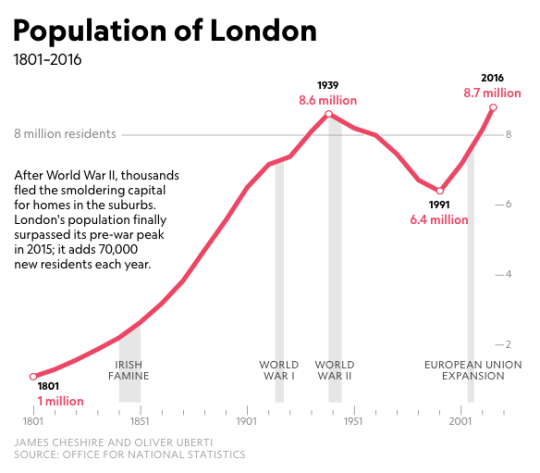
    As the manufacturing industry splintered, the docks of what was once the world’s largest port fell victim to shipping modernization and closed. The death in 1965 of Winston Churchill, the great prime minister, marked “the last time that London would be the capital of the world,” the Observer noted. Population continued a downward slide, bottoming out at 6.7 million in 1988. By then London’s fortunes had changed with deregulation of the financial services industry, known as the Big Bang, along with the shift to electronic trading, which enabled London to rival Tokyo and New York. A new financial district rose on the ruins of the West India Docks on the Isle of Dogs, a marshy nub that juts into the Thames. Canary Wharf, as the district is called, became London’s first modern large-scale regeneration project.

    According to National Geographic, London’s population grew by about 1.2 million between 2006 and 2016. That’s a pretty incredible number and is why the city estimates that they need about 66,000 new housing units a year just to keep up the growth. Like many supply constrained big cities, they’re not meeting that target.

    For the full essay, click here. It comes packaged with some incredible photographs by Luca Locatelli.

  • Increasing housing supply in Ontario

    The Government of Ontario is currently working on a Housing Supply Action Plan that they hope will address “the barriers getting in the way of new ownership and rental housing.”

    Through initial consultations, they have already identified 5 key themes (my words below):

    1. The approvals/entitlement process for new housing is too slow
    2. There are too many restrictions on what is allowed to be built (that is, we should be encouraging more “gentle density” and “missing middle” type infill)
    3. Development costs are too high
    4. Tenants need protection; regulation is making it increasingly difficult to be a small landlord
    5. Overall housing innovation

    The province is also looking for public input and is currently running this online survey. It is open until January 25, 2019. And I would encourage all of you to complete it and help shape the action plan.

    My understanding is that the plan should be ready by Q2-2019.