Daily insights for city builders, delivered every morning at 6 AM ET. I’m Brandon Donnelly — a Toronto-based real estate developer and founder of Globizen. I’ve been writing here since 2013.

Tag: housing development

  • Less new housing — for now

    Approving new housing is one thing. And it is an important one thing. But you also need to sell/lease and finance the project. And that is a lot more challenging in today’s environment compared to a few years ago. I think a lot of people look at our cities, see a shortage of housing, and wonder why developers don’t just build more of it. But it’s not that simple:

    “Our industry is now taking a second look at our [calculations] and saying it’s costing more to build, it’s costing more to lend,” he said. “And there is a threshold in regards to what a purchase price or sale price can be. So there’s a bit of a pause in the market right now in regards to starting construction.”

    Throughout this last development cycle and, in particular, during the pandemic, development costs increased dramatically. But the revenue side was also increasing — meaning you could sell and/or lease space for more. That kept development going. You could still successfully underwrite new projects.

    But now the cost of debt has increased and the revenue side has expectedly slowed both in terms of pricing and velocity. This dramatically changes the feasibility of new projects, which means the market is going to need time to adjust to this new environment. This, of course, will happen. But in the interim (i.e. right now), it is going to mean a lot less new housing.

    This should not come as a surprise.

  • Introducing CORKTOWN

    Today, Slate Asset Management announced its latest condominium project: Corktown. Named after its neighborhood, Corktown is located in downtown Hamilton just south of the GO Centre station.

    If you’re a longtime reader of this blog, you might remember that I first wrote about this site a few years ago when we were just starting community engagement.

    Since then, the design has evolved to include a tower on the southeast corner of the block (pictured above) and a mid-rise building along John Street South. This site is also now fully zoned.

    So it’s go time. Phase one, called Corktown East, will launch this summer and condo pre-registration is live as of today. To register, head over here.

  • No-cost affordable housing in Toronto

    It upsets me when I read things like this (click here if you can’t see the embedded tweet above). I think it creates a false sense of a free lunch and ignores all of the nuances and complexities associated with inclusionary zoning.

    IZ is an obligation to provide a certain number of affordable units in new housing developments. There’s a lot of detail and debate around where this should apply, how much needs to be provided, and at what degree of affordability.

    But at the end of the day, it’s important to keep in mind that at meaningful levels of affordability, these IZ homes are going to be built at steep losses. More info on the economic impacts of IZ can be found here.

    The simple math is that the costs to build these homes are going to be greater than the revenues that they bring in. Which is why developers aren’t out building affordable housing everywhere. There’s no margin.

    In order to build, somebody or something needs to provide a subsidy so that this revenue-expense shortfall can be made up. How this works its way through the market is where I have tried to focus the discussion when writing about IZ. There are complexities. Some lessons from Portland, here.

    But to just assume that these costs will get magically absorbed by housing developers, with no other knock-on effects or distortions to the market, is incorrect.

  • Azaleas — L-shaped infill housing

    This is an interesting infill housing project in Villa Allende, Argentina. Designed by Studio LZ, the community contains seven homes, built across a 600 square meter site. Each L-shaped home is 63 square meters and hugs a private courtyard space (many of which have an outdoor BBQ). On the main floor of each home are the kitchen and living areas. And on the second floor are two bedrooms, as well as a second bathroom.

    It’s a simple but clever design. Looking at a plan of the project, you can see that, despite its compactness, the L-shaped houses have been arranged in such a way that there are no direct facing conditions. The courtyards and window exposures alternate. It’s almost as if they are Tetris pieces that have been pulled apart. The result is a dense community that still manages to offer some of the benefits of low-rise housing.

    Photos by Gonzalo Viramonte

  • Flats for land

    In Athens, I have a learned, there is something known as antiparochi. The practice took hold in the middle of the 20th century at a time when Athens was in desperate need of new housing. Supposedly during the 1950s, an estimated 560,000 people came to Athens from the countryside in search of opportunity — effectively doubling the population of the city. That was a bit of a problem for a city with no money to build new housing. So something needed to be done. The solution was a ground-up arrangement (i.e. it wasn’t a government initiative) that allowed developers and contractors to increase the supply of new housing without having to ever pay for land. And given the time period in which this took hold, it also spurred quite the modernist building boom, leaving an architectural legacy that to this day continues to define Athens.

    Here’s an explanation of how antiparochi works (taken from this BBC article by Alex Sakalis):

    Here’s how it worked: a contractor would approach the owner of a house and offer him a deal. He would knock down his house, and build a block of flats in its place. In return, the homeowner would be given a certain number of flats (usually two or three), while the contractor would then make his money by selling the remaining flats to Greeks who were seeking accommodation. Generally, no money was exchanged and no contracts were signed.

    What’s so incredible about antiparochi is that it emerged spontaneously out of the housing crisis in Athens. “There was no specific law which told people ‘OK now you have the right to collaborate and build whatever you like’. It was the people themselves that found out this possibility,” says Panos Dragonas, professor of Architecture at the University of Patras.

    Even more incredibly, the state completely accepted what its citizens had started doing, introducing only a few minor regulations, such as a maximum height for the apartment buildings – known as polykatoikies in Greek – and a ban on building over archaeological sites or on top of Athens’ seven historical hills. There were no property taxes – the state never made any direct income from antiparochi.

    The elegance of antiparochi was that it appeared to solve all of Greece’s problems at once. It provided homeowners and home seekers with modern apartments, while creating enough profit for the contractors to continue investing in construction without state subsidies or bank loans.

    Photo by Anastase Maragos on Unsplash

  • A question of land value

    Let’s say that we have a piece of development land worth $100. That is the market value of the land based on its highest and best use at this particular point in time. Now let’s assume that the land was just encumbered with a new burden: inclusionary zoning. All of a sudden there is now a requirement to make available X% of any residential units built at 50% of average market rents for the area.

    Technically, the land is now worth less than $100. And there is a school of thought out there that, in instances like this one, the price of all land should automatically reset downward to offset and account for the inclusionary zoning burden. But as I have argued before on the blog, land prices tend to be fairly sticky, unless the owner is distressed and really needs to sell.

    So what can often happen is that the land owner will stubbornly cling to the original $100 number. The thinking being, “I was once told that my land is worth $100 and so that’s the minimum price I’m willing to accept.” In this scenario, you may need a broad increase in rents in order for a transaction to occur. This way the market rate units might be able to fully subsidize these new affordable units, preserving any margins and justifying the original $100 number.

    Of course, the impact of inclusionary zoning is a hotly debated topic and there are a number of variables to consider. And so I will leave it at that for today. The real purpose of this post is to consider another permutation. Let’s once again say that we have a piece of development land worth $100. But instead of being owned by 13 siblings — and 3 cousins that live abroad and can’t be reached other than by fax — it’s owned by the government.

    In this case, the government wants to sell the land and is considering two options. It can either (1) sell it for $100 and maximize immediate taxpayer revenue or (2) it can sell it for $80 with the condition that the buyer agree to deliver X% of affordable units (and a bunch of other goodies and positive externalities). I would also add that this fictitious town is experiencing what some might call a housing crisis.

    If you were a private sector actor, you would probably choose option 1. You would take the additional $20 and retire to Florida (I’m off by a few zeros). But this is the government we’re talking about and presumably the government is thinking about the broader public good. Which option do you think is better at maximizing that?

  • The real reason people oppose new development

    image

    A good friend of mine just sent me this fascinating research paper called: Opposition to Development or Opposition to Developers? Survey Evidence from Los Angeles County on Attitudes towards New Housing. It is a study out of UCLA that was published earlier this year by Paavo Monkkonen and Michael Manville.

    For the paper, they conducted a survey-framing experiment with over 1,300 people in Los Angeles County to test how strongly they felt about a number of common anti-housing sentiments; arguments such as traffic congestion, neighborhood character, and strain on local services. 

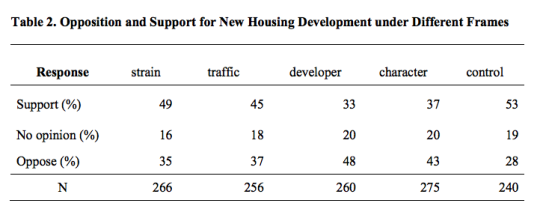
    However, they also introduced another argument: large developer profits. And interestingly enough, they discovered that respondents were 20 percentage points more likely to oppose a new hypothetical housing development when the survey was framed around the developer making a lot of money.

    Here is a table from the paper showing the various frames, as well as the percentage of people who supported, had no opinion, and who opposed. Note that under the “developer” frame, the opposition number is 48%.

    image

    So their “takeaway for practice” is as follows: “Housing opposition is often framed as a form of risk aversion. Our findings, however, suggest that at least some opposition to housing might be motivated not by residents’ fears of their own losses, but resentment of others’ gains.”

    Photo by Cameron Stow on Unsplash

  • The future of housing in Toronto

    On Monday evening I gave a 45 minute talk at the Rotman School to a delegation of about 70 people from Portland. The talk was about Toronto housing, but more specifically about the history and possible future of high-rise housing in this city. 

    Thanks to everyone who commented on my lead-up post over the weekend. It was really helpful to hear what other people in this city (as well as people not from this city) are thinking. Many of the comments also echoed my own beliefs.

    The narrative I told in my presentation was about two significant, yet very different, periods of time when Toronto built more high-rise than low-rise housing. The first was our post-war suburban slab tower boom. And the second, which we are currently living through, is really the outcome of the Places to Grow Act (2005).

    But as I mentioned over the weekend, the really interesting question is: what’s next?

    In my view, what we are seeing today is fundamentally different than what we saw in the post-war years. Despite the fact that we were building towers then and we are also building towers now (albeit much taller ones), the ideology behind them has changed. It has gone from suburban to urban.

    Toronto’s post-war towers were built upon a particular dream. The dream of getting in your car, escaping the decay of the city, whisking up the Don Valley Parkway (nobody whisks on the DVP), and being rejuvenated by all the light, air, and green space afforded to you in your Ville Radieuse.

    But it turns out that people of means didn’t want that back then. They wanted a suburban house. That was the dream.

    Today, however, cities are back in vogue

    Companies are moving into city centers to compete for the best talent. Retailers are moving downtown to capture disposable income. And the most pressing problems are no longer about decay and urban blight, they are about housing affordability, gentrification, and too many rich people pushing out the poor.

    The narrative has changed.

    So in the context of Toronto, I feel as if we are at an inflection point when it comes to housing. The multi-family dream may not have stuck decades ago, but I believe it will stick for many, though not all, today. And this will happen for a variety of reasons ranging from sheer preference to sheer necessity. The alternative is no longer an affordable bungalow on a 50′ x 150′ lot that happens to be 10 minutes from the subway.

    But as a result of this shift, I also think a number of other things will happen. 

    Eventually, Toronto will look to loosen some of the land use restrictions on its single family neighborhoods. This could mean “gentle” low-rise intensification (new planning buzzword, take note), as well as the acceptance of laneway or accessory dwelling housing. This won’t be popular, as one person said in the comments over the weekend, but eventually the pressures will become too great.

    At the same time, I think we’ll be brought full circle with respect to our suburban towers. The suburban ideals in place at the time means that many of these tower communities have relatively low densities. That represents a tremendous opportunity for this city and it’s only a matter of time before we truly figure out how to unlock them.

    But for all the change and disruption that’s happening in Toronto, I think it’s also worth saying that those of us who live here should consider ourselves a lucky bunch.

    One of the things I actually asked the delegation from Portland was, what struck you the most when you arrived in Toronto? The response I got was: its vibrancy. 

    Everywhere you walk downtown, they said, people are on the streets – walking, cycling, and hanging out. In fact, some said it’s almost hard to remember which street is which because every street seems to be so full of activity. Most North American cities do not have this kind of sustained vibrancy in the core, I was told. And so that makes us a pretty special place. We must be doing something right.

    It’s easy to take those sorts of things for granted when you live somewhere. So today I’m trying to do the exact opposite of that. I’m trying to stop and appreciate the place I call home.