Daily insights for city builders, delivered every morning at 6 AM ET. I’m Brandon Donnelly — a Toronto-based real estate developer and founder of Globizen. I’ve been writing here since 2013.
Traffic congestion and a lack of affordable housing are two clearly defined problems facing most, if not all, major cities. We know they exist. We call them crises. And yet, we can’t seem to implement effective solutions, even though we know what they are. Why is that? In her new book, On The Housing Crisis: Land, Development, Democracy, Jerusalem Demsas makes the argument that it is a failure of local democracy. There is a disconnect between what we say we want to happen and what we are actually doing. This resonates with me. In my mind, it’s looking upstream at what is bottlenecking us from making the decisions that will produce better outcomes for our cities. So after reading this conversation with her about the new book, I decided to buy a copy.
Here’s an interesting, though not shocking, chart from a recent Globe and Mail article talking about “Canada’s dysfunctional housing market.” What is noteworthy is that Toronto is dead last when it comes to the number of new 3+ bedroom homes built between 2016 and 2011.
Peterborough, for example, is a census metropolitan area with somewhere around 130,000 people. And yet, based on this data, it is building more family-sized homes than Toronto.
Why this is not surprising is that the vast majority of new homes now built in Toronto are high-density and built out of reinforced concrete. This means that they are relatively expensive on a per square foot basis.
In fact, you could argue that mid-rise housing — the exact high-density type that is supposed to be most attractive to families — is the most expensive to build. What this means is that if you’re building a 3+ bedroom home in this way, it’s not going to be affordable to most.
It also means that people are going to go shopping elsewhere: Ottawa, York, Simcoe, Durham, and so on. The expected market outcome is decentralization. But in my mind, this raises an important question: Is this what people really want?
This is a great debate. And many will argue that grade-related suburban housing is exactly what people want. What we are seeing is a result of raw consumer preference.
However, the costs are so skewed in favor of low-rise housing, that I think it’s hard to say with absolute certainty the degree in which this is true. What if higher-density 3+ bedroom homes were the cheaper option? My bet is that we would see a lot more centralization.
The development charge rate for a 2+ bedroom apartment in the City of Toronto is currently $80,690 per unit (effective June 6, 2024). As development charges work, this is supposed to pay for the growth-related impacts of adding a 2+ bedroom apartment in the city.
However, the above chart suggests that there are also impacts to not building that 2 or 3 bedroom apartment in an already developed area next to existing infrastructure. It means the home goes somewhere else (further away) or doesn’t get built at all.
This past week, Toronto City Council approved the launch of a new affordable housing initiative called the Rental Housing Supply Program. Here’s the agenda item if you’d like to dive into the details and read some of the supporting reports. There are a number of components to the program, and one of them is a subsidy that will be administered by way of a forgivable interest-free loan:
Subject to the adoption of the Rental Housing Supply Program, the City will continue to support RGI and affordable rental homes through the allocation of up to $260,000 per eligible affordable rental and RGI home. This is the maximum allowable funding allocation under the Rental Housing Supply Program. Actual funding per project will be determined based on the evaluation of applications on a site-by-site basis, in consultation with the Chief Financial Officer & Treasurer, and based on project parameters and additional sources of funding that can be leveraged to support the project’s financial viability. These funds will be provided as interest free forgivable loans to eligible and approved projects and will be tied to milestones and requirements in agreements with housing providers.
Total funding for the program is $351 million. And the intent is that these funds will be distributed in the near term to 18 affordable housing projects in the city, all of which are expected to start construction sometime between now and the end of 2025. In total, this is anticipated to create about 6,000 new affordable rental homes. That’s a good thing.
Now, I don’t know anything about these projects. I don’t know if $260k is the right figure. And I don’t know if a forgivable interest-free loan is the exact right mechanism to deliver these funds. But what the program does do is recognize this: Deeply affordable housing cannot be built without some form of subsidy.
Developers are often criticized for only building expensive housing. But the reality is that developers are, for the most part, takers of market pricing. In other words, we can’t just decide to build for less. We can reduce build and finish quality to get costs down, but at a certain point, the cost to build is the cost to build.
And if that cost to build isn’t what the market would view as affordable, then you’re not going to get there without a subsidy. No developer is going to build if their expected revenues are less than their costs. Directionally, that’s what this new program appears to recognize.
According to this report (2023) from the Centre for Cities, the UK has a backlog of about 4.3 million homes. This is in comparison to other Western European countries for the period from 1955 to 2015.
Said differently, these 4.3 million homes are effectively missing from the UK’s national housing market because it failed to build and deliver at the same rate as some other rich countries.
The report also argues that this housing shortage started not at the end of the post-war period, but at the beginning of it in the 1940s.
Increase housing supply where new homes are needed. More homes are built in Wakefield than Oxford. Building in places with fewer jobs won’t fix prosperous cities’ housing crises.
Planning reform to introduce a new flexible zoning system that would allow builders to build if they follow the rules, while maintaining special protections for National Parks, Conservation Areas etc.
Zoning of land in walkable distances around train stations in the green belt for suburban living and with protected green space, which would provide 1.8 to 2.1 million homes.
Increase the use of permitted development rights to cut the red tape that makes it hard to build upward extensions or infill developments.
Stop subsidising home ownership. Despite Right to Buy, home ownership as a share of private housing has fallen in every city since 1981. The Government should stop subsidising ownership, tax housing wealth increases by abolishing the Capital Gains Tax exemption for primary residences and treat owning and renting equally.
None of these proposed solutions should come as a surprise. We know that housing follows money/jobs. And we know that if we want more of it, we need to remove the barriers to building it, especially around higher-order transit.
If you’re looking to block new development, drive up the cost of housing, and appear “progressive” all at the same time, one generally effective technique is to do it under the guise of historic preservation. San Francisco is really good at this, as are many other cities. And it works because, who doesn’t think that history is important?
This exact thing just transpired in San Francisco, where earlier this year Supervisor Aaron Peskin passed an ordinance enacting new density controls for most development in the Northeast Waterfront Historic District, the Jackson Square Historic District, and the Jackson Square Historic District Extension (solid neighborhood names).
Of course, sometimes you can run into resistance when you’re trying to push through new anti-housing policies. And in this case, San Francisco Mayor London Breed actually vetoed Peskin’s bill. In a letter dated March 14, 2024, she wrote:
Restricting new housing runs counter to the goals of our Housing Element, which the Board of Supervisors unanimously approved just over a year ago. It also runs counter to what we need to do to make this City a place that creates opportunities for new homes for the people who need them today and for future generations growing up in San Francisco.
This ordinance passes off anti-housing policy in the guise of historic protections. Existing rules already protect against impacts to historic resources. I believe we can add new homes while also supporting and improving the vibrancy of our unique neighborhoods. Many areas of San Francisco, including eastern neighborhoods like the South of Market, Potrero Hill, and the Mission, have also already removed density limits to encourage new housing.
However, her veto was ultimately overridden by the Board of Supervisors and so, as far as I understand it, the above density controls stand.
It seems like just yesterday that I wrote about Canada’s population surpassing 40 million people. Because today, some 9 months later, we’re already over 41 million.
Since 2000, we are the fastest growing country in the G-7:
This is, in many ways, a positive thing. But it’s also a serious problem if, among other things, we don’t build enough new housing (source):
In 2013, Canada ranked 13th out of 170 countries in meeting the basic needs of citizens, according to data tracked by Social Progress Imperative. By 2023, it had fallen to 39th, in large part because of a lack of affordable housing.
For more on this topic, here is a recent article from Bloomberg talking broadly about Canada’s declining social safety net.
It is very disappointing to hear that Paul Calandra — Ontario’s new Minister of Municipal Affairs and Housing — is talking about “use-it-or-lose-it” zoning policies and that mayors are coming out in support of it. This is a terrible idea.
On the surface, it may seem like this would force/incentivize developers to build more housing sooner. But what it fails to recognize is this: just because a developer wants to build, it doesn’t mean that they are able to build.
This current market environment is a perfect example. It is likely that the Greater Toronto Area will see dozens of new condominium launches this fall. These are developers who will be spending millions of at-risk dollars to bring their projects to the market in the hopes of pre-selling homes and then obtaining construction financing.
However, it is highly probable that not all of these projects will actually start construction in the short-term. And if/when that happens, it will not be because these developers are just squatting on entitled land; it will be because they can’t get financing. In other words, the market isn’t there.
This will not be a good day for anybody. So I fail to see how it makes sense to penalize developers who happen to find themselves in this unfortunate situation. It’s as if our only solution to the current housing crisis is to make it more expensive to build new housing.
For another post that I wrote on this topic, click here.
This week Bloomberg reported that Dubai is facing a “housing disaster” as a result of overbuilding. There’s simply too much supply coming onto the market. About 30,000 units are expected to be completed this year, which the industry believes is about 2x actual demand. As a result, the industry — yes, the development industry — is calling for a 1-2 year pause on all new construction in the city so that the excess units can be absorbed and demand can catch up.
I’m not an expert on the Dubai market. And I’ve only been to the city once. But my sense is that there are relatively few barriers to new supply, especially compared to markets like Toronto and San Francisco. And so it’s not surprising to hear that supply is and has been outstripping demand. According to Bloomberg, the market peaked about 5 years ago.
For the industry to call for a moratorium on new construction it must mean that there’s concern of a prolonged housing slump and perhaps even some sort of systemic collapse. But if the objective is more affordable housing, than you might argue that Dubai has been doing a pretty good job of that. Here is a global city with a “housing crisis” on the opposite end of the spectrum. So what is it that makes Dubai different than, say, London or San Francisco?
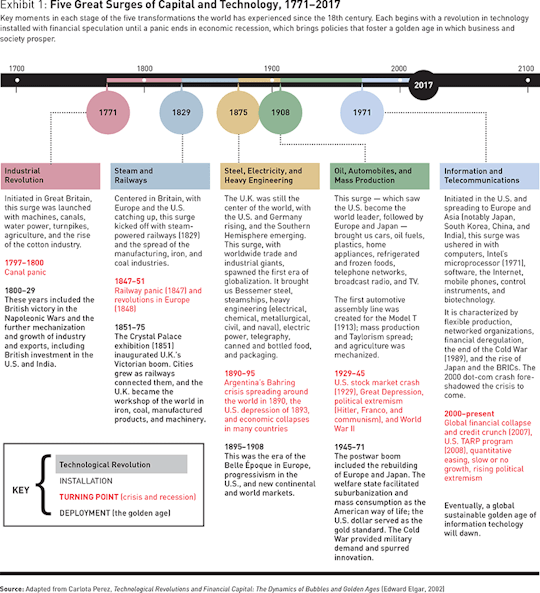
Carlota Perez is a professor that specializes in the social and economic impact of technological change. In 2002, she published an influential book called Technological Revolutions and Financial Capital: The Dynamics of Bubbles and Golden Ages.
One of her arguments is that economic growth since the Industrial Revolution has occurred through a series of cycles and surges, ultimately culminating in a fifth great surge centered around information and telecommunications. This is our current economic environment.
Perez was recently interviewed by strategy + business and they published this diagram (if it’s too small, click through to the article):
The five surges of capital and technology since 1771 are:
Industrial Revolution
Steam and Railways
Steel, Electricity, and Heavy Engineering
Oil, Automobiles, and Mass Production
Information and Telecommunications
Number 4 – oil, automobiles, and mass production – is what produced widespread suburbanization, a middle class filled with homeowners, and new forms of retail employment. And I am sure that most of you would agree that it’s not quite over yet.
According to Perez, each cycle has two phases: an installation phase and a deployment phase. This latter phase is a “golden age.” But in between these two phases is a turning point that is typically characterized by some sort of crisis and recession.
Her belief is that we are in this turning point right now. You see it with Brexit. The demagogues being elected. And more. If you buy this, the key question naturally becomes: How do we cross this chasm and enter our next golden age?
What’s also important to keep in mind about this theory is that it means that what we are seeing today, socio-economically, is not in fact new. We’ve been through this before. I’ll end with this quote from the interview with Perez:
In the 1920s, wealth distribution looked the same as it does today. The top 1 percent received 25 percent of society’s total income. By the 1950s it was down to 10 percent. Every installation period brings inequality until the state comes back actively to reverse it and relieve social unrest.
So what’s happening today may be temporary and it may be history repeating itself. If you’re interested in this topic, you can read the full interview here.
“If I meet one more anti-gentrification activist who moved to Seattle ten minutes ago, I shall scream.” –Dan Savage
So it’s not just developers who are frustrated by the many paradoxical desires that we have of cities. We are concerned about housing affordability and we want to minimize displacement, but we do things that restrict new supply and put increasing pressure on our existing housing stock.
Below is another excerpt from Dan Savage. It’s from an article called: Doing Something Real About Gentrification and Displacement. Dan writes a sex-advice column, but clearly also feels passionate about urban issues. When he talks about “this city” he’s talking about Seattle.
“Housing scarcity—exacerbated by the ridiculous amount of this city zoned for single-family housing—deserves as much blame for the displacement crisis as gentrification. More. And unlike gentrification (“a once in a lifetime tectonic shift in consumer preferences”), scarcity and single-family zoning are two things we can actually do something about. Rezone huge swaths of the city. Build more units of affordable housing, borrow the social housing model discussed in the Rick Jacobus’ piece I quote from above (“Why We Must Build”), do away with parking requirements, and—yes—let developers develop. (This is the point where someone jumps into comments to point out that I live in a big house on Capitol Hill. It’s true! And my house is worth a lot of money—a lot more than what we paid for it a dozen years ago. But the value of my house is tied to its scarcity. Want to cut the value of my property in half? Great! Join me in calling for a radical rezone of all of Capitol Hill—every single block—for multi-family housing, apartment blocks and towers. That’ll show me!)”
His overarching point is that lots of highly-educated people with money are choosing, today, to live in urban centers. And whether we like it or not, that is going to cause gentrification. We can’t stop that. But what we can do is try and alleviate housing scarcity.
His other solution involves building lots of transit to address geographic isolation. I agree with him on this point and I’ve argued it before on the blog. If we can all agree that one of the issues is land/housing scarcity, then transit is certainly another way to “pull in” new supply. Though I think we need to be realistic about the level of service required to make areas desirable.
If you have a few minutes, check out Dan Savage’s article. It’s a good and entertaining read.