Daily insights for city builders, delivered every morning at 6 AM ET. I’m Brandon Donnelly — a Toronto-based real estate developer and founder of Globizen. I’ve been writing here since 2013.
Last month, a giant 4K digital cat was installed on a billboard near Shinjuku station in Tokyo. See above tweet. It was created using a 26 x 62 foot LED display, and the resulting effect is very much a trompe-l’œil. The cat looks like it’s sitting on a ledge that is carved into the side of a building.
The cat doesn’t have a name. But the New York Times has reported that locals have started to call it “Shinjuku east exit cat” because of where it is situated relative to the station. I am going to assume that this name sounds a little more endearing in Japanese.
Having spent a fair bit of time in Asia in my twenties — mainly Taipei, Tokyo, and Hong Kong — I’ve always been impressed by how playful Asian cities are with their buildings, billboards, signage, and lighting. It can make us feel overly conservative. A trip to Tokyo can be like a trip to the future.
I appreciate that most people don’t want their cities to be overrun with advertising, and that’s what billboards are usually for. It can get tacky. I get it. But sometimes it just makes sense to stick a massive 3D cat on the side of your building. It’s fun and it captures people’s attention.
The Kowloon Walled City was once one of the most densely populated precincts in the world. And by some measures, it was. Prior to its demolition in 1993, the Walled City was believed to house some 50,000 people — mostly informally — and was known for problems of prostitution, gambling, and drug usage.
But despite these problems, the Walled City is the kind of urban settlement that fascinates architects, planners, and other city builders. This is partially because it wasn’t centrally planned. There is no individual architect or specific team responsible for its design.
It was, instead, a kind of self-organizing system — both from a built form standpoint and from, I’m sure, a socioeconomic standpoint. And so it is fascinating to see what results when you let that happen on its own.
Here are a series of cross-sections of the Walled City that were meticulously drawn prior to its demolition. They obviously aren’t new, but it is the first time I am seeing them. It is interesting to see everything from mahjong parlors to strip clubs stacked on top of one another in such a confined space.
When I was in my early 20s, I spent a summer living and working in Taipei and Hong Kong. It was a wonderful experience. I’ll never forget my apartment in Hong Kong’s Causeway Bay. It was a small single room with a small bed and an even smaller bathroom. The bed didn’t fit me — at all — and my legs would hang over the bottom of it. I couldn’t stop hitting my shins on the bottom of the frame at night. The bathroom didn’t have a dedicated shower, just a hose coming out of the wall. So everything would get wet. It also took me 15 minutes the first morning I showered to figure out how to make the water hot. Eventually I got it.
Despite all this, I remember being enchanted with Hong Kong. Here was this tiny little place with very little developable land that had managed to become, through trade, finance, real estate and other things, one of the wealthiest places in the world. Capitalism! I could also feel the connection to Toronto. Hong Kong has one of the largest Canadian expat communities in the world. In fact, I ran into one of my high school math teachers in a bar in LKF. That was wild. He had moved there with his wife to teach. I suppose because of all of this, I have tended to follow the region a bit more closely.
Last July, the British government promised a path to citizenship for the 3 million or so Hong Kong residents who hold or are eligible for a British National Overseas passport. This passport, as I understand it, was given to citizens at the time of the 1997 handover. Though I don’t know how utility was actually derived from it over the years. Before last year’s announcement, this document didn’t include the right to stay in the UK. However, now it does. And the UK government expects that some 300,000 Hong Kong residents are going to take advantage of this in the first five years of the program. And indeed, according to the Financial Times, 2020 was the first year since SARS back in 2003 that the region lost people — it had a net outflow of about 39,800 people.
What will this mean for Hong Kong? Well, Bank of America estimated earlier this year that capital outflows from Hong Kong could reach £25 billion in the first year of the program. But maybe this is being too conservative. Here in Canada, capital outflows from Hong Kong hit a record last year at C$43.6 billion. But this too could be an underestimation, as it doesn’t include transfers below C$10,000 and probably a bunch of other transfer methods. How much money is actually flowing outward?
This weekend the Financial Times published the above survey results showing sentiment around leaving Hong Kong. Surveys are, of course, a funny thing. Saying you might probably potentially do something is a lot different than actually doing something. But for what it’s worth, about a quarter of pro-democracy supporters (which is maybe half of the population?) responded by saying that, yes, they would be prepared to leave. If you include those who responded no, but that they would reconsider and leave if things got worse, the number increases to about 70%.
I don’t know how meaningful all of this becomes for Hong Kong. Time will tell. But it has me thinking about my tiny bed and tiny shower in Causeway Bay.
The latest (15th) edition of Knight Frank’s annual The Wealth Report was published last month. I find these interesting because they give you a global view of how and where capital is flowing into real estate (specifically prime real estate). London, for example, did rather well last year despite the pandemic. Buyers from the around the world spent nearly $4 billion on what is commonly referred to as “super-prime properties.” This is real estate with a sale price of US$10 million or more. London saw 201 super-prime properties trade hands last year, with an average price of $18.6 million and with 31 of these transactions being at or above $25 million. This is an increase compared to the year prior (2019), which I suppose is something given that the UK’s housing market was more or less frozen between March and May of last year. These figures put London at the top, ahead of New York and Hong Kong, when it comes to super-prime real estate sales in 2020. (London figures via the Financial Times.)
Another interesting thing that you’ll find in the report is a city ranking that Knight Frank calls their City Trifecta. What this index does is take Knight Frank’s City Wealth Index (which considers where wealth is currently concentrated) and then adds in two other dimensions: innovation and wellbeing. The idea here is that innovation should drive future economic growth and wealth, and that wellbeing (quality of life) is pretty important when it comes to the future competitiveness of our global cities. When you look at the world’s top cities through this lens, the ranking starts to differ from what you may be used to seeing with cities like London, New York, and Hong Kong at the top (see above chart). Now you have Munich taking the number one spot; Boston and Toronto in 5th and 6th position, respectively; and cities like Zurich jumping up ahead of cities like Hong Kong. These kind of rankings always need to be looked at with a critical eye, but they can be interesting nonetheless.
Hong Kong is known for having mysterious holes in many of its tall buildings. The Repulse Bay Hotel (pictured above) is one example. Completed in 1986, its hole is 16m wide by 24m tall.
They started because of feng shui and more specifically because of “spirit dragons.” Some believe that spirit dragons live in the mountains surrounding Hong Kong and that they like to descend each day in order to bathe in the water. Legend therefore has it that if you obstruct their path of travel, bad things could happen to you. These holes are where they fly.
The other reason for these tower holes is far less superstitious and entirely practical. Hong Kong has a kind of built form known as “wall-effect buildings.” These are large buildings with large floor plates that create a kind of wall in the landscape. So to break up the massing and allow more natural light and air to flow through, holes are introduced.
So maybe it’s because of spirit dragons or maybe it’s to encourage more light and air. Either way, these tower holes have become part of the Hong Kong landscape.
Here is an interesting article from the Financial Times talking about the quiet move of people and companies from Hong Kong to Singapore. I say quiet, because apparently Hong Kong-based companies are reluctant to overtly signal that they are setting up offices and moving some of their executives out of the city, in case that starts to upset people over in Beijing.
But the real estate market in Singapore seems to be benefitting from some of these macro trends, as well from the city-state’s handling of the coronavirus. This is despite there being a 25% stamp duty tax on foreign property purchases (US nationals and a few others are exempt) and despite the fact that the economy shrank in the second quarter of this year by the largest percentage (13.2%) since independence in 1965.
According to FT, there were 2,362 residential property transactions in the core central region of Singapore in the first 9 month of this year. This compares to 1,962 transactions for the same period last year. Of these total sales, 260 residential homes were sold to foreign nationals this year (~11%), compared to 316 last year (~16%). While this is obviously a decline, including a decline in the percentage sold to foreign nationals, it still feels pretty significant given that the borders were presumably closed, or largely closed, earlier this year.
Apparently 75% of the above 260 homes were sold to buyers from either mainland China or Hong Kong. I don’t know how this percentage compares to last year. But the narrative out there right now is that it is up (along with office leasing by foreign companies) and that Singapore is a pretty safe place to put your money right now.
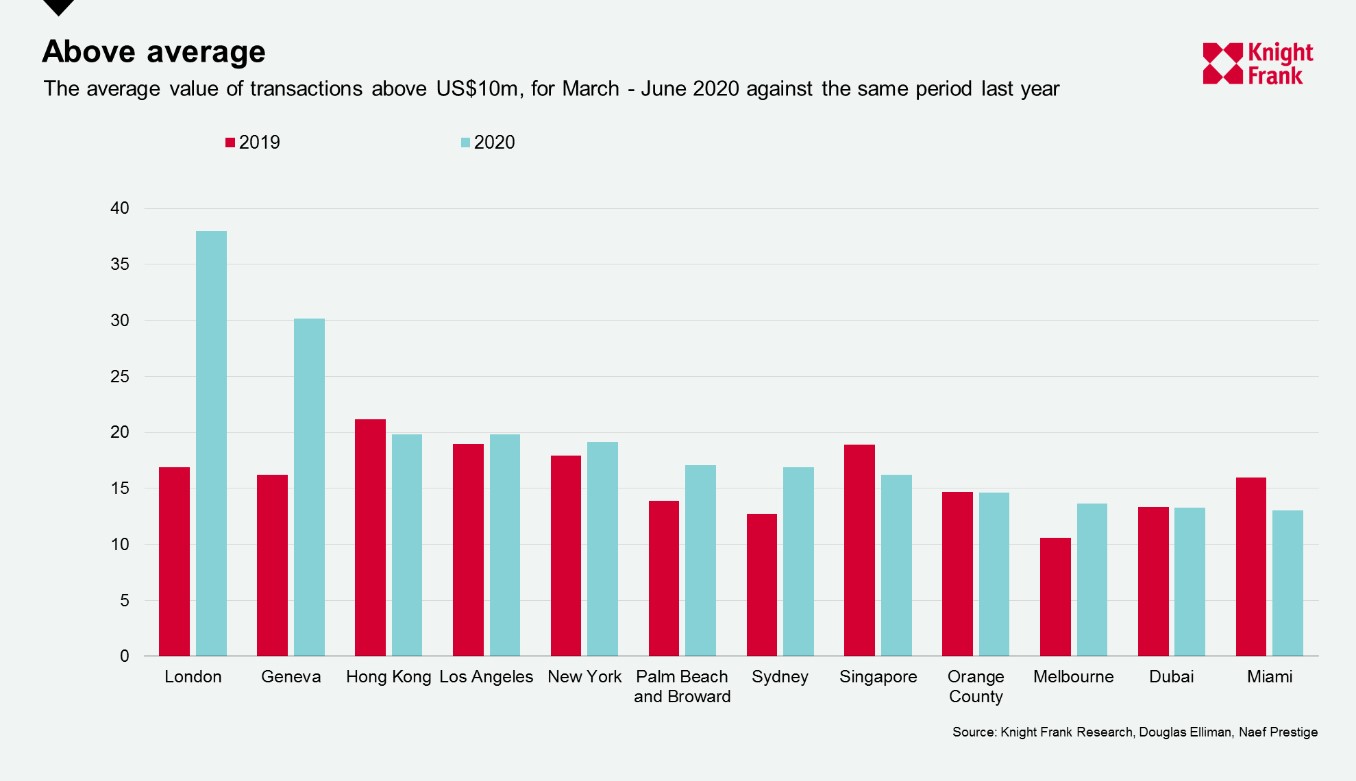
This is a chart from Knight Frank showing the average value of “super-prime” residential real estate transactions in 12 global markets between March and June 2020, and versus the same period last year.
Knight Frank classifies super-prime real estate as having a value greater than US$10 million and ultra-prime real estate as having a value greater than US$25 million.
In this particular chart, London takes the top spot with an average super-prime transaction value of US$38 million. This is a big jump compared to 2019 where the average value was US$16.9 million.
Typically it is Hong Kong that takes the top spot in this ranking, but this year it fell to third. Still, Hong Kong had the highest number of transactions with 60 super-prime sales taking place in the first half of 2020. This is down from 155 in the first half of 2019.
Overall, Knight Frank recorded 281 super-prime transactions across these 12 cities in the first half of this year. This is, not surprisingly, a decline compared to last year, which saw 594 transactions over this same time period.
But all things being considered and given some of these price increases, the super-prime market is certainly holding its own.
This Thursday is the launch of a brand new city event called the WRLDCTY Virtual Festival (vowels, clearly, suck). Presented by Vancouver-based Resonance Consultancy, the “host cities” are New York, London, Hong Kong, Los Angeles, and Toronto.
The idea is to bring together thought leaders and city lovers from all around the world on a virtual platform for three days. The speakers include people like Richard Florida, Bjarke Ingels, and Dan Doctoroff.
The other thing they’re doing is offering up over 20 virtual urban experiences. Think yoga on Santa Monica Pier, burlesque in Brooklyn, and graffiti art tours in Toronto. It’s clearly no substitute for actual travel, but this is the best we’ve got right now and we’re all trying to adapt.
A general admission ticket is free, but some of the headline events require a pro pass and if you’d like to do some virtual networking and chat with other guests in the “Community Center,” you’ll also need that same pass. Here’s the full agenda.
UBS and PwC’s recent report on billionaire wealth highlights some interesting trends about the global economy and global wealth.
Billionaire wealth in mainland China is now second to only the United States, having grown by about 1146% from 2009 to 2020, compared to 170% in the US. As of the middle of this year, it was sitting at about USD 1.7 trillion in China, compared to USD 3.6 trillion in the US.
Hong Kong remains a force with only 1,105 square kilometers of land (not all of which is developable). Billionaire wealth grew by about 208% to USD 356 billion over the same time period as above. That puts it ahead of the United Kingdom, Canada, and Brazil in total dollars.
About half of all billionaires seem to have a significant amount of their wealth invested in real estate. Somewhere between 21-40% of their net worth.
At the same time, the report identifies the real estate industry as having the fewest number of “innovators & disruptors.” Only 17% of billionaires (whose wealth is primarily derived from real estate) are classified in this way. The report calls out the sector as being “especially slow to embrace technology to boost efficiency.”
Perhaps the most interesting takeaway is that, even within the rarified billionaire community, tech is driving polarization. For most of the last decade, the sector didn’t matter all that much. The rich were getting richer. Now it’s more so the tech rich. And COVID-19 seems to be accelerating this trend.
This is not to say that I think people are particularly worried about billionaires who maybe aren’t getting as rich as they used to. That’s like complaining about being too good looking. But it is clear that tech is driving a bunch of macro shifts in the global economy and this is just another example of that playing out.
This ArchDaily interview with Gary Chang about nano-scaled architecture is worth a read. Gary Chang is founder of the Hong Kong-based Edge Design Institute and is a pioneer in the world of compact living and small-scale architecture.
In fact, many of you have probably seen where he lives. His place has been widely publicized over the years. Dubbed the Domestic Transformer, Gary has been living in the same 32 square meter apartment in Hong Kong for over 40 years and has been using it as a kind of laboratory for his design work.
Depending on where you live, 344 square feet may not seem like a lot. But this is Hong Kong. And in Hong Kong even this is apparently on the large side for some locals. In his ArchDaily interview, Gary talks about the rise of “nano-homes” in Hong Kong — everything you need, including a wine fridge, in only 16-18 square meters.
Of course, to do this, you kind of have to reconsider how you think about space. Gary refers to it along the lines of time-based space planning. Instead of just focusing on raw space, he focuses on activities and functionality over time.
“Over the years, I have been more focused into the notion of time rather than the physical space itself, and in this latest model M-2007 (calling it the Domestic Transformer, the year the first episode of the movie of Transformer was launched), I simply explore a time-based system of living in this apartment; instead of me moving from one room to another in the traditional sense, the apartment transforms for me for different functions. I basically utilize the entire home all the time, a great departure from the conventional definition of a home such as the system in Japan in nLDK (n denotes the number of bedrooms, L for Living Room, D for Dining Room and K for Kitchen).“