Daily insights for city builders, delivered every morning at 6 AM ET. I’m Brandon Donnelly — a Toronto-based real estate developer and founder of Globizen. I’ve been writing here since 2013.

Tag: homeownership

  • Our bias toward homeownership

    We have a cultural bias toward homeownership in this country. Other countries have it too. We believe that homeownership is what you should aspire to.

    In 2011, Statistics Canada pegged the homeownership rate at 69%. 9.2 million households out of a total of 13.3 million. Other more recent data suggests that it’s probably a bit lower, though still higher than that of the US since the financial crisis.

    Regardless, more owners than renters.

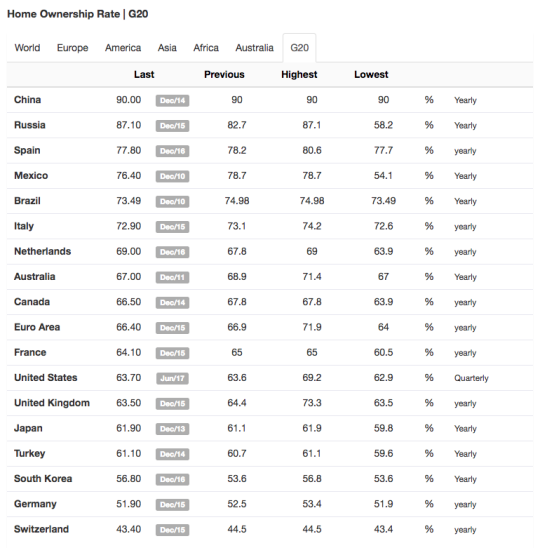
    I am not here to throw stones. I get it. I own my home. However, I do think it’s important to put this into perspective. Below is a chart from Trading Economics of homeownership rates in the G20:
    image

    At the bottom of the list – with the lowest homeownership rates – are Germany and Switzerland. Germany appears almost evenly split between owners and renters. And Switzerland is more renters than owners. 

    Both of these countries are wealthy. Both have a higher GDP per capita than that of Canada according to the World Bank and the International Monetary Fund. 

    Anecdotally, I can also say that some of the wealthiest people I know have made the decision to rent. They have simply decided to invest their capital elsewhere.

    I’m not trying to insinuate any sort of correlation with these statements, but I am trying to draw attention to a cultural bias.
  • A new kind of homeownership

    Yesterday Andreessen Horowitz announced an investment in the startup Point. They led an $8.4 million Series A round.

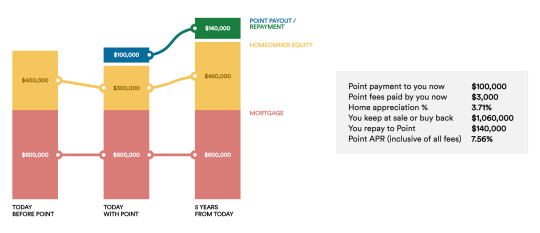
    Point is an alternative to traditional home equity loans and HELOCs. The way it works is that you actually sell a portion of your property. Here’s an example:

    In this scenario, the home is worth $1M. Point makes an offer to buy 10% of today’s value in exchange for 20% of the home’s future appreciation on a 5 year term. You pay a 3% fee when the $100,000 (10%) is paid out, but you don’t make any monthly payments. You just give up potential future appreciation. (If the home doesn’t appreciate, Point doesn’t make money.)

    What’s interesting about this model is that traditionally “housing” has meant one of two things. Either you own 0% of the home (i.e. you rent) or you own 100% of the home (usually with the help of a mortgage).

    Point is making it easier for you to potentially own 95% or 90% of your home. They are taking an equity stake, which is why there are no monthly payments associated with it. 

    The investment angle is that homeowners get to diversify their wealth out, and (Point) investors get to diversify in, without having to worry about actually managing the property.

    Would you use this as a tool to unlock your home equity wealth?

  • The decline of US homeownership

    Charlie Gardner (aka the Old Urbanist) recently published an interesting pair of posts (here and here) about the decline of homeownership in the United States.

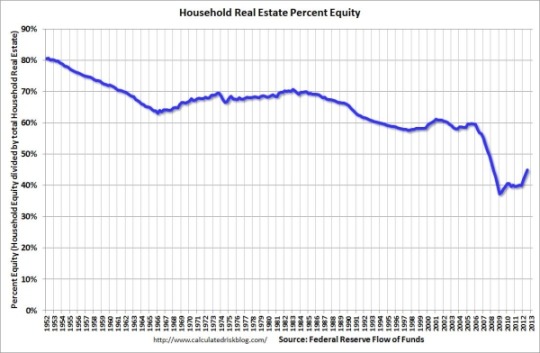
    What really stood out for me, though, was this chart (showing the percentage of household real estate equity):

    And this conclusion:

    “The implied conclusion here, that a dramatic expansion of debt has been necessary just to maintain the illusion of a stable homeownership rate (setting aside the explosion of debt in the 2000s necessary to support an increase in homeownership), puts an even more negative spin on the figures from the preceding post.  In short, a decline in homeownership has until the past few years been masked by shifting demographics and an increase in household debt.”

    What I would now be curious to see is the above chart in terms of household equity value. Because I wonder to what extent rapidly appreciating home prices (as a result of cheap credit) are having an offsetting affect on declining equity percentages.

  • A look at homeownership rates

    The Old Urbanist (Charlie Gardner) recently published an interesting post talking about the origins of American zoning using the work of Professor Sonia Hirt and her new book, Zoned in the USA: The Origins and Implications of American Land-Use Regulation.

    One of the central themes in his post is the American (and Canadian) fixation on single-family homes:

    …the United States is the only developed country of those surveyed, apart from Canada, to widely employ single-family detached residential zones that bar all commercial and multifamily uses.

    And the reason for this is largely because of two longstanding beliefs in American (and again Canadian) culture: Your goal should be to become a homeowner, and that home should ideally be a single-family detached home.

    But there’s lots of evidence to suggest that these legal protections (and many of the other things being done to encourage/subsidize homeownership) aren’t actually that effective at driving up homeownership.

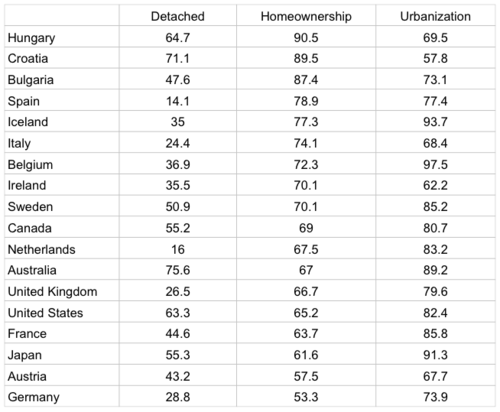
    In his post, Charlie includes a chart showing the percentage of detached homes and the homeownership rates for various countries (data is from 2013/2014). I sorted it based on homeownership and added urbanization rates to see if there was any correlation (doesn’t appear to be).

    Source: Charlie Gardner & Wikipedia

    The US and Canada are quite good at putting lots of people in detached housing (though not as good as Australia!), but the homeownership rates are nowhere near the top. In fact, the US falls in the lower half.

    Did you think the homeownership rate would be higher in the US?

  • A century of homeownership and renting in England and Wales

    This morning while I was reading about gentrification in Berlin, I clicked through to an interesting overview of homeownership and renting in England and Wales over the last century. Here’s a video. If you can’t see it below, click here.

    [youtube https://www.youtube.com/watch?v=LDnGryGJ1ZA]

    The video starts in 1918, where the vast majority of households (77%) rented. As of 2011, this number has reversed. 64% of households in England and Wales now own their home.

    If you compare this housing trend to what happened in the United States and Canada, you’ll see a similarity. Although, the US was ahead in terms of promoting homeownership. They reached 50% ownership somewhere in the mid 1940s, whereas England and Wales didn’t reach this number until around 1971.

    image

    All of this is an interesting reminder that our obsession with homeownership is a relatively new one. But it’s also not a universal one. The homeownership rate in Berlin is 15.6%, and it’s only 49.5% in London. People in big cities tend to rent more.

  • Are condos at a tipping point?

    I live in a condominium in the St. Lawrence Market neighborhood of Toronto. And recently, I’ve had a number of “empty nesters” ask me if they could come check out my condo and get a feel for what it’s like to live in a downtown neighborhood like the Market.

    And they’re asking because they’re contemplating something that has become quite common for folks whose kids have left the roost. They’re considering, for a number of reasons, selling their suburban home and right-sizing to a downtown condominium.

    Whether it’s because they want to free themselves of cutting grass and shoveling snow, they don’t like stairs anymore, they want to be able to lock the door and head to Florida for the winter, or they want an amenity rich urban lifestyle, the uptake on condos has been significant both in Toronto and other cities around the world.

    Indeed, the condo market has become great at serving “both ends” of the market: first time buyers/young professionals and empty nesters. But what I wonder is if we might be at a tipping point with respect to the middle segment of the market: families.

    The average new construction low-rise home in the Greater Toronto Area is roughly $650,000 right now. But this would be more for houses in the center of the city. There, you’re probably looking at anywhere from $650,000 to $1 million for a “typical” 3 bedroom Toronto house.

    By comparison, a new condominium might average somewhere between $550 and $600 per square foot in the city. So for a 3 bedroom condo at, say, 1,300 square feet, you’d be looking at somewhere between $715,000 and $780,000. Add in parking and you’re somewhere between the mid $700,000’s and just over $800,000.

    In all cases, we’re talking a lot of money. But the point I’m trying to make is that condominiums and houses are becoming cost competitive. There are obviously differences between both housing types, but if your goal is a 3 bedroom place to raise a family, that utility could be met in both cases.

    There may still be psychological/societal barriers to raising kids in a condo, but I wonder if we might be close to a tipping point now that the economics are starting to line up. What do you all think?

  • Why the homeownership rate is higher in Mexico than in the US

    If you check out the “What I read” page that I recently added to Architect This City, you might notice a blog by Charlie Gardner called the Old Urbanist. I discovered it a few months ago (when he added ATC to his blog roll) and it’s good stuff.

    Last week he posted this interesting piece comparing homeownership rates and house sizes in both Mexico and the US. His finding is that there’s a fundamental mismatch in America in terms of the size of housing and the size of households. One and two person households now represent more than half of the market, and are on the rise, and yet 40% of houses in the US have 3 bedrooms.

    Because of this mismatch, he’s arguing that households are being poorly served by the US housing market and that it’s driving down homeownership levels. It currently sits around 65%, which is a drop from over 69% during the mid 2000s. Contrast this to Mexico, where there’s a greater number of one and two person households and the homeownership rate is 80%! Oh, and where only 6% of homes are financed using a mortgage.

    So what the Old Urbanist is suggesting is that we need to embrace smaller homes. He doesn’t explicitly say it, but he mentions the opportunity to redevelop laneways and alleys, which many of you will know I fully agree with. It’s a great post and I suggest you have a read if this topic interests you.