Daily insights for city builders, delivered every morning at 6 AM ET. I’m Brandon Donnelly — a Toronto-based real estate developer and founder of Globizen. I’ve been writing here since 2013.
Since the 1940s, the US has been adding roughly 9 million new homeowning households about every 10 years. This, after all, is a fundamental component of the American Dream. But Aziz Sunderji — who writes over at Home Economics — has recently been arguing that this 80-year boom is now at an inflection point. And it is largely because the rate of population growth in the US is now declining. Here’s his chart, which uses data from the US Census Bureau and the World Bank:
In fact, for the first time ever, the Census Bureau is now forecasting the US population to start declining. The current forecast has its population reaching a high of 370 million in 2080 and then declining to 366 million by 2100. But even before these far off dates, organic growth is expected to turn negative in less than 15 years (see above). So yeah, it makes sense that this would impact the real estate sector.
Generally the way the former works is that you have to have been living continuously in the home since July 1, 1971, and the building itself needs to have been constructed before 1947. If this is the case, then in theory, you should have seen relatively minor rent increases over the years.
This was the case for the late real estate agent, Alice Mason, who died at the beginning of this year at the age of 100:
She never left the rent-stabilized [controlled?] apartment where she held her storied dinners, in a century-old building on East 72nd Street. (In Manhattan real estate parlance, it was a classic eight, a gracious prewar layout that included three bedrooms and two maid’s rooms.) In 2011, the developer Harry Macklowe bought the building for a reported $70 million and began to turn the units into condos, buying out the tenants to do so.But Ms. Mason refused to give up her apartment. When she moved there in 1962, the rent was $400 a month. At her death, it was $2,476. The apartment below her, in the same line, was recently on the market for just under $10 million.
Green, Penelope. “Alice Mason, Real Estate Fixer and Hostess to the Elite, Dies at 100.” The New York Times, 13 Jan. 2024, www.nytimes.com/2024/01/11/style/alice-mason-dead.html.
For better or for worse, this is an obviously awesome deal, and reason enough to never move and have family members move in with you before you die so that you can try and pass down this asset for generations to come.
BlogTO recently asked: Is it a good time or a bad time to buy a condo in Toronto right now? My unsolicited opinion is that if you are someone who would like a home in Toronto, now is an excellent time to buy it. But that’s not actually what I want to talk about today.
If you read the post, you’ll come across this line: “She emphasized that these are unprecedented interest rates…” Hmm. I think it’s important to point out that these are not unprecedented rates. Rates today are certainly higher than they have been for about two decades. But they’ve been even higher before and, if you go back to say the 1980s, rates today still look historically low.
We just got used to ultra low rates and now we need to adjust to them being higher. And we will. The first step is feeling confident that rates won’t go even higher in the short term. Because if you think you know where rates are going to hang out, you can then make decisions around that.
Steven Levy over at Wired recently wrote a short piece comparing Opendoor’s iBuying approach to what Zillow was doing when it was in the space. (Thank you Robert Wright for forwarding me the article.)
As we have talked about before, the fundamental problem with Zillow’s model is that it couldn’t accurately predict where home prices were going. It was losing too much money and so they shut down that side of their business.
The article talks about Opendoor’s approach and how they’ve spent the last 8 years refining a valuation model/approach that is now apparently pretty accurate. That’s positive. But here’s another excerpt that I found particularly interesting:
There’s one controversial aspect of the business model that Wong didn’t bring up. It appears that when companies like Zillow and Opendoor can’t easily sell a home, the fallback is what’s called an “institutional sale.” All iBuyers sell a small but not insignificant percentage to institutional investors with aspirations of being “mega-landlords.” While the marketing materials of the iBuyers emphasize clean sunny rooms and frictionless transactions, that segment of the market involves hedge funds like KKR and Blackstone snapping up properties for rental, limiting the inventory available for families seeking homes. Even the Biden administration has weighed in on the evils of this trend: “Large investor purchases of single-family homes and conversion into rental properties speeds the transition of neighborhoods from homeownership to rental and drives up home prices for lower cost homes, making it harder for aspiring first-time and first-generation home buyers, among others, to buy a home,” said a recent White House dispatch.
It’s interesting for two reasons.
First, these highly tuned valuation models are now being used to scale the acquisition of single family homes. No specific figures are given, but Levy speculates that some iBuyers could be feeding up to 20% of their homes to institutional buyers. Economies of scale are a challenge with this asset class. Here technology is helping.
Second, I don’t like the tone toward renters in the above White House dispatch: “[It] speeds the transition of neighborhoods from homeownership to rental.” This line in particular implies that renting is perceived as being suboptimal to homeownership and that “speeding”’ towards the former is something that should be avoided for reasons of social good.
Even the words that are used here suggest biases. A single-family home is called, well, a home. But a rented one is a rental property. I reckon that a home is a home regardless of whether it’s low-rise, high-rise, rented, or owned.
Here’s a cogent argument by Dror Poleg about how urban economics can be used to explain the evolution of Web3, and also why it’s all a bit of a ponzi scheme, but that when it works, it works.
His argument revolves around ownership and participation. If you own real estate in a city, you could say that you are both a part owner of said city and a participant. You participate by virtue of living and/or doing other things there, but beyond that you also have a vested interest in the city doing well. Because if the city continues to do well and grow, there should be more demand for real estate, including yours, and that likely means your wealth will increase over time.
This same force could be said to apply when existing property owners oppose new development. It restricts supply and increases the value of people’s existing “ownership” in a city. It’s kind of like being a company and not issuing new shares so as to not dilute your existing shareholders.
This connection between ownership and participation is similarly a hallmark of Web3. In the world of crypto, users buy tokens (some fungible and some non-fungible) and those tokens provide access and rights to various things.
For example, owning tokens might allow you to vote on key decisions affecting the overall organization. And if the organization does well and continues to grow, all token holders should, in theory at least, see their wealth increase. More people will want those same tokens. Ownership and participation.
Web2 companies, on the other hand, do not typically offer this automatic connection between ownership and participation. That is, of course, unless you’re a shareholder. If you’re just a regular user of a platform like Instagram (which I am), but you don’t own any shares in Meta (I do not), then you’re only a participant.
If you happen to be a widely followed influencer then you can certainly benefit indirectly from the platform, but you do not benefit from any sort of direct ownership in the organization. Pretty much everything accrues to the house.
In fact, you also don’t own your followers, from which you derive your indirect benefit. Not to pick on Meta, but if Meta decided that your content was suddenly inappropriate for the platform, perhaps too salacious, then it could choose to close you down and your indirect benefits.
This, of course, is one of the great promises of crypto and Web3. If you’re a part owner and you have some say in the way things are being run, you can maybe avoid this kind of outcome. And if things really aren’t working out, one should have the flexibility to take their followers and be extra salacious somewhere else.
We shall see if this is ultimately how Web3 plays out, but the connection between ownership and participation is an interesting one and, if things do end up working out as planned, maybe it can be harnessed to improve our cities. Because we know the problems: inequality, housing supply and affordability, and many others. The system is clearly far from perfect.
If you’ve been following the housing market (in most cities) over the last year, this chart likely won’t surprise you. It is from a recent City Observatory article by Joe Cortright talking about the “k-shaped housing market” that we have seen emerge over the last year. The above is for the US, but I would imagine that the chart would look similar for Canada, as well as for other countries. Here’s an excerpt from the article:
There’s an obvious explanation for the different trajectories of house prices and rents: Low income workers rent; high income workers own and buy homes. High income households have been barely grazed by the Covid-19 recession. In fact, the combination of low interest rates and enforced savings (because many kinds of consumption spending, including dining, entertainment, travel and even much retail have been constrained by lockdowns), mean higher income households may find housing a much more attractive spending item. If you can’t go out to dinner, or take a vacation, you have more money to spend on a new home. Low wage workers are in the opposite situation. Low wage workers have borne the brunt of the recession; they are also much more likely to be renters than higher income households.
It is perhaps worth reiterating that our fixation on homeownership is not universal. If you live in Switzerland — a very wealthy country — you’re more likely to rent than own. And if you live in Germany, you’re more likely to live in an apartment than in a low-rise house. Still, that doesn’t change the fact that the impacts of COVID-19, and our lockdowns, have been felt unequally. This chart is an example of that.
Across the 50 largest metro areas in the US, about 31.9% of millennials — those aged 18 to 34 — owned a home as of 2017. And according to recent census data (via the Redfin), only 5 of these cities had a millennial homeownership rate higher than 35%. They are as follows:
The top spot goes to Salt Lake City, which sits at just over 40%. It also has the highest share of businesses owned by millennials at 8.4%. Not surprisingly, the cities on this list all have relatively affordable home prices, with Detroit being the most affordable.
I think you could interpret this list as a bit of a leading indicator for US cities on the rise. Affordability, and walkability, may be the draws today, but as millennials lay down roots, start businesses and earn more money, I am sure we’ll see these cities transform even further.
Through initial consultations, they have already identified 5 key themes (my words below):
The approvals/entitlement process for new housing is too slow
There are too many restrictions on what is allowed to be built (that is, we should be encouraging more “gentle density” and “missing middle” type infill)
Development costs are too high
Tenants need protection; regulation is making it increasingly difficult to be a small landlord
Overall housing innovation
The province is also looking for public input and is currently running this online survey. It is open until January 25, 2019. And I would encourage all of you to complete it and help shape the action plan.
My understanding is that the plan should be ready by Q2-2019.
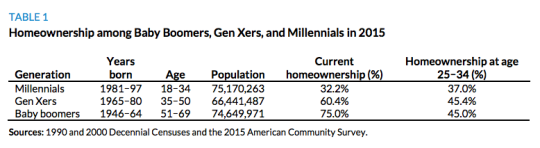
The Urban Institute has a new study out that looks to explain why Millennial homeownership rates are lower than that of previous generations. The typical refrain is that Millennials have a lot more student debt and that the cost of housing in urban centers has risen faster than income levels. But this report tries to put some math behind those explanations. All data is for the US.
Not surprisingly, marriage and kids are significant drivers, and Millennials appear to be delaying both. According to the study, being married increases the probability of owning a home by 18%. If marriage rates in 2015 were the same as they were in 1990 (this is the time period for the study), the Millennial homeownership rate would be 5% higher. Having a kid increases the probability by about 6.2%.
There’s also a widening spread between the homeownership rates for more educated and less educated Millennials. Presumably the distinction is a 4 year university degree. Between 1990 and 2015, the spread between the two groups increased from 3.3% to 9.7%. This was identified as an area of “great concern” because of the possible long term implications.
Combine this phenomenon with the stats that white households have a higher homeownership rate compared to all other racial groups and that having parents who are homeowners increases the likelihood of also owning a home (let’s ignore, for a second, the other intergenerational transfers of wealth), and you have a recipe for rising wealth disparities.
Of course, some of you will undoubtedly argue that in this part of the world we are overly fixated on homeownership as a mechanism for wealth creation. I mean, there are many examples of very wealthy countries with homeownership rates that are far less than what they are here in Canada and the US. But that’s a discussion for a different blog post.
If you’d like to go through the full Millennial Homeownership report, you can do that here.
I just discovered an interesting new Seattle-based startup called Loftium.
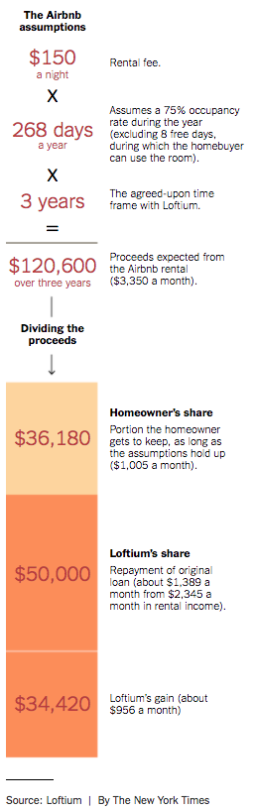
The way it works is that they provide down payment assistance (up to $50,000) to prospective homeowners as long as they commit to renting out one of the home’s bedrooms on Airbnb for 12 to 36 months. Loftium is positioning it as a way to help first time buyers get onto the property ladder.
Here’s an example of how the math might work (taken from the New York Times):
The details certainly matter a great deal here but, high level, the homeowner gets $50k upfront, ~$1k per month in shared Airbnb revenue, and the opportunity to buy a home. You just have to be committed to being a host.
And from Loftium’s perspective, they put out $50k at the outset and get back just over $28k a year for 3 years. Assuming these assumptions are correct, that’s a pretty good IRR.
However, if the home doesn’t generate enough Airbnb income during the agreed upon term, Loftium is on the hook because the homeowner doesn’t owe anything after the “services contract” expires.