Daily insights for city builders, delivered every morning at 6 AM ET. I’m Brandon Donnelly — a Toronto-based real estate developer and founder of Globizen. I’ve been writing here since 2013.

Tag: history

  • Preserving place

    I was recently asked: How do you go into a neighborhood, build new, and not erase and/or sterilize what makes that neighborhood interesting in the first place? 

    Gentrification is a controversial topic in city building. Too often I think we ignore what happens when we don’t invest in communities, but that doesn’t mean we shouldn’t be deliberate when we do make investments.

    Development is filled with tensions. We are constantly trying to navigate through constraints and balance out the wants of each and every stakeholder. It becomes an art. It doesn’t always work out as planned.

    To state the obvious, I would say that it starts with caring. If you’re not interested in community and city building, then the default response will be to simply replicate what worked on the last project.

    But every place has a local culture. And if city builders are to have any hope of preserving and building upon what makes that place unique, we have to first understand it. What made it successful in the first place? What is its DNA?

    Because then you’re in a position to think about both built form and programming in a way that is culturally sensitive.

    One example that comes to mind is the proposed redevelopment of Honest Ed’s / Mirvish Village here in Toronto. 

    The “micro tower” design is intended to create the sense that the area was built up organically over time. And the fine grain retail (50-60 individual retail spaces) is intended to house local retailers, micro retail startups, and pop-up shops. To me, both of these elements speak to the history and fabric of the area.

    Adopting a unique approach can also sometimes mean rethinking how you measure ROI. If all you care about is who will pay you the highest rent – right now – then you’re going to make a decision based on that metric.

    Maximizing revenue is not a bad thing. That’s what businesses are supposed to do. But sometimes there is or should be a larger vision at play. And sometimes you need to take a longer view.

    In Toronto’s Distillery District, the developers made the decision to eschew large chains and franchises (in favor of more local retailers) so that they could create a very particular place. Ultimately that particular place became a great place to sell condos, but they suffered early on for it.

    I like how Gary Vaynerchuk put it when he asked: What is the ROI of your mother? Sometimes you may not be able to measure it, but that doesn’t mean the ROI isn’t there.

    Any other suggestions?

  • Fun Friday: Your ancestry

    People often ask me about “my background”. When I’m feeling cheeky, I usually just say that I’m Canadian or that I was born in Toronto (because that’s what I culturally self-identify with). But that’s not what most people want to hear.

    The short answer I usually give is Eurasian (European + Asian) or Chirish (Chinese + Irish). Although I recently learned that Chirish means something else to people from Chicago.

    But now, thanks to 23andMe’s DNA test, I can give a much more specific answer. Here’s the full chart:

    Now I can say that I’m 50.6% East Asian & Native American and 49.2% European. 

    More specifically, I can say that I’m 43.7% Chinese, 2.0% Broadly East Asian, 2.1% Southeast Asian, 1.5% Native American, 1.4% Broadly East Asian and Native American, 16.5% British & Irish, 6.0% French & German, 11.5% Broadly Northern European, 1.7% Iberian, 1.7% Italian, 6.9% Broadly Southern European, 1.5% Eastern European, and 3.4% Broadly European.

    But the interesting thing is that I don’t really feel any cultural affinity towards any of the regions or countries listed above (except for maybe France since I grew up going to a French school based off the French schooling system). For me, I identify as being Canadian. That’s more than enough for me.

    Now it’s your turn. 

    What’s your “background” and how do you self-identify? I think this is an interesting discussion given that we are now an incredibly mobile world. What your DNA says and how you feel about yourself, could be two totally different things.

  • Big time Barcelona

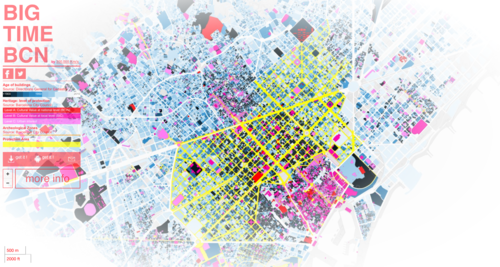
    image

    Barcelona is one my favorite cities in the world. I love the intimate laneways in the old part of town. I love how La Rambla functions as a spine for public life in the city–even if it is pretty touristy. I love the weather and beaches. And I love that there’s a strong culture of art and design that seems to permeate all aspects of the city. 

    Over the weekend I found an impressive website called BIG TIME BCN, that beautifully maps out the city’s more than 2,000 years of building. It covers over 70,000 plots of land and, if you hover of them, it’ll tell you the age of the buildings. It’s similar to what was done here for the Netherlands. But the colors on this one seem very Barcelona to me.