Daily insights for city builders, delivered every morning at 6 AM ET. I’m Brandon Donnelly — a Toronto-based real estate developer and founder of Globizen. I’ve been writing here since 2013.

Tag: high rise

  • Condo building identities according to Instagram

    I am very interested in the social side of buildings. What I mean by that is that we usually focus on the quantitative side. We look at sale prices. We look at average prices per square foot. We look at reserve fund balances. And as I recently argued, this is all very important stuff. I think we should do much more to make this data publicly available.

    But there’s also a side to buildings that’s harder to measure: the human side. Sale prices and staged MLS listings don’t tell you what the people who live in the building are like. What the vibe will be like at the pool during the summer. If you can expect to find dog poo in your elevators. But when you live in a multi-family building, I think most people will tell you that the qualitative side also matters.

    So this morning, I thought I would run a little experiment and pull the top Instagram photos for a random sampling of relatively new condo buildings in Toronto. These are public photos that have been uploaded and tagged with that building’s location ID. 

    Obviously there’s an inherent bias since I figure Instagram users probably lean towards Millennials. Also, the top posts could be easily skewed by a small number of heavy influencers. But I still thought it would be interesting to see if any particular identities started to emerge. And I do see some differences that reflect what I would have expected. I wonder how these might relate to the original marketing for the buildings.

    What do you think of the photos below?

    Feel free to do the same for your building and post the photo in the comments below. That could make for a really interesting discussion. My building is the first photo.

  • Throwing butts

    For whatever reason, some of the people living in high-rise buildings believe that if you flick a cigarette butt off a balcony that it will magically disintegrate on the way down. It’s either that or they don’t give a shit about anyone else.

    Because if you happen to live in or manage a building which has patios or terraces at the base of tower, I bet you have this problem:

    image

    Above is a picture of a Belmont cigarette burning through the tarp covering the wooden harvest table on my patio. 

    It’s a destruction of property, an environmental concern (many butts end up in stormwater drains), and a pretty scary fire hazard. I know of many incidences where thrown cigarette butts have started fires in a high-rise building. It happened last year in my mother’s building.

    However, the frustrating thing about this problem is that it’s exceptionally difficult to stop. I know this because I sit on the board of my condo building. The typical response is for management to send out notices to all the residents asking them to stop doing this. But frankly, that does nothing.

    So if any of you know of a company or service (or have a product idea) that can help with this, please contact me. But if no such company or service exists, I am positive that you could create it today and sell to almost every condo corporation and property management company that have a condition where terraces or patios sit below a tower. Because inevitably, there will be someone upstairs throwing butts.

    Many buildings have a similar issue with dog poo. People simply don’t pick up after their dogs. So some property managers have started taking stool samples of every dog who lives in the building. That way they can easily determine which residents aren’t picking up after their dogs. I guess that’s what it takes to get some people to give a shit.

    Of course, this isn’t a problem just in buildings. Cities in general are always fighting litter. That’s why you see ideas like this pop-up:

    //platform.twitter.com/widgets.js

    This particular one (in London) was designed to stop people from throwing their cigarette butts on the street. Instead, you use your butt to vote. In this case: England vs. Australia.

    We talk a lot about big ideas here on Architect This City. What driverless cars will mean for cities, how laneway housing could help with housing affordability, and so on. But the smallest ideas can also matter a lot for city building. Sometimes we forget that.

  • The future of housing in Toronto

    On Monday evening I gave a 45 minute talk at the Rotman School to a delegation of about 70 people from Portland. The talk was about Toronto housing, but more specifically about the history and possible future of high-rise housing in this city. 

    Thanks to everyone who commented on my lead-up post over the weekend. It was really helpful to hear what other people in this city (as well as people not from this city) are thinking. Many of the comments also echoed my own beliefs.

    The narrative I told in my presentation was about two significant, yet very different, periods of time when Toronto built more high-rise than low-rise housing. The first was our post-war suburban slab tower boom. And the second, which we are currently living through, is really the outcome of the Places to Grow Act (2005).

    But as I mentioned over the weekend, the really interesting question is: what’s next?

    In my view, what we are seeing today is fundamentally different than what we saw in the post-war years. Despite the fact that we were building towers then and we are also building towers now (albeit much taller ones), the ideology behind them has changed. It has gone from suburban to urban.

    Toronto’s post-war towers were built upon a particular dream. The dream of getting in your car, escaping the decay of the city, whisking up the Don Valley Parkway (nobody whisks on the DVP), and being rejuvenated by all the light, air, and green space afforded to you in your Ville Radieuse.

    But it turns out that people of means didn’t want that back then. They wanted a suburban house. That was the dream.

    Today, however, cities are back in vogue

    Companies are moving into city centers to compete for the best talent. Retailers are moving downtown to capture disposable income. And the most pressing problems are no longer about decay and urban blight, they are about housing affordability, gentrification, and too many rich people pushing out the poor.

    The narrative has changed.

    So in the context of Toronto, I feel as if we are at an inflection point when it comes to housing. The multi-family dream may not have stuck decades ago, but I believe it will stick for many, though not all, today. And this will happen for a variety of reasons ranging from sheer preference to sheer necessity. The alternative is no longer an affordable bungalow on a 50′ x 150′ lot that happens to be 10 minutes from the subway.

    But as a result of this shift, I also think a number of other things will happen. 

    Eventually, Toronto will look to loosen some of the land use restrictions on its single family neighborhoods. This could mean “gentle” low-rise intensification (new planning buzzword, take note), as well as the acceptance of laneway or accessory dwelling housing. This won’t be popular, as one person said in the comments over the weekend, but eventually the pressures will become too great.

    At the same time, I think we’ll be brought full circle with respect to our suburban towers. The suburban ideals in place at the time means that many of these tower communities have relatively low densities. That represents a tremendous opportunity for this city and it’s only a matter of time before we truly figure out how to unlock them.

    But for all the change and disruption that’s happening in Toronto, I think it’s also worth saying that those of us who live here should consider ourselves a lucky bunch.

    One of the things I actually asked the delegation from Portland was, what struck you the most when you arrived in Toronto? The response I got was: its vibrancy. 

    Everywhere you walk downtown, they said, people are on the streets – walking, cycling, and hanging out. In fact, some said it’s almost hard to remember which street is which because every street seems to be so full of activity. Most North American cities do not have this kind of sustained vibrancy in the core, I was told. And so that makes us a pretty special place. We must be doing something right.

    It’s easy to take those sorts of things for granted when you live somewhere. So today I’m trying to do the exact opposite of that. I’m trying to stop and appreciate the place I call home.


  • The housing typologies of American cities

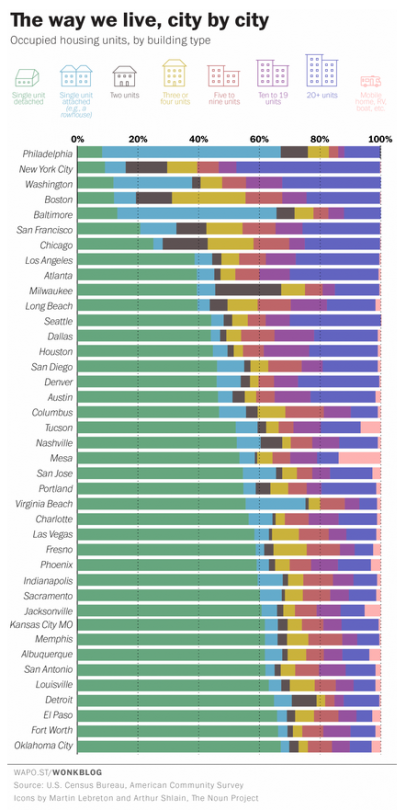
    Yesterday the Washington Post published a great chart showing the housing types of the 40 largest cities, by population, in the US. The list is ordered from lowest to highest according to the percentage of single-family houses in the city (green bar).

    Here’s the chart:

    image

    Not surprisingly, many of the cities at the top of this list (meaning they have the lowest percentage of single-family houses) are in the older east coast cities. 

    It’s also interesting to see just how much the rowhouse dominates the urban landscape in Philadelphia and Baltimore. In Philadelphia, almost 60% of the housing stock is an attached rowhouse.

    Housing is the backdrop for such a big portion of our lives. And when you live in a particular kind of home, it impacts your life whether or not you realize it. The dense rowhouses of Philadelphia and the single-family houses of Oklahoma City are the result of two very different kinds of urban landscapes.

    In Toronto, that backdrop is in the midst of a dramatic change. More and more of us are now living in high-rise condos. That hasn’t always been the case, of course. It’s a recent shift. But it looks like it’ll be a big part of our future.

  • Where will we live?

    image

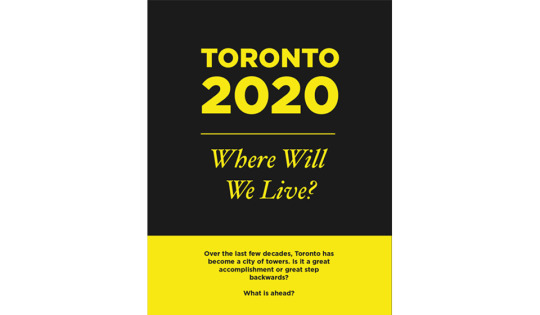
    This evening I participated in a roundtable discussion at WORKshop here in Toronto. It was part of an exhibition that they currently have on called, Toronto 2020: Where Will We Live? They are located in the concourse level of 80 Bloor Street West, so go check them out.

    The discussion this evening was all about the dramatic change in Toronto’s urban form over the last decade. In other words, the condo boom. We covered everything from the life cycle of buildings and urban design to demographics and policy. It was a lot of fun and I am certain the group could have continued talking all night.

    But one thing that I was reminded of this evening is how important it is for great city building to be cross-disciplinary.

    Take, for example, architects and (real estate) developers. 

    The stereotypical developer is greedy and only concerned with money. They don’t care about the impact that their buildings have on the built environment. On the other hand, the stereotypical architect is only concerned with design and not with the economic feasibility of projects. (I’m exaggerating here for effect.)

    The point is that neither of these participants in isolation could build a great city. A beautiful design doesn’t have much value if it can’t be financed and built. And a highly financeable project could end up contributing nothing to the city. In some cases it could actually detract from the built environment.

    So if we really want to build truly great cities, I believe it needs to be a collaborative effort. We need to bridge the divides in thinking and leverage each other’s strengths. 

    I have felt very strongly about this since I first started studying architecture as an undergraduate student, which is how I ended up taking business and real estate classes. I felt and continue to feel that the greatest opportunities exist at the intersection of different ways of thinking.

  • Survey: Homes for families

    I was looking through real estate listings this morning (which I do quite often out of sheer interest), and I started noticing a number of 3 bedroom condos (here in Toronto) that were priced under $1 million.

    Now, this is a lot of money now matter how you slice it. But given that the average price of a detached home in the city is now well over $1 million, I can’t help but wonder if condos will become more accepted as the family home.

    I’ve written about this topic a lot, because it’s something I’m interested in and I like living in a condo. But I’m seeing far more of my network looking for a low-rise house upon marriage/kids than for a bigger apartment/condo.

    So today I thought I would run a very quick survey. There are only 3-4 questions depending on how you answer and it basically revolves around housing type and whether or not you have or plan to have a family. I also ask what city you live in because I think this will have an impact on preferences.

    If you have 30 seconds, I would love to get your input and I’m sure the ATC community would be interested as well. The responses are anonymous, but I’ve made them public. Click here if you can’t see the survey below.

    [googleapps domain=”docs” dir=”a/brandondonnelly.com/forms/d/1wyMguhSlNv6pe6DS3duyJUqpzjImHI_KiYer1CKTVxo/viewform” query=”embedded=true” width=”640″ height=”600″ /]

  • Where are Millennials going to move when they start having children?

    Photograph Kembangan by Jason Waltman on 500px

    Kembangan by Jason Waltman on 500px

    Earlier this week I attended RealNet’s Q1 2015 market update webinar for the Greater Toronto Area. If you don’t already subscribe to RealNet, you should consider it. They’re one of the best sources for Canadian real estate market information.

    During their webinars, they occasionally run interactive surveys where they ask the audience a question and participants respond using their web browser. On this particular webinar, they asked the following question, which I thought was interesting:

    What is the likely housing moving by Millennials in raising their families?

    A) Move Up – Embrace urban high-rise housing forms

    B) Move Out – Accept extended commutes (including the Greater Golden Horseshoe and Hamilton Area) to find affordable ground oriented housing

    C) Move In – Cohabitate parental homes

    It’s an interesting question because it’s one that I’ve asked myself a number of times. Sure, Millennials are rushing back to cities and living in high density and walkable communities, today, but what are they going to do and where are they going to move when they start having children?

    As a Millennial myself, I know that I’ve always told myself that I want to stay urban for as long as I can (i.e. Move Up). But I’m only one data point. And given the seemingly endless demand for low-rise housing in Toronto, I always felt like I was in the minority. I figured that the majority of people, at least here in this city, still want a ground-related home when it comes time to raise a family.

    Putting aside economics, I still think that may be the case for a lot of home buyers. But the majority of people on this week’s RealNet webinar (which would be almost exclusively folks from the real estate industry) either think that preference is going to change (or already has) or that consumers won’t have a choice due to affordability.

    50% of the people on the call answered A – move up and embrace urban high-rise housing forms. The balance was about 44% for B and 6% for C.

    That’s not the outcome I expected to see. So today I’d like to re-ask this question to the Architect This City Community. Where do you think Millennials are going to move once they start having children? Please let us know in the comment section below.

  • Art and apartments

    Photograph Vancouver by Marc M on 500px

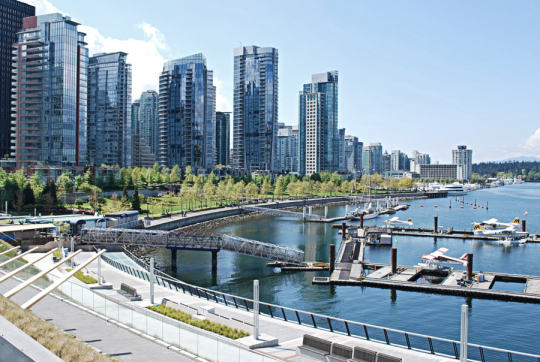
    Image Source: Vancouver by Marc M on 500px

    According to a recent Bloomberg article, this is where the rich are putting their money today:

    “The two greatest stores of wealth internationally today is contemporary art….. and I don’t mean that as a joke, I mean that as a serious asset class,” said Fink. “And two, the other store of wealth today is apartments in Manhattan, apartments in Vancouver, in London.”

    In case you wondering, Laurence Fink is the founder and CEO of BlackRock Inc., which today is the largest asset manager in the world. They have over $4.77 trillion in assets under management according to their website. That’s a mind boggling number.

    And if you read the Bloomberg article cited above, you’ll see that this interest in both art and apartments represents a shift away from gold as the de facto safe haven.

    “Historically gold was a great instrument for storing of wealth,” the chairman of BlackRock Inc. said at a conference in Singapore on Tuesday. “Gold has lost its luster and there’s other mechanisms in which you can store wealth that are inflation-adjusted.”

    What’s interesting and probably most relevant to the Architect This City community though is this investment focus on apartments.

    When people talk about a possible housing bubble in Canada they often cite house prices to median household income as a key ratio. The question then becomes: How can house prices be such a high multiple relative to local incomes?

    That’s relevant, but it’s not the entire story for cities like New York, London, and Vancouver. That ratio alone assumes that real estate isn’t a global investment vehicle. And for some people people it is exactly that.

  • A comparison between low-rise and high-rise housing costs

    Earlier this week the Globe and Mail reported that the average price of a house in Toronto has risen to $613,933 and that the average price of a detached house has risen to $1,042,405. Those are a big numbers.

    Low interest rates are a big part of this story. But there’s also a supply story at play here. The low-rise housing market in this city is heavily supply constrained and so we have an environment where people with more money simply outbid those with less money.

    The high-rise side of the market, on the other hand, is creating lots of new supply. And in my opinion that’s why its price growth has been more moderate in recent years and why the pricing spread between low-rise and high-rise housing continues to widen.

    Assuming these trends continue, one of the things I’ve thought about and written about in the past is whether we’ll eventually seeing a point where high-rise housing actually becomes a more affordable option for families. Because right now, if you’re in the market for a 3 bedroom home, a low-rise house is likely your most affordable option.

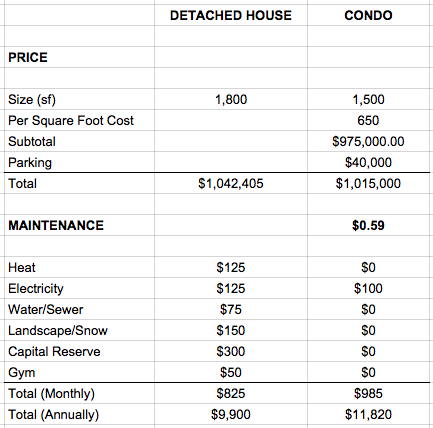
    Here’s a quick comparison that I did up this morning between a detached house and a high-rise condo:

    image

    For the detached house, I assumed 1,800 square feet at a price of $1,042,405. That’s the average price mentioned above. 

    For the condo, I assumed a 1,500 square foot 3 bedroom home. I priced it at $650 per square foot (which would be above average for the city) and then added $40,000 for a parking spot. Here you have a slightly smaller condo, but it’s also priced slightly less.

    I then compared operating/maintenance costs. For the condo, I assumed a maintenance fee of $0.59 per square foot (which I think is reasonable) and then added $100 per month for electricity. Typically electricity is billed outside of maintenance fees.

    For the detached house, I tried to create a similar living situation. I assumed that the owner wouldn’t be cutting their own grass or shovelling their own snow. I assumed that money would be put away each month as a capital reserve for future house expenses (similar to the reserve fund in a condo). And I assumed a gym membership since most condos have a gym. I ignored property taxes and insurance.

    The detached house still works out to be a less expensive to operate in this scenario, but not by much. Overall, the two appear quite comparable. Which is why I wouldn’t be surprised if we see a tipping point in the future where all of a sudden families start finally adopting the mythical 3 bedroom condo.

    I have published my spreadsheet to the web in case you disagree with my assumptions and want to create your own.

  • 3 stages of intensification

    image

    We all know that the Greater Toronto Area is growing and intensifying at an incredible pace. In fact, last year the region set a record with 25,571 new condominium units completed.

    If you listen to industry experts, such as George Carras of RealNet, they’ll tell you that this level of intensification — which usually means condominiums — is really a decade in the making. That’s when the government set out to explicitly encourage this type of growth.

    But in the decade since that decision, we’ve seen both government and the market evolve in terms of what that intensification should look like. It started out with a largely high-rise building typology. Tall buildings were to be allowed in the downtown, as well as in specific growth nodes throughout the region. But for everything in between — the officially designated “neighborhoods” — there was to be no development.

    This is what I’ll call the first stage of intensification.

    Then, we started to think about mid-rise intensification along the avenues. Most of these “avenues” (also an official term) cut through those same stable neighborhoods, but the main streets were seen as an appropriate place to allow additional growth. It makes perfect sense and so guidelines were created to help dictate what this new building typology should look like.

    This is what I’ll call the second stage of intensification.

    And it’s one that I’d argue we’re currently living through with new mid-rise projects like DUKE in the Junction (TAS project), Kingston&Co in Kingston Road Village (another TAS project), Abacus Lofts on Dundas West, and The Hive in Etobicoke. These are all mid-rise buildings going up in established neighborhoods.

    With the recent decision to also allow wood frame buildings up to 6 storeys in Ontario (instead of 4), we’ll probably see an even greater surge in mid-rise buildings once the private sector gets its head around this shift.

    So what’s next?

    I think it’s inevitable that we’ll eventually see low-rise intensification within our established neighborhoods. We started by avoiding them altogether, and then deciding that it was desirable to build along their periphery. But as demand for urban housing continues to increase, I believe it’s only a matter of time before we start to loosen the reins on our single family neighborhoods.

    Some of you might be thinking that this is going to be a bad thing, but I actually think the opposite. Projects such as Vancouver’s Union Street EcoHeritage prove that it’s entirely possible to intensify existing neighborhoods through sensitive and beautiful infill interventions. And of course, let’s not forget about laneway housing.

    The fact of the matter is that Toronto has already been intensifying its neighborhoods for a very long time — likely since the beginning — by converting single family homes into duplexes, triplexes, and other multi-family dwellings. We just haven’t been doing it in any sort of structured way.

    I don’t know when this will change, but I think it’s only a matter of time. And that will be the third stage of intensification.

    Image: Flickr