Daily insights for city builders, delivered every morning at 6 AM ET. I’m Brandon Donnelly — a Toronto-based real estate developer and founder of Globizen. I’ve been writing here since 2013.

Tag: health

  • NYC’s congestion relief zone is now on indefinite pause

    Boy, congestion charges are a pain to implement. Back in 2018, I wrote that New York City was considering a congestion charge for drivers entering Manhattan below 60th Street. Then in 2019, about a year later, I followed up with this post saying that the plan could be adopted as early as April of that year!

    That didn’t exactly happen. But I followed up again with a post in 2022 saying that New York City was still considering a congestion charge. And ultimately, it did finally get approved, even if it did take much longer than expected. It was rebranded a congestion relief zone (“relief” sounds a lot less offensive than “pricing”), and it was set to come into effect on June 30, 2024.

    This remained the situation until the first week of this month, which is when NY Governor Kathy Hochul held a surprise press conference and announced that the congestion relief zone would be placed on “indefinite pause.” I think that means cancelled. And it happened less than a month before the state was finally set to start collecting money.

    There is a legal question around whether she actually had the authority to intervene in this way, but let’s put that aside for now. Irrespective of that, this is a disappointing outcome precisely because we know that road pricing works. If you have a traffic congestion problem, price it, and then you will have less of it.

    What’s even more disappointing about this particular instance, though, is that many of us were looking to New York City to show us the way. We were looking for the most walkable and transit-rich city in the US to show people that, hey, road pricing works, and it won’t decimate your CBD.

    It is shocking to me that traffic congestion is allowed persist in the way that it does in our cities, and that there remains zero political will to actually address it. Instead of action, we like to preoccupy ourselves with red herrings. If only we didn’t have streetcars, Ubers, and so many bike lanes, then there wouldn’t be congestion.

    So what hope do we have now that even New York won’t do what is bold and right? Lots, as always. Cities, now is your chance to do what New York was too scared to do. Who will lead?

  • More people are cycling in Chicago

    One of the common criticisms of bike lanes is that most people don’t want to cycle in the winter. I mean, just look at Montreal’s winter cycling retention ratio.

    But that doesn’t mean that you shouldn’t invest in cycling infrastructure. Chicago, for instance, has been building out cycling infrastructure over the last few years (2020-2023) at an average rate of approximately 30 miles per year. This is double its rate from 2011-2019. And the results show.

    According to recent data from Replica and the Chicago Department of Transportation (CDOT), Chicago saw the highest growth in cycling among the 10 largest cities in the US between fall 2019 and spring 2023.

    Biking overall was up 119%. Crosstown trips were up 180% (bike trips that spanned across four or more neighborhoods). Trips related to shopping were up 117%. And notably, zero-car households were up 207%.

    Remember, this is a city that basically has the same weather as Toronto. It gets cold in the winter. And sometimes it snows. But clearly if you build good cycling infrastructure, people will use it.

  • Unnecessarily confusing communication from the CDC

    I saw a headline yesterday that the CDC was now reporting that vaccinated people can spread COVID just as easily as unvaccinated people. I then thought to myself, “this is not a good headline if you’re trying to encourage people to get vaccinated.”

    What I guess this is saying is that vaccinated people who end up contracting COVID (“breakthrough” cases) have similar viral loads to people who are unvaccinated. So it makes sense that they would then be able to transmit the virus to others.

    But the more important point remains that vaccinated people are less likely to spread the virus to others because they are less likely to actually get it in the first place.

    Yes, the vaccines are not 100% effective. But supposedly the latest hospital data suggests that vaccines remain 87% effective at preventing hospitalization. This, of course, means that some vaccinated people will still get sick and that, yes, they might transmit it to others.

    But for the vast majority of people that shouldn’t be the case.

    Update: My point is that clear and consistent messaging is important.

  • Blue Zones

    Over the weekend I learned about Dan Buettner’s Blue Zones. These are cities and parts of the world where, according to Dan, people have a much longer life expectancy. The five regions he identifies as Blue Zones are: Okinawa (Japan); Sardinia (Italy); Nicoya (Costa Rica); Icaria (Greece); and Loma Linda (California).

    Many of you have probably heard of this finding from Malcolm Gladwell. I think he writes about it in Outliers. I had. But I didn’t know about Dan Buettner and his efforts to teach these “secrets” to other regions around the world. 

    I can’t speak for the efficacy of his consulting practice, but I think it’s interesting that some of the characteristics of these Blue Zones include a strong sense of family and community, as well as constant moderate physical activity. In other words, activity that is integral to normal life, such as lots of hills in a mountain town.

    The links between urban form, walking and biking (instead of driving), and health outcomes are something that get a lot of air time. It is, of course, one of the reasons why denser cities are thought to be healthier cities. They encourage more active forms of mobility.

    But what else could we be doing to make physical activity an inseparable part of urban life? In Rio de Janeiro, they often incorporate fitness facilities into their public spaces, whether it’s a parklet or the beach. That probably doesn’t qualify as inseparable, but it’s certainly a start.

  • Human Development Index

    The Human Development Index (HDI) is a composite index that ranks countries based on four key indicators (3 dimensions):

    • Life expectancy in years (health)
    • Expected years of schooling (education)
    • Mean years of schooling (education)
    • Gross national income per capita (standard of living)

    Equal weighting (1/3) is given to each of the above dimensions: (1) health, (2) education, and (3) standard of living.

    And the resulting index value is a normalized number between 0 and 1, with the latter number representing the maximum possible value.

    Generally speaking, a country is thought to be developed or advanced when it has an HDI greater than 0.8.

    The way you calculate each dimension’s index value is by using the minimum and maximum limits set out by the United Nations.

    To give you an example, for gross national income per capita (standard of living), the minimum is $100 and the maximum is $75,000. (Logic behind these numbers, here.)

    Once you know the boundaries, you then use this formula for each dimension:

    Dimension Index = (Actual Value – Minimum Value) / (Maximum Value – Minimum Value)

    Each of the individual dimension indices are then aggregated together to create that country’s HDI.

    In 2017, the country with the highest HDI was Norway at 0.953. Brazil, which is what got me started thinking about this, was at 0.759. So not quite developed.

    Canada and the US were on top of each other at 0.926 and 0.924, respectively.

  • I love work

    I spent this morning drafting the third post in my BARED blog series. First one, here. Second one, here. If any of you would like to be featured next, or know of someone who you think should be featured next, please send me an email or tweet.

    At this point, I need to move onto other things today. But I did want to mention a post that Ev Williams (Blogger, Twitter, Medium…) recently penned where he talks about keeping technology in check and the drain of being always connected.

    Here are two interesting excerpts:

    “I’ve spent the last 20 years breathing and building the internet. So I have a good sense for the benefits of always-available instant access and all it entails. I also have a strong appreciation for the drain being constantly connected can cause on your health and sense of well-being.”

    “Building companies requires a ton of work — and I love work. But I’ve also found that working 24/7 no longer produces the best work product or the best life experience (not that it ever did).”

    This really resonates with me, as I am sure it does for many of you. I like being always connected. I like waking up every morning and writing a blog post. I like saying yes to things. And I, like Ev, love work. 

    But it can be draining when your ambition seems to exceed your body’s ability to keep on going. And when that happens, you no longer produce your best work, which is the whole point. 

    So in the end, I think we all need these little checks and balances. Exercise is number one for me. It is well worth the time it takes. What do you do for balance?

  • 2 new ways to think about economic inequality

    We talk a lot about economic
    inequality these days. We worry, among other things, that our successful cities
    are becoming playgrounds for the rich and that housing is becoming increasingly
    unaffordable for the middle class.

    Without negating the
    importance of things such as attainable housing, I’d like to offer up two,
    potentially new, perspectives on economic inequality.

    The first is an
    essay by venture capitalist Paul Graham
    . In it, he rationally unpacks, as he always does, the phenomenon of economic inequality. One of his key points is the distinction between rent seeking degenerate economic inequality and the economic inequality caused by rapid value creation (i.e. Two Stanford students decide to create a new search engine called Google).

    “If the rich people in a society got that way by taking wealth from the poor, then you have the degenerate case of economic inequality where the cause of poverty is the same as the cause of wealth. But instances of inequality don’t have to be instances of the degenerate case. If one woodworker makes 5 chairs and another makes none, the second woodworker will have less money, but not because anyone took anything from him.”

    Of course, Paul Graham is thinking about this from the perspective of a venture capitalist that funds startups and helps entrepreneurs get rich. But what about the impacts to people who live in a city where the rich are far richer than the poor?

    That brings me to the second perspective.

    A recent study, published in The Journal of the American Medical Association and written about in the New York Times, has discovered a surprising relationship between income and life expectancy across the United States from 2001 to 2014.

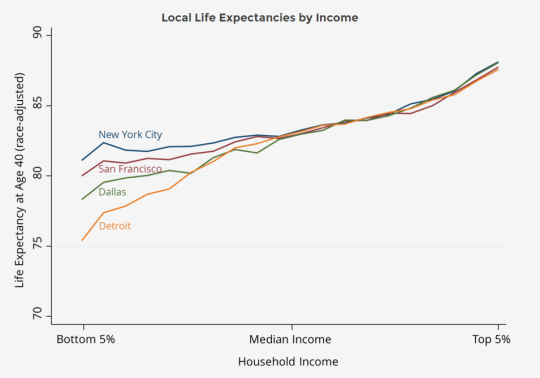
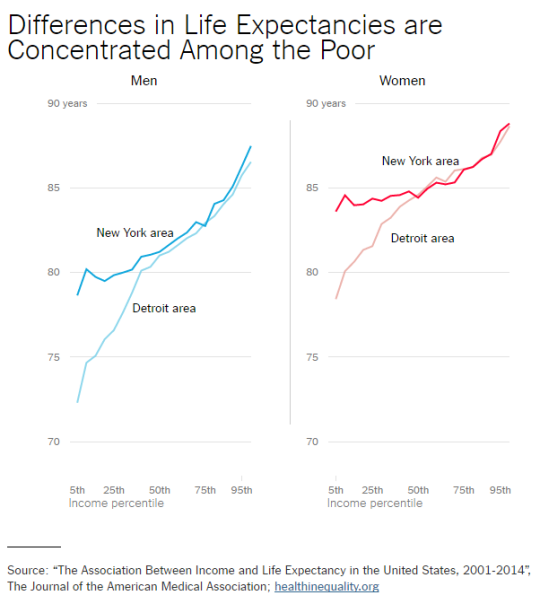
    What they found was that cities with high economic inequality – such as New York and San Francisco – actually have lower inequality when it comes to life expectancy. 

    Here is a chart from the New York Times:

    And here is a chart from healthinequality.org:

    If you’re rich, it doesn’t matter where you live. The life expectancy of a rich person in New York is roughly the same as a rich person in Detroit. (Though, as to be expected, women generally live longer than men.)

    However, as income levels fall, so does life expectancy. But it falls more in a city like Detroit than it does in New York. In fact, rich cities such as New York and San Francisco are almost model cities in this regard. Why is that?

    The biggest predictor appears to be health behaviors, such as smoking and obesity:

    “The research seems to suggest that living in proximity to the preferences — and tax base — of wealthy neighbors may help improve well-being. New York is not just a city of rich and poor, but also one of walkable sidewalks, a trans-fat ban and one of the most aggressive anti-tobacco agendas of any place in the United States.”

    So there you have it. Two, potentially new, ways to think about economic inequality.

  • The definition of a habit

    I recently heard someone define a habit as something that you need to do in order to feel normal. In other words, until you do it, you don’t feel yourself. 

    This, of course, could refer to both good habits and bad habits. And most of us probably have habits from both camps. But I like it as a clear and simple definition. 

    I’ve written about disciplines and habits a few times before, because I think of myself as having a few. The most public of my habits is this blog and, at this point, I certainly don’t feel normal if I don’t write everyday. I’ve missed a few days since I started writing in 2013 and each time I felt bad.

    My other big habit is going to the gym and lifting weights. And since my snowboarding injury back in February, I haven’t been able to do this properly (though I still tried). It’s easily the longest break I’ve taken from it since I started this particular habit when I was 16.

    Because of this, I really haven’t felt myself for about 2 months. My energy levels aren’t the same and I just don’t feel as mentally sharp. Those are some of the main reasons why I love this habit. And I still haven’t adjusted.

    Thankfully (with some help from Totum Life Science), my back and shoulder are finally starting to feel better. And so today, instead of writing about cities, I’m going to go to the gym and try and do one of my regular workout routines.

    I’m not quite at 100% yet, but I should be soon. And then I’ll finally feel normal again.

  • Spring forward with Apple’s new watch

    image

    Today was Apple’s big “Spring Forward” event. We already knew the Watch was coming, but now we know that it’ll be available for sale on April 24, 2015 and that their high-end “Edition” line will start at just $10,000.

    Within the tech community, there are mixed opinions when it comes to the Apple Watch. Some think it’ll be a total flop. Some think it’ll be the next iPhone. And some think it’ll do reasonably well, but that it just won’t be the next category killer for Apple.

    I personally think it will do really well. 

    I think there are enough use cases for which looking at your wrist is a better experience than pulling out your phone – particularly for quick glance activities. Think payments, transit fares, airline tickets, location-based notifications, and so on. 

    However, one of the big challenges for Apple Watch will be that they’re trying to replace an entrenched fashion piece. So not only is Apple trying to solve a problem that most people didn’t know they had, but they’re also trying to get people to give up their Movado or Patek Philippe – which is why they created a super high-end line.

    Whatever the case may be, I plan to pre-order a Watch next month (just the regular one, not the $10,000 one).

    I’m excited to try the health features (it’s a passion of mine). I’m excited to see what kind of data this new device generates both for me personally and in aggregate. And I’m excited to see what clever software developers end up creating for this new platform. Because that’s where the real potential lies.

    It might not seem like a big deal to move a computer from your pocket to your wrist (assuming people are willing to do that). But I think we’ll all be surprised at what kind of new ideas that generates.

    Hopefully I’ll soon be able to board a Toronto streetcar and tap my wrist to pay the fare. That would certainly be a civilized way to travel.

    What about you? Do you plan on buying an Apple Watch?

  • Architecture and well-being

    I haven’t spent a lot of time in hospitals. So I may not be the best judge of what I’m about to say. But why do we design hospitals to be so depressing? Why do they have to look so, well, clinical?

    I asked this question on Twitter a few days ago and I was recommended to listen to a 99% Invisible podcast called The Blue Yarn. If you haven’t yet heard of this podcast series, I would highly recommend you check it out (in addition The Blue Yarn episode).

    What this particular podcast was about was rethinking hospital design in terms of patients, as opposed to staff hierarchy. And the way they illustrated the need for that was through some simple blue yarn.

    Using yarn, management physically mapped out the paths of patients as they moved through this particular medical center. And what they found was a tremendous amount of waste. There was a lot of waiting around (in dingy rooms) and a lot of unnecessary moving around.

    Instead of putting patients first, the hospital had been designed in terms of staff offices and other criteria. Ultimately, this exercise ended up triggering a complete redesign of the hospital.

    After the redesign, there were a lot of grouchy doctors who had lost cushy offices. Some even quit. But the hospital became more efficient, more profitable, and, most importantly, safer for patients. So much so that their insurance expenses dropped by 37%!

    But this obviously isn’t the only foray into rethinking hospital design. In fact, there’s something out there called “evidence-based hospital design”, where the objective is to leverage data and actual evidence to figure out the relationship between architecture and patient well-being.

    One of the pioneering studies in this area was done in 1984 by Roger Ulrich. 

    The study took patients in Pennsylvania recovering from gallbladder surgery and split them up into two groups. The first group was given a room with a beautiful nature view and the second group was given a room with a view of a brick wall.

    What they discovered from this experiment was that the group with the view of nature not only recovered faster but also needed fewer painkillers during the recovery. That’s a fascinating finding.

    So it’s not surprising that this sort of thinking is making its way into contemporary hospital design. And that’s a great thing.

    Hospitals should be uplifting, restorative, and beautiful spaces. Does that not seem sensible?