Daily insights for city builders, delivered every morning at 6 AM ET. I’m Brandon Donnelly — a Toronto-based real estate developer and founder of Globizen. I’ve been writing here since 2013.

Tag: global cities

  • Winner-take-all cities

    Richard Florida, Charlotta Mellander, and Karen M. King have a new working paper out called Winner-Take-All Cities.

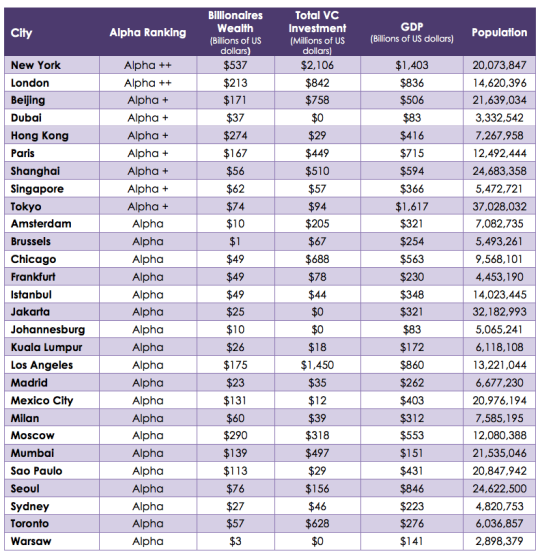
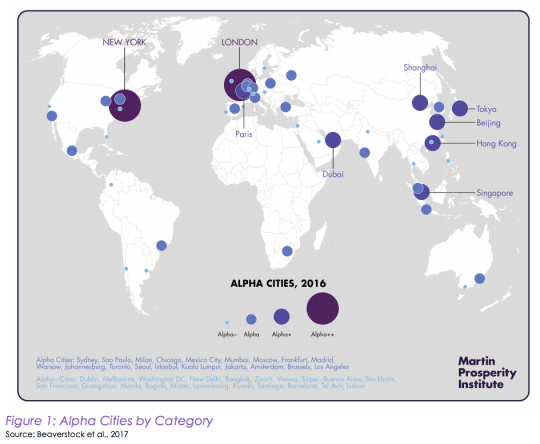
    It is about the phenomenon of “winner-take-all urbanism” and how a select number of alpha cities seem to overrepresent when it comes to talent, economic activity, innovation, and wealth creation.

    In this study they look at economic output, innovation (venture capital-backed startups), and billionaire wealth in each city. They then compare these factors to the distribution of the population.

    Here are the Alpha cities they looked at:

    In some cases the above concentrations were multiples of what the city’s population would lead you to predict. Their conclusion: “We find clear evidence of a winner-take-all urbanism
    across the global economy and the world’s cities.”

  • 4,000 years of urban history

    image

    The Guardian recently published an extract from a book by Greg Clark called, Global Cities: A Short History. 

    The article and book cover 4,000 years of urbanization. More specifically, Clark explains why some cities become global leaders, others do not, and why it is common for cities to rise and fall over time – at intervals that are only becoming shorter.

    Below is an excerpt that talks about Amsterdam’s rise in the 17th century; a period of time known as the Dutch Golden Age. In the 1600′s, Amsterdam became the undisputed financial capital of the world and spawned the very first stock exchange. (Though, let’s not forget about Tulip Mania.)

    “Amsterdam took over the mantle from Antwerp and Genoa as Europe’s major commercial city during the 1600s, and it developed many of the technologies that underpin today’s global cities. The overthrow of the Spanish elite, which had hampered the interests of powerful local merchants, granted more freedom to Dutch traders. Soon after, the blockade of Spanish Antwerp triggered a flight of capital and talented entrepreneurs to Amsterdam.“

    "The protestant city became prized for its safe port, political stability and access to inland waterways. It maximised its appeal by guaranteeing equal protection to all merchants, wherever they came from, while developing standardised institutional norms. A relaxed attitude toward interest-bearing loans spurred the development of modern finance in Amsterdam, including maritime insurance, making the city both the logistical hub and the trade financier of Europe.”

    Certain things have changed. Maritime pursuits were once paramount to a city’s success, whereas today, connectivity happens in a myriad of other ways. But other things have not changed. 

    As I read through the article, I couldn’t help but notice a few reoccurring themes. Being closed to innovation and immigration didn’t work in the past and I don’t believe it works today.

  • Big, bold, and global

    I love the way that urban planner Joe Berridge thinks about Toronto and city building. He is constantly considering our position on the global stage and urging us to fight for a top position by executing on real and meaningful projects. 

    Here is a recent article from the Toronto Star which lists some of those projects. They include everything from a new convention center to creating a fourth university (in addition to the University of Toronto, York, and Ryerson).

    Here’s a snippet:

    We could get “lost in domesticity — very nice, but that’s not enough,” he says, drawing on his experience leading urban renewal projects around the world.

    Toronto’s social cohesion is enough to attract 125,000 new people each year to the region. But they won’t stay if we can’t employ them and provide opportunities. And that requires global thinking.

    Berridge says it is the city’s “moral obligation” to use its taxing power, its wealth, its status as Canada’s only global city and the historical advantages of public education, public health and public services to propel Toronto into super city status.

    Cities will often talk in nebulous terms about being “world class.” That isn’t all that helpful. Let’s be specific and also acknowledge that great things cost money. Are we a top tourist destination? Are we a top convention destination? Are we attracting the smartest people in the world with the best schools? Do we have the best transit and health care systems in the world?

    Toronto is a great city and so it’s perhaps easy to become complacent. But past performance is not an indicator of future outcomes. We need to think in global terms. We need to keep in mind that this is an international competition. And every day all of us step onto that field.

    Thank you Joe for constantly reminding us of that.

  • The lure of super-places

    image

    If you’re a very talented person, you have two choices: you either move to New York or you move to Silicon Valley. This is the message that Peter Thiel delivered to a conference being held in Chicago earlier this month. Not surprisingly, it pissed a few people off.

    Peter responded by saying that he was simply illustrating the “extreme version” of a metaphor about the impacts of globalization and technology. And while it certainly doesn’t sound very nice if you’re sitting in Chicago, or the countless other fantastic cities between the coasts, I can appreciate what Peter is getting at.

    Saskia Sassen is known for coining the term global city. These are cities which play an important role in the functioning of the global economy. But what has happened, she acknowledges, is an even further concentration of activity within a select few “super-places.”

    Here is an excerpt from a Financial Times article by Simon Kuper (2014) talking about Amsterdam’s position in the world:

    “…a new, higher category of cities may now be emerging: global capitals. Amsterdam has risen but New York, London and Hong Kong have risen faster. The Dutch elite is moving to Amsterdam; but many ambitious Dutch people no longer want to join the Dutch elite. They want to join the global elite. That often requires moving to a global capital.”

    Anecdotally, I can say that almost everyone I know who has left Toronto for an opportunity has moved to New York, Silicon Valley, London, and so on. They have moved up the rank of global cities/capitals.

    So while Peter may not have chosen the right way to deliver this message, I do believe it is a message worth delivering.

  • Where the world’s billionaires live

    The Martin Prosperity Institute here in Toronto recently published an interesting report called The Geography of the Global Super-Rich.

    What they did was use the Forbes 2015 Billionaire List to chart billionaires and billionaire wealth by location and by industry. They also looked at the wealth gap in each location and whether the wealth was self-made or inherited.

    A correlation analysis was also done to see what key variables – such as population, density, economic output, global city standing, VC investment, and so on – were positively correlated with a greater concentration of super rich people.

    There are 1,826 billionaires across the world according to Forbes. The researchers were able to match 99% of them to a specific metro area / primary residence.

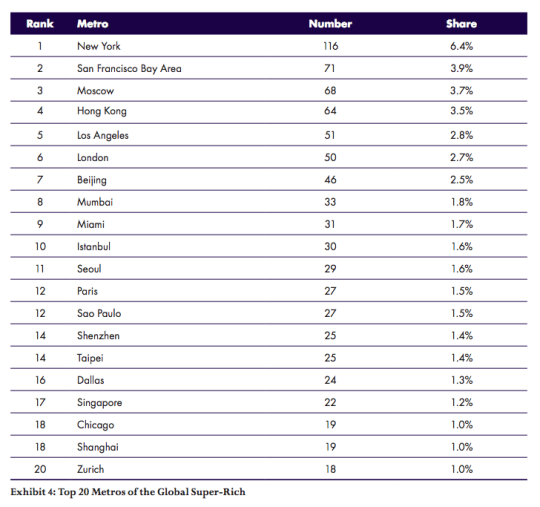
    Here are the top 20 metro areas in terms of the number of billionaires:
    image

    Look at Miami at #9. 

    I suspect that this may surprise some of you. But Miami has grown into a significant global city. As one of my friends from Miami likes to tell me: “The best thing about Miami is that it’s a Latin American city that’s so close to the United States.”

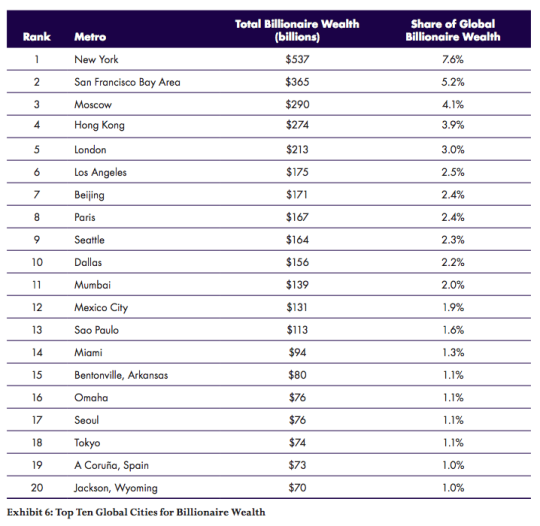
    Here are the top 20 metro areas in terms of total billionaire wealth: 
    image

    A bunch of changes on this list because of extremely wealthly people and families in places like Bentonville (Arkansas) and Omaha.

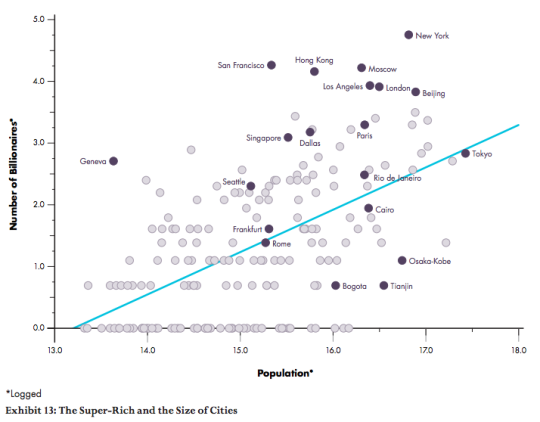
    One of the conclusions of the report is that the size of the city generally matters:

    “The geography of the super-rich is a function of larger cities. Both the number of billionaires and their net worth are positively associated with the population of global cities, with correlations of 0.56 for the number of billionaires and 0.44 to their net worth.”

    Here is a chart comparing population to the number of billionaires:
    image

    Cities such as New York, Moscow, and Hong kong, which sit far above the blue line, have more billionaires than their population size would predict.

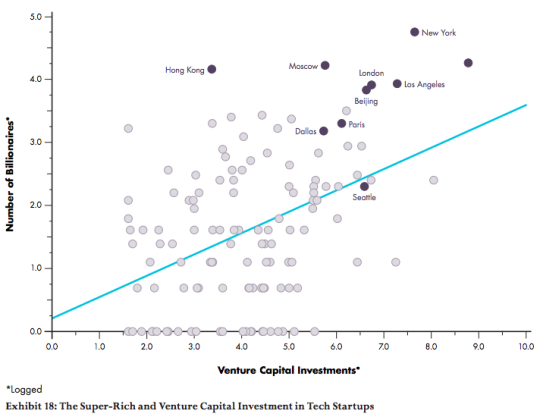
    Here is a similar chart comparing venture capital investment to the number of billionaires:
    image

    Once again, there is a positive association.

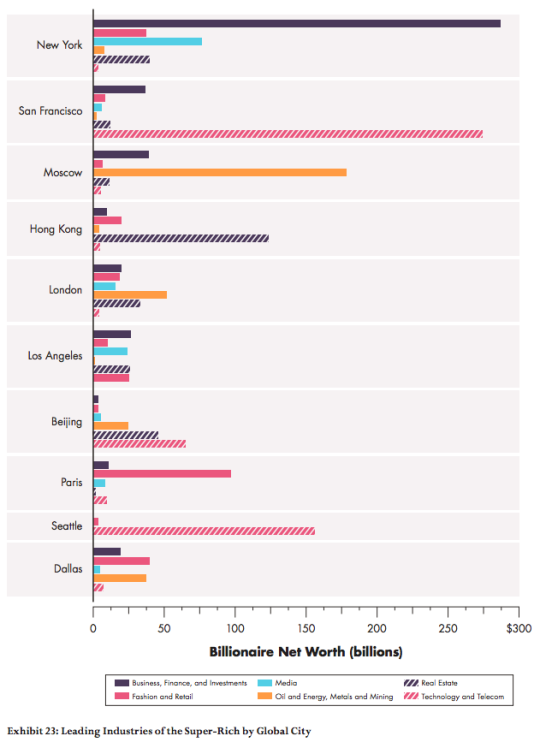
    Finally, here are a two charts that show which industries have produced the most billionaires:
    imageimage

    If you’re interested in this study, you can download the full report here. All of the charts were sourced from the report.

  • Journeys by walking

    Arup, the global consulting firm, has an interesting publication out called Cities Alive: Towards a walking world. The report highlights 50 benefits of walking and then 40 actions that city leaders can take today to transform their cities. The entire study was informed by examining 80 international case studies.

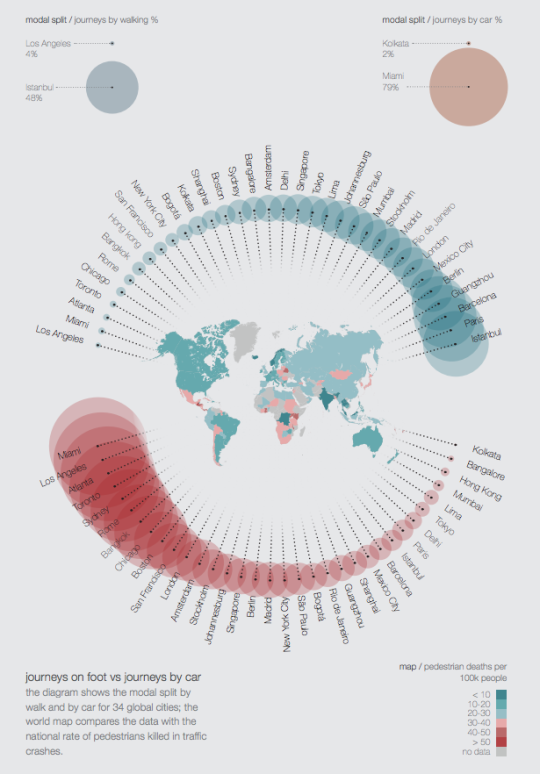
    As I was going through the report, the following diagram caught my attention. It compares journeys on foot vs. journeys by car for a collection of global cities.

    The turquoise circles represent % of journeys by walking. On the left is Los Angeles at 4%. And on the right is Istanbul at 48%.

    The red circles represent % of journeys by car. On the left is Miami at 79% (with Los Angeles right beside it). And on the right is Kolkata at 2%.

    The map in the middle of the circles represents pedestrians killed in traffic crashes per 100,000 people.

    I’m not sure where the data was drawn from, but it’s not all that surprising to see a few North American cities clustered towards the left (less walking; more driving). Still, I wonder how “journey” is defined.

    To view the full report, click here. Arup also produces a lot of other great content that you can download for free, here.

  • In support of a super-metro

    I just got home from a couple of coffee meetings, an afternoon bike ride and an impromptu basketball shootaround. Toronto is a different place in the summer. And it feels great to be biking everywhere.

    But Toronto is more than just Toronto. Toronto is at the center of a much larger urban agglomeration. And our continued success is going to partially hinge on our ability to work together in a coordinated way.

    Greg Spencer of the Martin Prosperity Institute recently published an interesting article called: Is it time to create a super-Metro? Here’s what it’s about:

    Our research at the Martin Prosperity Institute shows that economic competition is now primarily between cities rather than countries. To be successful in this environment, Toronto and its neighbours need to find a way to erase local divisions and solve their problems together. 

    Toronto is a wildly successful city, world-class in many respects. When our current institutional arrangements were forged, no one predicted the level of growth the region is experiencing. Status quo local government arrangements cannot adequately deliver the level of co-operation and collaboration needed to cope and plan for the future.

    Greg believes that the answer is a new regional authority that could give “democratic legitimacy to the very important decisions being made for the benefit of the wider region.” 

    I’m not going to comment on how all of this should be executed, but I fully agree that we need to think and act as one consolidated urban entity.

    Cities are the economic driver of the new global economy, but many (most?) of our governance structures do not properly reflect that reality. And the risk is that we are allowing arbitrary municipal boundaries and lack of coordination to hinder our ability to compete globally.

    This goes for Toronto and it goes for every other city region around the world.

  • Prime property appreciation around the world

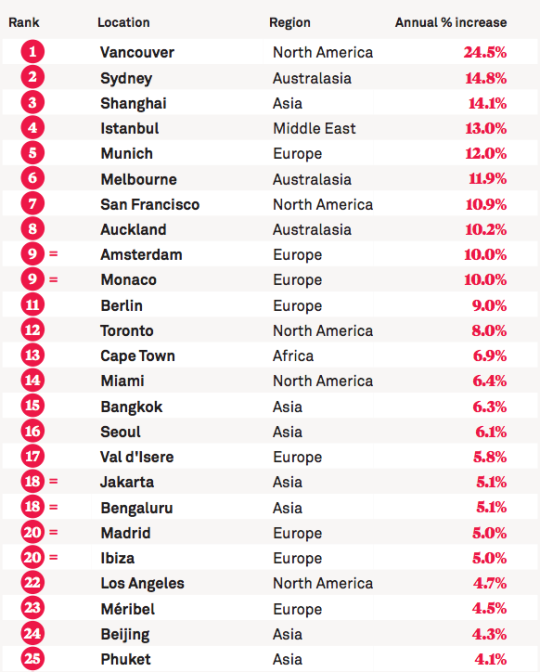
    Every year for the last decade, Knight Frank has published something called The Wealth Report. I’ve written about it before, but it’s basically a look at “prime property” and global wealth.

    As part of the report, they have something called the PIRI 100. It’s their “Prime International Residential Index”, which looks at luxury residential property prices around the world. They generally define “prime property” as being the top 5% of each market according to value.

    This year, the top 25 locations in their PIRI 100 are as follows (for the most part, the data is up to December 2015):

    image

    Here in Canada, we like to talk about the insanity of the Vancouver and Toronto real estate markets. This list helps to put that into perspective. Even by global standards, Vancouver is at the top of the pack by quite a significant margin. 

    It’s worth noting that since this is a “prime property” index, it’s pretty safe to assume that the buyer profiles for these sorts of properties would have a significant international bias. So in a way, this list is really about global capital flows.

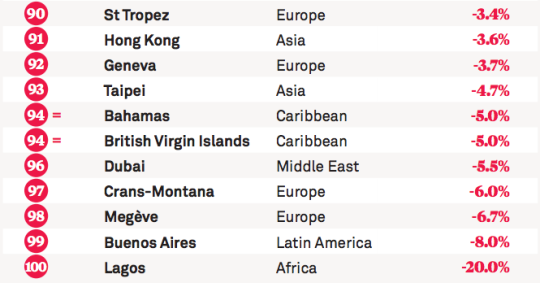
    Here are the bottom 10 locations on this year’s list:

    image

    If you’d like to see the full list, click here.

  • A new era of (digital) globalization

    McKinsey recently published a report called Digital globalization: The new era of global flows.

    The overarching thesis is that we are transitioning to a data-driven global economy:

    “Flows of physical goods and finance were the hallmarks of the 20th-century global economy, but today those flows have flattened or declined. Twenty-first-century globalization is increasingly defined by flows of data and information. This phenomenon now underpins virtually all cross-border transactions within traditional flows while simultaneously transmitting a valuable stream of ideas and innovation around the world.”

    One of the benefits of this shift is that it has become easier for emerging economies and individuals from all around the world to participate.

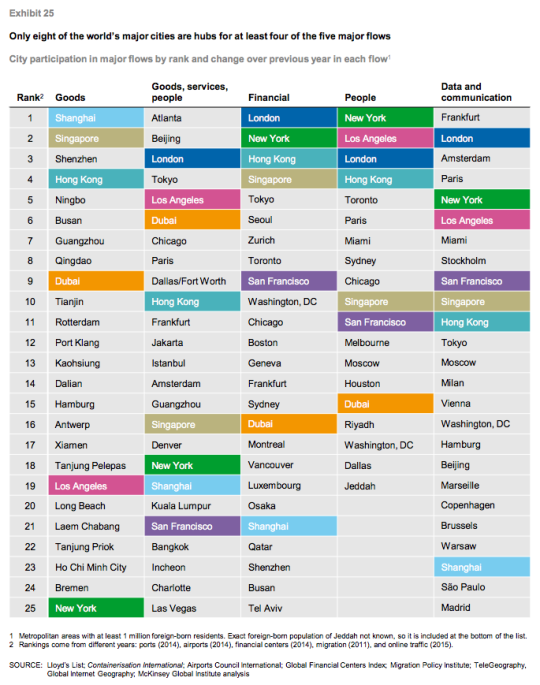
    Of course, not all countries and cities are participating equally. In their report, McKinsey ranks the top cities according to five global flows. In each case a proxy was used:

    “Unfortunately, data on global flows are not available at the city level. However, we have obtained data that serve as proxies for each of our five global flows. Container port volumes approximate goods flows; airport passenger volumes serve as a proxy for goods, service, and people flows; the ranking of cities in the Global Financial Centers Index by the Z/Yen Group provides an indication of financial flows; the number of foreign-born residents in a city measures people flows; and Internet bandwidth approximates data flows.” 

    Using this methodology, they believe that the world only has 8 truly global cities right now: New York, Los Angeles, San Francisco, London, Singapore, Shanghai, Hong Kong, and Dubai. They are the colored cities listed below:

    I always take these city rankings with a grain of salt. This stuff is not easy to quantify and a lot depends on the methodology that you use. 

    For instance, Atlanta sits on the top of “goods, services, and people” because it has the busiest airport in the world according to passenger volume. (It’s the primary hub of Delta Air Lines.) But is that enough to assert that Atlanta is #1? Maybe. Maybe not.

    In any case, the report is packed full of information. If you’d like to take a look, click here.

  • 10 city building predictions for 2016

    Dawn by Adrian Popan on 500px.com

    https://500px.com/embed.js

    Few things are better than waking up in the mountains and seeing a notification on your phone that 9″ of fresh snow have fallen overnight, bringing the 48 hour snowfall total to 16″.

    This is what people in mountain towns live for. They ski in the morning and then head to work in the afternoon. I heard a number of people on the mountain today saying that they, “want to be in the office after lunch.” It’s a lifestyle thing.

    On that note, today I’d like to focus on 10 city building predictions for 2016. I’ve been assembling this list over the past few weeks and now that I have had my fill of Utah powder for the day, I’m dedicating the rest of the afternoon to writing.

    These are never easy to put together. But here are my thoughts:

    1. We will see increased migration to secondary cities – outside of the alpha global cities – which offer a higher quality of life, more affordable housing, and the ability to live a particular lifestyle. This includes cities like Austin (creative startup hub) and Denver (outdoor recreation).
    2. As more and more cities wake up to the importance of lifestyle in attracting top talent, I think we will see a lot of cities follow the lead of Amsterdam and create “night mayors” or some other equivalent. These cities will begin to see nightlife as a competitive urban advantage.
    3. Global cities will start experimenting with different land use and property tax reform strategies to try and deal with rising income inequality and eroding housing affordability.
    4. We will see a barbell of residential unit sizes. We’ll see more well-designed small units as a way to try and promote housing affordability and we’ll see larger urban infill units for families and baby boomers who want to live/remain in walkable urban communities.
    5. In line with above, I think we will see a further rethinking of urban spaces. Flexible spaces, unique program mixes, and a continued blurring of public/private spaces. One example of this is the trend towards small private spaces surrounded by generous public/communal spaces.
    6. The Toronto and Vancouver real estate markets will continue to chug along because of low interest rates, a weak Canadian dollar, and increased foreign investment. That said, I think we will see more restraint when it comes to over-the-top luxury product.
    7. We will finally see a disruptive technology product that starts to get people in the real estate industry thinking that change is on the way. This will not be a product that ports an offline experience online; it will a new way of thinking about the industry.
    8. This will be the year that cities stop fighting Uber (and other similar marketplaces). Cities (and lobbyists) will finally accept that this is a new reality and then work to figure out the best way to create policy around it. Edmonton, Alberta has already become the first Canadian city to regulate Uber.
    9. Road pricing will get the attention it deserves in North America. Things will start out slow, but we will finally get ourselves on a path which recognizes that we can’t build our way out of traffic congestion in most major cities.
    10. I will publish a book on becoming a real estate developer.

    Many city building trends and shifts seem to happen in a global way. But I think it’s worth noting that a lot of these predictions were likely written with my North American lens on, and in some cases my Toronto lens on.

    It’s not easy sitting down and thinking about what will happen in the future. But it’s a worthwhile exercise. It forces you to take a stance and then, when the future does come, you can see how well you did. I saw Fred Wilson do this on his blog and I thought it was a great idea.

    Now I would love to hear what you think about my predictions and what yours are for this year. Please let us know in the comment section below.