Daily insights for city builders, delivered every morning at 6 AM ET. I’m Brandon Donnelly — a Toronto-based real estate developer and founder of Globizen. I’ve been writing here since 2013.

Tag: fred wilson

  • Today I am N+1

    Today is my birthday. 

    I am one year older, at least at face value. This got me thinking about something I read a number of years ago on Fred Wilson’s blog called The N+1 theory. The basic premise is as follows: whatever it is, there could be one more. It is an optimistic viewpoint that emphasizes continuous improvement and change.

    For example, let’s say you’re designing a building and you’re trying to make it as energy efficient as possible. You might think that you’ve arrived at the most efficient outcome, but in fact you’re probably just sitting at N. Stretch yourself. Go for N+1.

    Let’s say you’re working out at the gym and you feel you’ve done as many reps as you could possibly do. Well, if you stretched yourself, you could probably do N+1. People who lift weights will also tell you it’s that one additional rep that counts the most. 

    The mantra: Do as many or as much as you can possibly do (N), and then do one more (+1). The N+1 theory is a growth mindset. And if you apply this thinking throughout your life, I am sure you would see many benefits.

    At the same time, one could imagine this theory being applied in a destructive way. In a relationship, for instance, is it healthy to think of your significant other as N, meaning that you should be looking for someone better? That N+1. This strikes me as an unhappy way to live. I would prefer to apply this theory in a productive way. 

    Whatever the case may be, today I am firmly N+1. And I feel good about that.
  • This is not right

    I have largely avoided commenting on politics and Trump on this blog, but at this stage it is almost impossible to do that.

    Donations are starting to pile up for the American Civil Liberties Union (ACLU) as the tech community, and many others, begin to respond to Friday’s executive orders. Lyft announced a $1 million contribution to the non-profit group.

    Today, venture capitalist Fred Wilson wrote: Make America Hate Again. And yesterday, his business partner Albert Wenger wrote: Misleading the World on Immigration.

    At 6 AM this morning, Richard Florida started a tweet storm where he argued that “Trump’s immigration insanity” will fundamentally threaten the core of America’s innovation hegemony. 

    (He also argued that Canada, and more specifically Toronto, serve to “gain substantially”, as there will no doubt be a doubling down on tolerance to attract the best talent from around the world.)

    The Canadian tech community penned an open letter to reinforce the message that, here in Canada, diversity is our strength. This echoes similar messages from Prime Minister Justin Trudeau and Mayor John Tory.

    Mass protests have broken out at US airports (links to photos) spanning San Francisco to New York. 

    And I am seeing folks from Toronto offer up their homes (publicly on Twitter) to anyone who might be stranded at Pearson International Airport as a result of the orders. Many have even tweeted out their phone numbers.

    Everywhere I look this weekend I am seeing these sorts of messages. So while I could remain quiet, that doesn’t feel right. And that’s because what is happening is not right.

  • Tesla is winning the arms race

    “If we have data, let’s look at data. If all we have are opinions, let’s go with mine.” – Jim Barksdale, former Netscape CEO

    Fred Wilson wrote a post yesterday about Tesla’s data advantage in this self-driving car arms race that we are currently living through. (I found the above quote in the comment section of the post.)

    In their Q3 2016 update, Tesla claims to have logged more than 1.3 billion miles on its vehicles equipped with Autopilot hardware. This is important because the more data it collects – across diverse road and weather conditions – the better the vehicles get at driving without human intervention. As Fred Wilson put it: “more data is better than more software engineers.” So that places Tesla ahead of Google, Uber, GM, et al.

    I spent a lot of time driving over the past week, certainly more than usual, and I couldn’t help but think about how much better it would have been to instead sit in the backseat and read a book (or mindlessly scroll through Instagram).

    I always try and use cruise control on long drives, but unless the road is fairly empty, I find it doesn’t work very well. Everyone is driving at different speeds and so I usually end up having to reset it / adjust it every so often.

    The big question in my mind is still: How does the world look when driving longer distances doesn’t suck so much? What changes when you can get into your / a car (important distinction) at bedtime, fall asleep, and then wake up in a new place?

    A lot, I think.

  • It’s content marketing

    Oscar Wilde once said:

    “There is only one thing in life worse than being talked about, and that is not being talked about.”

    I’m sure that all of you can think of someone right now who subscribes to the philosophy that any press is good press.

    But there is something to be said about exposure. Almost every company on the planet wants it. They pay for it.

    They fight for it.

    It’s the lifeblood of business. If nobody knows who you are and what you do, you’re dead.

    In my view, one of the best ways to gain exposure today is content marketing. Marketing sometimes has negative connotations, but content marketing is probably the least offensive varietal. It’s a soft, rather than hard, approach. It invites you in and tries to earn your trust, instead of hitting you over the head with an ask.

    But at the same time, it’s a more difficult form of marketing. You have to be insightful. You have to be useful. And you have to try and create value for people on a regular basis. That’s easier said than done. I try and do that every day, but I don’t always succeed.

    I say all this because we live in a content-driven world. In fact, this blog – despite it being a personal one – is a form of content marketing. I like how Fred Wilson responded on his blog to the criticism that too many entrepreneurs treat venture capital blogs as scripture:

    “So how should entrepreneurs use this knowledge that is being imparted by VCs on a regular basis? Well first and foremost, you should see it as content marketing. That is what it is. That doesn’t mean it isn’t useful or insightful. It may well be. But you should understand the business model supporting all of this free content. It is being generated to get you to come visit that VC and offer them to participate in your Seed or Series A round. That blog post that Joe claimed is not scripture in his tweet is actually an advertisement. Kind of the opposite of scripture, right?”

    Again, that doesn’t make the content necessarily bad. It’s just the truth. It’s content marketing.

  • The rise of tech outposts

    What happens when wages and real estate prices become too high in a city? Companies start growing in lower cost locations. We’ve all seen this before. 

    Fred Wilson recently blogged about this “spillover effect”, citing a New York Times article talking about the growth of tech offices in Phoenix. As someone who sits on the board of many technology companies, he was noticing a thematic trend:

    “A big theme of board meetings I’ve been in over the past year is the crazy high cost of talent in the big tech centers (SF, NYC, LA, Boston, Seattle) and the need to grow headcount in lower cost locations.”

    We talk a lot about housing prices on this blog, and so I think it’s useful to see how this, along with high wages, also impacts companies. The two are interrelated.

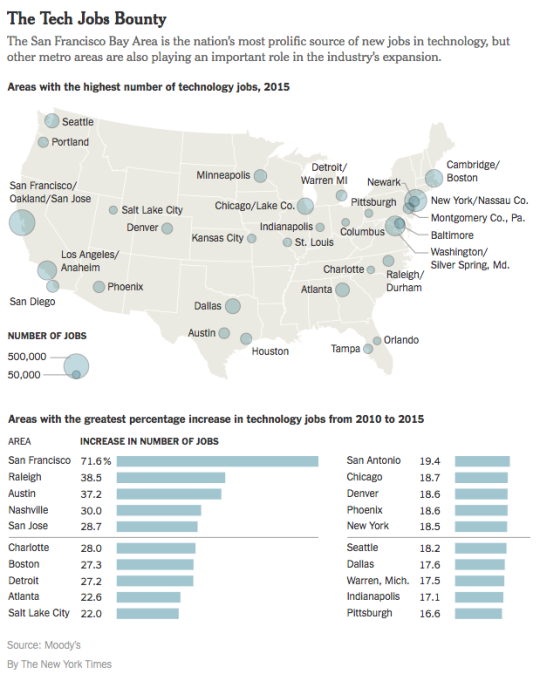
    Below is a chart from the NY Times article showing the US cities with the highest number of technology jobs and the most growth from 2010 to 2015. 

    San Francisco is in a league of its own. But overall, the growth is in tech and many cities are adding lots of technology jobs. Look at Detroit and Boston right beside each other (Detroit obviously has a smaller starting base). And look at how Miami is nowhere to be found.

    Of course, one interesting question is whether these new outposts – such as Phoenix – can truly come into their own and carve out a niche:

    “We don’t want to be San Francisco’s back office — we need more creators here,” said Scott Salkin, a founder and the chief executive of Allbound, which is based in Phoenix, makes sales software and has offices down the hall from Gainsight’s.

    Even with the high cost of living, it’s hard to supplant the coastal hegemony. That’s where people go to chase riches. As comedian Daniel Tosh likes to say, “the middle of the country is for people who gave up on their dreams.”

    Though for some, living in a place like Denver or Salt Lake City and snowboarding every weekend is a better outcome than living in a studio apartment and commuting an hour to work.

  • Business model innovation

    Fred Wilson has a great post up on his blog today about open protocols. By open protocols he is referring to things like TCP/IP (transmission control protocol and internet protocol), HTTP (hypertext transfer protocol), and SMTP (simple mail transfer protocol). Whether you realize it or not, you rely on these protocols every single day if you go on the internet, browse the web, and write emails.

    If you’re interested in these sorts of nerdy things, I recommend you read his post. I’m not going to write about open protocols today – though I do find them fascinating. Instead, I would like to talk about the last paragraph of his post. 

    Here it is:

    “I believe that business model innovation is more disruptive that technological innovation. Incumbents can adapt to and adopt new technological changes (web to mobile) way easier than they can adapt to and adopt new business models (selling software to free ad-supported software). So this new protocol-based business model feels like one of these “changes of venue” as my partner Brad likes to call them. And that smells like a big investable macro trend to me.”

    This is interesting to me for 2 reasons.

    First, business model innovation is incredibly powerful. Once a company has built itself up around an existing model, it can be painfully difficult to change. Imagine you have a 200 person sales team that would become unnecessary should you pivot your business model. Are you going to fire them and make the switch?

    This is also one of the reasons why some tech companies can exist for so long before they make any money. Sometimes – but not always – it’s because the investors believe that if the company has users, attention or whatever it may be, that they will figure out a way to monetize them/it. And maybe, just maybe, it’ll be a business model that no one has ever thought of before.

    Second, look how he is publicly sharing his investment thesis. Why would he do that? Shouldn’t he just go off and do it and not tell anyone? Clearly, he too believes that there’s greater value in being open and transparent.

  • Home prices and negative interest rates

    This morning, I am looking at the following chart of average home prices in the Greater Toronto Area:

    It’s from this Globe and Mail article.

    These are staggering numbers. The average price of a detached home in the suburbs (905 area code) increased 21% year-over-year. In the city (416 area code), the increase was 19.6% YOY. These numbers are almost unbelievable.

    The article focuses on low supply (decrease in listings) and high demand. And that is certainly a big part of what’s going on here in this city, as well as in many others.

    But of course, the backdrop to all of this is our low / zero / negative interest rate environment.

    Larry Summers has a great post on his blog (which I discovered this morning via Fred Wilson) that talks about this “remarkable financial moment.” In some instances, real interest rates are actually negative! (You should read his post.)

    There are always people threatening that interests rates just have to go up. But Larry, as well as others, continue to argue that natural real interest rates are likely to remain close to zero going forward.

    Fred mentions Albert Wenger on his blog this morning and I have written about him before as well, here. In his book World After Capital, Albert argues that capital is no longer the scarce resource of our time. Instead, it has become attention.

    If you believe all of this to be true, then perhaps the numbers at the top of this post aren’t so unbelievable after all.

  • What technological deflation could be doing to the economy

    Earlier in the week, I came across this post (via Fred Wilson), arguing that rapid technological progress is causing systemic deflation in the broader economy.

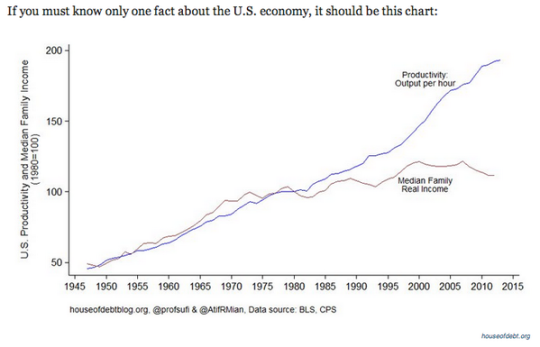
    Here’s a chart that illustrates the author’s point:

    What is happening here is that despite advances in technology and increases in productivity, real wages have been stagnant for decades. (This chart is for the US, but it likely applies to many other countries.)

    This is an interesting paradox. For a long time, increases in productivity were met with corresponding increases in income. So why the divergence?

    The author believes that it’s because the gains brought about by “extreme technological progress” are being unequally applied to the economy. In other words, they do not benefit the majority of people. He then goes on to argue that we could be entering an entirely new macroeconomic era: 

    “Economic growth may be over soon, at least in absolute terms. On the other hand that will be at least partially offset by the technological deflation. So instead of the decline of the innovation it will be just the opposite, the explosion of the innovation that will turn the economy to the decline. And moreover, it will not be a tragedy since we will be able to produce higher standard of living with fraction of the GDP today. Few adjustments needs to be done into our economic system to cope with the change for sure.”

    When you read things like this it makes the idea of a “basic income guarantee” seem far more palatable.

    The other chart that stood out to me was this one below, which shows the declining cost of solar panels and the rise of global solar panel installations. 

    It’s a great reminder that it’s only a matter of time before we wean ourselves off of oil. And, that we could be headed towards some sort of third industrial revolution where the marginal cost of energy is almost zero. Already about 25% of Germany’s electricity comes from renewables.

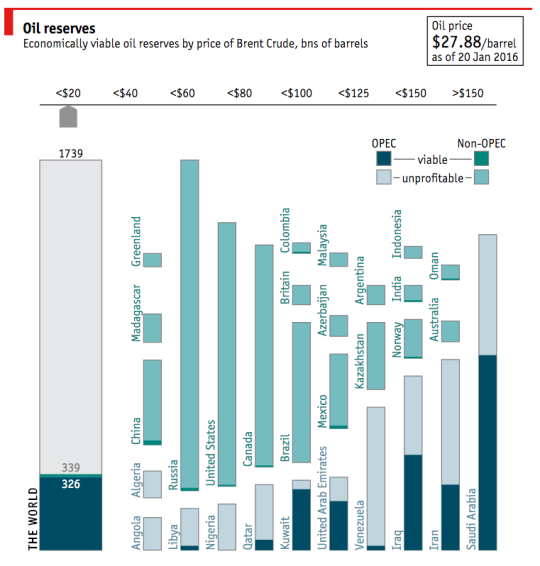
    On that note, I am going to end with a fantastic interactive chart from The Economist (screenshot below) that outlines oil reserves around the world by country. If you click through to their website, you can then toggle the price of oil (per barrel) to see how much of those reserves are actually viable.

    With the price of oil where it is today ($27.88 per barrel as of January 20, 2016), there are only a handful of countries with profitable oil. I am sure you could have guessed which ones.

    What will happen if, or should I say when, that oil is no longer needed? 

  • Fred Wilson on where the New York tech ecosystem is heading

    Venture capitalist Fred Wilson is the poster boy for the New York tech industry. And this morning he posted an interesting video on his blog of a recent talk he did at Google NYC.

    At the 4:50 mark he begins talking about the evolution of the tech sector in New York and how it became what is probably the second most active startup hub in the United States.

    Given yesterday’s post on talent and the recent CityAge conference I participated in, I thought this video would make a great follow-up. There’s talk of lifestyle, diversity, gender equality, and talent within cities.

    Fred is heavily involved in growing and improving computer science education in New York, which is a perfect example of how cities can better leverage the people and talent they already have – as opposed to just focusing on bringing in new talent. Coding is a valuable skill to possess.

    I also found it interesting that Fred ended up in New York precisely because his wife wanted to live in New York. And that had a lot to do with all of the things you can do in the city, outside of work.

    If you can’t see the video below, click here.

    [youtube https://www.youtube.com/watch?v=_fZCrasNIfQ?rel=0&w=560&h=315]

  • The evolution of unions

    Today is Labo(u)r Day in Canada and the United States.

    It is the official end of summer for a lot of people, which is always a bit sad. (Unlike a lot of people I know, I’m not a huge fan of fall.) But primarily, today is a day to celebrate the labor union movement.

    Fred Wilson wrote an excellent post on his blog this morning about this topic. I agree with him and he put it far better than I could this morning. So here are a few snippets:

    When one looks back over the history of the development of the modern economy from the agricultural age, to the industrial age, to the information age, the development of a strong labor movement has to be one of the signature events. Capitalism, taken to its excesses, does not allocate economic value fairly to all participants in the economic system.

    I am a fan of the idea that labor needs a mechanism to obtain market power as a counterbalance to the excesses of markets and capitalism. I think we can look back and see all the good that has come from a strong labor movement in the US over the past 150 years.

    However, like all bureaucratic institutions, the “Union” mechanism appears anachronistic sitting here in the second decade of the 21st century. We are witnessing the sustained unwinding of 19th and 20th century institutions that were built at a time when transaction and communications costs were high and the overhead of bureaucracy and institutional inertia were costs that were unavoidable.

    Click here for the full post.

    On that note, I am in the market for new – ideally daily – blogs to read. Blogs such as this one, which generally focus on a particular topic but are written by one person and are a bit personal in nature. I find those are where the best online communities develop.

    If you know of any, please leave the link in the comment section below. A lot of readers have also asked me for similar recommendations, so I am sure they would appreciate the suggestions.

    Happy long weekend 🙂