Daily insights for city builders, delivered every morning at 6 AM ET. I’m Brandon Donnelly — a Toronto-based real estate developer and founder of Globizen. I’ve been writing here since 2013.

Tag: fred wilson

  • Uber to go public in 2019

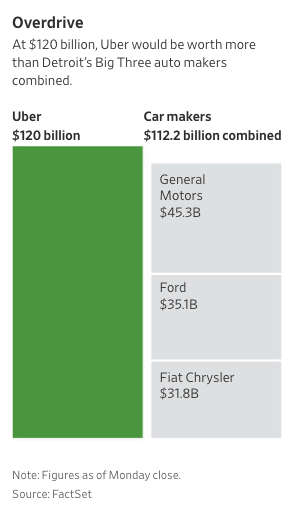
    Last week it was announced that Uber had confidentially filed for an IPO (right after Lyft did the same). It could go public as early as Q1 of next year. And supposedly, a valuation of $120 billion is being tossed around. The company last raised money in August of this year (from Toyota) at a $76 billion valuation.
    image

    Here are a few other interesting figures from a WSJ article published in the fall:

    – Uber has indicated that it doesn’t expect to be profitable for at least another 3 years. This year it is expected to hit between $10 and $11 billion in revenue, compared to $7.78 billion last year.

    – First Round Capital invested about $1.6 million in Uber’s first two fundraising rounds (2010 and 2011). If the company does in fact reach a valuation of $120 billion in the public markets, that early investment will be worth $5 billion. (First Round sold some of their shares to SoftBank in January and I’m not sure if the above figure accounts for that.)

    – Over 50 companies have invested in Uber since its founding, not including a slew of individual investments from people like Jeff Bezos of Amazon.

    On a related note, Fred Wilson, who is far more knowledgeable on this topic than I, recently published a post talking about the relationship between the private and public markets and what could happen to (tech) valuations in 2019. 

    It’s a good follow-on read to the above.

    Figure: WSJ

  • Winner take all

    We have talked a lot on this blog about the concentration of economic activity in global cities. Here is an old post about a paper called “winner-take-all-cities”, which documents the overrepresentation of talent, economic activity, innovation, and wealth creation in a select number of alpha cities.

    But this same phenomenon is playing out in a myriad of different ways. Aaron Renn calls this the “superstar effect” and has been writing about it for years. Another more recent example is this post by Richard Kerby called: Where did you go to school?

    Kerby looked at where venture capitalists in the US went to school and discovered that around 40% of them have gone to one of two schools: Stanford or Harvard. His argument is that not only is the venture capital industry lacking in gender and racial diversity, but it’s also lacking in cognitive diversity.

    My point with this post, though, is one of hyper-concentration. Tech is a dominant force in today’s economy. And in 2017, nearly 45% of all venture capital investment in the US went to companies located in the Bay Area – meaning San Francisco and San Jose.

    So here is an example of a select number of schools training a select number of minds that then go on to invest in a select number of cities. Fred Wilson, who is a venture capitalist, has a good response to this problem of diversity in the VC industry.

    But, of course, this is bigger than just the VC business.

  • Airbnb and affordable housing

    image

    Fred Wilson published a good post last weekend on the proposed bill that went to New York City Council this week regarding new reporting requirements for Airbnb and their hosts in NYC. You can read more about his position on his blog, but he is in favor of a comprehensive bill that would properly legitimize short-term rentals. He is also not opposed to city and state taxes on the service.

    What I wanted to focus on today were his comments around housing. This is already sounding like a broken record, but Fred draws attention to the severe supply-demand imbalance that is occurring in the boroughs of Brooklyn, Queens, and the Bronx, precisely because many/most young people were priced out of Manhattan long ago and want to live in these places.

    But I particularly like his comments around what makes for good policy and what makes for good politics. I agree with his view that it is often a case of the latter over the former. I think a lot of the excitement around Airbnb is a red herring. For me, it’s akin to the fixation on foreign buyers and their impact on the local housing market in places like Toronto and Vancouver.

    Yes, they are factors. But the data suggests they are marginal ones. As Fred points out, they are almost certainly not the root cause of the problem. The reality is that we need a lot more housing – both market-rate housing and subsidized housing. The challenge is that nobody wants to pay for the latter and so we’ve instead decided to focus on things that sound like they’re going to help.

    Photo by Jon Tyson on Unsplash

  • Two sides of the same bitcoin

    Warren Buffet recently said in a Yahoo Finance interview that when you buy cryptocurrencies you’re not actually investing. Instead, you’re speculating – speculating that “somebody else will come along and pay more money tomorrow.” Investments need to generate a return. And nobody is at all clear on how to value these crypto-assets. This is noteworthy, of course, because it’s Buffet.

    But I thought Fred Wilson wrote a good rebuttal on his blog where he points out that, while, yes, a discounted cash flow model isn’t going to be very useful in helping you determine value in this instance, what we are actually seeing is, “the creation of a new internet, built upon protocols that allow for decentralized networks to form…” We’ve talked about this many times before on the blog.

    So where I stand on this debate is that I agree with both Warren and Fred. I don’t see crypto-assets as something I want to start putting a lot of money into right now because I don’t know how to calculate what the IRR may be. But at the same time, if crypto-assets are creating decentralized infrastructure that will one day power the “new internet”, I am positive this new internet will eventually create businesses that will fit into Warren’s definition of an investment. 

  • First day of summer

    Today was the first day of the year that truly felt like summer here in Toronto. It also happens to be my birthday. 

    So I did the only sensible thing one should do on a day like this. I went to a rooftop patio after work, with my family, for two of my favorites: a bowl of spaghetti al limone and a negroni. Simple.

    image

    In other news, Fred Wilson wrote a great post on his blog today about why he loves Canada and why it is an increasingly important place for the tech sector. 

    For those of us who already know that Canada is the greatest country on earth, it’s a noteworthy post not because it is likely to tell you a lot of new things, but because it was written by Fred fucking Wilson.

  • What’s the realtor jiu-jitsu move?

    Today’s post is a set of related questions for all of you.

    Fred Wilson has a post up on his blog today called, The Jiu-Jitsu Move. It’s about how people often dismiss new technologies, market entrants, and/or consumer behaviours as silly; whereas the real power move is to embrace and leverage them. That’s what he is calling the jiu-jitsu move.

    He gives a few examples, but for obvious reasons this one stood out to me:

    I spent the day yesterday at a real estate industry event and talked to a lot of agents about the fact that their clients are often more informed than they are these days. I encouraged them to embrace that fact and use it to their advantage and not fear it. It is hard when you have grown up in an industry when your advantage was information and you no longer have that working for you.

    For all the agents (and real estate consumers) who read this blog, I am curious if you agree with the above. Are consumers increasingly more informed than agents? I am sure that many of you will disagree. But if things are really changing, what should the jiu-jitsu move be?

  • What happened (in tech) in 2017

    I am still catching up on reading after being mostly offline last week, minus short windows where I would go online to upload these daily blog posts.

    Here is a post that Fred Wilson wrote on new year’s eve about “what happened in 2017.” It has become a tradition of his to write a “what happened” post on the last day of the year and a “what is going to happen” post on the first day of the new year. He then uses these posts to keep track of how well he does on his predictions for the year.

    His three headlines for 2017 were: (1) crypto; (2) the beginning of the end of white male dominance; and (3) the tech backlash (i.e. tech is the new Wall Street). It is worth a read. Crypto was an obvious one, but he has been writing about it – and investing in the space – for years. Of particular interest in this post is how he positions it as the basis for Internet 3.0 (the decentralized internet).

    What is also clear from the post is just how ingrained tech has become in our everyday lives and how much it reaches beyond simply the tech industry. I have been saying this for years, which is why I spend a lot of time writing about it on this blog.

  • Depression babies

    Recently I’ve been seeing a number of posts/articles talking about the dot-com bubble. It seems to be driven by talk of a pending crypto bubble. 

    Whatever the case may be, the recounts are interesting. In this one by venture capitalist Fred Wilson, he talks about how 90% of his net worth went to zero following the crash. And the only reason it wasn’t all of his net worth was because he was fortunate enough to sell some tech stocks in advance of the crash to buy “two significant pieces of real estate.” The two properties were 10% of his net worth before the crash and 100% of his net worth after the crash.

    Fred goes on to talk about how he had to learn about diversification the hard way. And this reminded me of a theory that many of you are probably familiar with called “depression babies”. This is the belief that large macroeconomic shocks – such as the Great Depression and the dot-com boom – create a lasting impact on people’s propensity to take financial risks.

    And indeed, there’s evidence to suggest that this is in fact the case. In this 2010 paper by Ulrike Malmendier and Stefan Nagel, they came to the following conclusion: “Our results show that risky asset returns experienced over the course of an individual’s life have a significant effect on the willingness to take financial risks.”

    I often think about this with respect to my own career. I started working in real estate before the 2008 financial crisis. I also happened to be living in the U.S. at the time – where it was far worse than in Canada. We got off easy. I remember seasoned real estate professionals telling me that it was going to take at least 20 years before the U.S. would build another commercial office building. It was that bad. And that was the sentiment at the time.

    Of course, that wasn’t the case. It didn’t take two decades to resume building. But I like to think that 2008 will remain permanently etched in my mind. It’s my reminder that crashes can and will happen. Don’t forget that. Stay disciplined. At the same time, it’s my reminder that these periodic crashes create opportunities. Because fear invariably makes us overshoot the mark.

  • Thoughts on labor, and the end of summer

    Well, just like that, the unofficial end of summer. Labor Day weekend. But I agree with Shawn Micallef: “Defy the crowd and keep enjoying summer.” There are still weeks of it left.

    But given that it is Labor Day weekend, here are two things to think about. 

    The first is a Financial Times article by Lawrence Summers where he argues that America needs unions more than ever and that, indeed, the central issue of American politics today is the “economic security of the middle class.”

    Here is an excerpt that speaks to declining bargaining power on the part of labor:

    “But I suspect the most important factor explaining what is happening is that the bargaining power of employers has increased and that of workers has decreased. Bargaining power depends on alternative options. Technology has given employers more scope for replacing Americans with foreign workers, or with technology, or by drawing on the gig economy. So their leverage to hold down wages has increased.”

    It’s also worth mentioning that only about 6.4% of private sector workers in the U.S. are in a union today. This is a decline of almost two-thirds since the 1970s and is a good segue into the second thought of this post.

    Two years ago Fred Wilson wrote a post on his blog (which he reblogged today) where he argued that “labor needs a mechanism to obtain market power as a counterbalance to the excesses of markets and capitalism.” 

    But, that this mechanism needs a refresh. He calls it Union 2.0.

    “However, like all bureaucratic institutions, the “Union” mechanism appears anachronistic sitting here in the second decade of the 21st century. We are witnessing the sustained unwinding of 19th and 20th century institutions that were built at a time when transaction and communications costs were high and the overhead of bureaucracy and institutional inertia were costs that were unavoidable.”

    This makes perfect sense to me. 

    At the same time, we can’t forget – and this is how Summers ends his article – that, today, “the most valuable companies are the Apples and the Amazons rather than the General Motors and the General Electrics.”

    That tells me that what may have worked in the past will likely not work in the future.

    Photo by Jonas Viljoen on Unsplash

  • Crane capital of America

    When people like Richard Florida talk about today’s “superstar cities”, the usual suspects include London and New York for finance, the San Francisco Bay Area for tech, Milan for fashion and design, and so on.

    And you can certainly find the data to back up these claims. For instance, if you look at venture capital dollars invested, many of these same cities reappear near the top: San Francisco, San Jose, New York, etc.

    One city that doesn’t often appear on these sorts of lists, though, is Seattle. 

    However, clearly something special is taking place in the city. For the second year in a row, Seattle has been named the construction crane capital of America. No other American city comes close right now. (However, Toronto is still #1 in North America.)

    At the same time, if you think about all of the companies that have come out of Seattle over the years, you start to realize that maybe VC dollars invested isn’t enough to tell the entire entrepreneurial story.

    Venture capitalist Fred Wilson once said on his blog that if you look at dollars in and dollars out, Seattle outperforms – by a lot. And that’s very interesting to me. Is this simply the lasting legacy of Microsoft? Or are there other – transferable – lessons to be learned here?