Daily insights for city builders, delivered every morning at 6 AM ET. I’m Brandon Donnelly — a Toronto-based real estate developer and founder of Globizen. I’ve been writing here since 2013.

Tag: financial times

  • How Europe is reopening

    Just over a month ago, as North America was beginning its lockdown, the Europeans were the ones showing us how to stay sane in quarantine through balcony orchestras and viral internet videos. Now we’re looking to them for how best to reopen the economy and minimize the number of fits and starts.

    • This morning Spain recorded its lowest daily death rate from the coronavirus. It is beginning to prepare for a phased relaxation of its lockdown rules. Things will not return to normal overnight. [Financial Times]
    • Spain allowed construction activity and manufacturing to resume this past week. As a reminder, Spain’s strict lockdown started on March 14. [New York Times]
    • Bookstores are open in Venice, but that’s about it. Customers have to enter one at a time, or schedule an appointment. Hotels, restaurants, and cafes remain shuttered. It is believed that at least 1/6th of all Italian restaurants and bars will not survive. Reopening is not happening uniformly across Italy’s 20 regions. [Wall Street Journal]
    • Last week, Denmark became the first country in the Western world to reopen elementary schools. The desks are far apart and teaching outside is being maximized, but some/many are concerned that this is too soon. Are we prioritizing the economy (i.e. free up the parents) over the health of our children? [New York Times]
    • The Czech Republic currently has one of the lowest number of cases on the continent. But hardware stores and bike shops are some of the only nonessential businesses that are allowed to be open. The Easter weekend saw an over 60% increase in year-over-year sales. Biking is something to do right now. [Wall Street Journal]
    • On Monday, the lockdown will be further relaxed by the Czech government. Weddings of up to 10 people will start to be allowed. Gyms are expected to open on May 11, but their change rooms will remain closed. (I’m surprised by this one.) Malls, hotels, and indoor restaurants aren’t expected to reopen until June 8 at the earliest. Should the number of new daily cases exceed 400 going forward, the government has said it will reimpose a lockdown. [Wall Street Journal]
    • The UK is not yet considering a relaxation of its lockdown. As of Sunday, the situation remains “deeply worrying.” The UK currently has the 5th highest national death toll. [Globe and Mail]
    • On April 13, Emmanuel Macron announced that France would begin a phased reopening of its economy — schools and some businesses — starting on May 11. This is a unique approach. He gave a firm date, well into the future. What if this doesn’t make sense when the time comes? Clearly the government felt that the psychological benefits of a firm date outweighed the potential risks. Minimize uncertainty during an uncertain time. [Le Monde]
    • Lots of discussion around the porosity of borders. Logically, there’s a view that unless there’s a common strategy, it’s better to keep borders closed. But what are the economic implications of doing that? [New York Times]

    Photo by Grant Lemons on Unsplash

  • COVID-19 in the developing world

    One of the things that Bill Gates mentions in his recent TED talk about the coronavirus is that we need to be aware of what might be coming in developing countries, particularly in the southern hemisphere with winter about to arrive. (There’s some evidence of a relationship with temperature.)

    So far, countries like Brazil have been criticized for taking a laid-back approach to fighting the coronavirus. But the same could be said for many, or perhaps most, countries around the world at the outset.

    However, in the case of densely populated slums — like Brazil’s favelas — the problem is expected to be more severe. Without the ability to socially isolate and without proper services, it is questionable whether they will be able to “flatten the curve” in the same way that some developed countries have. There’s also a lack of government oversight in these communities.

    Incidentally, the Financial Times is reporting that organized crime has started to step in to fill this void — and it is happening over WhatsApp. Here is an excerpt from the above article: “Whoever is caught on the street will learn how to respect the measure. We want the best for the population. If the government is unable to manage, organised crime resolves,” read one message sent to residents of a Rio de Janeiro slum.

    One hope is that rich countries will be largely through their outbreaks by the summer and that a vaccine will be well on its way.

    (On a related note, here is an excellent slide deck from the London Business School on the economics of this pandemic. It’s very comprehensive and worth a read.)

  • The latest coronavirus figures

    The Financial Times has some of the best charts/graphics that I have seen on the coronavirus and its impact. They’re also free and regularly updated. Below is the cumulative number of deaths, by number of days since the 10th death (last updated March 23 at 21:00 GMT). I prefer this to the number of cases because it is more precise, though impacted by things like demographics. The number of cases is impacted by how good you are at testing. Some countries have been far better than others. And what we are continuing to learn is that lots of people were and are completely asymptomatic.

    Seeing China (and Iran?) continue to flatten out is encouraging. (Note the logarithmic scale.)

    Here has been the impact to the Chinese economy. It’s slowing coming back.

    And here are traffic volumes around the world. This chart was published on Sunday, March 22. At that time, Tokyo looked to be largely business as usual.

  • How temperature impacts the transmission of COVID-19

    The Financial Times published the following chart last night. It shows the cumulative number of COVID-19 cases around the world, across the number of days since the 100th case in that particular country. The message here is that most western countries appear to be on a similar trajectory. (The grey dotted line represents a 33% daily increase.) Whereas in Asia, and in particular Hong Kong and Singapore, they have seemingly managed to slow the spread.

    Now, there are a number of possible explanations for the outliers; everything from stricter quarantine rules to more rigorous testing. There’s also an argument that Hong Kong and Singapore were better prepared as a result of the SARS outbreak in 2002. (More on these explanations, here.) But the other factor at play seems to be climate.

    A recent study (by Jingyuan Wang, Ke Tang, Kai Feng, and Weifeng Lv) has concluded that, like the flu, the transmission of COVID-19 appears to be significantly impacted by both air temperature and relative humidity. In their research, they looked at the reproductive number (R), or the severity of infectiousness, for all Chinese cities with more than 40 cases between January 21 to 23, 2020. (Large-scale government interventions began on January 24, 2020 and would have therefore skewed the numbers.)

    What they found was that for every one degree Celsius increase in temperature and every one degree Celsius increase in relative humidity, the reproductive numbers drop by 0.0383 and 0.0224, respectively. Air temperature, in other words, has more of a positive impact on containing spread than relative humidity — which feels right. That is also apparent when you look at the above charts. Take note of Korea, Iran, and Italy near the top left corner of the temperature chart.

    If you’d like to download a full copy of the research paper, click here.

  • Economies of agglomeration in London

    The media tends to describe agglomeration economies — one of the benefits of big urban areas — as being entirely serendipitous. Minimize travel. Maximize chance encounters at the local coffee shop. And then all of a sudden patents will go up and new startups will emerge. That does that happen, I’m sure, but there’s a bit more structure to a lot of these encounters. Economies of agglomeration is not just about serendipity. It is about the benefits of and the decision to concentrate economic activity.

    Last week, a think tank in the North of England (IPPR North) published a report outlining, among other things, job creation and productivity across England. Based on these metrics, London and the South East dominate, with “productivity” in London being by far the highest. Almost half of England’s new jobs over the last decade were in these two regions. Above is a chart from the Financial Times. The trade-off is wealth and income inequality. And the report does look to how the government could address this centralization of power and wealth.

    Like Singapore’s low fertility rate, this is an instance of leaning into the wind.

  • Berlin apartment rent freeze has frozen capital expenditures

    Last year, the city of Berlin agreed to a five year rent freeze for some 1.5 million flats constructed before 2014. The way it was initially approved is that it would freeze rents at mid-2019 levels and allow for only 1.3% inflationary increases. All of this is being challenged in the courts, but the Financial Times is suggesting that it could still come into force by March 2020. Here is an excerpt from a recent article. (Guy Chazan isn’t holding back about the kind of people that he believes Berlin attracts.)

    The legislation, which should come into force by March this year, is City Hall’s response to a lingering housing crisis that shows no sign of easing. Packed out with Brexit refugees, international party people and wannabe tech entrepreneurs, Berlin is in expansion mode, its population growing by 40,000 a year. Yet affordable housing remains scarce. Rents have doubled over the past decade, as new residential construction fails to keep up with soaring demand.

    As I mentioned before on the blog, these policies are not intended to apply to new buildings. That would surely choke off new construction, which would only exacerbate the underlying supply issue that Berlin is facing. But not surprisingly, this move has also put a freeze on capital expenditures, according to the same FT article. Local trades are complaining that, “It’s as if someone’s just turned out the lights.”

    Photo by Gilly on Unsplash

  • A crisis of regional imbalance

    Last week’s general election in the UK was yet another example of the urban-rural divide that we are all seeing emerge around the world. Taking a look at this chart from the Centre for Towns, it’s pretty clear that the type of community someone lives in (i.e. how urban), says a lot about the way in which they probably voted. In big cities, the vote share was 49% Labour. And in villages, communities, and small towns, the vote share was about 48-58% Conservative.

    But what does this stem from? According to John Burns Murdoch of the Financial Times, the biggest predictor (for constituencies) of a swing vote over to the Conservatives during this last election was the share of the population in a blue collar job. Here is a graph from John’s article. Circles with a black outline are constituencies that changed hands last week. Note Great Grimsby, which I wrote about here, in the top right corner.

    These facts probably aren’t all that surprising to most of you. But it is an important reminder of how concentrated the new economy is becoming in big — or perhaps I should say, certain — cities. The Brookings Institution recently referred to this as “a crisis of regional imbalance.” Because it’s not just a case of urban vs. rural. Brookings found that from 2005 to 2017, more than 90% of innovation sector growth in the US could be traced back to just five metro areas. (You’ll be able to guess most of the five. Only one stood out for me.)

    This is the world we live in.

  • Berlin approves rent freeze on existing apartment buildings

    Berlin just approved a five year “rent freeze” on apartments in the German capital. The rent caps will be implemented on January 1, 2020, but will apply retroactively to all rental agreements from June 18, 2019 onward (which is when the decision was made). It is estimated that this new law will apply to some 1.5 million apartments.

    The move is in response to rapidly rising apartment rents, which grew about 12% in 2017 alone. So I can appreciate where this is coming from.

    From what I have read, it will not apply to new construction, which is the first thing I checked when I saw the decision. That would have almost certainly choked off any new apartment construction in the city. With a capped top line, it wouldn’t take long for costs to increase and make new rental construction infeasible.

    That said, a similar squeeze is liable to happen for existing buildings. It is one thing to cap rents (revenue), but what about utility, maintenance, labor, and other operating costs (expenses)? As costs rise and operating margins tighten, it can become exceedingly difficult to reinvest in, or even maintain, an apartment building.

    For more on the announcement, here’s an article from FT.

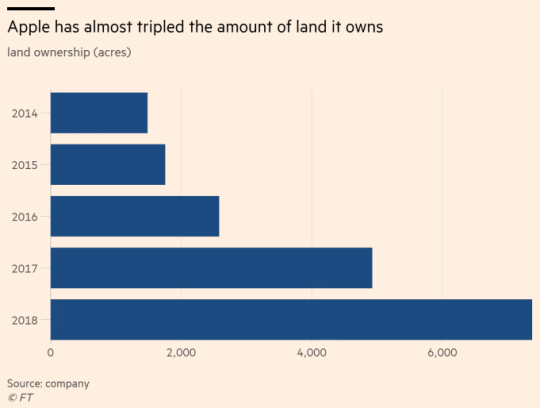
  • Apple now owns 7,376 acres of land

    In 2011, Apple owned 584 acres of land.

    As of this year, and according to the Financial Times, the company now owns about 7,376 acres. 

    Apple uses its “facilities and land for corporate functions, R&D and data centres.” The latter would include server farms for its various online services, such as iMessage, Apple Music, and the App Store.

    It can be easy to think of “the cloud” and the online services we use every day as existing only in some ethereal world up in the sky or in a distant land.

    But the reality is that these services have very real physical space requirements. The above chart begins to speak to that.

  • Battle of the Bungehuis

    image

    This past July, Soho House Amsterdam opened up in the storied Bungehuis building. Not really news, other than the fact that FT just published this article talking about the building’s history and some of the project’s hurdles, which I of course found interesting.

    Completed in 1934, the Bungehuis originally served as the offices for a prominent trading company. The architect was ADN van Gendt. When he died during the building’s construction, Willem Jacob Klok took over.

    Also noteworthy about the building’s construction is that, according to Wikipedia, twenty houses had to be demolished in order for it to be constructed.

    This underscores a point that I have made before on the blog. Cities are not static. Most of us probably look at the Bungehuis and consider it to be quite a handsome piece of architecture. Some of us may even go so far as to say that we don’t make buildings like they used to.

    Soho House is on record saying that they were “not very budget-conscious” during the renovation because of the sense of responsibility that they felt around the building and its history.

    image

    But I think it’s important to note that this building was initially built for a for-profit company and things had to be demolished in order for it to come to fruition. 

    I can’t say for sure whether this development was opposed in the 1930s, but it may have been. Cities and buildings have a way of ingratiating themselves over time.

    In any event, starting in the 1970s, the building became home to the arts faculty at the University of Amsterdam. And as recent as 2015, it became home to the Bungehuis occupations – a protest occupation started by students and staff of the University who were opposed to a slew of academic cuts.

    image

    Then in a state of poor repair, the building was ultimately sold to Aedes Real Estate, who now leases it to the Soho House Group for their private club and 79 room hotel. Above is a picture of the club’s rooftop pool and lounge.

    The big hurdle, or at least one of them, was the fact that Amsterdam currently has a moratorium on new hotels – as a way to try and mitigate “overtourism” – unless it can be demonstrated that it will represent “an extraordinary addition to the existing stock.”

    Since Soho House Amsterdam opened in July, I guess we know the answer to that test. But it sounds like it may have been a battle. That wouldn’t be a first for this building.

    Images: Soho House Group