Daily insights for city builders, delivered every morning at 6 AM ET. I’m Brandon Donnelly — a Toronto-based real estate developer and founder of Globizen. I’ve been writing here since 2013.

Tag: fast company

  • Feel-good stories about city building

    One of the things that I have learned over the years from sitting on panel discussions about city building is that, if I talk about the challenges and economic realities of development, I will be less popular than if I just tell feel-good stories about urbanism and architecture. The latter is often what people want to hear. It’s more exciting.

    But to ignore the economic realities of the world is to ignore real solutions. And this, as I have talked about before, is one of the main qualms that I had with architecture school. Money, economics, and real estate matters were tertiary, if not entirely taboo. Just focus on the purity of design and everything else will resolve itself.

    Now don’t get me wrong, I love design. It is fundamental. But so are a bunch of other things, which is why I think this article, by Benjamin Schneider, hits the nail on the head. It is specifically a review of a MoMA exhibit called New York, New Publics, but really the overarching message is this one here: “Enough with the feel-good architecture.”

    To tell a feel-good story within this framework, urban development projects must be edited and curated to cleanse them of these associations. Favored projects must somehow appear to transcend capitalism, NIMBYism, an anti-urban federal government, and the compromises inherent in the transformation of the built environment. Because this is impossible—except in the case of marginal beautification projects—the public is left with false expectations about how cities get built, making the hard stuff even harder to pull off.

    City building always involves compromises. But the more we’re upfront about what they are, the sooner we’ll get to more optimal solutions.

  • Ikea launches new digital influencer campaign in Tokyo

    Social media, as we all know, isn’t all that real. Photos are cropped, edited, and distorted all the time. But that’s kind of how things work these days and it’s not just on social media. Back in 2014, it was revealed that about 75% of Ikea’s catalogues were made up of computer generated images. It’s simply a lot faster to do that than stage a bunch of spaces for photoshoots. Fast forward six years and Ikea is now taking it a step further by integrating “digital influencers” into their ads. Here’s what that looks like:

    This particular campaign was done to promote a new store in Tokyo’s Harajuku district. And it features a popular digital influencer known as Imma. This is my first foray into the world of digital influencers, but Imma is apparently popular enough to have some 265,000 followers on Instagram. What I have just learned is that a real human is first photographed and filmed for all of this content. Imma’s digital head is then transplanted onto said content. That’s how these digital influencers are created.

    It all feels very Japanese to me. It also feels a bit like the starting premise of a great Black Mirror episode. But on the other hand, is it really all that different from the highly doctored content that already graces the internet?

  • Airbnb announces new Backyard initiative

    Airbnb has just announced a new initiative called Backyard, where it will be looking at new ways in which homes can be designed, built, and shared. They are, in a broad sense, becoming architects.

    The initiative has been in the prototyping phase for some time now, but the plan is to put forward some sort of product in 2019. Despite the name, the initiative won’t just be focused on small backyard cottages or accessory dwelling units.

    Here is an excerpt from Fast Company:

    “Backyard investigates how buildings could utilize sophisticated manufacturing techniques, smart-home technologies, and gains vast insight from the Airbnb community to thoughtfully respond to changing owner or occupant needs over time,” Gebbia says. “Backyard isn’t a house, it’s an initiative to rethink the home. Homes are complex, and we’re taking a broad approach–not just designing one thing, but a system that can do many things.”

    This is yet another example of tech and real estate coming together. But as I’ve mentioned before on the blog, I think eventually we’ll stop making that distinction; it will just become the way in which we build companies.

  • Design, technology, and culture

    Every now and then I’ll come across a website, a product, or something that immediately resonates with me. Usually that means I’ll immediately subscribe to it, buy it, follow it, or do whatever the action is supposed to be. It doesn’t happen all that often – though I think it should be a goal of companies and organizations to delight – but that’s exactly what happened to me this morning when I stumbled upon Subtraction.com.

    Subtraction is a blog about design, technology and culture (all things I love) and it’s written by Khoi Vinh. Khoi is Principal Designer at Adobe. Prior to this, he was Design Director of The New York Times and co-founder of the design studio Behavior, LLC. Fast Company also named him one of the 50 most influential designers in America. But enough of all that. His blog is great.

    Whenever I write about blogging, I tend to get questions about other blogs I might recommend. So today I’m recommending Subtraction.com. I’ve also added it to my working reading list, which I don’t think many of you are aware of because you probably just read this blog in your inbox. But it exists and I’m happy to add to it if you have interesting suggestions. (Please leave a comment below.)

    P.S. Because of Subtraction, I now have the movie High-Rise on my watch list. Have any of you seen it? Because I don’t have cable or Netflix, I tend to be painfully out of the loop on these sorts of things. It’s based on a book by J.G. Ballard and it’s the story of a 1970s suburban London apartment building that starts to socially degrade. How could I not want to watch that?

  • Getting older

    Yesterday I promised that today’s post would be less sad. I am sticking to that promise, but I am also sticking with a somewhat similar theme: getting older.

    Fast Company recently published an interview with New York-based architect Matthias Hollwich. The topic is aging and the kinds of spaces that we have created for people as they age: retirement communities, nursing homes, and so on.

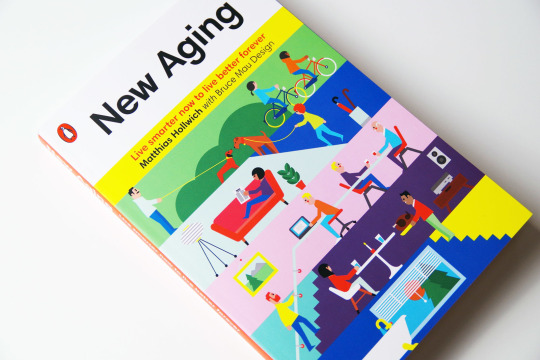
    The reason this is getting airtime right now is because Matthias has just published a book on the topic called, New Aging: Live smarter now to live better forever

    image

    But this isn’t a new focus. Matthias actually taught at the University of Pennsylvania while I was there and I remember his design studio being focused on this topic. (I wasn’t in his studio, unfortunately.)

    The sound bite that I really like from the interview is this one:

    “I think the biggest flaw is that it’s age segregation. You take all of the people who are above 75, 85, or 95, depending on what type of environment it is, and put them into one place. And then you’re just surrounded by old people, people who have social and physical challenges, and you’re not around the vibrancy of a multi-age environment, which is something that we experience all life long. I think that is something that society really has to rethink.”

    Not only do I agree with him, but I think it exemplifies one of the things that I love about architecture. The idea that the way things are done today is usually not some sort of universal truth. Instead, everything can be questioned, rethought, and reinvented for the better. It’s a very entrepreneurial way of operating and I don’t think that parallel, between entrepreneurs and architects, is drawn or leveraged nearly enough.

    I also don’t think we’ve given enough design consideration to this topic of aging. I mean, why can’t the spaces that people end their lives in be as (or more) sexy and enjoyable as (or than) the spaces they live the rest of their lives in? That’s what I want when I’m 95.

    So kudos to Mattias and the rest of the team at Hollwich Kushner (his firm) for caring about and working on this

    Book image from Matthias Hollwich’s Facebook.

  • How Bitcoin could transform home buying

    Earlier today a friend of mine sent me this Fast Company article talking about bitcoin and the future of home buying. I’m really glad he did. Both because I wasn’t yet sure what I was going to write about today and because this is a topic that I’m deeply interested in.

    I recently heard Brad Burnham (venture capitalist at Union Square Ventures) say in a talk that if you’re thinking about Bitcoin just as a currency, then you’re thinking about it in the wrong way. If you take nothing else away from today’s post, I think you should remember that. Bitcoin, and the underlying block chain architecture, have the potential to be very transformative.

    The Fast Company article was written by Matt Weiss of IDEO (the powerhouse design and innovation firm). Here’s an introductory snippet:

    Insert block chains: a relatively new and promising technology that could transform the way we digitally exchange value, similarly to how Internet protocols, like TCP/IP, transformed the way we exchanged information. For example, to transfer ownership of a home today, there are countless check of authenticity and intermediaries involved to insure the transfer is legitimate. By using a distributed database (a.k.a. “a block chain,” the same technology behind Bitcoin) to prove authenticity, we could legitimately transfer ownership immediately without the need of a middleman. In fact, when we think about block-chain technology and the industries it could disrupt, real estate tops the list. While Trulia, Redfin, Angie’s List and others have brought some transparency to the opaque world of home buying and home ownership, most of our experiences in this industry are fraught with incomplete, inaccurate, and asymmetric information.

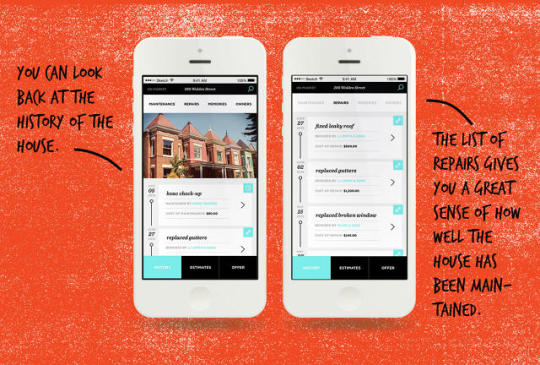
    Following this, he goes on to talk about what it might be like – each step of the way – to buy a house using the block chain technology. There are even mockups of what the app could look like. I highly recommend you give it a read if you’re interested or involved in this space.

    The real estate industry hasn’t seen a lot of innovation. It remains an opaque market with lots of information asymmetries. I have no doubt that will one day change; it’s just a question of when. Perhaps it’ll be the block chain that makes that happen.

    Image: IDEO via Fast Company

  • Further evidence that laneway housing is going to happen

    image

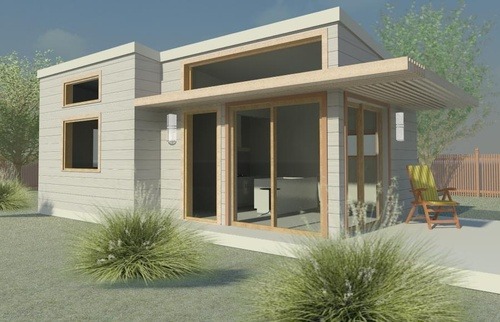
    Earlier this week Fast Company ran a piece talking about “the next big thing in urban planning” – backyard cottages. As the name suggests, backyard cottages are basically accessory dwellings built in the backyards of existing single family homes. And the idea is that they’ll provide new affordable housing options in competitive and supply constrained markets such as the Bay Area in California.

    While somewhat different than laneway housing–which you probably know I support here in Toronto–they do share many similarities. We’re talking about the intensification of our residential neighborhoods at the scale of the single family home. And the potential benefits go beyond just affordability. It would also make our communities more sustainable, more walkable, and more conducive to transit.

    But there are challenges. I don’t know about the Bay Area, but many municipalities don’t allow a “house behind a house” and many communities don’t want to see their neighborhood itensify. However, we are seeing companies, like New Avenue, emerge to help homeowners navigate the process of building a backyard cottage. This company in particular claims to have worked with over 90 homeowners. 

    So I think we’re going to see more, not less, of these types of housing solutions. Vancouver is already doing it. And so is Portland

    Now here’s a question for you. If you owned a house in a single family neighborhood, would you be fussed if your neighbor erected a backyard cottage or laneway house? I’d love to get your opinion. Let me know in the comment section below.

    Image: New Avenue